
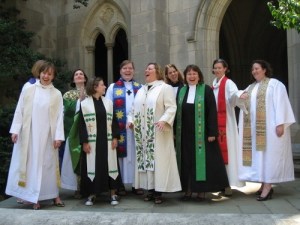
 Almost 30 years ago, I was a 20-something pastor in the PCUSA.
I graduated from seminary with $30K in debt and a desire to serve wherever God sent me. My family included only a black lab, so I could move anywhere. Although I was basically a city person, most of the interesting city church positions were – at least in my perception – the domain of young male colleagues who had been specially groomed to climb The Ladder.
I was called to serve a little church in a little town. Another clergywoman in that Presbytery helpfully commented to me that those tiny rural churches had such low self-esteem that they would even take us women. But I loved that church in a tiny village and I think they loved me. My salary was $9000 a year for a FT position (and it grew to $16,000 after a few years.) Note again my seminary debt and do that math.
Today’s young pastor graduates with even more debt – most likely – and they are probably better at math than I was. Those with true calls may opt out of professional ministry even before they begin or they might give parish ministry a try and find that:
1) while the minimum clergy salaries (and they will be paid the minimum right out of seminary) are much higher today, they will earn much less than others their age with professional graduate degrees
2) they might not care about making big money, but they don’t want to default on their loans either, and they will need enough money to live a simple life
3) they might find that the loneliness, the frustrations, and the hours are too difficult to continue in parish ministry.
Three years after my ordination, my denomination gathered other pastors who’d been ordained the same year I’d been ordained. They’d found that many Young Pastors leave professional ministry by the fifth year, and so – all over the country – there were Young Pastors meeting 3, 4, and 5 years after ordination to prepare for our next call and find companionship. Many of us were happily serving our churches. Many were also exhausted and Sabbath-challenged.
Sadly, the denomination discontinued this program at least 15 years ago for lack of funding.
Young pastors today tell me that – while there are indeed openings out there . . .
- many of them are in rural towns (and they have spouses who need to find work so larger towns and cities are their only option)
- many positions are part-time which require an additional part-time job to make ends meet
- many positions are with congregations that do not want to be 21st Century churches (although they might declare that they want to grow, change, etc.)

 A Church for Starving Artists
The problem I have with this is that it makes it sound as though a pastor should be more concerned with finding a church call that “supports” his missional vision, rather than being about the care of souls, which is what I think being a pastor is ultimately about. Yes, some of those churches may be mordibund, but they are still filled with people who need a pastor. Maybe those people are too old or set in their ways to embrace “missional ecclesiology” but they need pastoral care too. I guess that is the wisdom I see in the parochial-episcopal model like you have in the Catholic Church, where a priest/pastor gets sent to a particular congregation. Yes, he can try to change what he wills, but ultimately it is about spiritually caring for the people, not the success of projects. Maybe some of those congregations will die out in 20 years, or 10 years. But right now, there are people in that congregation who need to be cared for by a pastor, regardless of whether they are hip enough to change, grow, or embrace some mission.
LikeLike