
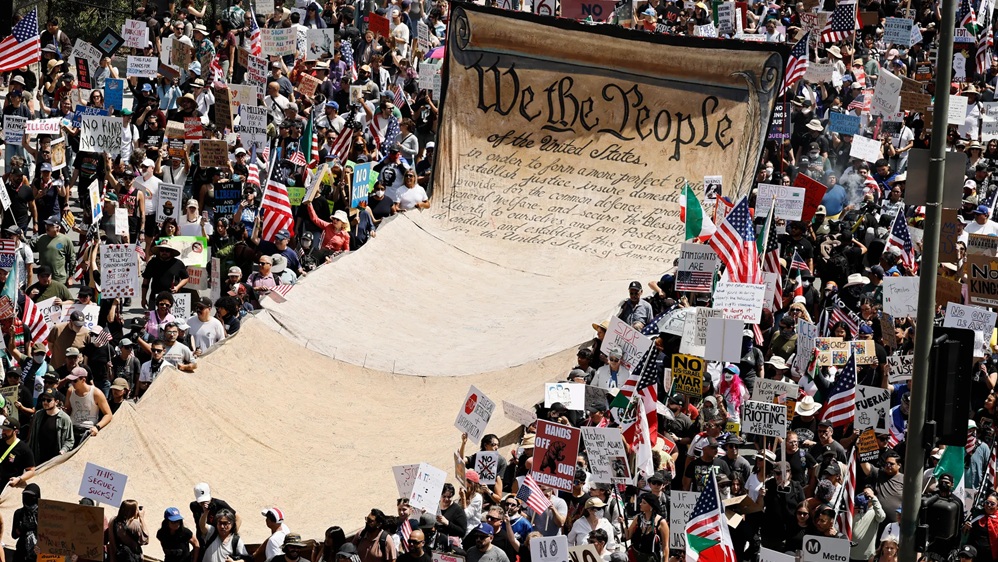
I didn’t attend one of the 2000 planned protests last Saturday, for what it’s worth. I was not feeling well for one thing but – most of all – I was struck by the comment of a friend regarding the fact that protests are not enough. My friend is a faithful and wise Man of Color who was not criticizing those who gathered as much as he was challenging all of us to make a commitment that costs something if we are honestly interested in fighting injustice.
He wrote these words which sting a little, but they are supposed to sting a little. That’s what prophets do.
This is possibly the lamest form of resistance I can think of. These marches have been reduced to little more than slogans aimed at countering something that has already happened is happening. Beyond walking around holding signs with slogans there is zero tangible plan of action or strategy.
He speaks the truth.
[A couple other things: 1) These protests were not against the military. They were not meant to dishonor the Army on it’s 250th birthday. They were against threats to our democracy. 2) I also sound like a jerk here, and I have participated in other protests. The hope has always been to express anger/sadness/outrage so that the world can see that Things Are Not Okay And Some Of Us Want To Express That We Know Things Are Not Okay.]
Protesting is not enough. It’s just the beginning. It’s – as my friend C wrote – “the lamest form of resistance.”
Unless there is some degree of impact – moving the system towards justice – then we who protest and then return to our air conditioned homes congratulating ourselves have done too little to serve God’s purposes. How are we gladdening the hearts of God’s children? This is what God tells us to do over and over and over again. Release the captive. Feed the hungry. Support the widows. Welcome the strangers. Bring good news to the poor.
What does that look like in real life? What can we do beyond protesting peacefully?
Low risk ideas:
- Support political candidates who prioritize the values of Jesus (as opposed to the values of people who govern more like Pharaoh or Herod.) Jesus said culture-shifting words about caring for those on the margins whether they were poor, sick or powerless. Whether we call ourselves Christian or not, this is the most loving way to live in a cruel world.
- Donate money to organizations or people who are doing what we cannot do: provide shelter for the unhoused, assist refugees, rebuild neighborhoods after natural disasters, offer medical care to people in war torn places.
- Pray for ICE workers as well as at-risk immigrants. Pray for those in power as well as those abused by those in power.
Medium risk ideas:
- Volunteer where there are needs: tutor in low income schools, serve meals at the local shelter, teach financial literacy to people in debt, spend time in a respite care facility for people with dementia or developmental issues, mentor a refugee family, coach at-risk kids. Don’t do this one time. Do it enough to form relationships and partnerships. And don’t tell everybody we’re doing it.
- Find one organization that especially speaks to you and give sacrificially to them. I’m talking about not buying a second car in order to send that car payment to a program that changes somebody’s life.
High risk ideas:
- Stand between people in danger and people abusing their power. Kids being bullied and the bully. Adults being assaulted and the assaulter. Family members treated unfairly and the family members hurting them.
- Increase our proximity to the desperate. Live among “the least of these.” Send our children to schools where they are the minority and make those schools better. Put ourselves in spaces where we can learn from people whose lives do not include vacations or house keys. Be willing to be uncomfortable for the sake of those who are always uncomfortable.
Please suggest other ideas. As much as protests are important (and sometimes fun) we need to figure out how to do more than protest on an occasional weekend.

 A Church for Starving Artists