Monthly Archives: May 2026

My Day in Newark Penn Station

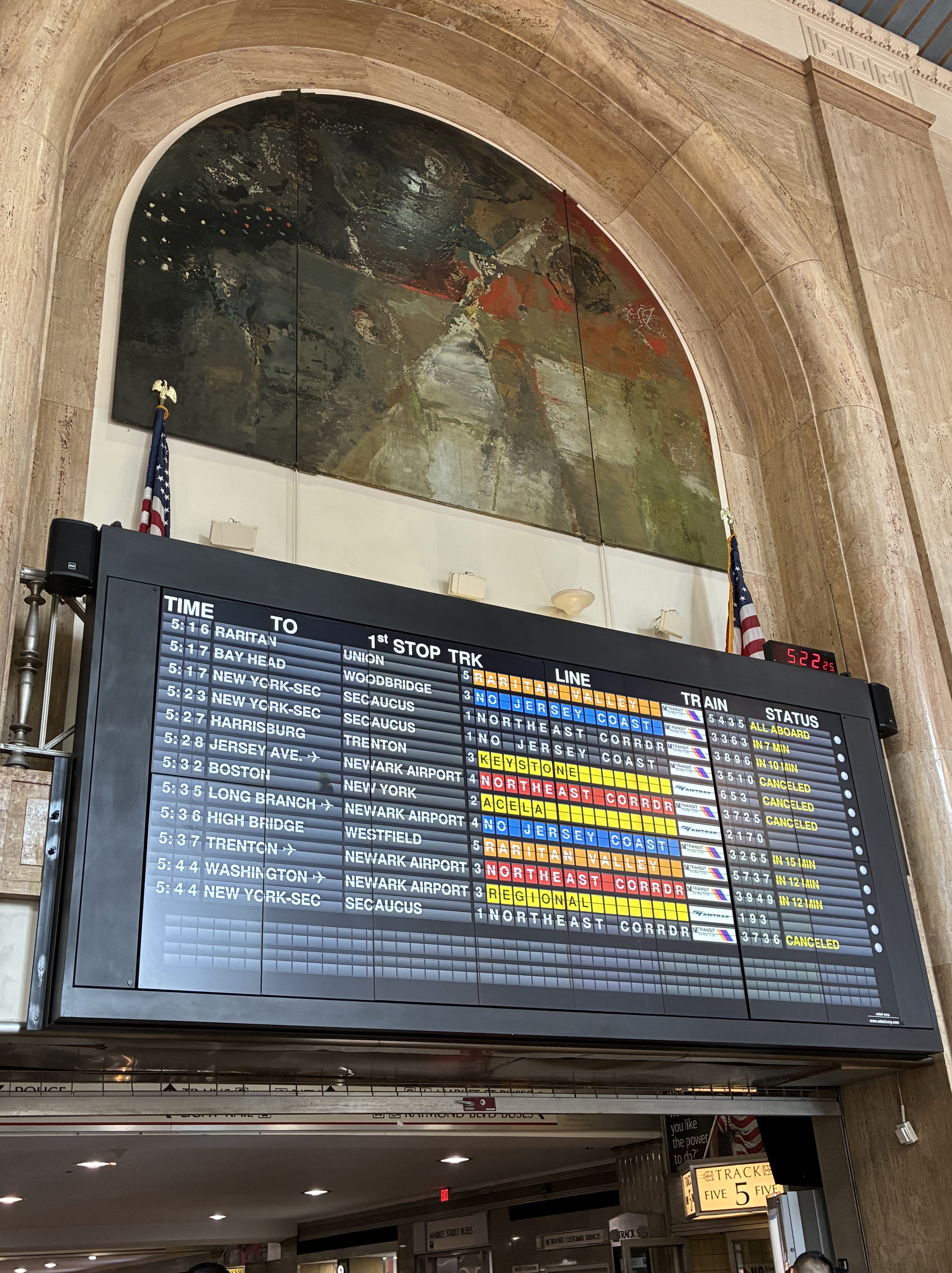
A fire on an Amtrak train early this morning resulted in the cancellation of my trip home to DC which was supposed to leave around 9:30 am.

I got to spend the day in an urban train station with nothing to do but hang out and watch people.  And it occurred to me that Donald Trump would hate it here.

[Note: These are pastoral observances, not political ones.]

The president has told us numerous times about the kind of humans he likes and the kind of humans he doesn’t like.  And so I’m glad he wasn’t here with me today.

In my eight hours waiting at Newark Penn, this is what I saw:

Mostly people with darker skin than mine wearing a variety of fashions from buttoned down collars to every kind of t-shirt (Knicks, NASA, a picture of Santa above the words “Believe.”) Torn jeans and hot pants. At least one bikini top. 

Travelers with all kinds of challenges like wheelchair riders and folks with mobility canes and seniors pushing walkers with stuffed carryalls attached and little kids with too much energy to sit around and wait for a train.

People with psychological situations like the young man who randomly yelled every couple of hours about a bear, to the folks who were definitely talking to themselves rather than talking into ear pods.

People who were very short and very tall, emaciated and heavyset, bearded and clean shaven, gray haired and lime green haired. 

What I heard were recognizable and unrecognizable accents.  I’m confident that most continents were represented.

Towards the end of my day, I phoned a friend after learning that her sweet dog had passed away.  I had no qualms about weeping in a train station because I lived there now – and when the call ended, I noticed that the woman next to me was also weeping. 

 “I’m so sorry about your friend’s dog,” she said.  And then she told me that her own dog had passed away suddenly last summer and she was still upset about it.  Bella had been her best friend’s dog and that friend had died of cancer at the age of 35 so when Bella died, it was like losing her last connection to her friend.  $@%# cancer.

I showed her photos of Zuzu and photos of a different dog named Zuri who graced the presence of our Presbytery office. Zuri passed away suddenly on Tuesday.  And I showed her pictures of our Spense who died in 2025 and she showed me pictures of her new dog Luna wearing a little sombrero.

And then she left to catch her train.  We didn’t know each other’s names but we knew all the dog’s names. 

And when my train finally arrived for boarding, I thought about Donald Trump who never had a dog or a cat according to biographers.  And he has said he doesn’t like immigrants or disabled people but he says he does love handsome men and beautiful women.

I was blessed to observe America in an urban train station today. And as the trained pulled out of the station, my σπλαγχνίζομαι (splagchnizomai) was on overload. And I I felt really sad for the powerful man who has no idea what he’s missing. 

What Happens When We Give People What They Don’t Need?

I recently read about a group of church ladies who have weekly “crafternoons” (cute) when they create original wreaths for front doors. Flower wreaths for the spring. Evergreen wreaths for the winter.

What threw me was that this is a mission for unhoused neighbors. To be clear: they are making front door wreaths for people who don’t have front doors.

Q: What happens when we give people what they don’t need?

A: Lots of things, including people leaving organizations in which they once participated regularly.

Church would be one of those organizations. HH and I will be looking for a new church in the coming months and our hope is that we will connect with a church that gives us the spiritual nurture we need so that we (and the rest of the congregation) can offer what our neighbors need.

What we will not need:

  • Homiletical explanations on why Jesus could have been crucified on a Thursday instead of a Friday. (We don’t care.)
  • Social justice conversation groups that make us smarter but don’t change things that need to be changed.
  • Bible studies without any practical spiritual inspiration.
  • People who bicker, especially about things Jesus didn’t die for.
  • Of course: Congregations that don’t address what breaks God’s heart in the neighborhood.

We love all kinds of music, all kinds of people, all kinds of architecture. We hope to find people with whom we can be messy and imperfect. We particularly love people who are easy to laugh and cry with.

I share this not as a request for identifying potential congregations in Our Nation’s Capital (where we are moving in a few days) but to remind so many congregations I love that nobody needs what many of our churches are offering.

  • Nobody needs a congregation of people who gossip or slam each other behind their backs.
  • Nobody needs a Bible study that never challenges what we have always believed/teaches us anything new.
  • Nobody needs a gorgeous sanctuary with beautiful people who are ashamed to share their real lives with each other.
  • Nobody needs another bake sale or car wash to “help the needy” when we won’t even offer a ride to a neighbor who needs a lift to the hospital.
  • Nobody needs a wreath when they have no door, especially when we have the opportunity to help them find a home with a door.

Just as we regularly evaluate our church staffs (preferably both paid and volunteer) it’s helpful – also – to evaluate the impact of our congregations in terms of the congregation and community’s spiritual health. Is our congregation offering what anybody needs? Things like authentic community, security, inspiration, moments of awe, opportunities for life-changing service? In this wild and often infuriating world, this is what people need – whether we admit it or not. One day most of us will look for these things.

Good Funerals Are Like Holy Resets

HH and I watched – back to back – two excellent funeral episodes of our favorite shows last weekend. And I’ve attended two funerals on as many Saturdays – the first for one of my favorite people who passed away much too soon and the second for a Charlotte institution in the arts world.

I love a good funeral.

It’s not about the choreography or the music or the refreshments. It’s always about the person and the way that person is remembered – preferably within the context of God’s grace. I’ve known followers of Jesus whose funerals were weirdly impersonal – about both the deceased and the Creator. And I’ve known atheists whose funerals were surprisingly holy.

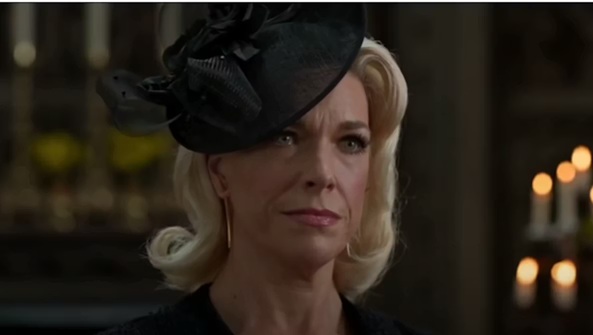
The funeral of Rebecca’s father on Ted Lasso was one of the best ever and not because her father was a great guy. It was perfect because her people who didn’t just show up; they were with her in a way that only deep affection can muster. The funeral of Coop’s father on Your Friends and Neighbors was inspiring to watch if only because it illustrates what not to do when a loved one dies. Coop is surrounded by his “friends and neighbors” but they are all fake.

All this is related to a podcast I heard recently with Bill Burnett, the author of Designing Your Life. I’m in a privileged stage in life in that – so far – I’ve had a great life and if I died tomorrow, it would have been much more than enough. And yet I’m beginning a totally new stage of life in a new city, with new opportunities, and new adventures. Everybody should get this: a fresh chapter.

A good funeral can kick start a fresh chapter. To hear about someone’s authentic bravery and sacrifice or someone’s tireless creativity prompts us to do better – even if what we do is not all that sacrificial or creative. A good funeral makes me want to be a better human. What about you?

Managing our Fiction/Non-Fiction Intake (for Spiritual Reasons)

The only reason I’ve read any novels over the past year was because of my Brewery Book Group (whom I’ll miss when we move from Charlotte. Anybody want to start one in Our Nation’s Capital this summer?) While the novels we read could be bleak (The Emperor of Gladness) they were usually uplifting, if dark (Vigil.)

When I read over this (gifted to you) NYT article about the 2026 Pulitzer Prize Books, I was especially drawn to the Nonfiction Winners and Finalists – as always. This doesn’t mean I’m more scholarly or serious than people who prefer fiction. It’s probably because I’m still in constant-search-of-sermon-illustrations mode. There’s nothing like a quote from Pilgrim at Tinker Creek or Life Together to close out a traditional Presbyterian sermon. Sermon illustrations can also be found in novels, of course, but it was often so long since I read a novel that I didn’t want to date myself. (“In that new novel The Brothers Karamazov . . .“)

Note: Preachers who quote from the most recently published novels are perhaps the most well-read pastors. They are reading what they want to read rather than what they have to read.

In regards to that article about the 2026 Pulitzer Prize Winners, I was drawn to the nonfiction list and especially to:

While I take occasional breaks from the difficult news of the day, my Current Events Sabbatical never lasts more than a couple days and I have to confess before you and the LORD, that I am a little judgmental about it when people tell me they “don’t read the news anymore” much less nonfiction tomes about homelessness or human torture. Reading only feel-good novels or the Style Section of the newspaper is like living in a gated community. If we don’t see homelessness or human torture, it doesn’t exist.

Clearly, I’m a fun date.

My hope for all of us is that we have some proximity to human suffering for the sake of our souls. I’ve occasionally asked in this blog “Who is the poorest person you know?” The answer reveals how gated our lives have become. If the poorest person we know has to make daily choices involving food versus medicine, we have more opportunities to follow Jesus than if the poorest person we know can only travel to Europe every other year.

Yes, Jesus died for rich people and rich people experience their own version of torture in many cases. But it’s easy to forget that not everybody can afford to meet for coffee dates or drive a car with AC when we don’t blink over buying a $5 latte or an e-car.

Gated communities, in my opinion, are a spiritual problem (unless you are the King of England.) Gated life experiences are a spiritual problem for everyone. Reading about the difficult life situations of our neighbors is part of the continuing education each of us need. If we know that human suffering exists – whether we read about it or witness it up close and personal – we are more likely to address it in some way in the name of Jesus.

Balancing the joyful and the terrible is part of life. And it’s a good indicator of our spiritual health.