I knew Alex Lang when I served in Chicago Presbytery. He was a bold choice when called to serve as Head of Staff of First Presbyterian Church of Arlington Heights in his early thirties. And as a person who has served alongside hundreds of pastors, I can confidently say that Alex is among the best of us.
The last Sunday in August was his last not only in that congregation but in professional ministry in general Please read his story here..
Consider the hard work of faithful pastors on this Labor Day weekend. Thank you.
Back from sabbatical and s-l-o-w-l-y re-entering so that I don’t lose all the good Sabbath habits from the past three months.
– I missed lots of social media birthdays. Know I love you, Summer Birthday People.
– I’m back in the office Tuesday. Have already deleted all my office emails from the past three months as I said I would need to do. If you sent me essential information from the summer, I didn’t see it and know our staff handled it if necessary.
– One of my early back-from-sabbatical goals is to figure out how to offer Sabbatical time (and funding) to all professional church staff, especially those who have never been able to have this time.
And finally – if you are eligible for a Sabbatical wherever you serve (church, academics, etc.) please take it. If you are offered one and you don’t take it, that’s on you. (No saving Sabbatical months to tack onto your retirement.)
One of the hardest I’ve ever laughed in my life – and so inappropriately – is when I was the guest at a funeral and the soloist sang Feelings (whoa whoa whoa) by Morris Albert:
Feelings, feelings like I’ve never lost you And feelings like I’ve never have you again in my heart
Just no.
This post is not about that but – sadly – the first thing that pops into my mind when I hear the word “feelings” is that song. I am hoping to replace that first thought pop-up with this instead:
I’ve had a lot of feelings over the past couple of days. My mom is still dead and even though it’s been 35 years, I miss her so much. A friend’s daughter who was not supposed to live this long just started her first year in college. I spent the afternoon yesterday laughing hysterically with one of my favorite people who also misses Mom. Three more families are obliterated by gun violence in Jacksonville by a man who was taught that hating Black people is okay. And still another family in my hometown of Chapel Hill woke up yesterday in tact and went to sleep last night forever missing a husband and father – again due to gun violence.
“I don’t know how to feel” is more common that we’d like to admit. It’s seems easier to numb out. It’s harder to let the pain sink in, and yet feeling is what makes us human. It’s what keeps us from being plastic and fake.
He reminds us that – when we gather for the Lord’s Supper – we are drinking to remember even though many of us drink to forget.
To feel. To share feelings. To love and support each other. To make earth more like heaven especially when it feels like hell. This is what we were made for.
I am not a “What if?” person ordinarily. I don’t spend time pondering “What if I’d met HH in seminary?” or “What if we’d accepted that call in ____?”
I’m not writing this so that you will respond with being sorry my Mom died so young. Yes, it was a life-altering experience and parishioners from those first years after she died still remind me how much I choked up when I was their pastor during prayers and sermons and ordinary conversations. (Romans 8 was a challenge to say out loud even though I believed it.) It’s not the most shattering thing in life to lose your mom when you have a six week old baby. But it was not easy.
Mom would have been 90 years old today.
More to give myself a moment’s indulgence rather than feel sad or sorry for myself, I spent time over the weekend imagining “What if?” What if she were alive today?
I imagine her to be in good enough health to be able to have dinner at her favorite restaurant – The Angus Barn – with her kids and grandkids and all our spouses over the weekend. And Dad – who I imagine would be there at age 93 if she were alive – would need a cane even though he left it in the car because he’s always been that guy.
(He died just after she did of a broken heart. And also non-Hodgkins lymphoma.)
She would have had 13 grandchildren and five great-grandchildren with another one on the way. We would probably have gathered for an exhausting time over at C&C’s in Raleigh – after dinner – with cake and ice cream and all the great-grand babies. SNE would have baked not one but two of Mamaw’s pound cakes. (Big crowd.) SET would have helped her pick out a cute outfit.
We would have laughed hysterically about those times Mom and Dad and Mamaw and Papaw played Rook late into the night with color commentary after each hand. Or the time Mom, C, and I watched Team USA beat Russia in the 1980 Winter Olympics and we lost our minds as if we knew anything about ice hockey. There would be another 35 years worth of stories.
Dad would have commented that Mom’s always been “a jewel.” He would have gotten a little weepy when he said it.
I’d rather have had my mom for only 32 years than have any other mom for a longer lifetime. The truth is that her lifetime was excruciatingly short and her death altered all of our lives. But HH and I try to keep her alive by talking about her and Dad often. I have lunch on her birthday every year with a mom I admire.
If you knew her (she has two surviving siblings, 20 surviving nieces and nephews, and 19 first cousins) I’d love for you to share a memory in the comments. Or just thank God that we all get to know each other.
As the global treasure Nelba Marquez-Greene always says, “God bless especially the grievers.”
To be called “The New Black” means something’s newly popular and – often – in the news. Not only have pink (the Barbie movie) and orange (the TV show about women in prison) been called The New Black, you don’t have to be a color to be considered. Coding, Physics, and Cronuts have each been “The New Black” in their own contexts.
I wonder if Anxiety is (and has been for a while) The New Black.
On Sabbatical, I’ve had time to read multiple newspapers and listen to several podcasts each day. And every single day there are multiple pieces about anxiety to the point that it increases my own personal levels of anxiety. (i.e. worrying about worrying)
Young people are experiencing more anxiety than ever according to the American Academy of Pediatrics as reported by CNN.
Parents are also overwhelmed with anxiety according to this article.
And have you noticed how the retail industry has literally banked on anxiety since the beginning of time? The wrong deodorant = social disaster. The wrong tires = unsafe driving. The wrong college = future limitations. The wrong disinfectant = disease. The wrong face cream = aging. The wrong pharmaceuticals = more anxiety.
The koine Greek work for anxious is μεριμνάω (merimnaō) and it shows up over 20 times in the New Testament. Obviously anxiety is not a new issue.
But as we Church People consider what breaks God’s heart in our post-pandemic, politically divided, gun-saturated, individualistic culture, addressing anxiety seems to be a place to start. Are we adding to the anxiety or relieving it? Are we offering a community where sharing anxiety is safe? Are we offering a message of resilience – not because of who we are but because of who God is?
The Future Church will truly be a sanctuary and by that I don’t mean that we will avoid conflict or the realities of a broken world. We will face our conflicts and address this broken world with the Truth that there is a different way.
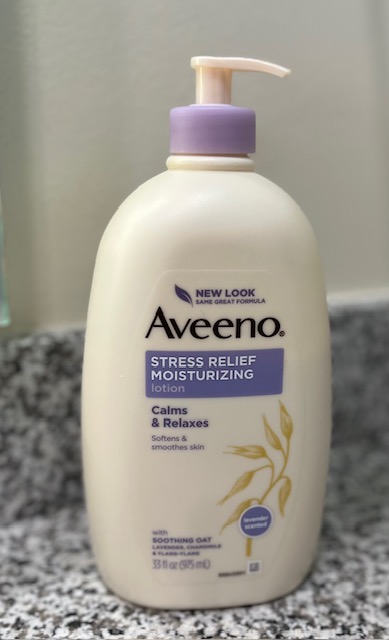
Image of the mega-sized lotion I use to relieve stress. Frankly, it’s going to take more than lotion.
*I’m increasingly cognizant that using the word “Black” is fraught in that it impacts people with dark skin. I’m using the word here to quote a familiar saying.
It’s been a long time since I felt expectations laid upon me as a Pastor’s Spouse. Gone are the days when I might be expected to direct the choir or teach Sunday School by virtue of being married to the Pastor. And yet, I still hear comments about The Pastor’s Spouse.
It’s still weirdly true in many church circles that opinions expressed regarding the Pastor’s Spouse are okay:
“She doesn’t seem to like us very much.”
“He’s never here on Sundays.”
“She spends a fortune on clothes.”
“He seems to be a good father.”
Yes, people talk about each other in congregational settings but conversation about the Pastor and the Pastor’s Family seem not only common. It’s routine.
Those of us with spouses are grateful that “the role of our spouse” is no longer part of our annual review (seriously, this was once a thing) and yet – across all professional and private roles – what Spouses do can impact our own reputations. Exhibit A: Ginny and Clarence Thomas. It feels hugely inappropriate for her to have business/relationships/opinions that bleed into his role as a Supreme Court Justice. A Pastor friend of mine shared a while back that her spouse’s letters to the editor of their local newspaper expressing views on everything from abortion to immigration were impacting her own ability to be a Pastor. People assume she has the same opinions as her spouse. Maybe she does and maybe she doesn’t.
But this has me thinking: Our spouses are their own people. And yet . . .
What are spouse boundaries in terms of their personal activism?
How do my spouse’s relationships impact my own professional life?
Are spouses obliged to keep their opinions to themselves for the sake of the Church?
I was once asked in an interview (when I was a young single female pastor), if you moderate the Session, who will bake the brownies for the meeting? True story. I’m glad those days are over. And if they aren’t over where you live, I hope you address it.
HH and I are a team. And yet we are our own people.
What are your thoughts about spouses and boundaries? And this is not just a question for clergy families.
As HH and I were recently landing at JFK from our travels, the flight attendant came on the intercom and asked all passengers to remain in our seats for fifteen minutes before disembarking. There was a medical emergency and the aisles would need to be clear so that EMTs could board with a stretcher. As soon as the plane landed about half the passengers stood up, retrieved their carry-on bags from the bins and stood in the aisles. Had they not heard the flight attendant’s request? Then the captain took the mic and asked everyone to who was standing to return to their seats so that the medical personnel could get a stretcher down the aisle. Nobody moved. Seriously. No. Body. Moved. The EMTs boarded and made their way down the aisle around the passengers with their carry-ons and then escorted parents with a sick child who was in their father’s arms because they couldn’t get the stretcher down the aisle. This happened on August 2nd on Delta Flight 235.
When I was a parish pastor, I was told that one of the Sunday School teachers had tossed the curriculum and was teaching her students etiquette instead of Bible lessons. Her own daughters were in the class but the etiquette was needed for the other students, she later told me, because they had not been raised right in her opinion. None of their parents attended our church which – she explained – was probably why they didn’t know how to dress or eat their snacks properly. Her concern was that “they didn’t really belong” in our church. (Her words.) This was in the early 1990s.
Meanness, rudeness, sadness, and loneliness are not new in our culture. And yet it’s getting worse.
Please read this 2023 article by David Brooks. I don’t always agree with him, but he rightly notes that our culture is a hot mess. According to Brooks, we can blame:
Technology – “Social media is driving us all crazy.”
Sociology: “We’ve stopped participating in community organizations and are more isolated.”
Demography: “America, long a white-dominated nation, is becoming a much more diverse country, a change that has millions of white Americans in a panic.”
The Economy: “High levels of economic inequality and insecurity have left people afraid, alienated, and pessimistic.”
Actually, though, Brooks says the true reason for our moral demise is this:
We inhabit a society in which people are no longer trained in how to treat others with kindness and consideration.
I would put it another way:
We have utterly forgotten that every human being has been created in the image of God.
Do we need lessons in etiquette, emotional intelligence, regulation of our own emotions, morality and cultural awareness? Probably. But mostly we need spiritual maturity and by that I mean that we need to learn – and this is lifelong learning – about loving our neighbors simply because they bear the image of God. I include in this list kids who don’t dress well or know which fork to use, sick children on airplanes and their exhausted parents, rude people, Donald Trump, and people who criticize the Barbie movie even if they haven’t seen it.
This was once a role of the Church but – honestly – there are so many examples of how the Church has failed here. It’s no surprise that most people (and the numbers are increasing) don’t look to the Church for teaching what the love of God looks like.
We in the Church are often too busy covering up misconduct, keeping bullies happy, or perpetuating an institution rather than deeply loving God and neighbor as (we think we are loving) ourselves.
We are not loving ourselves when we are greedy, self-centered, clueless, and disdainful. And yet I actually hear people boasting about how the meaning of life – for them – is about:
Looking out for me and mine
Clinging to grudges
Destroying rivals
Taking advantage
Church People: I have no answers about how to get more people to your congregation’s Rally Day (aka Sunday School Kickoff) in September. But I will ask another question:
Look at the DNA of your congregation and note what about your church’s programming, mission, worship, and hospitality teaches mean, rude, sad, or lonely people how to be different?
I used to float, now I just fall down I used to know but I’m not sure now What I was made for What was I made for?
From What Was I Made For? by Billie Eilish from the Barbie movie.
We are not our jobs no matter how important they might be. We are not our houses or our cars or our vacations no matter how impressive they might be. We are not our relationships. We are not what somebody paid for.
We were made because . . . God.
And we don’t always have to be on our toes.
One of the reasons I’m not a fan of complementarianism is because God created us for different purposes that are not always gender-specific. Even in Scripture, women can be prophets, entrepreneurs, judges and spiritual leaders. I believe that while we have different particular purposes, all of us share at least two:
We are called to be the person God created us to be.
We are called to treat others as God created them to be.
Valued. Loved. Honored – just for being us because that’s how God created things.
Image of Margot Robbie from the Barbie movie.
P.S. I love this article in The New Yorker that includes the fact that “Gerwig presented (film) executives with a poem in the style of the Apostles’ Creed“when pitching her idea for the film. I hope somebody still has that poem.
Some sabbaticals have themes. For my first sabbatical (2002) the theme was “recover from cancer surgery.” A sabbatical had been planned but it was replaced by 12 weeks of recovery from surgery, most of which I don’t remember. #Percoset
My second (really my first) sabbatical, was just a couple years later when the theme was “places where churches thrive but followers of Jesus are in the minority.” I spent time in a couple U.S. cities known for their lack of churchiness and several Muslim countries, thanks to the Lilly Foundation.
This year’s sabbatical had no set theme except to rest. I rest by reading and writing and drinking coffee in lovely places and staring into space looking at wondrous things like ancient ruins and turquoise seas and rocky cliffs. I finished reading Awe and realized that this is actually a sabbatical about wonder. Thank you God.
And this brings me to the spiral staircase. HH and I rented a place with an awesome view. That’s pretty much why we chose this place. It’s not fancy but the view is spectacular. And it has a spiral staircase.
A spiral staircase is one of those home features like a fire pole or a canopy bed that I always wanted in my home as a child. A spiral staircase is a space saver but – after about 3 minutes – I was over it And yet, a couple weeks living with the spiral staircase have worked well in terms of slowing down.
You can’t run up or down a spiral staircase. Really, you can’t.
Also you can’t carry many things on a spiral staircase. It’s tricky carrying a load of laundry much less a piece of furniture. But it’s kind of growing on me – not to the extent that I need one – but in terms of appreciating the requirement to move slowly especially upon approach. We’ve banged our heads more than once just walking up to it.
And so this is sabbatical 2023. I am in awe of so many things I’ve seen, conversations I’ve experienced, foods I’ve eaten, people I’ve observed. Dacher Keltner says that “awe awakens the better angels of our nature.” Yes, and it does more than that. Future posts.
I’ve needed this. Actually all of us need it.
I’ve been keeping my boundaries in terms of “not working” during sabbatical but one thing keeps gnawing at me and it’s something I hope to do when I return in September. How can our Presbytery make it possible to gift sabbatical time/funding for church professionals who ordinarily do not receive one (i.e. transitional pastors, temporary supply pastors, part-time pastors, pastors in validated ministries, musicians, educators, administrators)? And how can we assist their congregations in making sabbatical possible?
We have a few more days at this location with our spiral staircase. I’m going to miss it, but not as much as I miss our view of the Tyrrhenian Sea. I’m thoroughly drenched in privilege and I hope to share it.
One of our family’s favorite stories is about the Beatles Walking Tour we took in London in 2007. The five of us joined about 10 other tourists and an entrepreneurial Londoner who led us through the neighborhoods where the Beatles and their friends once lived. It was very entertaining. Near a flat John once rented was a bus stop and our tour guide offered that “This is the place John and his mates could have caught the bus.” Or not. We stood outside Jane Asher’s townhouse and our tour guide noted that “This is the place where Paul might have entertained his friends.”
As HH and I finish our pilgrimage to the Holy Land, I’ve thought about that Beatles Tour and how entrepreneurship even impacts our religious sites (although many would consider a Beatles pilgrimage to be holy.) Overheard by tour guides and seen on road signs:
“This is the actual Jerusalem Thorn bush used to create Jesus’ crown of thorns.” (Note: most of these bushes do not live for 2000+ years and it was not our guide who said this.)
“This is the place where Jesus body was prepared for burial.” (In The Garden Tomb.)
My favorite discovery this trip was the road sign that pointed to “The Good Samaritan.” Keep in mind that The Good Samaritan was not an historical person and there was no historic “inn” where the G.S. took the man robbed on the road from Jerusalem to Jericho.
Jesus made up parables to explain what God is like (much like Aesop wrote his fables to teach life lessons.) It’s one thing to venture a guess where Jesus was buried based on scripture and tradition and science/archaeology. It’s another thing to point to a place where an imaginary person spent time. Imagine seeing a roadsign in Kansas pointing to “Dorothy’s house” or a German map marking where Rumpelstiltskin lived.
Our guide said that there’s an inn off the Good Samaritan exit that tells about the life of Samaritans (who were real people) and posits what it might have been like if someone had been mugged on the highway and needed an inn.
Jesus – the rabbi – told shocking stories about prodigal sons and lost sheep and unforgiving servants as a literary device to explain theological truths. There was no literal Good Samaritan and yet the story is true theologically. Some believe that the Hebrew story of Jonah is also a parable explaining the lengths God will go to get us to obey our calling.
As our wise leader of this pilgrimage said the other day, it doesn’t really matter where it happened. It matters that it happened. Amen to that. God is bigger than our human tendencies to want to control and own God’s story.
We worship and revere God is different ways and those varieties of practices are in moving display throughout the Holy Land. Some of us wear a hijab or long skirt. Some men wear skull caps and/or side curls. Some of us build magnificent mosaics with thousands of tiny tiles. Some of us tend to simple gardens. Some of us sing 19th Century hymns. It’s all beautiful and holy and good.
The difference between a vacation and a pilgrimage is that one is intentional about seeking God’s direction. And yet vacations can also include moments when our hearts are full and our minds are curious about holy things. This is the true place – our hearts, our minds, our bodies – where God shows up.






 A Church for Starving Artists
_-_75_(50558355441).jpg)