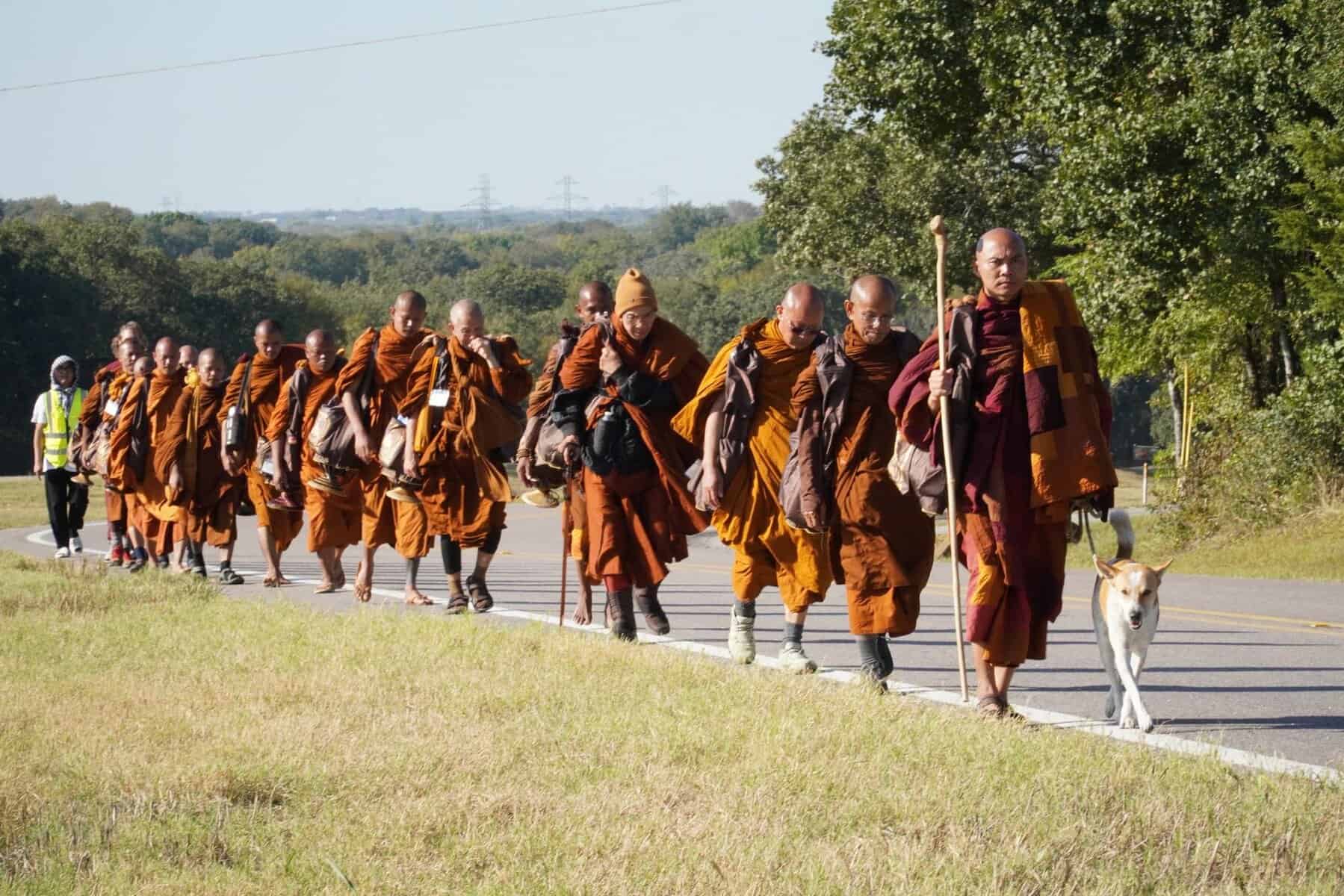
The Buddhist monks not only walked through Charlotte today, but one of them handed my friend a flower as they passed her house. She was holding her baby wearing a bear suit. A glimpse of heaven.
Before someone makes a snide comment about a Christian (me) imagining that Heaven and Buddhist could be mentioned in the same sentence, please remember that God works through all kinds of people and respecting the faith of others is a holy thing. I doubt that my Christian friend becomes a Buddhist just because of her special one-on-one moment with a monk.
(I remember touring Istanbul years ago and someone in our Christian group refused to walk into the Hagia Sophia for fear either 1) Jesus would condemn them or 2) she might be persuaded to become Muslim. ) Was her faith actually that flimsy?
News flash: Jesus died for the world. We are all trying to figure this out.
We are in the throes of some ugly realities in our nation and beyond. The Russians have turned on the heat in terms of attacking Ukraine and they have literally turned off the heat on this winter day in Kiev. Renee Good is still dead and there are reports that her widow might be investigated for opposing ICE activity. This is the tip of the iceberg in terms of global injustice and insanity in these January days.
And yet, I am seeing glimpses of heaven. A friend who lives in Minneapolis is taking food to her terrified neighbors and others from across the country are pitching in. Another friend is promoting a Go Fund Me account for a Muslim family who’d been saving for IVF until the husband’s job was terminated by DOGE last year. And yet another friend was saved over the weekend – pulled from a burning car – by an undocumented neighbor.
We have to look for them – those glimpses of heaven – but there are all around us because God is working everywhere. I highly recommend this article: The Big Inshallah for other glimpses and full views of heaven on earth.
Thy kingdom come, thy will be done, on earth as it is in heaven.
Some of us pray that prayer every Sunday. And there is evidence of it’s reality every day of the week.
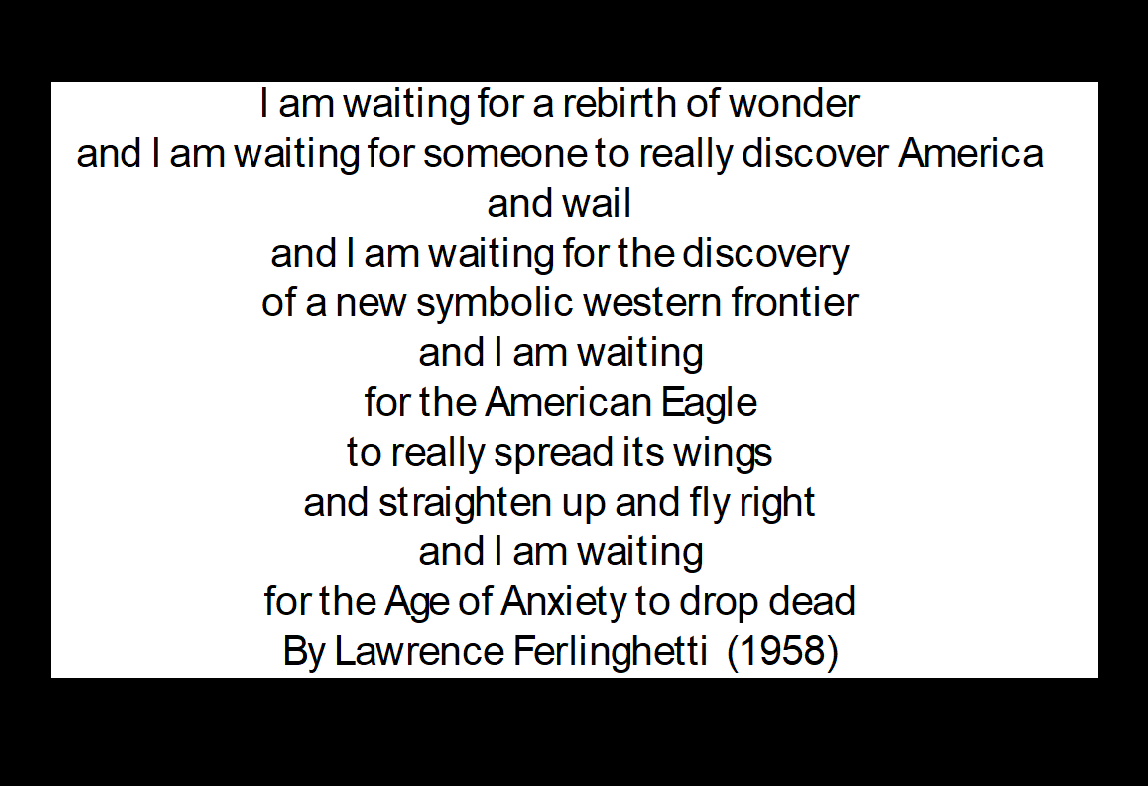
Thanks to LG for referring to Ferlinghetti’s poem “I Am Waiting” in his Epiphany sermon today. We Christians call Advent and Lent the “waiting seasons” but – considering the political anxieties of these days – this reference to “waiting for The Age of Anxiety to drop dead” seems especially timely.
Wonder is a feeling of amazement and inexplicable beauty but these days our wonder seems intrinsically tied to our anxiety:
I wonder if our nation’s democracy can survive this current leadership.
I wonder if the chemo will work.
I wonder if the labor pains will be too much for me.
I wonder if our relationship can endure this stress.
I wonder if my job will be terminated.
I long for wonder that’s unrelated to anxiety. I long for the kind of wonder that actually reduces anxiety.
Growing older with a sense of wonder feels like a shot of resurrection. Children get this – at least if they feel secure and safe. They wonder about everything from fireflies to snowflakes to shark teeth to flower petals. Their brains are constantly absorbing new things to wonder about.
In the meantime, we adults are wondering about doom.
I wonder if one of the purposes of Church is to generate wonder. For a chunk of time each week we are asked to consider what God has done, is doing, will do. We might be moved to tears of joy by the music. We might imagine a new outcome for what’s happening in our lives right now.
Good therapy turns our anxiety on its head – eventually. Good spiritual direction shifts our anxiety to epiphanies of relief. Good Church sparks wonder in the Creator who’s got this. Good Church inspires us to take action in the name of an Active God. Good Church draws us into a community that doesn’t make sense in the eyes of the world.
How is our church community moving us to wonder?
We who find our anxiety melting away – in spite of all indications that life is a hot mess – might be called demented or clueless. But wonder is about faith. I don’t know what God’s going to do about this, but I believe God is at work in the world.
Maybe we have to believe this because without it our souls will die or our brains will explode. It’s a choice we make: to believe that God is still God and we are not.
And yes, we still wail. We still pray that America will spread its wings and fly right. Maybe tomorrow. Maybe a generation from now. But still we hope. And when we have no hope we lean on each other to hope for us. This is Church.
On December 17, 2025 someone told me I was in danger of sudden death. Those were the words she used and she is a health professional.
There was a concern that I might have a pulmonary embolism during a scheduled physical therapy visit. She took me to the ER across the street and I didn’t die, thanks be to God. But over the course of that day when my heart, lungs, and blood were being tested, I reminded HH where he could find my funeral plans.
There is a file in my laptop that says “If I Die This Year.” I tweak it on January 1st – or thereabouts – annually and it includes my funeral bulletin and requests for everything from scripture to music to staging.
What I really want is that anyone who speaks begins by saying “My name is ______ and I am Jan’s _____ or I know Jan through _____.” I really like to know who’s talking during a funeral and how they know the departed. It’s all part of the story.
As a parish pastor, our deacons once offered “end of life” forms to anybody who wanted to keep their funeral wishes in the church office and only a handful of people did it. Some parishioners were horrified. Others thought it was a good idea but they never completed a form.
That’s fine, but I know from being in Church World that family members appreciate it when they have some idea about their loved ones’ wishes. It’s also good to know what they don’t want. (My friend CB wanted her ashes spread on the doors of the Wittenberg Church on the 500th Anniversary of the Protestant Reformation. She did not want anyone to sing “Morning Has Broken.”)* Sometimes we can accommodate our love ones and sometimes we can’t.
Yes, we all need medical directives and power-of-attorney directives, but spiritual directives are also important. Believe me, your loved ones will be grateful. It’s a little thing we can do to help in those early days.
It can also offer humor in what might be difficult days. Once HH shared with friends that – if he should die on vacation – he’d like to be buried in a particularly cranky church member’s front yard. Everyone’s grateful that didn’t happen.
I remember thinking in the ER that it would be extremely inconvenient for me to die that day. HH and I already had three funerals/memorial services to attend in the coming weeks and our newest grandchildren’s births would be forever tied to Grand Jan’s unexpected demise. Been there. Done that. And I wouldn’t wish that on anyone else.
The preacher for my funeral knows she will be preaching. If we die together, the families can work it out.
My point is that we do not know what the future holds and there will be surprises in 2026. We pray that most of them will not involve cancer diagnoses or plane crashes, but we don’t know. If we can make it easier for our loved ones, all the better.
In my first church, the local funeral director always wanted me to wager with him on who we thought would die in the New Year. “_____’s not looking so good. I don’t think he’ll be around much longer.” Seriously, this was a conversation I had with that funeral director every January. A foreshadowing of Kalshi?
New Year’s Resolutions notoriously don’t stick but here are a few I hope will stick in 2026. Actually they are more aspirational than obligatory:
Make a friend whose political ideas are the opposite of yours. Be curious about their lives.
Go to the party, even when you don’t feel like it.
Smile at every baby you greet.
Say something nice to a stranger. “I love your scarf.” “You look amazing today.”
Contact your members of Congress (which is another opportunity to make friends with political adversaries AND say something nice all in one fell swoop.) Ask them to do a Town Hall in your community and if they show up, don’t attack them – verbally or otherwise.) Invite them to coffee.
Listen to truth-tellers even if their words sting. (I’m talking about truth-tellers in the family, in the church, in the office, etc.) Is it possible, they could be right?
Ponder writing notes for what you’d like at your funeral or memorial service. It’s cathartic even if no one find these notes after you’ve been dead for years.
May the new year bring us more laughing than weeping, more joy than sorrow, more love than hate. Life is a gift.
*This request was indeed carried out.
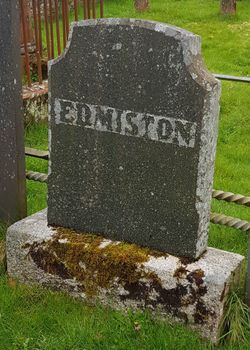
Image from one of my ancestors who left Scotland but on their way to the States died in County Donegal, Ireland. Full name known only to God.
I hope everyone reading this post has the most wonderful holiday season possible, filled with peace and goodwill toward everyone, and hope for the future of the world.
The reality is that this holiday time comes with anxiety and maybe even bit of dread. Some of us will not be home for Christmas. Too many of us have no literal home. And sadly “home” is not comforting and peaceful for everyone.
I encourage you to read this conversation in The New York Times with Thomas Friedman and David Brooks. It sparks some profound ideas explaining why our nation – and the world – are so deeply divided. According to Friedman, human beings are driven first and foremost by 1) finding dignity and avoiding humiliation and 2) home. Home involves being “anchored in a community where people are connected, protected and respected.” (Quote from Andy Karsner)
Amen.
Some of what divides us is related to “home”and it involves the search for human dignity. What does it feel like to be “home”? What definitely doesn’t feel like “home”? The answers to these questions explain why we are divided as a nation.
I grew up in a university town in North Carolina where most adults had a college education, belonged to a Protestant church, and the secondary schools were segregated and not equal until I was in the third grade. A Black college professor – Howard Lee – was elected mayor when I was thirteen. 95% of my high school graduating class went to college.
My children grew up less then ten miles from The White House where most adults had a college education. Our neighbors might belong to a Protestant congregation, but they were just as likely to be Roman Catholic, Jewish, Muslim, or non-affiliated. They were from all over the world. Our local public schools relished in the fact that over 100 languages were spoken. They took field trips to talk with astronauts. U.S. Presidents spoke at their assemblies.
I currently serve a Presbytery comprised of 92 congregations in seven demographically diverse counties in North Carolina. In one of the rural counties, 24% of the population lives below the poverty level while two other counties are among the wealthiest in North Carolina. In Mecklenburg County, one out of every 464 residents is a millionaire.
Consider what feels like home and what doesn’t feel like home to this array of humans.
According to Thomas Friedman, it’s our experiences of “race, pace and price” that divide us. For example:
RACE
“I can’t feel at home where the mayor is a Somalian refugee.”
“I’m so proud of our city for electing a Somalian refugee as our mayor.”
PACE
“I don’t want to learn AI. What’s wrong with using a library?”
“It’s an exciting new future that we won’t perceive anything like we do now.”
PRICE
“Why can’t Millennials grow up?”
“We don’t think we’ll ever be able to afford a home of our own.”
Who gets to feel at home in this rapidly changing world? And are we willing to offer respect and dignity to people who grew up differently than we did or people who see the world differently than we do?
Friedman also offers this:
Along comes a guy — a political genius in his own way — named Donald Trump who says: “I have a metaphor that can cut across all three of these lines, and it’s called a wall. I’m going to build a wall against those people who don’t make you feel at home in your own home; I’m going to build a wall against the pace of change of those things that make you not feel at home in your own fold; and I’m going to bring down the walls to home ownership.” It’s no wonder so many people voted for him. And yet even more people didn’t vote for him.
What will it take for us – as a country – to feel like home together? (Again, please read the article.) I believe that we in The Church have a powerful opportunity to teach the world how to love each other and treat each other as God’s children, even when we are different. More “both/and” and less “either/or.”
The prophet Isaiah has a word for us about this too:
The wolf shall live with the lamb; the leopard shall lie down with the kid; the calf and the lion will feed together and a little child shall lead them. The cow and the bear shall graze; their young shall lie down together; and the lion shall eat straw like the ox. The nursing child shall play over the hole of the asp, and the weaned child shall put its hand on the adder’s den. They will not hurt or destroy on all my holy mountain, for the earth will be full of the knowledge of the Lord as the waters cover the sea.Isaiah 11:6-9
Higgins (who is British): Sam, so back home, what does Christmas make you think of?
Sam Obisanya (who is Nigerian): “Colonization.”
Season 2, Episode 4 of Ted Lasso “Carol of the Bells”
I made a thoughtless and culturally insensitive statement yesterday. Actually I thought I was being so culturally respectful. But I was wrong and I’ve apologized.
What is “woke” to some (assuming “wokeness” is bad) is “culturally aware” to others (assuming “cultural awareness” is good) and it divides us. Nevertheless, unless we never leave our hometown or meet someone of a different nationality or religion, it’s a natural part of our education. If we are very fortunate, God will bring people into our lives who think differently from us.
And so – for the love of God – we need to know that:
Serving pork to a person who is Jewish or Muslim is most likely offensive.
A woman showing up at an Orthodox Christian baptism without covering her head is most likely offensive.
Devout Sikh men are required to wear a turban. Most Muslims do not wear turbans. (This was life-or-death knowledge after 9-11-01.) Also, no one should ever be killed – of any faith – for wearing a turban.
Many (most?) people in the Western world think of Santa/Saint Nick/Kriss Kringle when they think of Christmas. In the United States, people of other faiths hang stockings and decorate a tree. Christmas is a cultural celebration – even for many Christians – having less to do with God than twinkling lights and presents.
(Note: this post is not another criticism of saying “Happy Holidays” instead of “Merry Christmas.” You do you.)
My point is that we in the West have no idea how many assumptions we make about Christmas in order to claim it only for people like us. We used the hymn “People, Look East” for our staff devotional this morning and it’s one of my favorites. But HH reminded me later that – if you happen to live in India or China or Australia – you would “look west” for the coming of Jesus in Bethlehem. This is true.
The Three Kings of the Christmas carol ostensibly came from the east: perhaps Persian, Arabia, and Babylonia. That would be Iran, Saudi Arabia, Yemen, Oman, UAE, Qatar, Bahrain, Kuwait, and Iraq today – all east of Bethlehem. That makes sense when looking at a map.
But looking at the whole world and the whole of life strengthens our empathy muscles. As the saying goes:
“Everyone has two eyes, but no one has the same view,.
Empathy is a Biblical expression of love – no matter who says otherwise. My AI friend put it this way:
The main Greek words for compassion are σπλαγχνίζομαι (splagchnizomai), meaning a deep, gut-wrenching empathy leading to action, and οἰκτιρμός (oiktirmos)/ ἔλεος (eleos), referring to mercy, pity, or tender compassion. While splagchnizomai emphasizes visceral, active concern, oiktirmos/eleos highlights mercy and pity, with both reflecting a divine or human capacity for deep feeling for others’ suffering.
We Church People are better at feeling mercy for others than showing active concern for the world. If we know anything about what’s happening in the United States right now, we know that there are brown and black people afraid of being taken from their families without due process. Most of those taken in the past weeks actually have citizenship or documentation. And even if they don’t, they deserve human respect. We might feel bad for them, but are our feelings leading to action?
Where people are illegally colonizing parts of Gaza and the West Bank, perhaps we feel a sense of injustice for the people who are being removed from their own land, but do we offer more than feelings?
I can hear you thinking, “Way to bum us out at Christmas, Jan.” And that’s not my intention. We can still find joy in all the lights and gifts and music of the season. And we can love God by loving those for whom Christmas means terror and grief. What if we answered the question: What Does Christmas Make You Think Of? by saying,
“I think of all the opportunities to actively love as God loves us.“
This includes making people feel comfortable in our families and in other families. It means sharing unexpected – and maybe undeserved – gifts. It includes bringing peace to those who are experiencing no peace.
It means building relationships with people who think differently from us. If you are able, please watch or rewatch the Carol of the Bells episode of Ted Lasso. The Higgins Family may or may not be Christian, but they spent one beautiful Christmas exemplifying the love of God to people who had gathered from North, South, East, and West.
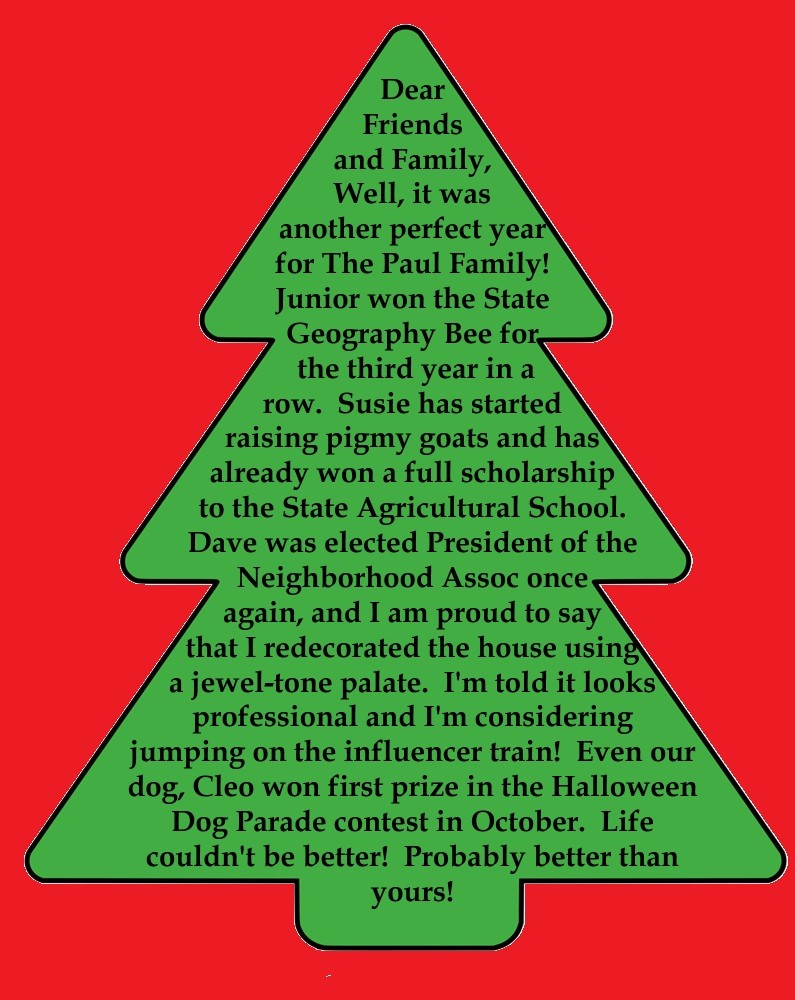
I read church reports, mission studies and clergy profiles for a living. Lots of them sound like those stereotypical Christmas letters that share all the achievements of the year but fail to mention issues of financial stress, addiction, and family trauma. Sometimes I read a congregation’s description of themselves hoping to call the imaginary “pastor with young children who will help us grow the church.” But there’s no mention of the fact that they had to lay off the Associate Pastor due to financial issues or that several in the congregation are still reeling from the Pastor Emeritus running off with a liturgical dancer.
Some pastors probably want a tidy church with no conflict, expecting that those exist. Other pastors love a challenge (if it will not involve abuse or martyrdom.) A great pastor enters their ministry with a vision that aligns with the vision of God’s people and the knowledge that failure is can be a great learning experience. (Maybe we can discontinue that thing we’ve been doing for years because 1) it has no positive impact on the community and 2) everyone hates doing it.)
Every once in a while, I read a report or a profile that speaks the truth:
“I served for years as a generalist Associate Pastor and realized that my true calling is to specialize in adult faith formation. I’m not a great preacher. I don’t love youth work. But watching adults of every age experience that spark of inspiration that changes their lives brings me deep joy.”
“Our congregation spent many years in denial that our neighborhood had changed. We wondered why we were not growing. We wondered what we were missing. Even though we are a white congregation of lifelong Presbyterians, we realized that our campus is in the middle of an international neighborhood with people who care more about feeding their families than reading The Institutes. (We still love John Calvin, but we didn’t love our neighbors as God is calling us to love them.”)
“Our congregation split ten years ago over ministry to LGBTQ neighbors and it broke our hearts. And yet, because God uses even brokenness, we have arisen to become a congregation sure of our responsibilities to love and serve even those whom we don’t understand. God did this. A great example involves a Bible Study Group of conservative retired men who decided to volunteer to serve dinner at a local Pride Cafe to get to know some of the youth who eat dinner there on Friday nights. Instead of judging those who gathered, they prayerfully entered that space wanting God to help them understand. The men were changed in that they saw these young people through the eyes of Jesus. And the young people were changed in that they had mentors who increasingly heard them. Don’t misunderstand: this took five years and lots of missteps. But God has made us more curious than judgemental, just like in Ted Lasso.”
I would rather serve a congregation – or call a pastor – who is aware of the hot-messiness of life than one who says, “Everything is fine” when asked about staff conflicts when everyone’s threatening to quit. One of the most destructive truths I see today is when a Pastoral Nominating Committee and/or a Pastoral Candidate are not truthful about their reality.
Churches that overstate their commitment to reaching out to neighbors.
Pastors who don’t love youth work while applying for a youth position because they want to relocate for family.
Congregations that declare they want to grow, but have zero intention of doing what it would take “to grow.”
Pastors who lie about why they left their last position and are about to repeat that lie in a new position.
Churches that minimize their doubts about a pastoral candidate because they’ve been searching for so long and everyone is tired. (“Who cares if he sounds kind of racist?)
We perpetuate all kinds of issues when we are all happy clappy and fear revealing or facing the truth. The God’s-Honest-Truth is that when we insist on creating a false impression about who we are, we pay for it.
Don’t forget that God is holy and amazing.
When we admit that things are not perfect but God is perfect, then we can begin to become the people we have been created to be. And life is way more fun when we have the confidence to say, “I would love to do ministry with people who know what it’s like to be imperfect.”
HOLIDAY: from the Old English word “hāligdæg, meaning “holy day” originally referring exclusively to religious festivals, but later expanded to include any day of rest, celebration, or exemption from work.
I love that British people go “on holiday” because it’s a little reminder that stepping away from the ordinary has spiritual overtones. It’s possible to see every day as a Holy Day if we focus on things like gratitude and the meaning of life.
Or life can be like this:
The opening national news story last night as HH and I were settling in with our turkey sandwiches was about “The Black Friday Holiday.” (Yes, a National Guard soldier had died in DC but that story came second to projected shopping stats.)
And when did Black Friday officially become a holiday?
If we’re honest, almost all our holidays (at least in the United States) have become about money from Martin Luther King Day (mattress sales) to Valentine’s Day (flowers and cards) to Labor Day (household appliances.) It wouldn’t surprise me if more U.S. high schoolers could identify a Toyotathon before they could identify the town where Jesus was born.
Our American culture is all about money. It feels like money is everything.
Wealthy Christians (including this one) find more security in financial success than in Jesus if we are honest with ourselves. Yes, we depend on Jesus as our Lord and Savior but Jesus wants us to buy a nice home with good schools and build wealth for our children. I’m embarrassed to know hundreds of Christians who believe that they have money because they are “good.”
People striving to “make it” in America are taught that conspicuous consumption is the path to success. I officiated a wedding in 2025 between a young couple from Asia who had been taught via social media that a bride needed three wedding dresses for a true American Wedding – one for greeting guests, one for walking down the aisle, and one for the reception. They included a line about promising to get out of debt in their wedding vows.
It would be boring to write all the examples of how and why the love of money has broken our country. It feels almost impossible to overcome systemic poverty or convince the 1% to share.
My concern is for our souls. What happens to a culture when money becomes the holiest thing? I think we might be seeing those consequences today.
There has always been inequity in this country. There has always been greed. And yet it seems more and more acceptable to treat people cruelly if we can convince ourselves that they are not like us. We applaud when vulnerable people are harassed if we consider them criminals.
Few of us would admit that money (and the stuff we purchase with money) are the holiest things in our lives. But this is the season when we might ponder what are the holiest things in our lives. Advent begins this Sunday and we can choose to take a moment or a chunk of moments to ask ourselves:
What’s the holiest thing in my life? What do I worship? What do I make sacrifices for? What do I treasure? If we decide that – actually – it’s not a new Lexus or even matching pajamas – I promise that Advent will be more life-giving than soul-crushing.
Anyone who has read this blog for a while knows that I think about death a lot. I have my reasons.
Necessary Losses is still an important book for parents, pastors and retirees, and I plan to read it again in the coming months. I’ve written quite a bit about retirement and I am privileged to experience it myself in the next few months. I feel strongly about retirement.
Most of our youngest pastors will not retire after 40 years in professional ministry. Thank you Cliff Lyda.
I remember the last time I served communion to MVW. She was an elder who had just served the congregation The Lord’s Supper and – as was our custom at that church – the 8 elders and deacons who had served the congregation sat on the front pew and I then served them by name. I remember saying to her, “This is the bread of life, broken for you M. This is the cup of salvation, poured out for you, M.” She was dying of cancer. I knew it was the last time I would serve her communion in that sanctuary.
Terrible and beautiful.
I remember saying goodbye to a beloved elder in the hospital knowing she’d be gone by morning. How do you keep saying goodbye to people you love over and over and over again? The quick answer is that you cry and then you trust you will see them again.
Last Christmas Eve, HH and I sat side by side in church pews for the first time in over 40 years. He was retiring and I had no church responsibilities. It was heavenly. As bells rang and liturgists participated in a perfectly arranged reading of the lessons, we both sat there in our fancy-ish clothes with other people in fancy-ish clothes absorbing only inspiration and beauty. We didn’t have to check with the ushers. We didn’t have to jerry rig a sagging microphone. We just sat there relishing in the beauty.
(I remember a woman in her fancy-ish clothes many Christmas Eves ago who asked me on her way out of the 11 pm service what I was wearing under my robe. What she meant was that she was wearing a glittery cocktail dress for the occasion and was I also wearing a special outfit? I laughed out loud because I was maybe wearing a t-shirt and pants that were too big. Did she not realize that Christmas Eve for the pastor didn’t involve parties and our children would maybe get a PB&J for dinner at midnight?)
Again, sitting in a pew on Christmas Eve was heavenly. I will most likely get to do that again this December 24th.
I am also bracing myself/hoping to relish my last sermon, the last time I serve The Lord’s Supper, my last General Presbyter Report, my last committee meeting. I am frankly quite excited. And also these are necessary Last Things.
As we enter “The Holiday Season” this week, it will be the last time some families will enjoy Thanksgiving with a sick parent. It will be the last time in the family home before it’s sold next year. It will be the last Christmas morning before the divorce is settled.
And it will be a time of firsts: the first Thanksgiving with a new baby, the first Christmas with a new partner. The first Christmas you get to sing Silent Night in a pew with your pastor spouse.
Several of my colleagues have lost spouses in recent weeks and months. Kids have lost parents. Parents have lost employment. My hope is that we can deeply appreciate the joys and sorrows of first and last times. Most of the time, we won’t even realize that “this will be the last time.” But that’s a blessing too. It’s why we have community: to be with us in those terrible and beautiful times.
Urinated (of course it was an emergency) in public?
Driven while under the influence of alcohol?
Driven without a license?
Driven a car with an expired registration?
Littered?
Driven without their seatbelt hooked?
Pirated a TV streaming service?
Imagine, for a moment, that while committing any of these crimes you are pulled out of your car or your home by masked men armed with government issued weapons who push you facedown to the ground, possibly in front of your family, co-workers, or friends. You might try to explain that you have papers in your wallet. You might tell the men that your boss has copies of their visas if they’d just go inside and talk with the boss. They take your phone and place you in a van to drive you to an undisclosed location where you are not allowed to contact your family or an attorney.
Yes, you are guilty. But doesn’t this seem extreme?
The comments we can expect when people put stories on social media about ICE arrests are about what criminals deserve. A few of my favorites over the weekend:
If they tell you to roll your window down and you do it, they will not break it.
Let’s roll ICE!!!
I voted for lots and lots of this.
The paid protestors strike again!
Over the weekend, Willy Aceituno, a naturalized U.S. citizen from Honduras, was stopped twice in Charlotte by ICE within minutes. (See photo above.)
The first time, he was quickly released. The second time, he was asked to roll down his window which he refused and so officers broke the window in his truck and pulled him out of the car, pushed him to the ground (while he was saying “I’m a citizen.”) And then they escorted him to their van. Fortunately they realized he was telling the truth before taking him into detention.
Yes, he resisted arrest. Yes, he speaks Spanish (and not much English.)
But imagine for a moment that this happened to one of us who happens to be White, who doesn’t suffer fools gladly, who is late to work. It feels like harassment (being pulled over more than once within minutes.) It feels threatening (having someone break a window). It feels incendiary. (Why not listen to him? Why not let him show his documentation?)
The punishment doesn’t fit the crime. Yes, if you are a violent criminal, it makes sense to use harsher tactics perhaps. But it’s evil to treat every person who was defending their property or overstaying their visa or committing a victimless crime as if they are Jeffrey Epstein or El Chapo.
And here’s the part when Jesus enters the conversation: Jesus granted grace to the woman at the well even though she was apparently guilty of unseemly “situationships.” (Listen to Dr. Alice Ridgill’s sermon preached today in Charlotte about Jesus and the woman.) Jesus included Judas at The Last Supper even though he knew Judas would betray him. Jesus befriended tax collectors, lepers, and other women whom righteous people rejected.
One of the essential tenets of my Reformed Christian faith is about grace. I believe that God loves us and forgives us especially when we don’t deserve it. This doesn’t mean that we break civil or religious laws with reckless abandon. It means that even when we make mistakes, even when we make bad choices God is gracious. Exhibit A:
But God proves his love for us in that while we still were sinners Christ died for us. Romans 5:8
Can governments run themselves with such lavish grace? No. Governments do not have the same authority or holy perfection as the Creator of the world. But we can do better. We can show mercy after holding people accountable.
And in the Church we try to hold people accountable, not to punish them unmercifully but to restore them to wholeness. We try to discipline each other with an eye on resurrection.
Cruelty reigns in the world today and ICE is not the only offender by any means. But honestly the only Reign that can heal us is the Reign of God. God is perhaps the only One who doesn’t punish us according to our cosmic crimes.
Image of the scene where U.S. citizen Willy Aceituno was held by ICE after an officer broke his truck window.
Because I’m less than 2 weeks post-surgery and not getting out much, I continue to wonder – sitting in my rental recliner – how I will deal with retirement (122 days) after 40+ years of seeing much of life through an ecclesiastical lens.
I’ve heard of pastors who continue to write sermons every week post-retirement. That will not be me. I am more likely to look at a dog walker with four unruly puppies and think “Church.”
So, regarding last Tuesday’s election: All the political analysis is wearisome, especially when pundits claim that “lessons learned” involve doing what successful candidates did. No.
Mamdani won because he captured what most voters in NYC need from their city government. Spanberger won because she seemed to address what most Virginians decided they needed (or didn’t need.) Same with Sherrill in New Jersey. There might be a thread that connects them, but Mamdani would probably not be elected in The Commonwealth, nor would Spanberger be elected as NYC’s mayor. Context is everything.
This is also why – when a church tells me they want to open a preschool because the church down the street opened a preschool and they seem to be growing – we will fail at “Mission.” What’s needed in our multi-cultural suburb is not the same as what’s needed in our rural small town. And the only way to know what our communities truly need (which is what it means to love our neighbor) is by having a relationship with them. It’s not about getting new members. It’s not about “growing.” It’s about Luke 7:22.
‘Go and tell John what you have seen and heard: the blind receive their sight, the lame walk, the lepers are cleansed, the deaf hear, the dead are raised, the poor have good news brought to them.’
Blindness, lameness, leprosy, deafness, lifelessness and poverty look different in different contexts. They are manifested in everything from domestic violence to unemployment to teenage mental health issues to hunger. Sometimes the blindness involves the fact that Church People don’t even realize that their neighbors are dealing with desperation. Even the prettiest neighborhood includes people who need life to be different.
I wonder why people join the church they joined. For many it’s family heritage. For others it’s connecting with the cool kids. A friend told me recently that she’s worshipping with a church because of the door greeter who was a hot mess – hair disheveled, clothes not matching the weather, clearly dealing with some thing in her life. The greeter had been included in a leadership role while in most congregations she’d be considered an embarrassment. “That’s my kind of church,” my friend said. And that is also Jesus’ kind of church. And also that’s not everybody’s context. Not everyone has homeless neighbors.
Do we even know our context? Do we want to know it? Or are we trying to follow some kind of ministry formula that works for another congregation?
These are things I ponder while hanging out in my rental recliner. I was expecting a more dramatic launch feature but it turns out to be a gentle push. Again, this reminds me of Church.








 A Church for Starving Artists