Author Archives: jledmiston

The Holiness of Pancakes

If you’ve ever had Chocolate Chip Pecan pancakes from Zada Jane’s in Charlotte or the Pumpkin Pecan pancakes at Blueberry Hill in the southern Chicago suburbs or the Potato Pancakes at Walker Brothers in the northern Chicago suburbs, you know that eating pancakes can be a religious experience.

Pancakes are forbidden for most Whole 30, Keto, or gluten-free eaters.  The historical reason why Christians eat pancakes on the day before Ash Wednesday is to get all the sugar and butter out of the house before swearing them off for Lent.

Pancakes are a treat.  Good pancakes are heavenly.  Pancakes that appear to show the images of Jesus and Mary are . . .  interesting, mostly for what it means to see Jesus and his mother at breakfast.

We who long for deep meaning and purpose seek signs.  A burning bush would actually be terrifying and who would believe us?  A blinding light knocking us off our horse on the road to Damascus seems a little over the top.  But gentle signs – we prefer those: like that still small voice (which is also translated as “sheer silence.”)

Or we try really hard to find signs where there are no signs.  Is the fact that I didn’t get that job a sign that God has better things for me?  Or is it a sign of misogyny?  Is the fact that the Person-Of-My-Dreams is alternately abusive and sweet a sign that I’m called to be with this person to save them?  Or is it a sign that I need to get out fast?

We look for what we want to see and this is one reason we need a community.  We need people who will tell us the truth we don’t want to hear.  We need people to pick up our pieces after we’ve been shattered. We need someone to take us out for pancakes when it’s been a rough week.

I call this community Church.  At its best Church lavishes truth, healing, and comfort on all who gather and we do this because we have seen the power of truth, healing, and comfort that God offers.

Take someone out for pancakes today or take yourself out for pancakes.  And look for signs from God about what we are supposed to do and be today.  Chances are, today will have to do with telling someone the truth, healing a broken spirit, or comforting the grief-stricken in the name of the One who created us to be holy.  The signs are all around us that this is what the world deeply needs.

Image of a pancake sold on eBay in 2007 for $338 because of its likeness of Jesus and Mary (or Moses and Elijah)


We Are Not What People Think of Us (But It Feels That Way)

Somewhere along the way The Church evolved from a “hospital for sinners”* to a club for people who’ve got it together. At least this is true in the White Church.

Sure, we know we are not perfect.  But we like to give the impression that we are perfect-ish.  Or at least we minimize what others might consider imperfect.

What would people think of me if they knew that:

  • My child attempted suicide?
  • My spouse lost his job?
  • My morning routine includes taking two anti-depressants?
  • My marriage is a sham?
  • My father’s in prison?
  • My daughter wants to marry a woman?
  • My dog has fleas, my son has head lice, and my furniture has bed bugs?

Some of us say that we don’t care what people think, or we don’t care what they think anymore (because we’re older now.) But even the most confident among us has a touch of fear that people will learn that things are not perfect over at our place and they will judge us and maybe even reject us for it.

Repeat after me:  I am a Hot Mess and it’s okay.

We are not what people think of us.  But sometimes it feels that way.

What if people think I’m a loser and they’re right?  What if people think I’m ugly and they’re right?  What if people think I’m stupid and they’re right?  What if people think I’m a bad parent and they’re right?

First, put on some Lizzo and let it fill the air.  Secondly, remember that God made you and you are the unique and beautiful agglomeration of DNA and experiences that deserves love and respect.  It’s okay if people judge us as long as we know – to our bones – that we are created in the image of God.  And frankly, we always need some of God’s people around to remind us that we deserve to be treasured.

We are not what people think of us.  We are what God thinks of us – and yes, we have fallen short of perfect big time.  But nobody needs a Savior if things are perfect.  Have a good Monday.

Image from the movie After Lucia (2012) and thank you SPC.

*Augustine of Hippo (354-430 CE) supposedly said that the Church is a hospital for sinners not a museum for saints.

Church Home

When you picture a church building, what does it look like? A traditional brick structure or a white clapboard edifice?  A glassy modern building or a school gym?  An auditorium or a theatre?  Stained glass or clear glass or no windows at all?  A central pulpit or an elevated pulpit off to the side or no pulpit?  A chancel or a stage?  A narthex or a welcome center?  Pews or movable chairs?

Newer congregations (those established sometime in the past 50 years) seem not to be as attached to their buildings as congregations in older churches.  Believe me, if you worship in a church sanctuary that dates back to the 18th or 19th or even the early 20th Century, people are attached to that building.

New church buildings – if new church plants meet in a church building at all – don’t have Tiffany windows and hand carved pews.  It’s easier not to become attached to the building when it doesn’t feature soaring arches and cozy cushioned pews.

But longtime church people are very attached to their church buildings. Very. Attached.

In a changing world, the church building becomes The Constant for many.  And today, more and more churches are closing after a slow death.  Some are being sold to other congregations. Some are being sold to developers.  And the pain must be excruciating for those who have loved both those buildings and the people who once prayed there.

So yesterday, I was meeting with leaders from the 1001 New Worshiping Communities in our denomination and was told a cool thing:  sometimes when churches decide they don’t have the capacity to continue, they give their buildings to new congregations just getting started.  S. was telling us that sometimes the older members of the former church come back to worship with the new congregation in the old church building.

The people are different.  The music is different.  Maybe even the language is different.

But the older members sometimes come back.  It’s the place where they got to know God.  No matter who’s there, God is also there.  It’s their church home.

Image of one of the prettiest little sanctuaries in the United States: Union Church of Pocantico Hills, NY.

This is a Great Time to Be an American Christian

Eboo Patel always inspires me and makes me want to be a better Christian. When he spoke Tuesday night at Queens University in Charlotte, he told a story about Martin Luther King, Jr that I’ve been trying to find with no luck, so I’ll share the gist of it here.

It was the late 1950s/early 1960s and Dr. King was living in a violent and dangerous United States. His home had been bombed.  I’ll type that again:  His. Home. Had. Been. Bombed.

Crosses were burning and Jim Crow was alive and well.  In 1963 a Birmingham church was bombed killing four young black girls.  Our nation was on fire.

Dr. King was asked, “If you could live in any time in history, when would you live?”  He pondered the thought of living in the time of Socrates or Plato imagining the amazing conversations he could have.  He imagined being with the first followers of Jesus and what he could learn from them.  He considered all the monumental times in history and what it would be like to be at the signing of the Declaration of Independence or at the signing of the Emancipation Proclamation.

But as tempting as those extraordinary periods of history would be, Dr. King said that he would most like to live in the time he was actually living.  Even with the racial injustice, random cruelties, and national divisions he understood the particular time in which he lived to be the perfect opportunity to do good work.

As I write this, political divisions seem insurmountable and Twitter is not helping.  The coronavirus is spreading.  Among the opinion pieces in recent newspapers include:

Lord have mercy.  Christ have mercy. Lord have mercy.

Nevertheless . . .  it’s a great time to be an American Christian.  God has blessed us with plenty of work to do for good.  We have be handed a full platter of opportunities to fight hate with love and to fight gun violence with peace.  We have countless opportunities to clean up the environment.  We have countless opportunities to offer loving security to our children.

Yes, it will wear us out.  Dr. King often looked tired, but he was never hopeless.  I believe that God is calling each city and town to create an environment in which everyone created in God’s image can thrive. (People created in the image of God = all people.)

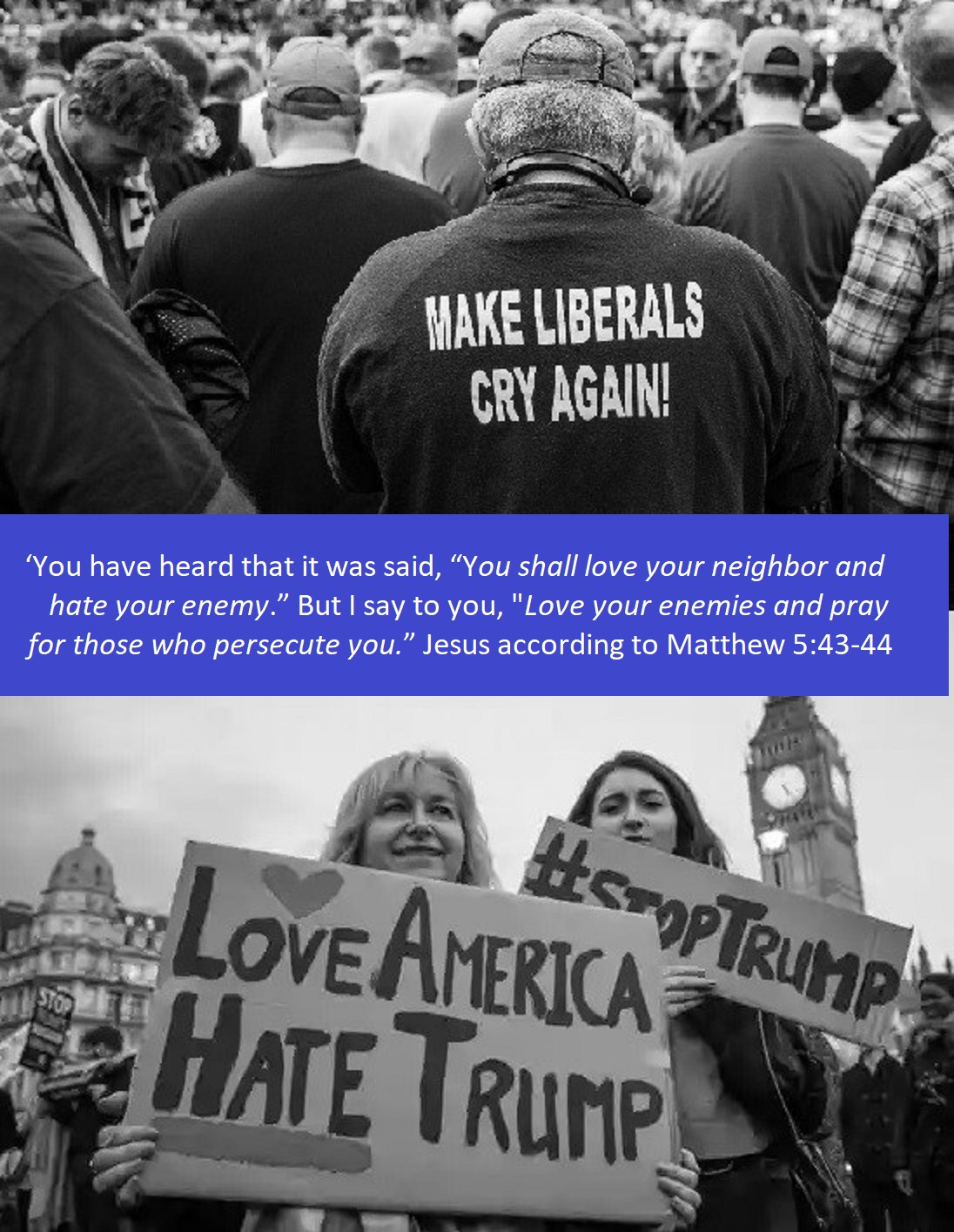
The world doesn’t have to be so ugly and broken.  We can be the people who refuse to use social media to spew hate.  We can be the people who see everyone – including our enemies – through the eyes of Christ.  We can be the people who say no to everyday cruelties.

We have so many opportunities to love instead of hate today. Let’s make it today’s challenge: Love someone who makes you crazy.  Love someone whose political views are the opposite of yours.  Love someone you don’t understand.  Or just try really hard not to hate them.

Images like the ones shown above are everywhere.  It doesn’t have to be like this.

Paying for Services

Here’s an interesting article by Austan Goolsby about What’s Killing Shopping Malls (it’s more than Amazon) but I’m struck by this particular thing:

“With every passing decade, Americans have spent proportionately less of income on things and more on services.”

Today we spend more on travel, movies, eating out, childcare, education, and business services than we spend on products sold at the mall  – or any retail store.  So interesting.  Buying habits have evolved through the decades:

  • In 1920, Americans spent more than half their income on food and clothing purchased in traditional stores.
  • Today we spend only 12.2% of our income on food and clothing.

So, here’s what I wonder regarding “worship services.”  Many Church People refer to what happens Sunday morning (or whenever) as The Worship Service.  It’s a different kind of “service” from services like babysitting or lawn mowing or housecleaning.

The “service” that happens in a church context usually involves a time of praise, confession, proclamation of the Gospel, and thanksgiving. And – maybe I’m wrong but – most people do not consider the financial offerings they give to the Church to be about “paying for services.”

Many pastors provide “services” like officiating at weddings and funerals.  Some of us are paid something additional for these events and some of us are not.  (That’s for a different post.)

And if we really think about it, the services a particular church provides are so much more than what happens for an hour every week: food pantries, counseling, education, space for 12-Step Groups and other non-profits, clothing closets, prayer spaces, childcare, coffee, companionship, community dinners, rides to the polls, and beyond.

A bride once referred to me (her pastor and the officiant at her wedding) as “a vendor.”  Ouch.  I was hoping that our connection was more about our relationship with each other and God than a business proposition.

This is a huge culture shift – the notion of spending more of our money on services than things, and frankly I wonder if Dr. Goolsby factored in personal economics.  If I’m a poor woman living on minimum wage, I’m probably spending most of my money on food and rent rather than “things.”  I’m not buying things because I don’t have the money to buy the latest Ninja food processors or Air Jordans.

A Vitamix seems awesome but I’d rather have a therapist and a pedicurist.

Doing seems better for the soul than havingBeing seems more fulfilling than doing.  And being (a follower of Jesus, a believer, a faithful Jew, a practicing Muslim, etc.) seems to be about service – but we are the ones doing the serving.  This – and not owning stuff – seems to be the meaning of life.

Image of the Bluth’s Frozen Banana booth from Arrested Development.

Moving Day

It was about this time in 2011 when everybody in our little family – except for HH – was individually planning to move in the next six months.  I would be leaving Our Nation’s Capital to join HH in Chicagoland.  FBC would be graduating from college to return to Our Nation’s Capital.  SBC would be moving from one dorm to another (but didn’t know where) and TBC would be moving from a dorm to an apartment (but didn’t know where.)

And now, nine years later we continue to move: SBC to a new apartment last month, TS (who is now part of our family) from SC to VA by way of CT, and me from one apartment to another TODAY.  I’m preparing a place for me and HH to live in Charlotte when he arrives in a few months. (We’ll have a guest room!)

I loved living in one town for the first 23 years of my life.  It brought stability and comfort and I remember – even as a young child – being grateful that my family stayed in Chapel Hill while so many of my friends moved in and out.  Our children appreciated growing up in Our Nation’s Capital while – again – so many of their friends moved in and out.

Some of us move from one home to another and some of us don’t.  I have family members who’ve lived in the same home for over sixty years.  I have clergy colleagues who’ve followed God’s call to multiple states through their professional ministry and I have other clergy colleagues who have stayed within a specific geographic area to serve multiple calls in the same general vicinity.

It’s easier to Kondo your closets when you move every few years.  It’s also easier to let go of things and travel more lightly.  Every move is bittersweet in that we are losing something and gaining something with every new address.

Whether we stay in the same house where we were born or move every year (hello military families) the truth is that every single one of us is called to move in some way:

  • To move in terms of the way we see the world.
  • To move in terms of our spiritual maturity.
  • To move in terms of becoming more and more like the people we were created to be.

If you happen to be part of a Judeo-Christian faith tradition, moving is our thing:

A wandering Aramean was my ancestor . . .

I am about to do a new thing; now it springs forth, do you not perceive it? I will make a way in the wilderness and rivers in the desert.

Very truly, I tell you, when you were younger, you used to fasten your own belt and to go wherever you wished. But when you grow old, you will stretch out your hands, and someone else will fasten a belt around you and take you where you do not wish to go.’ (He said this to indicate the kind of death by which he would glorify God.) After this he said to him, ‘Follow me.’

Following the God who made us is not for the fainthearted.  God will take us where we didn’t think we’d ever go – and I’m not just talking about geographic locations.

Today I’m moving from one apartment to another in the same building.  Easy, right?  Yes, it will be.  It’s an easy move because God knows that my capacity to move spiritually and relationally and professionally can be exhausting.  I’m grateful for a God who knows me well enough to help me discern that moving from the 5th floor to the 4th floor is about all I can handle right now.

Presidents move too (both geographically and in their capacity to be noble servants, God-willing) and President’s Day is an excellent day to start afresh in a new place.

May you find yourself starting afresh as the days get longer.

Image from Two Men and a Truck in St. Louis where I’ve never lived.

What Do You Do for Spiritual Reasons?

When FBC was in kindergarten, we got a note after school from his teacher that shared this information:

“___ might be especially hungry when he gets home because he refused to eat lunch.  We had a pizza party and he said that he couldn’t eat that pizza “for political reasons.”

FBC lived by his convictions from an early age.

There are many things I do or don’t do for “political reasons” but mostly those choices have deeper roots.  My hope is that my “political reasons” for doing or not doing something is more deeply based on “spiritual reasons.”

I just registered for the 2020 National White Privilege Conference in Mesa, Arizona and one of the preconference classes is Racial Justice as a Spiritual Imperative.  One of the things I am trying to be is consistent in my life.  I want to live according to the broader message of what Jesus teaches (love your neighbor, love your enemy, love Jesus more than other stuff) and part of Jesus’ message involves doing ministry on the edges.

Jesus created community with all kinds of people beyond his own cultural boundaries: foreign women, tax collectors, “unclean” folks.  In the United States today, we white people have built a boundary around ourselves that we don’t even notice or acknowledge.

“White” is normative for us. We make sacred assumptions that white = better, smarter, more successful.

White supremacy is the foundation of our nation’s history from how Europeans treated the native population to slavery and Jim Crow and – today – how we see immigrants.  But most of us do not realize much less accept this.  We make sacred assumptions that things were better in the old days.  We forget that this great nation was built by people of color.

My faith in Jesus teaches me that I need to understand these hard truths.  My faith in Jesus teaches me that I need to learn from people of color.  My faith in Jesus reminds me that we are all human beings created in God’s image.  It is a spiritual imperative that I address racial injustice.

Some of us do not eat meat for spiritual reasons.  Some of us tithe our earnings for spiritual reasons.  Some of us do not drink or swear for spiritual reasons.  Some of us volunteer at soup kitchens for spiritual reasons.

If we living out our faith, it shows up in what we do and what we don’t do in our everyday lives.  And I want to be clear: this is not about check lists and using the Bible as a weapon to chastise each other.  It’s about spiritual disciplines that help us grow as followers of Jesus.

What do you (try) to do or not do for spiritual reasons?

Image from the 21st National White Privilege Conference to be held this year April 1-4 in Mesa, AZ. It’s important work.  I’ll be there for spiritual reasons.

Table for One

After my Mom died, Dad often ate dinner alone at the K&W in Chapel Hill.  He was a very social guy and it kind of broke my heart thinking about him sitting alone.  He probably chatted up the women serving chicken livers and chocolate pudding.  But then he would have taken a seat by himself.  He wouldn’t have brought a book to read and he certainly didn’t have a cell phone to read his email.  It makes me feel sad to think of him at a table for one.

HH and I are on the final stretch of living without each other and – just like running a marathon – we are at the point when it’s especially tough.  Living without your person is really hard.  Really hard.

I frankly enjoy eating alone in a restaurant because it’s a respite from meetings and wall to wall phone calls.  And I’m not having to cook or clean for myself.  At least for now, it’s comforting to have someone bring me sweet tea.

I once preached a sermon called Eating Alone for a communion service and I noted that – when we share in The Lord’s Supper together – we are feasting with those who are present and those who are no longer with us – the saints who’ve gone before us.  One never celebrates communion alone.

When I eat alone in a restaurant, I don’t feel alone at all.  Sometimes people at neighboring tables ask if I’d like to join them, and honestly, I don’t want to.  I need quiet time when nobody’s talking.  I find comfort in that table for one.

Loneliness is a weird experience.  I have been told many times that professional ministry is lonely and that mid-council ministry is especially lonely, but I have not found this to be true. I can’t share what’s going on with our pastors and congregations, except to share it with God who already knows.  And that’s all I need.

What I also need is my person.  HH moves to this time zone in April, and it’s a bittersweet move.  He is leaving a fantastic congregation in a wonderful place.  He is entering into the unknown in that we are hoping for a new fantastic congregation in a different wonderful place – but we don’t know where that is yet.

I will continue to eat alone sometimes and that will be fine.  But I look forward to setting a table for two at least once a day in just a couple more months.

Here’s to the people sitting at table for one. Maybe they’d like company.  Maybe they wouldn’t.  But try to notice them.  They might be missing their person.

Image is Automat by William Hopper (1927) Des Moines Art Center.

When Church Governing Boards Are Too Big (This Sounds Really Boring, But I Hope it Sparks Some Conversation)

[Note: I’m Presbyterian and Presbyterians call our governing boards “Sessions” but this post might also apply to your church’s non-Presbyterian council too.]

I can tell a lot from the size of a congregation’s governing board:

  • If a smallish congregation has a huge governing board, I assume there are trust issues.  (They don’t trust a small group of elders to lead them.)
  • A large board could be good (i.e. the congregation is also large and this board works like a creative, well-run machine along with the church staff.)
  • A large board could be not-so-good (i.e. committees and ministry teams are ineffective and this large group serves as a committee of the whole congregational system.)
  • A large board often = long meetings of the elders. (Note: no elder meeting should be longer than an hour and a half – and this includes at least 30 minutes of prayer and theological reflection.)

I’ve been taught that church boards should be sized according to the size of the congregation in this way:

  •  Six elders on the board for a congregation of 50 – 150 members, not counting the pastor.
  • Nine to twelve elders for a congregation of 300 members, not counting the pastor(s).
  • No more than 24 elders for any congregation over 300 members.

Our boards are more than receivers of reports.  In a perfect world, our boards are comprised of spiritual pillars who represent the diversity of the congregation.  They welcome faithful discernment and generate big themes for the ministry of that congregation.

Examples of Big Themes are:

  • addressing the opioid addiction in our community
  • addressing homelessness in our community
  • addressing the digital divide in our community
  • addressing systemic racism in our community . . .

. . . all to the glory of God who calls us to address what loving our neighbor looks like in our particular neighborhoods/towns.  God calls us to be good neighbors and so we act accordingly – in the likeness of Christ by the power of the Holy Spirit.

Too many times, the reality of our boards is that:

  • people are bored on the board.
  • people are uncertain what their role is.
  • people are comfortable doing practical tasks (picking curriculum, replacing the boiler) but are uncomfortable being spiritual leaders (praying for each other, sharing their faith stories, disclosing their doubts, discerning together what God is calling the Church to be.)

I love being Presbyterian because we are an elder-led denomination.  There are ruling elders (who serve on the board) and there are teaching elders (who are ministers of the Word and Sacrament.)  Or at least that’s our historic lingo.

Sitting with church people called to lead a church should feel like a room full of light bulbs.  But too often it feels like a life-sucking waste of time.

It doesn’t have to be this way.  Teaching our governing boards how to do generative ministry makes all the difference.  Nobody – except the people who seek power – wants to serve a church board that focuses on committee reports and congregational minutiae.  I’d rather sit through a reading of Calvin’s Institutes. Seriously – I totally would.

Elders rule.  They have the power to bring light to the everyday ministry of their congregation.  And those not currently serving on the church board are not exempt from responsibility.  They, too, have a role in participating in the ministry of their congregation.  It’s just that the elders are looking at the Big Picture.

What’s the Big Picture in your church?  Do you see it?  Do you agree on it?  Or are you frazzled over the artificial flower arrangements for next Sunday?

What would it take to change the culture of your church’s governing board to make it more enriching, exciting, and energizing for the sake of your congregation’s ministry?

What Really Happened Was This . .

So let’s say that your city or town needs a new highway.  Construction will involve removing whatever’s in the way, and it makes sense, of course, to take “blighted areas” or “slums” for the project.  Everybody wins!  Those eyesores become gleaming new highways which improve traffic patterns and make commuting from the suburbs easier.

The Wikipedia definition of Urban Renewal literally puts it that way.

What actually happened in many of our cities and towns was Urban Removal.  African American neighborhoods were sacrificed for various “renewal” projects, and although the most photographed properties in the city proposals showed rundown lots, most of the properties served a thriving middle-class African American community.

In 1958, the City of Charlotte voted to destroy the Brooklyn Village neighborhood. Brooklyn Village included the first Black high school, twelve churches, stores, medical offices, restaurants and the homes of about 9000 citizens – all owned or occupied by African Americans. The Charlotte City Council at the time promised to create a new and improved neighborhood for the Brooklyn residents.  It never happened.

What does this have to do with the Church?

I could go on and on about this but I won’t for now.

What I will say is that our Presbytery – 96 congregations covering seven counties – voted unanimously over the weekend to send a resolution to the Charlotte City Council and the Mecklenburg County Board of Commissioners asking them to urge the new developers of what was once Brooklyn Village to:

  • Ensure that 20% of the planned housing units be affordable for households or individuals earning 30% or below the area median income.
  • Ensure that 20% of the planned commercial spaces would go to African American owned businesses, offering subsidies if needed.
  • Allocate ongoing revenues from the development to a Restorative Justice Fund to provide economic stimulus and support to the African American community in the hopes of repairing some of the economic damage done to this community.

Our Presbytery commissioners unanimously approved this and many of our churches are committed to attending future meetings to speak up.

My friends, this is the 21st Century Church.  We build. We repair. We support the least of these.  I am profoundly grateful to serve among people who want to be this kind of Church.

Happy Monday.

Images of Brooklyn Village before it was torn down in the 1960s and 1970s in Charlotte, NC.