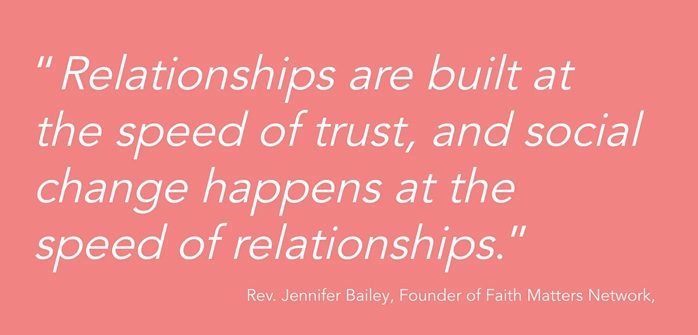
The rate of change is determined by the level of trust.
Somebody said that to me last week. (Thanks, if it was from you.) It was a take on Rev. Jennifer Bailey’s quote.
There are several rookie mistakes Pastors – and other leaders – make that will forever sabotage our effectiveness. The first is to try to change things without establishing trust. Show me a Transitional Pastor who decides to shake up how a church does Lent and Easter without first learning what they love about the way they do Lent and Easter and I’ll show you an unnecessary $#@ Storm. Show me a newly Installed Pastor who announces that the congregation will not longer be singing The Doxology during worship and I’ll show you a choir set on blocking every idea the Pastor has moving forward.
Trust is in short-supply these days. Institutions we once trusted have betrayed us. (There was yet another joke about the Catholic Church offered by the Irish Catholic host Conan O’Brien during the Oscars Sunday. Will the Roman Catholic Church ever recover from the sins of their past? Will the Presbyterians?)
How do we engender trust in our families, our communities, our institutions? Be trustworthy.
Listen to people who haven’t had a voice. (Note: Listening is not waiting for our turn to talk.)
Read the room. (Notice things like a detective. Or a person with emotional intelligence.)
One of the beautiful things about being a long-term pastor is that – God-willing – we have engendered trust even among communities that occasionally disagree. As Lent begins tomorrow, consider trust-building as a spiritual discipline.
We are a movie family. We regularly analyze movies together. We stay to watch all the credits.
One of the best things HH and I did as parents was take our kids out of school on opening day of epic movies like Harry Potter and Lord of the Rings and go to the Uptown Theater in D.C. We got in line early to grab our favorite seats: first row, center balcony. The red velvet curtains opened and we were transported.
The Oscars are tonight and we always watch although I’m not sure why. HH and I don’t care much about the fashions. Our favorites don’t always win and we often do not watch every nominated film. I’m fairly certain that some winners prevail because “it’s time” (Anthony Hopkins) or everybody likes them (Tom Hanks.) But it’s fun.
Great movies are those that make an impact. HH and I have watched three Gene Hackman movies since his death (The Conversation, The French Connection, and The Royal Tenebaums) and only one had much of an impact on me. We’d seen The Royal Tenebaums before at least twice and – still – it moved us when we watched it again. We laughed. We cried. We coveted the luggage – like all Wes Anderson movies.
The truth is that every one of us is in the impact business. We were each born to make a difference.
It might be an earth-shaking difference: Margaret Sanger. Or it might be a tiny difference: Jan Edmiston. But this is a calling each of us shares.
A couple years ago, an esteemed pastor challenged me to close ten churches in our Presbytery before I retire. (!) First of all, I am not a bishop. I don’t have the authority to close any church. In fact I find that congregations tend to close themselvesafter years of making no impact in their communities.
I visited a “small church” today that makes an enormous impact in the recovery community. Perhaps a handful of people gather for worship on Sunday mornings but hundreds have found wholeness through the nightly AA meetings.
I visited another “little church” a few weeks ago with about 25 members, and I learned that they feed a couple hundred people every month. They even have freezers to store chicken to hand out, donated by a local processing plant. And they have a Bible study for developmentally delayed adults with about five adult women each Sunday morning. They are making an earth-shattering difference.
Everyone can make a difference in someone’s life or in the life of their community. It’s predicted that 100,000 churches (of all or no denominations) will close by 2030, according to Mark Elsdon. Those that will close are the ones who forgot that they were in the impact business. They will close after benefitting no one in their neighborhoods. They will have long become rote responsibilities for the handful of members left.
Consider the movies, the groups, the individuals, the animals, the experiences that have made an impact in our lives. And then consider how we are making an impact for one other person or many other people. Even the small impacts can be life-changing.
After finding success with his 2000 book Bowling Alone, Robert Putnam was asked to participate in a documentary, produced by Netflix, called Join or Die. (I recommend it and it would make a good adult class offering.)
Although we Americans are increasingly self-isolating (we prefer streaming movies to public movie theatres), some of us are a part organizations even as adults. Some might be official. Some might be haphazardly structured.
As a pastor, I am a part of a Preaching Group (meeting annually in a variety of locations), a clergy support cohort of pearl clutchers (gathering via group threads and an occasional in-person meet up), a fun cousins group (annual reunions and occasional girl cousins only events), and assorted work teams and committees. I’ve rarely been part of a book group. I’ve never been in a running group or a birdwatching group.
An interesting thing is happening in The Church. For the first time in a while, I’m hearing that new people are finding their way into church sanctuaries in hopes of finding spiritual support during what feels like political mayhem to many of us. More than five people in the last month have contacted me to ask if I might recommend a church in the cities where they live. We often seek a group in specific circumstances: a support group in times of grief, a young mom’s group when we crave adult conversation, a church when the world feels overwhelming. Unfortunately, finding a church is probably a last resort for millions of Americans.
Creating community is not just a cool new fad. It’s essential to being a human being and – in the words of the Join or Die movie – essential to being a democracy.
It’s scary joining a group. What if I join a book group and I don’t like the suggested books? What if I join a singles group for general companionship and everyone wants to hook up? What if I join a church and it starts to feel clique-y or cultish? It’s okay to try something and step away. Repeat after me: “It wasn’t what I was looking for but I’m glad it works for you.”
A much-respected Presbyterian leader felt like he needed to share on social media last week that he’s joining the Quakers and leaving the Presbyterians. He is amazing and he will continue to be amazing. And it doesn’t mean he’s rejected us. He’s found what he needs and this is good.
So here’s my point: it used to be true that “the most important hour of the week” for church people and/or people seeking spiritual connection was the worship hour in a church sanctuary. Or so we were taught. This means that – for that one hour – the music, the liturgy, the sermon, the ambiance, and the hospitality must be impressive enough to lure people back next Sunday.
Worship is important. Of course. But perhaps “the most important hour of the week” for followers of Christ are those times in small groups, one-on-ones, long-standing circle meetings or Bible studies, or the brief time before and after worship when we greet each other and sip coffee and share real things. Those moments of community give us life. What if we spent more time fostering those moments? When I was part of Holy Grounds in Alexandria, Virginia we found that most folks came to Sunday night worship after they’d already connected with people through Monday Burgers or Friday Game Night.
I hope you are a part of something that gives your life meaning. And if we indeed have that, what if we looked out for others who seem to be seeking what might give their lives meaning too? This in itself is a spiritual discipline: notice people who are seeking community, not to “lure them in” but to love them and partner with them in life-giving things.
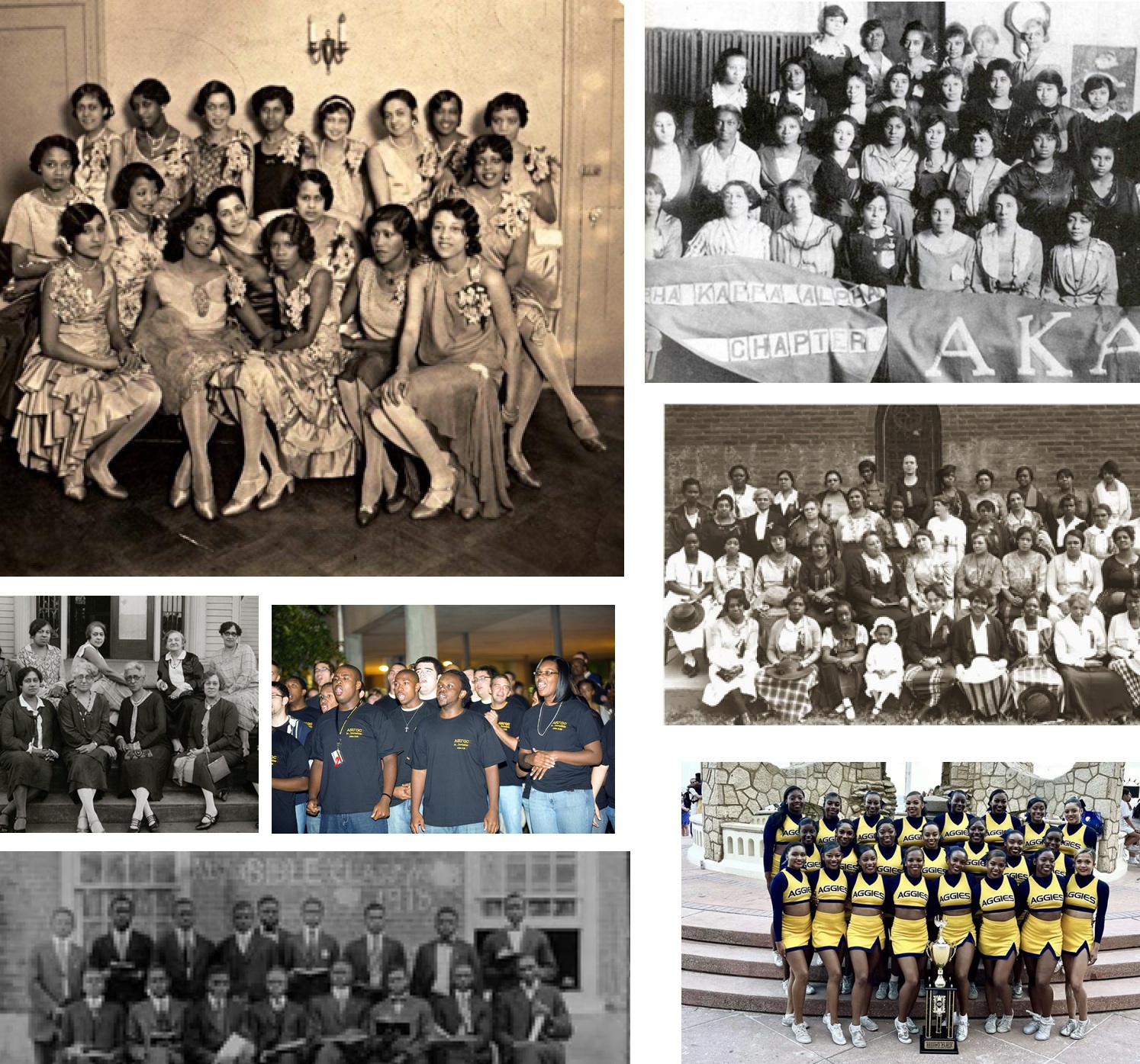
In thanksgiving for Black History Month, the mosaic includes images (from the top left clockwise) of The Girl Friends, Inc. established in 1927 during the Harlem Renaissance, members of Alpha Kappa Alpha Sorority Inc. founded in 1908 on the campus of Howard University, the Montana Federation of Negro Women’s Clubs in Butte, August 3, 1921, the NC AT&T State University Cheerleaders, the YMCA bible study class in Alcorn, Miss., ca. 1918, the Atlanta’s Neighborhood Union established in 1908, and (in the center) the Appalachian State University Gospel Choir established in 1976,
There’s a Bible verse that most of us have never preached on/heard a sermon about concerning what happens if we ignore the fact that our next door neighbors are involved in child sacrifice. I’m thinking that most of us would call 911.
From the beginning of human existence, God has expected us to be our siblings’ keeper – and I’m thinking brothers/sisters/siblings equal “neighbors” as Jesus defines them. We are expected to have concern for our neighbor and so if we become aware of some injustice or cruelty or grief, we need to do something to address those things. If we see a violation of God’s commandments, we are expected to seek repair.
Sometimes it’s easier not to know. Close our eyes to the evil next door (Leviticus 20:4-5) or pretend like we are unaware of the need (Luke 10:25-37) or deny that it’s our responsibility to care for another person (Genesis 4:9-10). The Bible is full of examples of this: we are expected to care for each other in this world – and not just the ones in our family, no matter what some say.
We live in a world controlled by the information we consume. When we are only exposed to “fake news” or incomplete news or strategically curated news, our ability to see each other as God’s Children is diminished. Too often, though, we like it that way. When we don’t know the fuller story, we don’t have to address what that story has revealed about ourselves.
I don’t know who wrote it, but I read this over the weekend:
It’s no accident that:
We learned about Helen Keller instead of W.E.B. DuBois in school.
We learned about the Watts and L.A. Riots, but not Tulsa or Wilmington.
We learned that George Washington’s dentures were made from wood, rather than the teeth of enslaved people and animals.
We learned about Black ghettos but not about Black Wall Street.
We learned about The New Deal but not about Red Lining.
Privilege is having history presented in a way that doesn’t make some people uncomfortable. And racism is perpetuated by those of us who refuse to learn or acknowledge the full story.
In honor of SNL’s 50th Anniversary, I’ve been re-watching some of the skits and fake commercials from previous years. This one stings, not merely because it’s particularly partisan, but because it reminds me that I’m complicit too.
I personally love Valentine’s Day but not for romantic reasons. I find schmaltzy cards kind of fun. I like telling people I love them.
Some people avoid Valentine’s Day like I avoid Mother’s Day. (Love my kids. Miss my Mom.) Some celebrate Galentine’s Day. Some people take St. Valentine very seriously and spend the day pondering martyrdom. And I recently heard February 14 referred to as Single Awareness Day.
Being single can be a joy. Sometimes partnered people feel single. Everyone experiences existential loneliness in that – even if we married believing that Our Person would fulfill every need and maybe even read our minds – we quickly realized that it was not possible. No one can thoroughly know us – how we think, what we think, why we are the way we are – except for One.
My personal faith story involves realizing that even though he was a male person born 2000 years before me in a wholly different context and culture, I deeply felt that God knew me through Jesus. Long story, but that was the takeaway.
Today I know partnered people who feel lonely. I know married people who wish they weren’t. I know single people tired of feeling alone. And yet . . .
February 14 is an excellent time to take a minute and be aware that each of us is a distinct and complicated human, worthy of love and filled with the proclivity to love others. Imagine a day – or just a moment – when we can single-mindedly appreciate the person we were created to be.
It is an underappreciated miracle when we have people to love, work that satisfies and a greater purpose in this life than making the most money, curating the best resume, or stockpiling the best toys. Life is a miracle and I love it when we remember.
May every single one of you have a day filled with sparks of insight and more than one moment of joy.
I keep a grappling hook in my office – a gift from church friends with whom I have grappled with many complicated issues.
Leadership researchers will tell us that issues can be simple, complicated, complex, or chaotic, but for the sake of this post, I’m going with simple versus complicated. One of the wedges divided us politically and theologically seems to be the unwillingness to grapple with complicated things. It’s easier (and lazier) to cling to simplistic opinions and let those opinions direct our political opinions.
We do this by assigning negative (and simplistic) assumptions to catch phrases or acronyms:
“DEI” comes to mean unfair hiring practices or the lifting up of unqualified people for the sake of being “woke.” But if we do some research, we find that DEI is a bit more complicated than that. Diversity, Equity, and Inclusion actually ensures opportunities for people whom we might not consider otherwise for employment or even participation in an organization: The person who can do the job even though they are in a wheelchair. The person who doesn’t look like everybody else but it equally up for the task. There are countless studies on the benefits of including a diversity of voices at the table. We omit whole demographics of people if we ignore those who are not like us.
Critical Race Theory has practically become a swear word that we attach to preschool programs or middle school field trips when – actually – it’s an academic theory studied in universities. According to Wikipedia “the word critical in the name is an academic reference to critical theory rather than criticizing or blaming individuals.” But we condemn people who consider Critical Race Theory by accusing them of “hating their country.”
Especially in these days, it’s really essential to do our research and by that I don’t mean getting our news from Raw Story or Turning Point Action. And I’m not merely referring to our media diet. This is also essential for those of us who take the Bible and our faith seriously.
When a political leader refers to “the Christian idea” that you “owe the strongest duty to your family” and “your first duty as an American leader is to the people of your own country” the curious Christian would grapple with that sentiment by studying their own Bibles and noting if this is what Jesus said.
When some Christians question the leadership of women in church, the curious Christian would do a deep dive into the context and culture of the words they quote to “prove” what they already believe. Turns out the apostle Paul was quite open-minded.
Christians who grapple with complicated issues of faith and life are taking the Scriptures seriously.
In some ways, following Jesus is quite simple: love your neighbor as yourself, feed the hungry, welcome the stranger, etc. It becomes more complicated when we dig into what these simple ideas mean:
Is the trans person our neighbor?
Is the hungry addict worthy of food?
If the stranger is undocumented, what’s our responsibility?
Sometimes we might grapple with issues and find that what we’ve always believed is not as simple as it seems. Sometimes we might be shocked by God’s Truth and it forces us to repent.
Is it easy following the way of Jesus? Yes. And not always.
When HH and I were Co-Pastors of Fairlington Presbyterian Church in Alexandria, Virginia the congregation was preparing to celebrate it’s 50th Anniversary. Established in 1947, the church experienced explosive growth (We beat Hitler! Let’s have babies!) and – almost forty years later – an explosive church split broke spirits and hearts. When HH and I arrived, the church was a bruised remnant of what it had once been.
As the 50th Anniversary was approaching, we decided to invite the Moderator of the Presbyterian Church USA General Assembly, the highest elected official in the denomination, to be our guest preacher. I had been a Commissioner to the 208th General Assembly and had happily voted for Rev. Buchanan for Moderator.
I called The Mother Ship in Louisville to ask how we could get on John Buchanan’s preaching schedule. We wanted him to be the preacher the day we celebrated our 50th Anniversary, and I was discouraged to hear that there were probably 3 requests for every possible preaching date in The Moderator’s 12 months of service.
Me: So is there to trick to having John Buchanan choose us – a small church that almost left the PCUSA denomination a few years ago?
Moderator’s Scheduler: It helps to have an unusual request, something unique.
Me: Like a candygram?
MS: Um, no.
Much less fun than a candygram, was the idea that we would have a petition, but not an ordinary petition. We would ask members the upcoming Sunday to not only sign them names asking John Buchanan to come to Fairlington Pres, but we would add comments about why we’d love for him to be the preacher on our 50th Anniversary.
Unfortunately there was a snowstorm that Sunday and worship had been cancelled. There would be no fun petition because the deadline for Moderator Requests was the next week.
We were shocked to hear back from the Moderator’s Scheduler that he had accepted our request and would be preaching on Mother’s Day 1997. The thing is: we never sent a request because of the snowstorm.
As the church secretary, ND and I were in the office pondering how this happened, she made a confession to me: On Monday morning, after the snowstorm, she had gone through the rolls of deceased members and – with different pens and different handwriting styles – had completed a masterwork of several hundreds of signatures and personal requests for John Buchanan to come to Fairlington. It would be our little secret. HH’s response:
He’s from Chicago. He’d understand dead people voting.
On Mother’s Day 1997, John and Sue Buchanan came to Alexandria and it was a wonderful celebration. The founding pastor Dr. Charlie Cowsert was present. General Presbyter Teri Thomas was present. The music was especially inspiring. And when I stood to introduce Dr. Buchanan, I shared the secret.
Charlie Cowsert had asked me before worship how we got John Buchanan to decide to come to our small church, and I told him I’d explain in my introduction. And so just before John preached, I told the story of the snowstorm and ND going through the rolls of deceased members and “he’s from Chicago so he’d understand death people voting.” It was kind of hilarious.
To my horror, John stood in the pulpit and PULLED THE PETITION OUT OF HIS FOLDER. “Please God don’t let him read it,” I thought to myself. I wasn’t sure it would be as hilarious when he read “comments by” the dead spouses and parents of those who had gathered. Thankfully, he did not read it.
But we laughed multiple times that day and John was delighted by our ruse. And for the rest of his term – unti Pat Brown replaced him as the Moderator of the next General Assembly, HH and I got phone calls from friends all over the country telling us that they had heard John Buchanan preach and he had told the story about preaching at Fairlington Presbyterian Church and the dead people’s petition. And he always chuckled at the punch line: “He’s from Chicago. He’d understand dead people voting.“
John loved Chicago. He loved elegant worship and justice for the underdog. He especially loved Sue and their children. And he – most of all – loved the God of Creation who died for us all.
Thanks be to God for an amazing life lived by an amazing man.
I’m a lifelong People Pleaser. Through the years, though, I’ve learned that it’s foolish to be more afraid of my congregation than God.
When I was a 20-something pastor in a small rural congregation, our church was preparing for a garage sale-type fundraiser. People had donated gently used clothing, including boots and coats, and the church ladies took the whole week to set everything up for the big sale on Saturday.
Around midnight on Friday, I got a call from the Volunteer Fire Chief asking for help. There had been a fire in one of the rental homes in our community and the family inside had escaped with only the clothes they were wearing. Two adults and two young children were wearing their pjs in the middle of winter, and the fire chief said that he knew our church was selling used clothes the next day. Would it be possible for the Mom to come in a grab a change of clothes for her children? “Of course,” I said.
I met Mom in the church basement while the kids and Mom’s boyfriend waited in the car. I helped her pick out a couple of outfits including cold weather clothes for both children and both adults. Items were to be sold on Saturday for $1 – $2 per piece. I didn’t charge her because that would be evil. She had just lost everything and we’re talking about less than $15.
The next morning – Saturday – word had gotten around that I – the pastor – had let this family get “all the best clothes” and had not even charged them. And they were not a deserving family. The Mom was unemployed and the man at her home that night was not her husband, nor was he the father of the two children.
The ladies were not happy with me even after I offered to put $15 in the coffers. Fun fact: the proceeds from this fundraiser were “going to mission.”
For the first time in my professional ministry – but not the last – I rewrote my sermon early Sunday morning after a sleepless night. I’m not one to spew anger from the pulpit even when I’m angry, but I was firm with a Southern accent.
What about grace had we missed? (i.e. None of us deserves it. That’s what makes it grace.)
What had we missed about helping those in need? (Especially when it costs so little.)
How did we miss that handing clothes directly to people with no clothes is mission just like collecting money and then giving it away to strangers?
Please don’t get the wrong idea: I am still more afraid of my congregation than God sometimes. I’m mindful of the variety of political perspectives in congregations. What might be an obvious Word to one side of the aisle could sound “tooliberal” to the other side of the aisle. I so I try to be careful. Sometimes carefulness feels like being “lukewarm” though.
A pastor asked me today, “What can we do to resist what some of us consider to be cruel government policies that especially hurt “the least of these“? Is there a denomination statement? Is there some training on resistance in our Presbytery?”
Denominational statements are often hollow. And while training can be helpful, the best thing we can do as preachers is Preach the Honest Word of God – even if it makes people uncomfortable. Grapple with the Scripture. Don’t equivocate. Remember who God is and who we are.
Also remember: Jesus was executed after he stepped on the toes of the politically powerful. Being “political” in the pulpit doesn’t mean being “partisan.” The Bible is an equal opportunity offender in terms of political parties. But some people will not like it. Some will accuse us of meddling.
Neverthelesswe must preach the Gospel with courage and steadfast faith.
It’s what we signed up for and – as we can read in the Scriptures – God’s Truth changes lives. (But first it might make us miserable.)
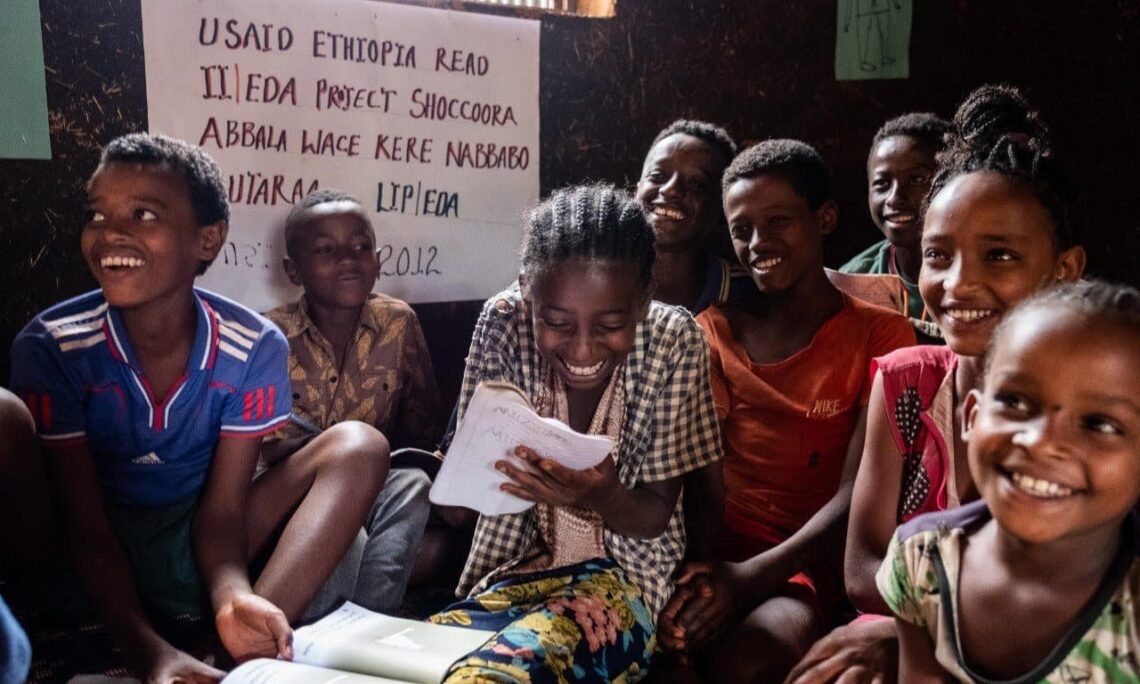
Image source. In my second church outside Our Nation’s Capital, we had members who moved to Addis to serve USAID in Ethiopia. From the U.S. AID webpage: “For 120 years, the United States and Ethiopia have partnered in health and education, agriculture and food security, science and the environment, and many other areas to improve the lives of all Ethiopians.” To cut humanitarian aid to those in need is the opposite of the Gospel of Jesus.
I am obsessed with this article by Ross Douthat. It’s part of his new book Believe: Why Everyone Should Be Religious. Douthat is a Christian with whom I have disagreed often. But he’s on to something in this hot mess of a world – becoming hotter and messier by the day – and it resonates.
A 2024 Pew study suggests that “the rise of the nones” – those with no religious affiliation – has leveled off. We now have a secularized cohort of human beings “for whom the religious quest can feel a bit like entering a store where every faith has its wares on display.” (Douthat) If a person with little to no experience in organized religion seeks some spiritual anchor in these days, where do they begin?
I am informed by a couple personal insights/observations:
What many secular people “know” about Christianity preached by ubiquitous leaders conflating nationalism with The Word of God is erroneous and often the opposite of the message conveyed by Holy Scripture. Many who purport to be Christian are Biblically illiterate, unable to identify the Ten Commandments much less The Sermon on the Mount.
In light of what feels like a constant barrage of disasters, we usually cling to the simplest (but incomplete) convictions. It’s easier but it’s also lazier. In an article about the tragic loss of figure skater Cory Haynos in the recent American Airlines crash into the Potomac, it’s noted that he cited John 3:36 on his Instagram profile. Yes, the Gospel of John says that “Whoever believes in the Son has eternal life; whoever disobeys the Son will not see life, but must endure God’s wrath.” And the Gospel of John also says “I have other sheep that do not belong to this fold. I must bring them also, and they will listen to my voice. So there will be one flock, one shepherd.” I’m fine with God figuring this out.
In my and HH’s own family, we have two who were raised Muslim and no longer practice but maintain some cultural rituals, one raised Hindu who practices her faith while incorporating monotheistic practices, two raised Protestant who no longer practice their faith regularly, and three PKs who can recite the Aaronic blessing and countless hymn lyrics and Bible stories. Each of them in their own way are spiritual seekers and/or believers trying to sort things out in these anxious days. We have been told that our current grandchildren “will choose their own religion” which will be difficult with nothing and everything to choose from. Again, when one’s upbringing has been wholly secular: “the religious quest can feel a bit like entering a store where every faith has its wares on display.”
And so what is the role for those of us in organized religion? First of all, we are usually not all that organized. Secondly, we are obligated to be lifelong learners in a world where most Christians have a sadly low level of Biblical/theological/historical literacy. We Christians would benefit from learning about other world religions, preferably from adherents. We will teach about our faith more from our actions than our words. We need to be confident enough and brave enough to refute false doctrines.
Example:
Church Person Who’s Been Taught that Homosexuality is a Sin: The Bible clearly says that homosexuality is an abomination. Look at Leviticus 20:13.
Pastor Who Can Read Ancient Hebrew or Parishioner Who Attends Bible Study Lead by Someone Who Can Read Ancient Hebrew: So, if you look at that verse in Hebrew there are two different words for “man” – ‘ish and zakar. This passage is not about two men together; it’s about one free man and one enslaved man. In other words, don’t assault your slave.
CPWBTTHAS: Well, that can’t be right. I’m just going to keep on believing what I believe.
PWCRAHOPWABSLBSWCRAH: Well you can look it up hereif you really want to wrestle with the Bible seriously.
The bottom line is that faith is complicated and the world is complicated and it takes effort to grapple with the things of faith and life. (Where have I heard that before?) We in historic religious traditions have an amazing opportunity to exemplify the faith that gives us hope and peace. Sometimes things feel hopeless and tumultuous. But I for one believe in a God who has shown us a better way in Jesus Christ.
Like many of you, I’m discerning how to pray for people who are hurting other people I love.
I spend too much time trying to figure out our current President and I’ve wondered this: Has he ever experienced unconditional love? It helps me try to make sense out of what I consider to be cruel words and actions. I wonder if he’s ever been in relationship with anyone who doesn’t “love him” for his money or his power. This is my prayer for the 47th President – that his heart would be melted by unconditional love from someone. Anyone. Maybe he needs a sweet dog, although I’m not sure it would help.
We can count ourselves utterly blessed if even one person in this world loves us without qualifiers or requirements. If there is more than one, we are drenched in cosmic favor. If we’ve been unconditionally loved by an animal – that counts.
Years ago, the Call to Worship on a random Sunday in my church was from Psalm 36:
Your righteousness is like the mighty mountains, your judgements are like the great deep; you save humans and animals alike, O Lord.
Unbeknownst to me, there was a guest sitting in the pews that day who was so bereft that morning that she decided to find a church. Her dog had died the day before. Her best friend for 14 years. Her family.
She sat among strangers feeling overcome with grief when she heard the liturgist recite Psalm 36. Her ears perked up when she heard these words: “You save humans and animals alike, O Lord.“ It felt like they were chosen especially for her. Maybe they were.
I know all this because she approached me after worship and told me about her dog and the comfort she received from that Call to Worship. Simple words remembering that it’s God who first loves us unconditionally even – and especially – in times of grief.
This morning we learned that the dog we’ve loved for over ten years whom we found on August 2, 2014 on a highway in Onslow County, N.C. had a fast-growing tumor which was causing the pain that had incapacitated him over the weekend. We said good-bye later this afternoon.
His name was Spense, so named because he was very expensive for a free dog. After taking him to a shelter near where we found him with no identification, it was discovered that he had all the worms and he had not been neutered. Of course we adopted him, signed off on surgery and bought the meds. And it wasn’t cheap.
But it was so worth it. We loved him so much but – honestly – he loved us even more. Unconditionally. Sometimes I admit that I couldn’t rub his stomach for a minute longer. I dreaded early morning walks in sub-freezing weather. He had a delicate stomach that required special attention. Still we loved him.
But Spense loved us more. Even this past weekend when he was in terrible discomfort, he wagged his tail when he saw me coming down the hall. He was always happy to see us.
Everybody deserves unconditional love . I wish this for everyone. And I thank God for all those who love me and have loved me, including sweet Spense.
Image of Spense Edmiston Lyon, Kid of Kids, Hound of Hounds (~2013-2025)









 A Church for Starving Artists