Author Archives: jledmiston

If Your Church Has a Preschool

Please never utter these words again in church: We hope our preschool will bring in young families.  

No.  That’s not why your church has a preschool, if you are hoping to be a thriving 21st Century congregation.  Don’t say it.  Don’t think it.

Here are the reasons to have a church preschool:

  1. To serve families in your community.
  2. To form authentic relationships with God’s children – the little ones and their parents alike.
  3. To share the love of Jesus either overtly (i.e. your preschool is church-related and you have weekly chapel services with Bible stories) or with actions that show what Jesus’ love looks like.

Also, please do not say you hope to call a new pastor who can bring in young families.  No.  You are setting up your new pastor for failure.

We in the church can and will change lives by offering non-transactional relationships with our preschool children and their parents.  Here are some ideas shared with me by various people who know how to create community:

  • At the beginning of the preschool year (like now) ask church members to take the name of one of your church’s preschool kids. (You’ll need a list of the students’ names.)  When you get a name, you also get a cute handmade bracelet with that child’s name on it in beads.  You wear that bracelet with “your preschooler’s” name on it all year long and your job is to pray for that child.  (Note: It is not your job to be a creepy stalker who gives gifts, cards, or invitations to the zoo.)  Your only job is to pray for young Olivia, Harper, Ethan, Kennedy, or Jude.
  • Early in the preschool year, the church holds an informal welcome for parents/babysitters who drop off the children.  Church people say things like, “Welcome to our preschool” and “We’re happy you’re here.” Give them coffee and tea or a water bottle. Things you don’t say:  “There’s a new member class this Sunday.” “Here is how you can make a donation to our church.” Please no.
  • During the first conference between preschool staff and parents OR in a note about how things are going, let the parents know that each child has a church person who is praying for them.  If ever there is a special prayer request (e.g. Jude has a broken arm and Jude’s parents would appreciate prayers for healing) they can let the teacher or preschool director know. If there is a holiday program, invite the church – and especially those with bracelets – to come and host a reception afterwards.  This would be a great time for church members with bracelets to seek out “their preschooler” and tell them/their parents “I have been praying that you are having a good year in school.”  Show them the bracelet.  If somebody is praying for my children, I will feel connected to them.  They care about my children. Also:  remember the parents’ names and greet them by name if you see them around.
  • Offer a Parent Get-Together every whenever (Wednesday evenings – with free childcare, Monday mornings, whenever.)  This is about the Pastor or Educator offering conversation groups for parents on topics like: Talking With Kids About Death, Talking With Kids About Monsters, Talking With Kids About Being Sad, Talking With Kids About Moving, Talking With Kids About Bullies.  Invite parents and their friends for a low key conversation and at the end of the no-longer-than-one-hour gathering, invite one parent to share about their kids briefly.  Something like this:  “My kids are Jordan and Ava.  They are two and six.  Jordan loves school but has some attention deficit issues.  Ava worries about a class bully.”  And then – this is the only church-y thing that happens – the pastor/educator prays for those children by name.  Here’s what happens:  Other parents with kids who have ADD or bully problems know they are not alone and they might even self-identify to the parents of Jordan and Ava.  Other parents might remember to pray for Jordan and Ava through the week or next week they might ask how things are going with the bully.  Connections are made.  Maybe parents get ice cream later with the kids.  This is how relationships and community are created.

Again, these are just a few ideas but the point is RELATIONSHIPS.  Bonus recommendation from widely respected youth and families rock star MTB here.

A great preschool offers safe play and learning.  An extraordinary preschool offers deep relationships and the church has a role in this, if the church truly wants to show those children and families what God’s love looks like.

It doesn’t look like proselytizing.  It doesn’t look like a church membership program.

It looks like relational ministry.

 

Rethinking the Word “Plantation”

This is a post for white people.

As a pastor in Northern Virginia, I occasionally officiated at weddings held on former plantations.  The homes were gracious and white-columned.  The gardens were lush and well-manicured.  These venues were popular for summer nuptials and throughout the South, you can still find former plantations to rent for your special event.

This is a little bit like getting married at a Nazi labor camp if you think about it.  While the officers might have lived in handsome residences, the prisoners worked under inhumane conditions and lived in overcrowded barracks.  Many prisoners died there.

If you tour large former plantations in the Southeast United States, you might have a hard time finding the slave quarters or any shackles or chains.  You certainly won’t hear about the enslaved people who died there.

Although many of us learned in U.S. History classes that all slaveholders were beneficent and all enslaved people were treated well, the truth is more difficult.  Many former plantations have erased all traces of slavery – although one important exception is the Whitney Plantation in Wallace, Louisiana.  The Whitney is one of the rare plantations focusing exclusively on the history of the enslaved people who lived there.  In additional to the original slave quarters, you can see the chains and shackles used to control those who labored without compensation and a reproduction of the slave jail for those who had misbehaved or were being transported to and from the property.

Imagine getting married at such a place.

And yet today, throughout the Southeast and beyond, there are retirement communities, golf resorts and neighborhoods with the word “plantation” in their names.  Too many Americans still consider a plantation to be the perfect wedding venue.  And this is because most of us never learned the true history of slavery in the United States.  It has been varnished or erased.

Too few of us realize that the enslaved people working on plantations were considered less than human.  Plantations were places from where enslaved people tried to escape.

From “plantation shutters” to “plantation resorts” we need to remember what happened on actual plantations for two hundred years in this country.  It’s not a sunny word.

I look forward to the day when the only place we see that word is on historical markers and those markers tell the truth about all who lived there.

Image of slave shackles in the museum at The Whitney Plantation. 

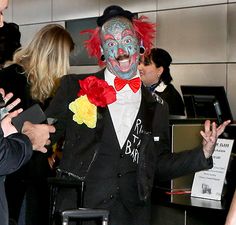
Clown on the Plane

While leaving town Friday, my traveling companion and I were so ready for a weekend in New England with friends. Believe me when I tell you that we were craving a break with everything in us.

We got to the airport and – at the gate – there was a clown.  A clown traveler.

He juggled.  He whipped out some scarves.  He wore a red nose.  He tried to engage other passengers who wanted to be left alone.

He was on our flight and traveled in First Class – so we can assume that the clowning business is disturbingly lucrative.

After a life-giving weekend involving  a birthday, a baby, and a boat, the clown was back at our gate for the return trip.  This time he was wearing bunny ears controlled by suspenders.

So, clowns:

  • They are creepy.
  • They enter our personal space whether we want to be engaged or not.
  • They sometimes turn up unexpectedly in non-circus tent locations.
  • They are often cranky rather than jovial.

Most clowns do not wear face paint and plastic noses so they are harder to identify.  But they can be found in every aspect of life and professionalism requires that we deal with clowns respectfully but firmly. Some of them are our co-workers.  Some of them are our customers.  Some people date them.

They make most human beings uncomfortable.  Many children are savvy enough to cry in their presence.  But adults cannot cry as freely in the presence of a clown.

We must simply appreciate their tricks without falling for those tricks. (There’s not really a coin behind your ear.)  We must be kind to the clowns in our lives without allowing them to play games with us.

As we begin a new season, let’s beware that we will encounter clowns from time to time.  Remember, they are just people pretending to be someone else.

Image of Rick the Barber, whose face is tattooed to look like clown makeup.  Sometimes he shows up in airports to pull pranks. The clown AA and I saw  traveling from CLT to HPN  looked more like a regular Joe. No face tattoos.

In Praise of Good Hair Days

Maybe because it’s a holiday weekend and I’m giddily headed to a birthday party in New England, but it feels like time to focus on lighter topics. Like hair.

(A lighter topic but nevertheless an essential one.)

Hair is everything.  We wish it wasn’t so we can actually think about something else occasionally but it is.  It’s the difference between a good day and a bad day.  Some think it’s a symbol of power, that it’s a symbol of fertility.  Some people are exploited for it.  And it pays your  (@%&#) bills . . . Anthony.

I love this speech about hair in Season 2 of Fleabag.  I’ve had my share of Mamie Eisenhower haircuts and cheetah-esque highlight jobs.  And it’s true: bad hair can ruin your day.

Show me a confident person and I’ll show you a person with good hair.  It doesn’t matter about the texture or the length or the color.  Short or long.  Braided or spiky. Good hair inspires courage and assurance.

Hair signifies life transitions: Breakup Hair. Wedding Hair. Post-Baby Hair. Protest Hair.  Like Fleabag says, “It’s a symbol of power.”

Frankly, I find bald men and women very attractive, so good hair doesn’t necessarily require lots of it.

I share these things in hopes that your hair (or your head) feels the last of the summer breezes this weekend.  The world is drenched in anxiety and sometimes we need to take a deep breath and run our fingers through our hair (or over our lovely bald heads) and relish the end of August.  Have a lovely weekend.

Image of Phoebe Waller-Bridge as Fleabag on Amazon Prime.

Happy Staff/Unhappy Staff

The Happy Staff of NEXT Church in Washington, DC

A Happy Staff = A Happy Organization.

There have been times when I have dreaded going into the office because of staff tensions.  And I’m talking about The Church Office.

If your place of employment is at a toxic waste facility or a kill shelter, I can understand why you would dread going into the office. But some assume that a Church Office always feels  like Thomas Merton’s Prayer Garden every day.  Calm. Relaxing. Holy.

I have a close friend who works for a nationally recognized non-profit that the outside world holds up as Effective and Creative.  But behind the scenes, they are a hot mess.  Leadership is weak.  Gossip is the prevailing culture.  And saddest of all (my friend tearfully shared) is that one young staff member in another division died suddenly last week and, upon asking his immediate co-workers about him, it became clear that nobody knew him.  They had all worked side by side in that office eight hours a day, five days a week for four years and no one knew if their colleague had a partner, a pet or a favorite ice cream. Did he live alone?  Did he have hobbies?  Nobody knew.

This single reality has made my friend know for sure that she needs to get out of there.  No one values community.  No one holds each other accountable.  No one challenges bad behavior.

A healthy staff is different.

I saw the above photo of the NEXT Church staff recently posted as one of their foursome was leaving for a new call and this is what I see – both in this photo and from my experiences with that organization:

  • They like each other.  They respect each other’s gifts and contributions
  • They each have gifts that add to the effectiveness of the organization.  If you pulled any one of these leaders from the staff, it would be a loss but the organization would (and will) continue to thrive.
  • They are not afraid to try new things, hold each other accountable, or continue to learn.
  • They are all curious about the world and each other.

If a church staff is happy/effective/mutually respectful, then the congregation will be too.  Every church needs and deserves a great staff because God Deserves Our Very Best. (This also goes for volunteer staffers but that’s for another post.)

[Note: there are so many small churches out there without any staff, so consider yourselves fortunate if you have colleagues down the hall.]

Occasionally church members will share concerns about their pastors’ effectiveness and leadership skills.  And then I ask if they have shared their concerns directly with their pastors.  What I commonly hear is that they could never tell their pastors to consider making healthy changes.  “I’m just a layperson.”The pastor is our friend.

And so, are you saying that you would sacrifice your church’s future for the sake of avoiding conflict?  (That would be a big yes for many congregations.)

I see too many congregations lose energy over the decades under poor leadership.  It doesn’t have to be this way.

Is your staff happy or unhappy with what’s going on in your Church, Non-Profit Office, Mid-Council, etc.)  Happier, healthier staff members gently change the DNA of even the most dysfunctional organizations.

Image of the extraordinary staff of NEXT Church.  Thanks J, P, L, and J.

Healthy (and Unhealthy) Dinosaurs

One of my favorite church staffs call their congregation “a healthy dinosaur.”

I take that to mean that they recognize that the way they do church is somewhat dated but they are healthy enough to keep going for a while.  They might be headed towards extinction, but they can probably last several more decades and maybe even a century.

Scientists believe that about 66 million years ago a meteor with the power of a billion Hiroshima bombs hit where the Yucatan Peninsula lies today.  Hello Cancun.

Within two minutes of slamming into Earth, the asteroid, which was at least six miles wide, had gouged a crater about eighteen miles deep and lofted twenty-five trillion metric tons of debris into the atmosphere” according to this article from The New Yorker. This jolt would have killed every dinosaur on the planet except perhaps for the ones that could fly (i.e. birds.)

I’m hoping that nothing resembling an atomic bomb (or a billion of them) ever hits the Earth but if that should happen, it’s obvious that life as we know it would immediately A) vaporize, B) be covered in molten goo, C) become crushed under massive amounts of radioactive debris, D) All the above plus several other unimaginable consequences.  But it doesn’t have to be this way.

BBC Future pondered in 2017 the question: What if dinosaurs hadn’t died out?

  • What if the asteroid missed the earth?
  • What if the asteroid hit minutes earlier or later and hit the Pacific Ocean instead of what is now southeastern Mexico?

Some scientists believe that the dinosaurs would have become extinct even if there’d been no asteroid for several reasons:

  • The temperatures had become too cool.
  • Dinosaurs were generally not good at community-building. They took care of their own without much regard for other nests or neighbors.
  • Some dinosaurs ate other dinosaurs instead of plants (which was the healthier choice.)

Maybe all of our congregations are dinosaurs headed for extinctions.  Or maybe the ones able to fly above it all will evolve and live on.  But clearly something totally different is emerging, and not only is this okay; it will be a blessing because God is all about blessing us when we at least try to follow the way of Jesus.

The First Century Church looked very different from what we know today.  No pews, stained glass, or Sunday School.  The people were the Church everyday.  There were prayers every day.  There was healing every day.  There were acts of mercy every day.  There was worship every day. There were holy experiences every day by the water, on the highway, in the field, throughout the marketplace.  Every Day.

I believe that the Church will never be extinct if we follow the lead of our First Century ancestors.  But if we are cold, if we fail to connect with our neighbors and love others as we love us and ours, if we make unhealthy choices and eat our own, we will indeed be extinguished from the Earth.

If we are unhealthy dinosaurs and we’ve forgotten our Early Church roots, we will die out faster.  If we are healthy dinosaurs, we can last longer but we too will die without evolving.

We can be the ones with ancient DNA flying above the world but living in the world to share what we have.  We might be dinosaurs now, but we can emerge into new species.  And emerging doesn’t have to feel like an atomic bomb landed on top of us, unless it’s the only way God can get our attention.  (Sometimes we just won’t make the changes unless a catastrophe happens.)

Image is the cover of The Last Days of the Dinosaurs (Prehistoric Field Guides) by Matthew Rake.


Church Bullies. They Are the Worst.

There have always been church bullies.  I don’t know whether some people are simply inclined to act out in despotic ways (e.g. the bossy personality gone awry) or if circumstances (our church is falling apart!) move ordinarily collaborative humans to act out.

But Bullying Pastors and Bullying Parishioners are real.  (I won’t get into Bullying Mid-Council Leaders here but maybe you’ve met them too.)

This article by David Brubaker spells out the four participants necessary for bullies to thrive:

  • There is The Bully who humiliates and gaslights.  Like Brubaker, I appreciate this 2015 article about the characteristics of bullies by Thom Rainer.  The Rainer article would be a good discussion piece for church elders to consider asking leaders, “Do we have a bully problem in this congregation?”  This would be a brave conversation important to establishing norms and transparency.
  • There is The Victim whom The Bully targets.  The Victim could be a vulnerable person or someone who questions The Bully.
  • There is The Enabler who sides with The Bully.  Brubaker says that enablers are either “true believers” who follow the bully’s lead or “craven opportunists” who believe that backing up the bully with help them gain their own power.  Good points. But I have found that enablers simply believe life will be easier if they stand with the most powerful person in the room – even if that person is a bully.
  • There is The Bystander who’s afraid to step in and speak up.  Sometimes bystanders are simply conflict-averse.  And sometimes they are terrified that the bully’s wrath will be turned on them next.  Bystander Training is a good idea for church councils because according to this 2018 article in the HBR, trained bystanders help in “leveraging the people in the environment to set the tone for what’s acceptable and what’s not acceptable behavior.”

Imagine a staff meeting or a board meeting or even a congregational meeting in which The Bully antagonizes The Victim will The Enablers looking on while The Bystanders speak up and call The Bully on their misbehavior.  This just might stop the bullying – at least for a moment.  And squelching it over and over again day after day, week after week could change the DNA of the organization and therefore alter the system.

Yay.

Especially in church settings when we are expected to be “nice” it’s tricky to know how to act when someone is not being nice.  Nice People who witness bullying behavior don’t know what to do with it.  If we who are Nice People challenge the bully, will we lose our Niceness Status?

As I’ve personally witnessed institutional bullying through the years, what makes me saddest is noticing that many leaders (or people who are supposed to be leaders) seem indifferent to church bullying.  They don’t seem to care enough to be willing to change the system.

“It’s just the way things are around here.”  “That’s just the way she is.”  “He’s always been like that.”  

I don’t accept this as a church leader.

A thriving organization and especially a thriving church organization depends upon participants who hold each other accountable out of love for God and each other.  It’s deadly to have bullies in church systems. I’ve observed it more often than I’d like to admit.

Image source.

People Who Know Things That The Rest of Us Never Want to Know

I was reading my Twitter feed last night and saw that a young mom in Colorado had died in a car accident.  Her children start first and third grade this week and her husband is a pastor.

After writing last week’s post about remembering the holy days of loss, several of you let me know your own special dates.  Today is the death anniversary for a friend’s sister.  My friend’s not old enough to have lost a sister but she did and that’s horrible.

There’s the writer whose husband died in a freak accident at the beach.  There’s the Nobel Prize-winning hero who survived capture and torture by ISIS. There are countless survivors of school shootings and other life-changing traumas.

These are the special ones.  They know something about life that most people don’t know and don’t want to know.

If they get through the worst horror of their loss and reach the place when they can put their shoes on again, they become The Ones Who Know.  They are no longer burdened by routine issues like not finding a good parking space or losing a favorite pen.  They don’t really care when they burn dinner because their hearts have been seared and they survived.

Survival means that we lived.  We lived to tell about it and work towards it never happening again – and the “it” is everything from the cancer to the stupid comments made to help us feel better.  Survival means that we understand the shallow concerns of those who haven’t been there.  It’s okay.  We love them.  They are innocents to trauma.

Today my heart holds those in the beginning stages of deep grief.  It’s horrible.  But they will find – eventually, if they make it – that they will become The Ones Who Know.  And they will become unspeakably wise.

Pastoral Care By the Numbers

I have a lot of friends whose mothers have died of breast cancer.  In my last parish there were about 10 of us.

One of them dropped by my study on a random morning and told me that I looked sad.  “I feel sad,” I said, “And I don’t know why.”

Is this a mom day?” she asked me.  (In other words: “Did anything happen on this date regarding your mother?)  And – actually – it was my mother’s death day.  Mentally I had forgotten but emotionally my body hadn’t.

I don’t love numbers unless they have something to do with relationships.  It helps me to remember certain numbers:

  • I was 32 years and 187 days old on the day my mom died.
  • I was 55 years and 19 days on the day I outlived my mother.
  • In a year and 25 days, I will have spent more time on this earth without my mother than I spent with my mother.*

As a parish pastor, I used to keep a calendar of special relational days for our members:

  • Death Anniversaries
  • Birthdays and Wedding Anniversaries for widows
  • Birthdays for those who lost children or parents

I don’t have the capacity to do this for everybody now, but I remember a few.  [Pro Tip for pastors and other compassionate people: contact people on their special days just to check in.  You won’t be reminding them of anything they aren’t already remembering on some level.  All you have to say is, “I’m thinking of you today.”]

When I was a pastor for a single congregation, I used to write newlyweds a note on their first wedding anniversary to check in.  “Thinking of you today. How’s it going?”  [Pro Tip:  this is why we do premarital counseling.  If we have established a relationship with a couple, then they have someone to talk with after the wedding if they need support. This first anniversary note often sparked a phone call to chat about marriage things.]

I remember when HH and I were figuring out what date to get married, I looked at all those summer Saturdays on the calendar and realized that – once we picked our wedding date – that date would never be an ordinary day again.

I remember when I looked over the calendar as a pregnant lady, checking out the day of the week my due date fell upon that I remembered that – no matter what happened on the day my baby was born – it would be a special date forever.

The numbers and dates are important relational tools.  And today, I’m feeling a little sad.  And I know why.

*Yes, I see a therapist.

What Do You See?

I recently drove around with a colleague who is a young pastor – just over a year out of seminary and as we drove around his church’s neighborhood, it was clear that he saw things.  And then he responded.  And then there was obvious impact.

  • He noticed a couple who owns the independent coffee shop and he introduced himself and now he has a relationship with them as local business owners.
  • He noticed the school down the street and he met the principal and now he volunteers there and he has a relationship with teachers, staff, and parents.  And probably some kids.
  • He noticed the new real estate developments, the For Sale signs, the road construction, the other church buildings, the homes literally on the other side of the tracks.  And then . . .

You get the idea.

The future of the Church is in leaders who see things. 

They see who is in the room and who is not in the room.  They notice who speaks up and who doesn’t.  They notice the signs – both the physical signs and the figurative ones.

Look at the photo above.  What do you see?  (What you see tells me a lot about what kind of leader you are.)

We need more pastors who know how to read the room, how to exegete the community, how to notice who’s not there.  My colleague who is the newish pastor totally gets this.  As he was driving me around, I asked him, “Who taught you how to do this?” and he said, “Hmm.  I think I’ve always known.”

We also need leaders with this kind of emotional intelligence.  And emotional intelligence – like reading a room and exegeting a community – can be taught.  Please reach out to someone if you need to learn this.  It will make your ministry so much more fun and life-changing.

Unknown image source.