Author Archives: jledmiston

“I love what I see when I look at you.”

This is a line – written by Aaron Sorkin – spoken by the character Calpurnia to young Scout Finch in To Kill a Mockingbird.  HH and I got to see the play last week in NYC and I remember thinking – when I heard that line – that everybody should hear those words as least once in our lives.

I love what I see when I look at my children.

I love what I see when I look at the U.S. Women’s Soccer Team.

I love what I see when I look at our faithful church leaders.

I love what I see when I look at you.

This line falls in juxtaposition to the line from Ava Duvernay’s title When They See Us.   When the world saw Kevin Richardson, Antron McCray, Yusef Salaam, Korey Wise, and Raymond Santana we saw rapists.  Some wanted us to see rapists when we saw those young men.  In fact, I believe that some love it when we look at certain people with fear or contempt or disgust.

This is not who God created us to be.

I believe that God loves us when God looks at us.  The truth is that we are ridiculous.  We are selfish.  We are cruel.  We are unlovable.  But God still loves us.  This is not to say that God doesn’t require us to be better humans.

How do we feel when we look at immigrants, refugees, brown people, black people, golden people, white people, elderly people, queer people, people wearing MAGA hats?  Do we generally feel afraid?  Safe?  Disgusted? Judge-y?

I do not love what I see when I look at some of our political leaders or people in detention centers or people who litter or church leaders who refuse to serve those outside their comfort zones.  I love the people (only because I try to see them through the eyes of Jesus) but I don’t love the behavior or the situation or the choices made.

Is this akin to loving the sinner while hating the sin?  Actually, it’s more than that.

When we look at each other what do we feel?  It’s a question that helps me check myself.  If I feel afraid, is that my racism creeping up?  If I feel disgusted, is that my white smugness showing it’s face?  If I feel deep love, is that Jesus in me?

I was in Our Nation’s Capital last week for the Fourth of July and I felt things. There Were Feelings.

There Were Feelings when I watched so many people wearing MAGA hats in that city I love.  There Were Feelings when I saw tourists on the Metro look at sleeping people on the Metro with disdain.

I’m wondering about this.  How do we feel when we look at each other?  Not what do we think.  Not what do we see.  But what do we feel?

I wonder if feeling love when we look at each other might be a spiritual discipline to try.  Can I feel compassion and love for someone even when I don’t understand them or I disagree with them or I fear them?

Monday Challenge #1: Try saying these words to someone and mean it.  I love what I see when I look at you.

Monday Challenge #2: Try to be the people God created us to be.

Also the play was very good.

Image of Celia Keenan-Bolger and LaTanya Richardson Jackson in the play To Kill a Mockingbird at the Shubert Theatre in NYC.  They play Scout and Calpurnia, respectively.

We are Great (and We Can Be Better)

After a few days of vacation in NYC and DC, I was chomping at the bit to write about The Fourth of July.  I love this holiday and it’s especially wonderful to celebrate in those cities.

I love our country.  And we can do better. (The US Women’s National Team cannot do any better, but the rest of us can.)

Someone asked me once why I hated the Church so much (because I was always pointing to what needs to change.)  Loving someone or something, and wanting things to be better are not mutually exclusive.

This week my posts will be about being better than we’ve been. Maybe all my posts are about this, but our constant efforts as American citizens must be that we strive for liberty and justice for all.  And as The Church of Jesus Christ we must strive to be faithful disciples.

Go USA!

Vacation Week

It’s Vacation Week for me and my HH.  No posting while we relax.

Have a wonderful week everyone and I’ll be back July 8th.

Rainbow Church

If you “don’t see color” in terms of skin tones you can stop reading here.

This is a post for people who see all the colors, who embrace the rainbow, who find joy in messy configurations of humans.

One of the truths about the Future Church is that it will be as diverse as its community – or it will die.  My own young adult children are constantly looking for community that looks like the world in which they live. That world is not predominantly white.

Maybe you live in an all white or all black or all brown or all golden area.  Or maybe you live in a very diverse area in terms of cultures but you only associate with people who look like you.  It’s an essential spiritual discipline that we branch out a little for the sake of the Gospel.

UPI reported in April that the United States will become a majority-minority country sometime around 2044.  If you are part of a congregation who embraces this reality but you wonder how you can adapt to these demographic changes, here are some questions to talk about with your people:

  • Does your church leadership look like the congregation you hope to be in the coming years?  (The only racial diversity I see in many of our white congregations is found behind the scenes doing building maintenance or childcare.)
  • Do you invite diverse preachers to your pulpit when the regular pastor is on vacation? (Different voices with different life experiences enhance the spiritual lives of our congregation.)
  • How comfortable would your congregation be if you called a pastor of another race? (Especially if your congregation doesn’t look like the neighborhood around it, it makes to sense to call a pastor who looks like/sounds like the community. Or – if you hope to broaden your staff’s – and your congregation’s – perspective, it makes sense to call a pastor who stretches you theologically and demographically.)

These are serious questions to discuss with God’s people in your midst.  Systemic racism (and white supremacy) are in our DNA and it will take very intentional and uncomfortable conversations to move forward.

The rainbow is our future – and in many of our communities the rainbow is our present.  This is cause for rejoicing in that this is the world God created.  This is what the reign of God looks like.

Rainbows also represent LGBTQA+ Pride, and I pray we are also welcoming of those rainbows as well.

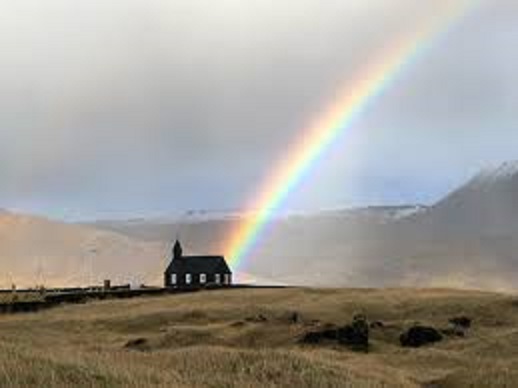
Image of a rainbow over a church building in Búðakirkja, Iceland.

Thursdays in Black

I’m pretty sure that Donald Trump is not E. Jean Carroll’s type either.

Only the least educated among us doesn’t yet know that rape is not about sex.  It’s about power.  Rape is a weapon.

It happened in the Bible and it happens today in cars and hotel rooms and refugee camps and alleys and dorm rooms and department store dressing rooms.  75.2% of all rapes are perpetrated by someone the victim knows.

So keep this in mind: most assaults are not the classic movie versions of rape where a stranger with a knife is hiding under your bed or in your closet.

We who have daughters who go to parties have taught them never to drink from a cup they haven’t poured themselves or from a cup they left sitting on a counter while they turned their backs. 6% of all rapes are perpetrated by more than one person that the victim cannot remember.

And what strikes me as especially ironic is the fact that the person accused by E. Jean Carroll of an assault in the 1990s (and she wasn’t the only one)  famously accused the Exonerated Five of assaulting a stranger in Central Park in 1989.  He called for the death penalty for those boys who had nothing to do with that attack.  But in the meantime he was – allegedly – assaulting acquaintances and perhaps even his spouse.

I like wearing black anyway, but when I wear black on Thursdays, I’m remembering my siblings who have been assaulted and know that many people will never believe us.  Say a little prayer today for women.  Most of the women you know have been assaulted in some minor or huge way.

The World Council of Churches invite us to wear black on Thursdays to be in solidarity with those who have been victims of sexual assault.  

If Bleak Was a Color

Dear graduates, you all come from the Middle East, from Syria, born and raised, but also from Lebanon, where you have lived and studied. Well, neither Syria nor Lebanon figure anywhere among the best countries of the world, nor among the best to raise your children in, nor among the safest countries to live in. It is very likely that they rank somewhere near the very end of such listings.  Dr. Nadim Nassar, Speaker of the 87th Commencement of the Near East School of Theology, Beirut  June 15, 2019

The color of hope is bright.  It’s fresh and cheerful and lighthearted.  I’m currently reading Embracing Hopelessness by Miguel de la Torre (which I strongly recommend) and there are no bright colors.  Dr. de la Torre writes:

Hope, as a middle-class privilege, soothes the conscience of those complicit with oppressive structures, lulling them to do nothing except look forward to a salvific future where every wrong will be righted and every tear wiped away, while numbing themselves to the pain of those oppressed, lest that pain motivate them to take radical action.  Hope is possible when privilege allows for a future.

We who hope have physical evidence that bad days will become good days very shortly, that wounds will be healed in good time, that even though we are crashing, there is a safety net that will embrace us and make us safe again.

Millions of people in the world do not have this.  Their bad days continue to be quite bad.  Their wounds fester and become life threatening.  They crash and then crash again and then crash again – because there is no safety net.

According to Dr. Nassar’s commencement address:

In 2018, last year, and for the second year in a row, Switzerland ranked as the world’s best country, followed by Canada, Sweden, Germany, United Kingdom, Japan, Sweden, Australia, United States, France, Netherlands. Nowhere on the list can any country from the Middle East be found; actually, there is no ranking for them.  There is also such a thing as a research analysis report on the best country to raise children in: Denmark ranks first here, then Sweden, Norway, Finland, Canada… Again, no Middle Eastern country is anywhere in
sight.

As for me, I am 1) enormously privileged and 2) not without hope – especially when I see this photograph of the 2019 graduates of NESSL (and look at all those women) who are hoping against hope that they will be called to serve as pastors of Christian churches in Syria and Lebanon, two extraordinary countries in spite of being crushed for decades.  “Syrian refugee” has become an everyday term for many of our congregations.  But here we see people of hope who believe there is a future for the Church of Jesus in these war ravaged nations.

We who hope cannot forget those who dwell in hopelessness.  In fact, if we choose to put them out of our minds and ourselves dwell in the most selfish kind of hope (i.e. If my people and I are okay, then all is well.) then we might as well admit that we are not Christian.  We are not followers of Jesus.  We are not “good people.”  We are simple people who reinforce oppression and injustice.

So much for a perky Wednesday post.  But bleak is a color too.

Images of the Pantone color Opaque Couche which has been voted one of the ugliest colors ever created and of the 2019 graduating class of the Near East School of Theology in Beirut.

It’s Actually Easy-ish Being Green

There is no official recycling in the building where our Presbytery Office works. And so three of us cheerfully schlep clear recycling bags full of paper and soda cans home to recycle from there on a regular basis.

The issue is that our address doesn’t include regular recycling pick-up and/or it’s available but nobody wants to pay for it.  Not sure.

Congregations are known for eating and drinking and – more time than not – I sip coffee in styrofoam cups while standing in church social halls picturing this in my mind. Styrofoam is not only not biodegradable, but it breaks into little bits and is really hard to clean up.  (Once a refridgerator box full of styrofoam popcorn used for packing blew open before the sanitation crew could pick it on my street and – believe me – it was a huge mess trying to pick up countless beads of Polystyrene blowing in windy Chicagoland.)  Single use plastics – whether they are clamshell containers or plastic straws are a problem for the environment and have been for a long, long time.  Surely we could find lots of real mugs and wash them for the love of God – literally.

Since environmental issues are only going to become more prevalent, congregations need to be on the forefront of being green.  Most denominations will help your church become more responsible: Presbyterians.  Roman Catholics. United Methodists. Lutherans. United Church of Christian. Reformed Church in America, Episcopalians, Unitarians, and free range Christians all have resources.

If we have any interest in serving the needs and interests of our youngest generations, this is one way we can make a statement that we are concerned about their future.  Or we can continue to use styrofoam cups (and toxic fertilizers and environmentally damaging building materials and more fossil fuels than we need.)

And this isn’t about getting popular with the young people.  This is about listening to the Creator.

Note: This would be a helpful and holy summer project for someone to take on in your congregation.  It starts with recycling bins.

I Don’t Look Good in Yellow

I once wore a very pale yellow bridesmaid dress in a spring wedding and it was not a good look for me.  In fact, I was fairly invisible walking down the aisle because the paleness of my dress emphasized the paleness of my skin.  Yellow is not my color.

Someone named Becky G. researched why yellow is considered the color of cowardice here and – whatever the deeper meaning of the color yellow might be  I prefer bold colors.  Give me hot pinks and blues and greens.  They bring out my eyes.

I would like to think of myself as a bold person, but I confess before you and God that I’ve often been more afraid of my parishioners than God.  I am a coward on most days.  (I seriously remember where boldness got Jesus.)

Many of our pastors are only bold when we know our congregations already believe what we are proclaiming from the pulpit.  Some say that it’s best to “preach purple” when we know that our pews are filled with a variety of political persuasions.  The Bible is an equal opportunity offender and there’s already something to offend everybody in Scripture.  But I find that preaching purple rarely pushes God’s people to be bold in faith.  God is calling disciples – and not just professional preachers – to speak up.

What does Scripture tell us about how to treat “the least of these” whether they are children at the southern border of the United States or homeless veterans living under a bridge or elderly people living in isolation in rural America.

But we don’t wish to offend.  We especially don’t wish to offend the people who pay our salaries.  We don’t want to offend co-workers or family members or even those who live under the same roof with us.

The world is not okay and I’m challenging myself – and you – to be bold at least one time this week in the way we speak and in the way we live.

  • There are children living in terrible conditions at the southern border of our country.  This is not fake news.
  • There are millions of people who are not benefiting from the same economy that’s making wealthy people wealthier.
  • There is mind-boggling opioid abuse in small towns in my state and in yours.
  • There is universal bad behavior in the form of verbal bullying and words that break apart rather than build up.

If it helps to consider being bold because it’s patriotic so be it.  It’s patriotic to lift up the Declaration of Independence which says:  we hold these truths to be self-evident: that all (people) are created equal. It’s patriotic to work for an economy to benefit all Americans, for example.

But – beyond patriotism and politics – for those of us who claim to follow Jesus, it’s faithful to lift up Scripture which tells us that all human beings are created in the image of God. It faithful to work for an economy to benefit all God’s children, for example.

Are we willing to be bold out there and speak up when our leaders, our congregations, and our country are being cowardly?  If yellow is the color of caution and timidity, none of us look good in that color – at least in the reign of God.

Image source.

To Those Seeking New Church Calls

This post is only of interest to a small slice of the population: professional ministers seeking new calls in denominations where they and the congregations they are seeking have some choice in the matter.

Now that I have the attention of 20 of you, I have urgent information.  Part of my role in my own current call is to read through Personal Information Forms (we call them PIFs in the Presbyterian Church USA) but they could also be called Search Forms, Resumes, etc.  For the purpose of this post, I’ll just call them PIFs.

I read lots of them.  I read PIFs for churches seeking new leadership. I read PIFs from seminarians getting ready to seek their first call.  I read PIFs from seasoned pastors seeking their second, third, fourth, or tenth call.  Here is what I’ve found:

  • It’s essential that you have someone proofread for spelling and grammatical mistakes.  Please.  You are saying things you don’t want to say about yourself if your documents are full of misspellings and unnecessary apostrophes.
  • Don’t be generic.  You be you.  Almost every pastor seeking a call will write essays lifting up their love for preaching/teaching/pastoral care/administration/mission.  Imagine Nominating Committees receiving piles of essays all saying essentially the same thing.  I’ve grown in my preaching.  I’m told I’m a good Bible teacher.  I have a heart for pastoral care.  I find administration so satisfying.  I’m excited by mission.  What about you is unique and even quirky?  Have you found community with a group of men who live under a bridge downtown?  Have you ever worked with trafficked women?  Do you have a particular compassion for men being released from prison?  Playing with refugee children?  Preaching in a mental hospital? Volunteering in an art class?
  • Don’t seek a generic church.  Know what you are looking for and seek out that church.  Is it a congregation that shows up?  Do they love their church staff?  Do they use their building as a tool for community ministry?  Let them know what you are seeking.  Note: One of the tough situations is when you are tethered to a geographic location and you feel like you will take any position.  What’s tough is that it shows.  Churches want someone called to serve them.  They don’t want a pastor who could serve anyone who can pay them.  It makes me tired just thinking about it. Again, this is very tough because – if you are tied to a certain city/town – you have fewer choices.  I still believe in call though.  You can certainly be called to serve in the place where you currently live.  But it will be a more difficult search.
  • Don’t tell personal stories in a way that will make people feel uncomfortable.  In your essays, don’t tell the story about that time you did a wedding and the mother of the bride choked on roast beef and died during the reception and you offered exquisite pastoral care.  Nobody wants to imagine that.
  • Be open to non-parish ministry.  If you are searching and nothing is clicking,  you can certainly do ministry in a coffee shop, in a taco truck, in a classroom, in a dentist office.  Do that if you need income before The Spirit moves.  God uses everything.
  • Pray.  How is your prayer life through this search?  I always tell search committees that they need to start praying now for their new pastors because they are out there, possibly hearing God whisper in their ears that it’s time to move. And candidates need to be praying for the next people they’ll serve.  God knows how much you need this new call.  But keep talking about it with your Maker. It’s a sweet moment when you and and the people you will be serving meet each other and click.

The search for a new call or a new pastor is arduous work.  But it’s also God’s work.  It’s going to be okay.  Be open to the unexpected.

How Will We Pay for It?

[The “it” here is not about utility bills or other everyday realities of ministry.  The “it” I’m more interested in is New Ministries.]

How will we pay for New Churches? And by “Church” I’m talking about any gathering of God’s people who may or may not know they are God’s people.  I’m not talking about the traditional congregations – of any size – who want a spiritual leader to do all/most of the things: preaching, teaching, pastoral care, administration.

I’m talking about something for the Fleabags of the world.  I imagine something like this:

A church property is re-purposed into affordable housing or a drug treatment facility or apartments for homeless veterans. Maybe they are using the old church building or maybe they’ve razed the old building and something new has been constructed.  But there is still “church space” on the property – and depending on the context/neighborhood, this is what happens there – in my dreams:

  • Sunday – Saturday – 24 Hour Prayer Room
  • Monday – Friday – excellent affordable childcare from 6 am to 9 pm
  • Monday – Friday – every 12 step group that needs space
  • Monday night – Death Cafe (Let’s talk about grieving.)
  • Tuesday night – “What Am I Doing?” Parenting Group (Let’s talk about our kids.)
  • Wednesday night – “What Does This Mean?” Bible Study
  • Thursday night – Interfaith Cafe (Let’s talk with people of different beliefs.)
  • Friday night – Storytelling/Music that Matters (Let’s share stories by theme: shame stories, failure stories, Where-God-Showed-Up-Unexpectedly stories)
  • Saturday morning – Brunch Church (Eat and talk to God and each other.  Also some listening for God.)
  • Saturday afternoon – Craft Church (making pillowcases for refugee children, knitting needle bags for people with substance abuse issues, crocheting blankets for shelter)
  • Saturday night – Pride Cafe for LGBTQ youth
  • Sunday – Church-ish

I would call the whole community Church-ish (stolen from Abby King-Kaiser) and – as you can see – no single pastor could do all these things.  The pastor’s job would be to oversee it and – in a no-financial-worries world – there would be about 3 FT pastors on this staff.

So here’s the thing:  How would we pay for it?

I have ideas for this too, but I’m just brainstorming:

  • On top of the housing/rehab/whatever space are market rate apartments/condos.
  • A big church – or several – to support it.
  • Partnerships with local businesses.
  • There is a pay-what-you-can offering at everything.
  • There’s a coffee shop/tea shop/ice cream shop with proceeds going to Church-ish.
  • The main gathering space is so beautiful, people want to get married there (so they rent it.)
  • Grants.
  • Online giving that makes everybody desperately inspired to make annual pledges.
  • Talking about money openly and in healthy ways.

Also God.  Not Magic Jesus but trust in a God who would be pleased by a gathering of misfits who believe but don’t exactly know what they believe.

So, what do you dream?  And how would you pay for it?

Image Source.