Author Archives: jledmiston

What’s Being Disrupted Exactly?

I’ve been to plenty of perfectly choreographed worship services.  Every syllable of the liturgy was flawlessly executed.  Every note sung by the choir was glorious.  Every word of the sermon was inspired.  The Spirit was present.

I’ve been to even more worship services that some would call imperfect – or even sloppy.  There was the time someone forgot to fill the baptism font. (And one of the ushers recruited a child to come forward with the family carrying a pitcher for me to use.  “I’m the water bearer,” she whispered to me. And the role of “water bearer” was born in that church.)  There was the time a deacon’s scarf caught fire on Pentecost. (And as she tore it off her neck, the pastor leaped up and stomped out the flames to great applause by the congregation.)  There was the time the five year old was reading the Psalm of the day and she couldn’t pronounce her “R”s. (And it was lovely.)  There was the time an elder who’d been recently diagnosed with frontotemporal dementia started playing with the hair of the first time visitor sitting in front of him. (And after the elder’s wife explained what was going on, the visitor smiled and said, “No worries.”) The Spirit was present at each of these moments as well.

Yesterday in Cambridge, England Dr. Paul Brandon Rimmer wrote a “letter of apology” to the Dean of King’s College regarding the “disruption” by his 9 year old son during the Evensong service on Father’s Day.  Apparently young Tristan is a non-verbal person with autism, and yet he expresses delight by making joyful noises when he is happy.  He was happy during Evensong.

An usher invited Dr. Rimmer and his family to leave because Tristan was being disruptive.  This happened in a church that welcomes all – even “the disabled” – according to their communications.

What exactly was being disrupted Sunday night?

  • Was it a performance much like a concert or a play?
  • Was it a worship service with the expectation that everything (even the joyful noise of a young worshiper who cannot speak) is for the glory of God?

[Dr. Rimmer notes that he and his family thought that Evensong was a worship service, but apparently they were mistaken.]

This unfortunate episode in the King’s College Chapel reminds us that we need to ask ourselves in every church-related activity:

Why are we doing what we are doing in church?

  • To perform?
  • To check off a list of “things churches do” whether we truly want to/need to do them or not?
  • To make the church matriarchs/patriarchs happy?
  • To compete with the church down the street?
  • To glorify God and enjoy God forever?

Just wondering.

What’s Up with Fleabag? And Other Church Conversations

It’s always dangerous to ask a Young Person to speak for their generation, but I do it anyway.  I met N at a fundraiser over the weekend.  She is 19 and just finished her first year in college.  She is clearly brilliant and I think she might be governor of North Carolina one day.  I not only liked her immediately, but I also wanted to pick her brain about many things.  (“Have you watched Fleabag?  I’m trying to find someone to talk about Fleabag’s understanding of the Meaning of Life.”)

I asked her about church.  She is not a church person (“at all“) although she is clearly a spiritually reflective person. And I asked her where she found her “church.”  Specifically, I asked her, “Who would bring you casseroles if you were recovering from surgery?”

Note: She probably doesn’t eat casseroles but it was a general question.

Everybody needs church – and what I mean by church here is this:

  1. Church is the community that gets you and wants the best for you.
  2. Church is the person or people who step up when you need a blessing, a prayer, a shoulder, an accountability partner.
  3. Church is the chosen family in which you are safe.
  4. Church is the gathering that shines light on the meaning of life.
  5. Church is the Body that points to the Holy
  6. Church is the community where you belong (see 1-4 above), then you behave (there are norms you come to follow) and then you (finally) believe. (Thank you Phyllis Tickle.  In the 20th Century Church, the order was reversed: believe, behave, belong.)

Also – when Jesus is in charge – Church is

  1. The Body of Christ in the world, changing everything so that life is ‘on earth as it is in heaven.’  This includes all that many secular organizations do too:  feed the hungry, house the homeless, love the unlovable, welcome the stranger, work for justice.

I’m blessed to be part of several churches. One of my churches meets in a local restaurant where people share openly about the meds they’re on and the relationships they are in/out of.  It’s where we show up for each other when there’s a Big Event in someone’s life.  This church is called Zada Jane’s.

Another of my churches is comprised of clergywomen who’ve been through things together.  We don’t need to explain ourselves much.  Laughing and crying are a large part of our liturgy in Ordinary Time.

Another of my churches is comprised of extended family who share faith in Jesus with a hearty dose of ancestor worship.  We are just now noticing that the ancestors are not actually worthy of praise sometimes and that’s okay because God is.

I could go on and on but I hope you see what I mean.

My college friend N says that with social media making community is so easy that she doesn’t need church.  For her and her friends, “going to church” is where you made connections – not always with God but with “the right people.”  It feels transactional.

Today, she gets a text about a fundraiser like the one we attended over the weekend.  She gets a message about a meet-up for coffee.  She sees a posting about a group gathering.  These are her people and they are diverse and plentiful.

Someone asked me last week if I’d figured out what’s next for the Church of Jesus Christ (hah) and I’m still working on it.  But Fleabag is part of that discernment because I know many people like the characters in that series.  And there are bright college students who grapple with life’s purpose and there are hopeless young adults who gather for eggs on Saturday mornings with hangovers and there are pastors who keep Narcan in their cars.  And there are the traditional Church People who still gather on Sunday mornings to sit in pews and sing and pray and hear the Word proclaimed and celebrate sacramental moments.

At least on this day, I see lots of kinds of churches that meet throughout each week and throughout each day in traditional and random places.

Some focus on belonging (“Everyone is welcomed.  We love you no matter what.“) Some focus on behaving (“This is how we live – by serving others.”) And some are believers – or people who want to believe – and they want to talk with and about Jesus.

What do you see for the 21st Century Church?

Image from Fleabag (written and played by Phoebe Waller-Bridge) with a priest (played by Andrew Scott) with whom she has a friendship.


Where – and When – Do We Read Books about Lynching?

I know where to get books about lynching: library, online, book store.  But where  – and when – do we read them?

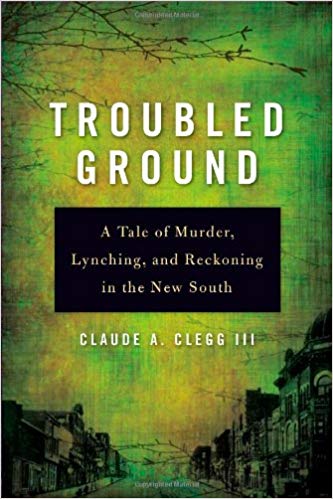
Before I go to sleep at night, I’ve been reading Troubled Ground: A Tale of Murder, Lynching, and Reckoning  by Claude A. Clegg III which is probably not the choice of Sleep Specialists.  It’s about a triple lynching in Rowan County, NC where my mother was born and my father grew up.  Between 31,000 and 37,000 people lived in Rowan County in 1906 – the year of the lynching and this account states that about 2000 witnessed the lynching of Nease Gillespie (age 55), his son John Gillespie (age 14, 15, or 16) and Jack Dillingham (in his late 20s or early 30s) for the murder of Isaac Lyerly (age 68), Augusta Barringer Lyerly (age 42), John H. Lyerly (age 8), and Alice Lyerly (age 6.)

The three black men may or may not have had anything to do with the murders.  They never confessed to the crime, even in the terrifying moments before they died, according to witnesses.  But on the night of August 5, 1906, they were arrested, removed from the Salisbury, NC jail without trial, hanged, tortured, cut, and shot in front of a crowd of about 2000 onlookers.  Many witnesses took home souvenirs of flesh.

My grandfather was 11 years Old at the time and it’s possible that he or members of his family witnessed that horror – or that he and family members visited the site of the lynching in the days to follow.  People did this.

So when do we – white people – educate ourselves about the realities of white privilege in our nation’s history by reading books about such horrors?  By the pool this summer?  Out on a patio sipping adult beverages?  Before we hit the pillow at night?

Students – I hope –  are assigned these books in class.  But what about those of us who are long past formal schooling?

There are book groups, of course.  There are lectures by the authors.  But my greatest hope is that we also read books that make us uncomfortable in Church.  (Note:  yes we should be reading the Bible too and if the Bible doesn’t make us uncomfortable then we aren’t reading very closely.)

While lots of young and old Presbyterians from Charlotte have been touring Birmingham and Montgomery and Memphis this week, we need to make our own pilgrimages of pain to those places.  I know I’m headed to Salisbury soon to a place once called Henderson Park, about a quarter mile south of the intersection of N. Long Street and Bringle Ferry Road.

Where will you be reading books about lynching?  And where will you be traveling to learn more about a particularly evil part of our history?

Dr. Claude A. Clegg III is Lyle V. Jones Distinguished Professor in African, African American, and Diaspora Studies at the University of North Carolina at Chapel Hill.  Salisbury, NC is his hometown.

Raised by Wolves

One of my Mom Fears is that someone will think my children were raised by wolves.  Believe me when I tell you that HH and I taught each of them how to change their sheets, do a load of laundry, and clean a bath tub.  That doesn’t mean it will happen but they know how to do it.

Living in community means being a good neighbor. And I’m not even talking about “communal living” when everybody shares a kitchen and a car.  I’m talking about picking up after ourselves.  I’m talking about holding the door open for people.  I’m talking about not watching Scream at midnight at full volume when the walls are thin.  I’m talking about appreciating each other – whether that means sending Thank You Notes or Thank You Texts.

Because our nation is so divided and so cranky, sometimes it feels like each of us was raised by wolves – which is actually unfair to wolves who are reportedly excellent parents.

It’s disturbing when people are rude – much less cruel – and this is a good day to treat each other as we would like to be treated.  Every religion holds up their own version of this Golden Rule.  We were not created to be insulting or crude or abusive towards each other.  We were born to show love.

And  so – for the love of God – please don’t let your pet eliminate waste in the stairwell. (This is a real sign from one of the stairwells in my apartment building.)

Be kind out there.


Painful Realizations

Ugh.  Growth hurts.

Preteens literally feel pain in their bones during adolescence.  Hot messes (count me in) feel pain when we realize exactly how hot of a mess we are.  And institutions endure deep pain upon realizing that they can no longer thrive without without re-examining the reason they exist.

We learn so much through pain, but few of us choose the painful route.

In churches, it’s just easier . . .

  • To keep the long term administrative assistant even though she’s kind of a gossip and won’t learn Excel.
  • To keep the long term music director even though he doesn’t play well with others.
  • To keep the ineffective pastor because she’s only 8 years from retirement.
  • To keep half a million dollars in the Cemetery Fund when we need those funds for mission because we don’t want to confront the gentlemen who controls the Cemetery Fund.

And so we languish in our current state of being and there is little spark in our lives (or in our institutions.)  There is hope and light ahead – but only if we wade through some painful realizations.  I’m not going to suggest what they are, but I will say that they are usually obvious to everyone but ourselves.

Trust is required for such moments as these:

  • Do we trust the colleagues and friends who tell us the difficult news that we need to tweak (or overhaul) our lives?
  • Do we trust our spiritual leaders who tell us that the church of our childhood will never come back?
  • Do we trust that God has got this?  AND that God expects us to participate?

I have a fantasy that goes like this: I visit a congregation and they tell me all the wonderful things God is doing among them.  And then they ask me what they could do to expand their ministry and spiritual growth.  And then they actually choose to do those things – prayerfully of course.  And then their ministry and spiritual maturity is expanded!  And then they say, “That was really hard, but God was with us and it was totally worth it.”

Image of the 20th President of the United States.


Let Your Pastor Lead

Not news:

  • Many of our congregations are struggling with diminishing numbers and energy levels.
  • Many of our pastors have no idea how to lead a congregation in a 21st Century culture.
  • Many congregations say they want to call a pastor who will help them grow.

So what do we do with this situation:  A congregation takes the bold step to call a forward-thinking pastor who does know how to lead a church in 21st Century ministry.  Maybe the pastor is from another part of the country or from another generation or from another culture.  And everybody is fired up!  And things are going to change!  And things do change!

And now they want to fire the pastor.

When we talked about growing, we didn’t mean with those people.

When we got a younger pastor, we assumed he would listen to his elders.

When she said she wanted to reach out into the community, we thought she was talking about doing that from her office.  Now she’s rarely in the office at all.

Pastoral Leaders must first and foremost love their people – because they are God’s people.  The ones on our search committees whom we met first might be easy to love because they interviewed and they “get” us.

But we’ve also got to love the ones who are cranky and cynical and don’t like the way we wear our hair.  We’ve got to love the ones who still adore their previous pastor and openly compare us to him/her.  We’ve got to love the ones who don’t respect us.  We’ve got to love even the haters.

Loving the haters is no joke.  But we can’t lead God’s people if we don’t love them. If we can’t love them, we might as well hit the road.

So pastors: love your people. And church people: let your pastor lead.  It’s said that Jesus was killed by his own congregation because he wanted them to change in ways they resented.  There are too many churches who have killed their leaders’ enthusiasm, if not their souls.  Please don’t do that.

Image of Ray Charles.


Conceived in Tombstone. Raised in the Church.

Although my mother wouldn’t have disclosed this information in a million years, my dad often told me that:

  1. I was conceived in Tombstone, AZ (where my parents lived at the time)
  2. And they only had 5 cents the day they learned they were expecting me.

(Yes I’ve mentioned this to my therapist.)

Although I’ve never been to Arizona except in utero, I look forward to visiting sometime.  (FYI: The White Privilege Conference is in Mesa, AZ April 1-4, 2020.)

Some of my uncles blamed Fort Huachuca’s nuclear testing activities for my parents’ early deaths – each from cancer.  Mom often told me that she could see mushroom clouds from her office window.  She work on post for one of the generals.

After reading this article in The New Yorker about Tombstone, I wonder if – even in utero – geography shaped me.

  • Once it was true that Fort Huachuca/Tombstone was settled to guard the Mexican border against Apache Indians.  (Fun fact: The Apache were indigenous to the area from which they were being blocked.)
  • Once it was true that Tombstone was the home of Doc Holliday and the Earp Brothers: Virgil, Morgan, and Wyatt who protected the locals from bad cowboys.
  • Now it is true that a group called Arizona Border Recon is taking the law into their own hands and “protecting the border.” Today their enemies are “illegal immigrants” rather than “savage Indians.”  Today there are still bad cowboys only now they consider themselves to be patriots.

And now – because the mines are long gone – Tombstone survives by reenacting gunfights between good and evil.  The shoot-outs performed by actors bring tourists.  Tombstone – like many places – has had to transform itself.  (Sound familiar?)

This statement from The New Yorker article is striking:

Frontier towns . . .  had to choose between extinction and transforming themselves into caricatures of their glory days for public consumption.  

I tend to think that there’s a third choice, but more about that later.

Some wonder if the Church as we’ve known it is destined to become extinct.  Or have we transformed into caricatures of our glory days?

Extinction of “the way Church was” or “the way we imagined Church was” is already happening.  But this is not bad news.

I started my fetal life in a place that calls itself “The Town Too Tough to Die” and I now live in a world where lots of institutions are dying and we have choices to make:

  • We can hang on for as long as possible unconcerned with our legacy and our higher purpose until there’s no more money to pay the light bill.
  • We can exhaust ourselves trying to reenact what Church once was: wringing our hands in hopes of returning to huge Vacation Bible School weeks, Women’s Groups that every woman wants to join, preaching without politics, and well-behaved children.
  • We can choose to allow old ways of being the Church to die so that God would connect us in new ways in a 21st Century Culture.

I hope to visit Tombstone one day to imagine what it was like for my parents and to ponder further what it’s like to be a town that’s died in some ways, although even their motto says that they can’t.

We who love the Church know that the Church won’t die (because: Jesus) and yet the way we’ve been the Church most certainly has and will.  To God be the Glory.  Things are changing and resurrection is our future.

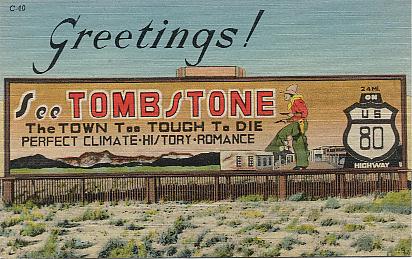
Image is a 60+ year old postcard from Tombstone, Arizona – The Town Too Tough to Die.  My parents found both history and romance there.

A Love Letter to Retired Pastors

Dear Retired Colleagues,

Thank you for your wisdom and professional ministry over the past decades.  I’m grateful for the time you loved God’s people in the particular congregations you served.

Although I’ve shared thoughts with you over the years, there’s something I need you to hear with an open mind.  Yes, some of you have excellent relationships with those clergy who serve your former congregations.  This is so good.  What you need to know that for every one of you who perceives your relationship with the current pastor of your former church to be excellent, there is at least one (if not ten) pastors currently serving other congregations as either the transitional or installed leader of your former congregation who wishes you would step back.  This is hard to hear and perhaps harder to believe.  I wish I could tell you I’m exaggerating.

Maybe it’s easier if you’ve moved to another town or another state.  And even then, it’s hard not to keep in touch with so many friends.  After serving a church for over 20 years, I moved half way across the country and still was asked to officiate at weddings and funerals.  They were willing to “fly me back.”  But I needed to say no.

The reason to say “no” the very first time you are asked to “come back” is this:

If you say “yes” to one family (or to six), you either have to come back for all of them OR you clearly show favoritism. 

And the hurt is real, my retired friends.

When you say “yes” during the Interim Time (whether you or another pastor recently left), it’s just like saying “yes” after the next Installed Pastor arrives.  I know you do not intend harm, but your are making it difficult (whether he/she/they admit it or not) for the other pastors who lead that congregation.

I get it:  you miss your friends.  You miss the pastoral calls and the holy moments.  You miss being the Biblical scholar.  You miss the identity.  But please believe me when I say that your continued presence, much less your continued leadership will one day be an event that the congregation will look back on as something that kept them from moving forward.

(This is the moment when some of you are thinking, “But they want me to come back.  Even the new pastor wants me to come back.”)  To quote Nancy Reagan: just say no.  Re-read the second paragraph if necessary.

The purpose of this post is to give you a way out.  Let’s say that you’ve agreed to do some weddings/funerals for former parishioners.  Maybe you did one.  And maybe you did half a dozen.  I’m inviting you to send a letter to the leaders of your former church saying this:

Dear (Name of Congregation here,)

I made a mistake.  In my love for your congregation, and so many of you individually, I thought it would be pastorally meaningful to accept your invitations to officiate at your family events.  But I was wrong.  It has only put me in the position of hurting others – including those who might want me to officiate at future events.  But – for the sake of your congregation’s health and in hopes of a thriving future for this church – I will no longer agree to officiate at any of your events, either within or outside the walls of the church building.  I made a mistake before.  Please understand that this is the most loving thing I can do for (Name of Congregation here.)

Yours In Christ’s Service,

Joe/Tammy/Bruce/Phyllis/Don/Warren/Dorothy/Whoever you are


Here’s another way to live into retirement:  if you long to lead Bible studies, preach, offer pastoral care/go on mission trips, we can find you another congregation in which to do this who would be thrilled to have your leadership!  Let somebody in your denomination know.

The #1 issue I hear at Boundary Training is about retired/former pastors continuing to show up and not-so-secretly continue to be involved.  Please know that you are loved.  Thank you for years of loving service.  But this congregation you love deserves a fresh start in order to be a 21st Century Church.  Please let them go.

Yours In Christ’s Service,

Jan


New Header

Twice in one week, I’ve had people send me links for blog posts that I might be interested in/want to read. And both of those times, the posts they sent me are pieces I wrote myself. A colleague – also this week – said that it’s too hard to find my name on this blog and so for the first time in 14 years I’ve changed the header. The quote I’ve used for all this time I first heard from Brian McLaren long ago when he was at Cedar Ridge:
Artists are simply people who are passionate enough to imagine things that do not yet exist.” Seona Reid, Principal of Glasgow School of Art, graduation 2003
I still believe that artists see what doesn’t yet exist. This is the Church God calls us to be. We are a Church for Starving Artists.

The Living Church

A couple weeks ago, HH and I were eating fish tacos in our Charlotte neighborhood. We were talking about the upcoming Opioid Training Breakfast we would be attending the next day.  (Note:  Nothing says Romantic Date like the words “opioid training breakfast.”)

Church happens here.

Our server – Leigh* – asked what we were talking about and we told her and she said that she knew something about opioid abuse and would we report back on what we learned.  And I said, “Of course.”

Last night I went back for more fish tacos and to let Leigh know what I learned.

Me: (entering the restaurant and seeing Leigh)  Hi Leigh!  How are you?

Leigh:  Good but busy.  (She was balancing multiple plates of tacos in her arms.)

Julie:  Hi.  Where would you like to sit?

Me: Anywhere.  I’m by myself so maybe this little booth.  

Julie:  I’ll bring water.

When things calmed down for Leigh, she came and sat down at my booth.  Julie soon joined us and Leigh said, “This is Jan and she just went to an opioids thing she’s telling me about.

Julie:  Hi.  I’m Julie.  I know something about opioids too.  I used to be a nurse but I went a little crazy in the pharmacy.  That was a while ago.

Eventually the bartender also came over and all of us were talking about what the community needs for people who deal with opioid and other substance abuse.  We compared experiences and rehab clinics we knew about and – bonus – I learned about the 19 Crimes Wine phone app that turns wine labels into history lessons.  (Please drink wine and other adult beverages responsibly.)

And it occurs to me that this – what I experienced over fish tacos last night – is The Living Church.  I will be praying that Julie has a healthy happy baby sometime this summer.  Leigh and I will continue to connect about opioids.  The bartender will continue to welcome people at his restaurant.  We have chosen to be a little community over there.

Here’s what nobody outside the Church cares about:

  • Whether or not the pastor wears a robe.
  • Whether or not the front door needs new paint.
  • Whether or not the church building is on an historic register.
  • Whether or not there are screens in the sanctuary.

The Living Church cares if the sick are healed and the lonely find community and the imprisoned are visited and the hungry find nourishment and the homeless find shelter.  The Living Church sees you and knows your name.

You can even be an introvert and be part of The Living Church.

Also, here’s info about the 19 Crimes app.

*Names have been changed – except for my own.

Image of my favorite fish taco place.