Category Archives: Uncategorized

Reprise: The Voices in Our Heads

I’m not sure but I might have read every article written about Anthony Bourdain and Kate Spade after their deaths last week.  I am struck by the common threads of depression – that dark tunnel of paralysis and the voices in our heads when the tunnel is darkest:

You are incompetent.  You are disgusting.  You cannot be trusted.  You don’t belong here.  You need to go away.  You are the problem.  You disappoint me.

Like Kate Bowler’s helpful appendices at the end of Everything Happens for a Reason: And Other Lies I’ve Loved we need tips on what to do when you love someone with depression and what not to do when you love someone with depression.  Here’s a starter list:

Dos:

  • Do ask if the person is having suicidal thoughts.
  • Do stick around and be present.
  • Do tell them they are important to you.
  • Do say that you are sorry they are in so much pain.

Don’ts:

  • Don’t tell someone to “cheer up” or “think positive.”  This is not about “happiness.”
  • Don’t “at least” someone as in “at least you are married” or “at least you’ don’t have cancer.“
  • Don’t tell someone that depression is a sin (for the love of God.)
  • Don’t suggest vitamins, hot tea, or a trip to Vegas.

I wrote about the voices in our heads in 2017 here.  Those voices continue to whisper in our ears, but there is another Voice that can override them.  A person can recover from depression and – whether you believe in God or not – I believe God has something to do with this.

Image of Anthony Bourdain in Brazil.
Making Lockdowns Fun

I spend a lot of time teaching adults about cultural shifts.  We cannot be an effective Church without being culturally proficient, so when longtime church people try to “bring in young families” or wonder “why people don’t come to church anymore”  I realize we have a lot more work to do.

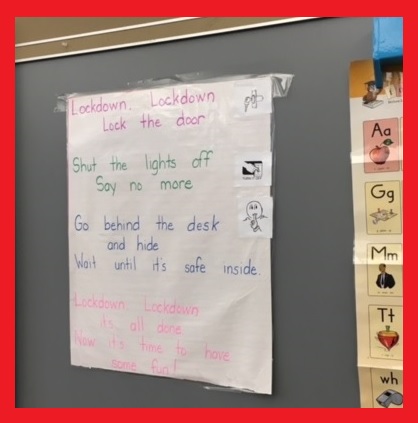
Sometimes I show slides of a 1950s first grade classroom and a 2018 first grade classroom and ask people to point out the differences.  Even during the course of the past few months, our children’s classrooms are making dramatic shifts.  Did we ever dream that this rhyme would be displayed in a child’s classroom:

Lockdown, Lockdown, Lock the door.

Shut the lights off.  Say no more.

Go behind the desk and hide.  Wait until it’s safe inside.

Lockdown, Lockdown.  It’s all done.

Now it’s time to have some fun!

There really is an exclamation point at the end of the poem. And it hangs on the wall of a kindergarten classroom in the United States of America.

I don’t really have anything else to say about this except that we are called to be The Church for the people who go to kindergarten in this school and for their parents and for the human beings with mental illness who prompt new security measures.  How are we doing?

Image from the Twitter feed of Georgie Cohen of Somerville, MA.  This will be her child’s classroom when she begins kindergarten this fall.

Connecting the Dots

I never understood the point of Connect the Dots puzzles as a child.  They seemed obvious and pointless, and yet . . .

it occurs to me now that professional ministry is all about Connecting the Dots with people.  It prevents us from silo-ing our particular  ministries.  It connects individual service to the big picture.  The dots that need to be connected in your church might be:

  • A computer training ministry for new immigrants
  • English as a Second Language classes
  • Vacation Bible School
  • Preschool
  • An annual fish fry
  • Wednesday morning Bible study
  • Bag lunches for homeless shelter
  • Cancer survivors group

We all tend to have our pet projects and interests.  But all of the dots are connected when a leader can point out how the dots connect to create the whole picture/the vision:

  • Becoming a safe place in the neighborhood where God’s love is shared.
  • Transforming the world for good in Jesus’ name.
  • Serving our neighbors in the image of Christ.
  • [Your congregation’s stated mission here.]

Some of our congregations busily fill our calendars with activities that have nothing to do with the core mission of our church but we’ve been doing those programs for so long that we can’t let them go.  It’s the pastors’ job to continue to help people connect the dots.  And if the dots cannot possibly connect  maybe it’s time to stop.  I’m talking to you, Strawberry Festival (that everybody dreads except the three ladies who run it.)

How do the assorted “dots” of  our efforts connect with the bigger picture?  It’s a question we need to ask and ask again.


More Than a Cute Purse

I get it. 

Kate Spade is known for creating her namesake company which sold cute pocket books in black and white and candy colors.  She’s known for her relationships.  David Spade and Rachel Brosnahan are her brother-in-law and niece, respectively.  She was somebody’s mom and wife.  Yesterday she died by suicide in her Park Avenue apartment.

I get it, because it could be any of us – or maybe it could just be some of us, but yesterday, it was one of us:  a person who seemed to have so much to live for.  She was successful – at least in worldly terms.  In 2017 Fast Company identified her as one of the Most Creative People in Business.  Successful is one thing.  “Most Creative” is especially interesting.

Her name was used interchangeably with her hand bags and when she sold her company, she started using the name Kate Valentine.  I wonder if this was because she wasn’t allowed to use her own name anymore for contractual reasons.  (See Walter Taylor, formerly of Taylor Wines.)  Giving up your name for an inanimate object feels spiritually disturbing.

Kate Spade was gifted in design and business.  That was her particular calling – among other things.

The calling of all human beings involves recognizing that each person is a child of God and each child of God is more than what we make/do/have.  When we are shattered and feel like we want to die, we need a circle of people.  I call that Church.

Kate Spade was more than a cute purse or a Park Avenue apartment.  I hope that – in God’s light – she knows that today.

Image source. It’s okay not to be okay.  You can call 1-800-273-8255 24 hours/day if you don’t feel okay.

Random Church is the Best Church

Yesterday was a back to back meeting day.

It started with an unexpected meeting and was followed by a scheduled meeting which was followed by a canceled meeting that turned into an unscheduled (but delightful) lunch with folks from meeting #2.  I was late to the next meeting because the lunch meeting was so interesting.  And that late meeting was followed by another coffee meeting where one of my NC cousins was also getting coffee (#BigNCFamily).

And then – on the way home – I thought I’d stop by the church building of a congregation planning to merge with another congregation because I had not been there yet.  One of the church matriarchs was there and she gave me a tour.  But then she did something random:  she invited me to dinner with some of her friends.

This kind of thing doesn’t happen in my life very often.  Actually it never happens.

  • Strangers don’t usually invite me to dinner.
  • I often am on my way to the next thing and have someplace to go.

I ate dinner with Shirley, Doris, and Bob at the local Showmars.  The other Bob would have joined us but he’s in Atlanta, I was told.  They described themselves as misfits, laughing and sharing stories from different chapters of their lives.  They talked about where they’d lived, assorted spouses, travels to interesting places. Doris has “been everything” but Presbyterian.  Bob sings in his church choir but he says he’s deaf. They invited me to join them any morning at 7:30 for breakfast – same place, same booth.

When I thanked them for including me, Doris said, “Shirley is the kind of person who never lets you go.”

Imagine a spiritual community where people invite strangers to a meal.  Imagine a spiritual community where friends are unafraid to share their failings as well as their victories without fear of judgment. Imagine a spiritual community where people never let you go.  This, my friends, is Church.

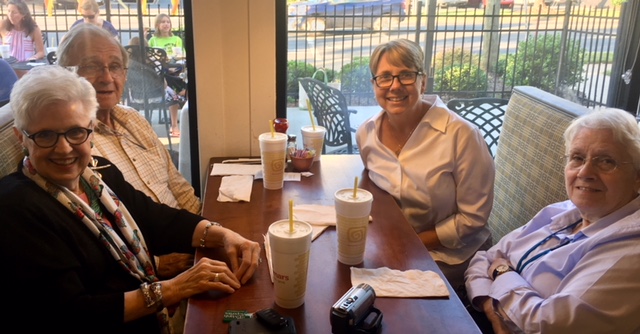
Image of me and my new friends at their usual booth in Showmar’s, Charlotte, NC.

How Do You Show God the Love?

You know those love languages made famous by Gary Chapman?  (My love language is “acts of service.” Please vacuum my floors.)

Just as I appreciate acts of service and you might appreciate acts of public affection or gifts, the way we express our love to God varies as well.   While one person might express her devotion by dressing in her finest clothing and worshiping every Sunday morning, another person might express his devotion by participating in a Moral Monday march.  Both are expressions of love for something bigger than ourselves.

How do you show your love to God?

  • You write checks to financially support your church?
  • You donate money to support other non-profit organizations?
  • You wear your best for Sunday worship?
  • You make time for worship on your way to a sports event (and dressing accordingly)?
  • You march to protest injustice?
  • You risk arrest for civil disobedience to protest injustice?
  • You spend quiet time in prayer and Bible study?
  • You do hands-on ministry (e.g. painting, refurbishing, tutoring, cooking, serving, cleaning, teaching, singing, visiting, installing, weeding, driving, baking) for people who appreciate such things.
  • You study the Bible?
  • You write notes to or visit the sick/lonely/grieving.?

Again, we tend to judge each other.  I’ve said myself that if the full extent of your spiritual practice is wearing a coat and tie on Sunday mornings, your commitment is lame.  I also know people who Twitter for Jesus – spreading what they consider to be teaching moments via social media – and that’s fairly lame for other folks.

My point is this:  churches must offer a variety of ways for people to show their devotion to God while also helping people ratchet up that commitment.  Maybe today you express your commitment to serve God by writing a monthly check.  But – as you read and study and pray – you are being moved to raise the stakes a bit and pick up a hammer or a paint brush.  Or maybe you’ve marched in numerous protests and you feel a tug to do more:  teach or mentor or register voters.

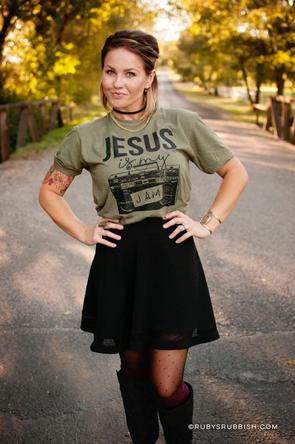
What is your Theological Love Language – in terms of how you love God?  I hope it goes beyond wearing a Jesus t-shirt.  (I’m pretty judge-y myself.)  But that’s a start for some people.

Image source.

Who’s Your Favorite Administrator and Why?

I’m headed to meet with the Administrative Personnel Association at their National Conference this Friday and I find myself totally enthralled.  Good church administrators are worth their weight in gold.

I’ve known several and here are some of the qualities I’ve treasured most:

  • They are nonplussed in times of absurdity.  A man protesting our church (because we had a female pastor) relieved himself in the church parking lot behind his car and when the police came and asked “Who ___ in the parking lot?” our administrator revealed that it was in fact the protester.  Things got ugly. She was subpoenaed at the man’s trial.  And she was literally asked – if she didn’t see him “do it” – how did she know it was human excrement?  Under oath, she shared that she’d grown up on a farm and she gave a detailed description of the varieties of excrement she had come in contact with.  True story.
  • They keep confidences.  One great administrator always knew where I was and with whom for my own protection.  She was a lock box.
  • They are endlessly polite with difficult people on the phone.  I’ve overheard a former administrator teach a retired pastor how to send an email over the phone. I’ve overheard her patiently share telephone numbers when callers couldn’t find their church directory.  “Oh here it is!” said one caller after she been given ten phone numbers – one by one – by the administrator.
  • They deal with visitors appropriately.  A good administrator has excellent emotional intelligence (and knows when to call 911.)
  • They make the rest of the staff look good.  Their ministry is organizing the rest of us and it’s a gift to the entire congregation.

What qualities do you most treasure in a good administrator?  I’d love to share your thoughts with the APA attendees.  Thanks.

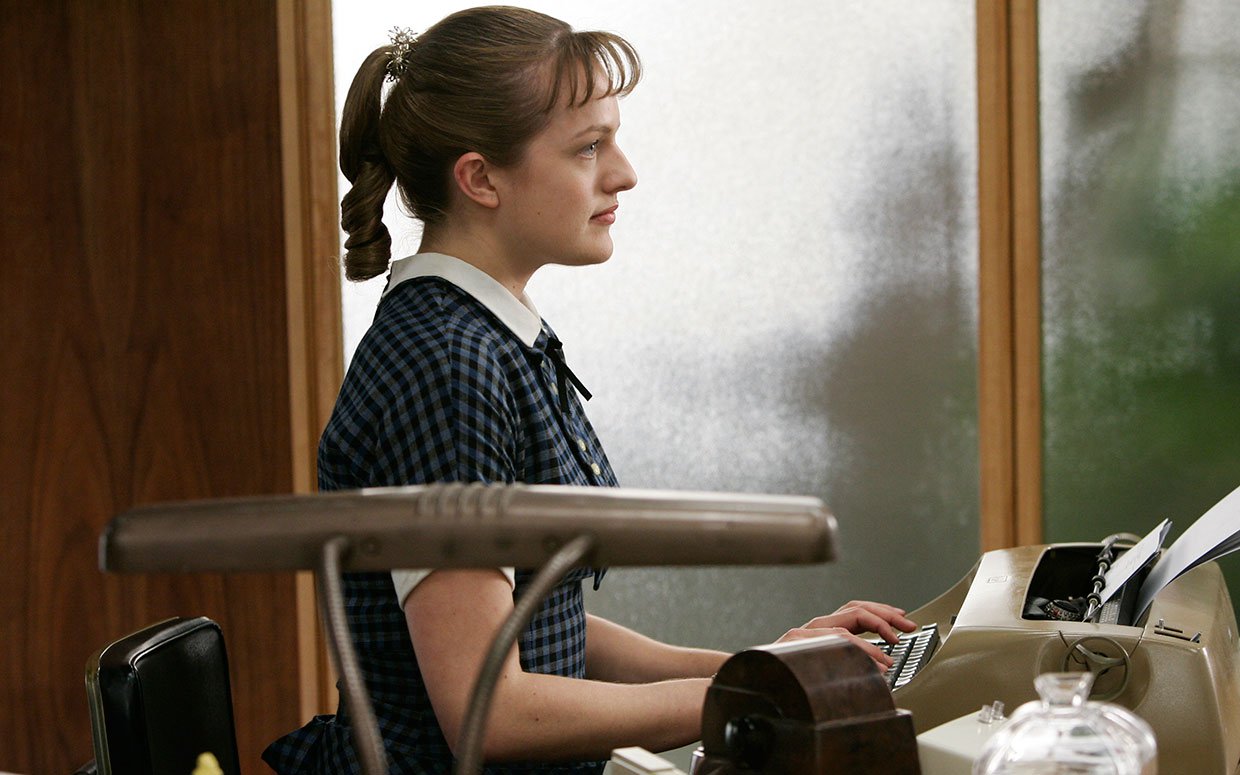
Image of Elizabeth Moss playing Peggy Olsen on Mad Men.  Note: Like Peggy, most administrators are at least as smart as their supervisors but not all of them are female.

The Cost of Closing Our Eyes

In a church conversation about building affordable housing on an empty lot they owned, one of the members stood up and – honestly – asked, “Are there people who need affordable housing?  I’ve never seen poor people around here.”

Actually there were hundreds of people in need of affordable housing around that church building.  But they were invisible to that particular parishioner and she wasn’t the only one.  Sometimes we don’t notice that there are people who live among us who struggle.

There are consequences for closing our eyes to the needs of our neighbors.  First of all we miss out on connecting with people with different life experiences.  And most of all, we miss out on opportunities to serve in the name of Jesus Christ.  (That’s what we do, Church, right?)

HH and I traveled to lovely Manchester, VT for his birthday in 2o16  and everything was tidy and trimmed and quaint.  Upon mentioning Manchester’s perfection to a waiter serving us burgers, he told us that – actually –  there are many, many poor people in Manchester, VT (Vermont’s poverty rate was 11.9% in 2016.)  But the poor are expected to stay away from tourist areas.  “Tourists don’t want to see poor people while they are on vacation.”

We cannot be the Church of Jesus Christ if we sequester ourselves away from the poor, the broken, and the unlovely.  “Not wanting to see” neighbors in need is the opposite of the Jesus’ teaching.  Jesus truly saw people in their real condition: shamed, bleeding, covered in sores, desperate, ostracized, insecure.  We are called to open our eyes and see our neighbors too.  All our neighbors.

Read This Book

In professional ministry, it often happens when engaged couples are making plans for their future.  Laughable plans ensue.

I was once given a “wedding day schedule” that looked something like this:

  • 4:00 Music begins playing.
  • 4:05 Guests begin arriving. 
  • 4:10 Guests begin to take their seats.
  • 4:25 Mothers are seated.
  • 4:28 Butterflies are released. 
  • 4:30 Groomsmen and Groom take their places. 
  • 4:35 Bridesmaids process down the aisle. 
  • 4:45 Trumpets sound and bride appears.  Etc. Etc.”

I remember one couple who told me that they would have their first child 2.5 years after their wedding date.  “And we hope it’s a boy.”

Good luck with all that.

Plans are good and I’m a big fan of preparation.  But we just don’t know what the future will bring.  We don’t even know how dinner will go tonight.

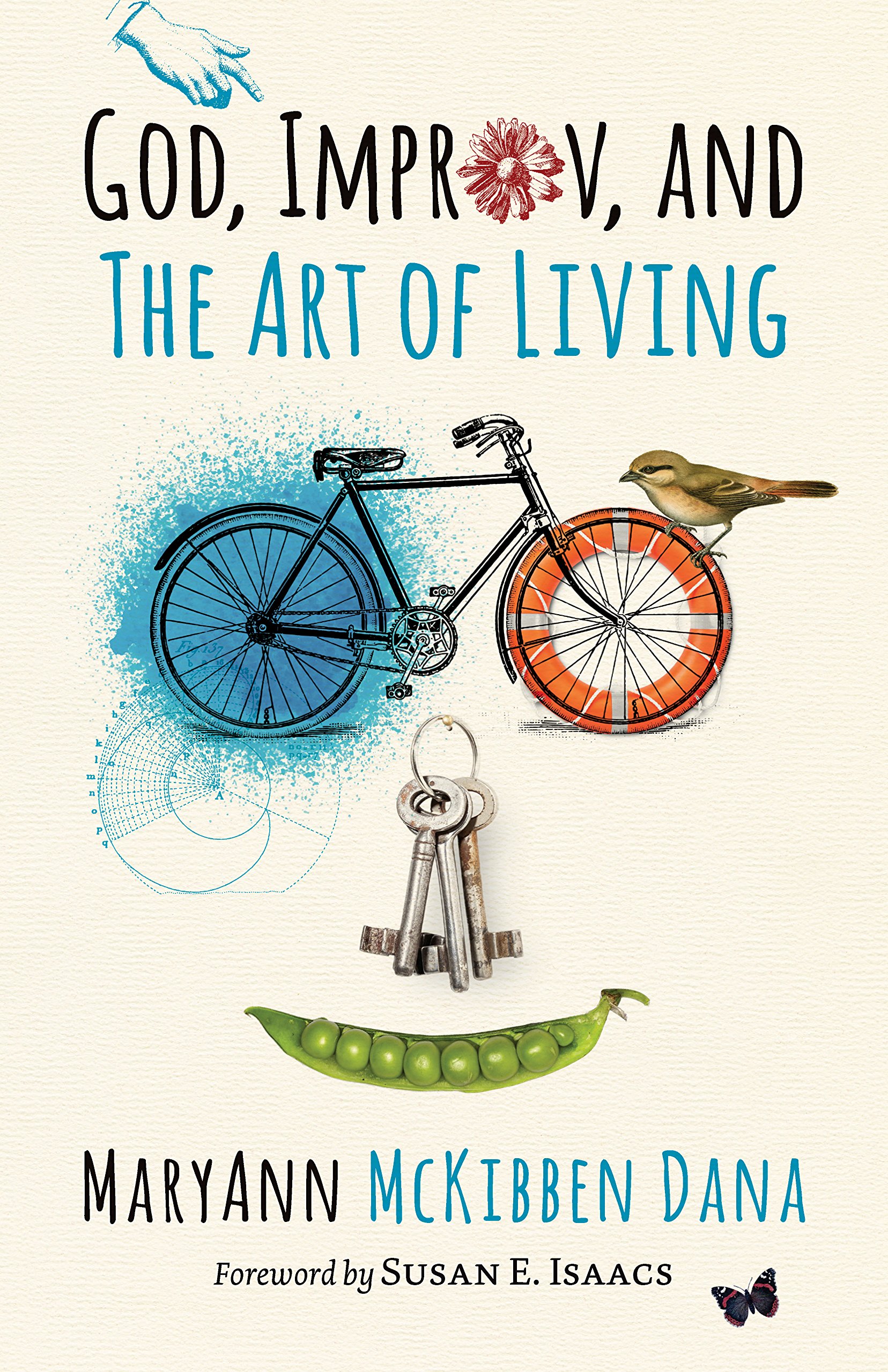
Improv is part of a well-lived life and MaryAnn McKibben Dana explains it all in her new book God, Improv, and The Art of Living.  MaryAnn unpeels the many layers of how engaging intentional improvisation in life brings satisfaction and wholeness.  Her book makes excellent life and faith connections, and the reflections will have an impact on my own ministry and life for years to come.

And as the mom of three young adults, I can see improv as a calming tool for those who find themselves in the throes of Big Adult Life Choices. It feels stressful to be in a season of life when there are so many decisions to make that may impact one’s life forever.  MaryAnn’s treatment of improv as a spiritual practice brings relief and hope to those in the throes of Serious Adulting.

Read it.  I especially recommend it for book groups that like to dig deeper into life.

Full Disclosure:  This blog wouldn’t exist without MAMD.  But nobody asked me to write this review.  I really just want everyone to read it.

My Memorial Day Privilege

Arlington National CemeteryAs a child, Memorial Day was celebrated as my grandmother Ethel’s birthday.  Since May 30 was the designated Memorial Day for her entire life – long before it was changed to the last Monday in May – Memorial Day involved cake and ice cream not parades and flags.

Another reason why our family never celebrated Memorial Day – except as a birthday celebration – is because the last family member to die in service to his country was my Great Great Great Grandfather Samuel Edmiston who died at Antietam.  And the country he died for was not the United States of America.  (Note: if anyone in my family of origin is aware of any of our kinfolk who died in battle defending the United States, please let me know.)

Although several family members and friends have served in the military, they all returned home.  I have friends buried in Arlington National Cemetery, but they all died many years after their service.  I’ve read and re-read the obituaries of noble men and women who have died in action through the years, but they were not my siblings or cousins or parents.

When a young person dies defending their country, I cannot imagine the depth of their families’ losses.  I hope I never know.  But Memorial Day is different for them than for the rest of us.

According to this source, the total combat deaths of American troops have been over 666,441 since 1775.  An additional 673,929+ have died in non-combat deaths.

Less than 10% of the U.S. population has served in the military according to Pew Research. And there is a widening divide between civilian and military culture according to this story. We wave our flags but few of us know what it’s like to experience Memorial Day as grieving people.  We celebrate this day as privileged people.

I am humbled by this fact.  I live freely in a nation I love which is also a nation that can be better.  On this Memorial Day, I also remember that in 2018 more school children than armed service members have died at the hands of military weapons.  As much as I appreciate the decrease in military deaths, this is a sin.

It’s time to use our privilege to change things.