Category Archives: Uncategorized

Excellent and Healthy Times to Say Yes and No in Church

I have the best job in the world because every day in God’s creation, I get to address the good, the bad and the ugly.  I tend to learn more from the bad and the ugly (i.e. what not to do) so that’s a blessing too.

Here you go for a quick list on a beautiful Monday morning.

Excellent and Healthy Times to Say No in Your Church:

  1. You are the former pastor and someone asks you to officiate at their wedding, funeral or child’s baptism.  The answer is no.  Saying yes sabotages the current pastor’s authority and ability to form close relationships with the congregation.
  2. You are a church leader who really wants the former pastor to officiate at your wedding, funeral or child’s baptism.  The answer is no.  Yes, you love that former pastor, but you are stealing the new pastor’s ability to be your spiritual leader and – in the long run – your congregation will suffer, especially if this becomes a habit with the former pastor.
  3. You learn about misconduct involving abuse of power of any kind: sexual, financial, physical, emotional and you are asked to keep it a secret.  The answer is no.  Depending on the situation, contact the pastor, the board of elders, the denominational leader or the police.  Note: It must be reported but confidentiality must be kept in terms of the name of the victim, if that’s the wish of the victim.
  4. There is a leader (or several of them) who have been in power for years and they want to solidify their power by tapping their own spouses, siblings, or children to serve next.  Nope. The church belongs to no particular family or clique, no matter how many generations are in the cemetery.  Yes, those leaders love their church to the point of feeling like it belongs to them.  And they could be inadvertently killing the church they love by not letting go.
  5. A generous person offers to pay for the new HVAC system, the new roof, the youth trip to Mexico, or the gap in the budget, assuming this will result in more institutional power.  (“We owe that family so much!“)  The answer is no (unless the gift is absolutely unconditional with no expectations in return.) Jesus talks about this kind of thing in terms of making it about us and our power.  Financial generosity doesn’t equal more power or more faithfulness than the ones who give “the widow’s mite.

Excellent and Healthy Times to Say Yes in Your Church:

  1. There are new neighbors who don’t look like most of the people in your pews.  They might even offend you in some way, but there are people who want to reach out to them and make them feel included.  The answer is yes.  We need to get over ourselves and our biases, read the New Testament, and note how many offensive people Jesus invited into God’s flock.
  2. Someone volunteers who has never volunteered before, possibly because “Mrs. D always does it.”  The answer is yes – I hope because Mrs. D. herself invites that person to lead.  (And Mrs. D. offers to help if needed.  And Mrs. D. doesn’t complain if the new volunteers does it differently.  And #3 in Yes List.)
  3. The church tries something new even if it might fail.  The answer is yes.  Try it for 3 months.  Try it for this season.  Try it for a year. Try it, assuming it just might work.  Try it while praying that it transforms something for good.
  4. A group of members have a vision for a Big Scary Dream that will show God’s love in a new way.  The answer is yes.  Let them present it to the other leaders.  Give them permission to explore it further.  Back them up.  You could be looking at the next computer training facility, neighborhood food program, or community homeless shelter.  (These Big Scary Dreams came true and have transformed thousands of lives.)
  5. During the pandemic and social distancing, members have  completely new ideas for ministry (for now and maybe for many years to come.)  The answer is yes.  Here are some I’ve seen recently:  A blessing of students’ technology instead of a blessing of the backpacks.  (The Grove Church in Charlotte did this during worship August 16)  Supporting a Tent City of neighbors who’ve been evicted from their apartments. (Henderson Grove Church in Mint Hill, NC is partnering with other congregations to provide provisions for those who’ve lost their homes.)

A healthy church knows when to say yes and when to say no.  It’s about faithfulness, good boundaries and shared power.  COVID-19 has given us the perfect opportunity to be the church in fresh ways.

Heads up:  I’m already pondering faithful ways we can be the Church during a socially distanced Advent and Christmas.  It could be glorious.

Ew

I spend my free time these days checking out places I want to visit once this pandemic is over.  I have Air BNB files for possible places to stay everywhere from rural Virginia to Italy.  And yesterday, I found a wonderful part of the country that looked like a place I might even want to live one day.

Gorgeous vistas. Nearby wineries.  Hardwoods and rivers.  Yes, please.

And then I clicked on a farm that looked like a wonderful place to visit for a hiking weekend . . . until I saw the words Christian Retreat Center.  I literally said, “Ew” out loud.

As I’ve written before “Christian” is troublesome adjective.  It’s a great noun, but it’s a problematic adjective.  When I was a pastor in Virginia, we received a Christian Yellow Pages in the mail filled with the names and numbers of Christian Beauty Salons and Christian Restaurants and Christian Auto Mechanics.

Ew.

I claim Jesus as my Lord and Savior.  I have spent my life trying to encourage myself and others to fulfill what the Bible says about expanding the reign of God.  But the adjective “Christian” is fraught with all sorts of issues.  I can only imagine what that adjective sparks for people of other faiths or no faith.

It could mean “not Jewish or Muslim” as in “we don’t want to give such people our business.”

It could mean anti LGBTQAI+.  My assumption is that this is not a place that will bake my gay wedding cake should I ever need one.

It could mean white nationalist.

It could mean “we are going to proselytize you”  to make sure I am the right kind of believer.

Guthrie Graves-Fitzsimmons regularly writes about how “Christian” typically means white evangelical homophobic politically conservative person according to the media, even though there are many Christians who are none of those things.  (Heads up: Guthrie’s book Just Faith: Reclaiming Progreesive Christianity can be pre-ordered here.)

Even as a Christian myself, I feel exhausted when I meet someone who assumes that being Christian means what they think it means: gun-loving, immigrant-hating, flag-waving judgey person.

Don’t get me wrong: I’m as judgey as the next person (which is why I blurted out “Ew” upon discovering a Christian retreat center out in the woods.)  I can put people in a box as quickly as anyone.  But I’m really trying not to do this to the point that has become one of my daily spiritual goals.

In these days of political divisions, the best answer to “Are you conservative or liberal in your politics?” seems to be: “It depends.”  The Bible is an equal opportunity offender in terms of politics.

I probably agree with the owners of that Christian Retreat Center more than I disagree with them on issues of theology and politics.  Or maybe not.  But we need to connect with each other – Believers and Non-Believers of all kinds – if we hope to be the world as God created it to be.

Following Jesus = loving people even when we disagree with them, and even if they are our theological, cultural, political “enemies.”  This is what Jesus teaches.

But – Christian siblings out there – we need to acknowledge that for many people in the world (including some of us) the word “Christian” has been hijacked to mean something that Jesus would find unrecognizable.  It’s up to us to show the world what the love of God looks like in the name of Jesus.

How are we doing with that?  Do people think “ew” when they see us coming?  Or – what’s perhaps worse – do people not recognize that we are indeed followers of Jesus because there’s no evidence of God’s love in the way we live?

Image of the 2015 Christian Phone Book as published and sold by these folks.


Pandemic Thriving

We are at the point in this pandemic adventure when “check-ins” abound.  Those of us who work with multiple congregations ask each other the same questions:

  • How are your churches doing these days?
  • How are they doing worship?
  • How are things financially?
  • How is their missional impact?

And in all those conversations, I also hear the same answers:

  • The churches that were thriving pre-pandemic are still thriving.
  • The churches that were dying pre-pandemic are still dying.

Yep.  Congregations that were already entrepreneurial, tech-savvy, and missional before March 15, 2020 continue to be so post March 15, 2020.  And those slow to adapt in general (Why do we need online giving?) continue to struggle.

I want to say, “I told you so” to those churches more interested in their history than their future, but actually, I wish I were wrong.  I wish the historic congregations, the inwardly-focussed congregations, the “we love our cemetery more than Jesus” congregations had a Holy Ghost Moment the second it looked like our normal was about to change forever.  I wish those congregations felt a jolt from the Lord that moved them to reach out and reach up.

But the creative churches have become more creative and the anxious churches have become more anxious.  This is a generalization, of course.  And it’s not too late.

Look at what’s happening in your congregation and ask: Are we energized for what’s possible that wasn’t possible before? Are we reaching new people who couldn’t worship with us or connect with us before?

Or are you consumed with worry that “we’ll never get back to the way it was.

Again, it’s not to late to make some shifts.  What is God inspiring your church to do and be that you couldn’t do and be before?  There are church leaders out there so ready to shepherd you into a new way of being and doing Church.  Connect with them before the end of the week.

Image of the Sunflower Fields at Forks of the River Wildlife Management Area in Knoxville, Tennessee.

The Chasm (and Why It’s Ruining Our Spiritual Lives)

Chasms are scary if you have a fear of heights.  I can barely look over the balcony railing from my fourth floor apartment, much less stand on one side of a mountain looking down. 

There are physical chasms that separate the surface of the earth.  And there are figurative chasms that divide human beings in terms of our opinions, our core beliefs, and our life experiences.

And there is a single time when the word “chasm” is used in the Bible.  (χάσμα pronounced “chasma“) It’s here in the story of Lazarus and the Rich Man.

There was a chasm between them in both life and death.  In life, the rich man led a comfortable existence with fine foods and elegant clothing and the poor man (Lazarus) was starving and covered in sores.  In death, the rich man found himself tortured in Hades and the poor man (Lazarus) was comforted at the side of Abraham.  And between them  – at least in death – was a great, fixed chasm.

It didn’t have to be this way.  It wasn’t supposed to be this way.

I’m not an economist, but I have concerns about the increasingly treacherous financial chasms between the rich and poor in the world God created.  This is not what God intended.

For 16 years, Ben Cohen and Jerry Greenfield of Ben and Jerry’s ice cream ran their company with this policy: the pay ratio between the highest salaried executive and lowest-earning-worker would be no greater than 5 to 1.

Yes, that was a long time ago but their corporate values were laudable and – if you ask me – holy.  Today, the pay ratios between the highest paid executives and their lowest paid workers in the same companies are depressing – and if you ask me – sinful.

(These are pre-pandemic numbers, published in early 2020 according to Bloomberg.)  The pay ratio between the highest paid executives and the lowest paid executives are:

  • Costco – 169 to 1
  • Apple –  201 to 1
  • General Motors – 203 to 1
  • Bank of America – 276 to 1
  • Merck – 289 to 1
  • Walmart – 1076 to 1
  • Chipotle – 1136 to 1
  • McDonald’s – 1939 to 1
  • The Gap – 3566 to 1

You can look up your own favorite companies on that Bloomberg link.  And this would be a good time to check the pay ratio on your church staff.  Is it fair?  Would you call it just?

The divide between rich and poor is increasing and this is bad for our country and our souls.  We have come to believe that people are poor because they’ve done something wrong when actually our structures are set up against the poor in ways that keep them poor.  From housing opportunities to educational opportunities to job opportunities, the chasm between rich and poor is not what God planned.

The chasm between rich and poor in this life is not fixed.  We can still cross that chasm if only we will.

Let’s reread the story of Lazarus and the Rich Man and ask ourselves this:

  • Do we notice the poor person at our gates?
  • Do we tend to the health concerns of the poor?
  • Do we ensure that the poor have food security?
  • Do we know the names of the poor who live on our streets?

I’ve asked this before and I’ll ask this again:  What is the first and last name of the poorest person you know?  It’s a real question.  What’s your answer?

Are we going to die perpetuating that chasm between rich and poor?  Or are we going to notice and then lift up those who are hungry and sick in our communities?  Again – the chasm is not a fixed one.  For now.

Image of The Grand Canyon overlooking the Colorado River.

The Future of Congregations is in Partnerships

Individual congregations often partner with other congregations in a variety of ways:

  • If your church is part of a denomination, you are connected to other churches in the denomination.
  • If your church is on one of a variety of campuses, you are connected to the other campuses of the main church.
  • If your church is part of an interfaith network, you are connected to congregations of other faiths.

These partnerships might result in joint mission, education, and worship experiences.  Maybe they even share a pastor.

The truth, however, is that most of our congregations are not as connected as they could be for the sake of more impactful ministry.

Imagine the impact if:

  • Your congregation has a vegetable garden and you partner with a church that wants to share your fresh vegetables with the canned goods from their food pantry.
  • Your congregation has a preschool and you partner with a neighboring church without a preschool who provides healthy snacks to yours.
  • Your congregation partners with another congregation (which doesn’t look like yours) for a Civil Rights trip to Birmingham with ongoing conversations about race.
  • Your congregation partners with a non-profit to provide a jobs training course on your church’s property.
  • Your congregation partners with a local school for a monthly “Thank You” Party to community helpers.  (This month: Firefighters!  Next month: Police Officers!)

Most of our congregations, however are Lone Rangers.  It’s easier to do mission on our own without the collaborative meetings and extra administrative work.  But the future is in partnerships.

By definition, partnerships are about more than perpetuating an institution (like the church.)  They build community.  They exist to serve people.

So, as your congregation moves into the fall, ask your leaders these questions:

  • Are we connected to other congregations and how?
  • Are we connected to other faiths and how?
  • Are we connected to community leaders and how?
  • Are we connected to community non-profits and how?

If the answer is “no” to all those questions, I’m going to venture that your congregation is focused inwardly (and your ability to thrive is stifled.)  If the answer is “yes” and your connections are between a single member or two, then how might your partnerships become broader?

The future of healthy congregations will involve partnerships because the healing of the nations requires all of us together:  houses of faith, community leaders, non-profit organizations, educational institutions, for-profit businesses.  The world needs us to join together.  And God calls us to a common purpose.

Somebody Else’s Freedoms

I live in an apartment building and someone threw a party Saturday night.  I didn’t want to be That Person but I was sleepy at 1:30 am.

A couple things:

  1. There’s a pandemic.  At one point I saw the inside of the party room (more about that later) and it was a wall-to-wall, mask-less affair.  There appeared to be about 20 nice people holding red cups.
  2. The pounding bass could be heard throughout our floor.  I live about ten apartments away from Party Central and it felt like the music was coming from my closet.
  3. Several residents and I were gathered outside their door knocking in hopes that someone would hear us so we could ask them to turn down the bass just a little.  (They couldn’t hear us knocking.)
  4. Finally someone opened the door to take out the trash (which is when we saw how many people were in there) and he said he’d definitely turn it down.  (They did, two hours later.)
  5. Saturday nights are generally not party nights for Pastors  but I seriously considered telling the partiers that I was a brain surgeon with a procedure scheduled for 6 am and by keeping Dr. Jan from resting, they were risking the life of a twelve year old in need of a miracle.  It sounded more important than “I have to wake up and preach the gospel of Jesus Christ in the morning.

Connecting with friends is important.  Preaching the gospel is important.  Performing surgery is important. Loving our neighbors – even when they are rude – is important.

Everyday we see and hear about neighbors who believe that wearing face masks is important to prevent the spread of COVID-19 and neighbors who believe it’s important to allow people the freedom not to wear a mask.

This article is a must-read . Whenever freedom is described as “religious,” things are going to be heated. One person’s “religious freedom” might be the ability to withhold business from black people because of the “curse of Ham.”  Someone else might feel their “religious freedom” is threatened if they can’t harbor undocumented immigrants.  “Religious” and “Christian” are dangerous adjectives.

And personal freedom is more mundane than this.  Is it okay for me to burn citronella candles on my balcony if the people on the balcony above me are allergic to citronella?  What if it’s safer for me to walk the dog in the bike lane instead of the sidewalk, which means bicyclists have to go around me?  Is it okay for me to buy all the toilet paper?

Individual freedoms have trumped (sorry) the common good for a while now and this is not merely a legal concern or a public health concern or a capitalist concern.  This is a spiritual concern.

Weighing what is most important is a daily task.  Sometimes it’s easy. (The need for socially isolated people to gather loudly or the need for people to sleep at 2 am.)  Sometimes it’s less clear. (The need for students to get back to school or the need for teachers and staff to feel safe.)

But the bottom line is about how we treat our neighbors.  Can we see the world through their lens – not necessarily to change our own minds but  – to try to understand where they are coming from?  Can we compromise?  Can we try to see them through the eyes of Jesus.  (This one really helps me when I want to choke someone.)

Imagine if we Christians were known for loving our neighbors as ourselves.

The Strange Little Things We’ve Lost

I really miss going to restaurants.  It’s not about the food really or the fact that I don’t have to cook that night.  It’s about having a little break in the midst of an ordinary week.

During this pandemic, we’ve lost jobs, routines, and social closeness.  And there are also strange little things we’ve lost that make a difference in our emotional well-being.

  1. We’ve lost the mini-vacations of visiting museums, shopping, and eating out.  The change of scenery, the treat, the opportunity for something unexpected to happen have all been minimized during these days of quarantine.
  2. We’ve lost the ability to start the day making a command decision at our local coffee shop.  At home there’s one kind of coffee.  If we buy coffee out, there are at least six decisions to be made before we get to the office: hot or cold, caf or decaf, whip or no whip, sugar or sugar-free, skim or whole, short or tall.  Remember this scene from You’ve Got Mail?
  3. We’ve lost the ability to connect with strangers.  It goes without saying that the lack of touching between family members who don’t live together is hard.  But it’s also hard to stand six feet away from the cashier, the post office employee, and the person on the street.  Call me inappropriate, but I used to touch the shoulder of my public librarian when she walked me over to the copy machine.  “Thank you so much.” (touch shoulder)

As a person living alone for two years while HH and our dog were still in the Midwest, I would sometimes sit at the bar of breakfast diners and talk with perfect strangers about what they ordered.  They might ask me what I’m reading.  I’ve been asked more than once about movies, books, and even where I go to church.  I loved that connection with strangers.

I also loved wandering into cute shops looking at the candles and greeting cards.  I loved going to the movies on a rainy afternoon.  I loved wandering into a secondhand store looking for treasures.

I really loved meeting people in coffee shops.

Those things are gone for now and five months into this thing, I feel it.  It takes it’s toll.

It also goes without saying that this is a First World Issue that shows my privilege.  Variety is a privilege.  Options are a privilege.  Making six decisions about our morning coffee is a privilege. Eating in restaurants is a privilege.

I remember being asked by a guy for money on Central Avenue in Charlotte, and I told him that I was on my way into the restaurant he was standing in front of and I didn’t have money, but I’d buy him breakfast.  It was very clear that he didn’t eat in restaurants much.  He asked for McDonald’s french fries (we weren’t in a McDonald’s.)  He wanted a milkshake in a restaurant that didn’t do milkshakes.  But having that opportunity to hang out with that person was not only a privilege for me; it was a gift.  I miss random encounters.

We who’ve had the opportunity to enjoy such strange little things pre-pandemic are just fine.  And yet, I admit before you and God that I miss them.

Image of Undercurrent Coffee Shop in my neighborhood and one of their mochas.  It’s not like this anymore.

Pray for Lebanon

We tend to pray hardest for those people and situations with whom we have a personal connection.  It’s only natural.

In spring 2017, I was blessed to visit Lebanon and Syria, and I still have prayer partners living there.  And they are shaken today.

Not only are they our siblings as God’s children, they are also our denominational siblings: Najla and Rola and Hala and Hadi and Sanah.  And there are many more.

How many of us realize that there are Presbyterian Protestants in Lebanon and Syria? And being The Church there is not easy sometimes.

Our clergywomen colleagues have struggled to be ordained and called to professional ministry positions in countries with limited opportunities.  Our congregations in the National Evangelical Synod of Syria and Lebanon (NESSL) deal with being Protestant Christian minorities in countries with a long history of civil war.  There are more refugees in Lebanon per capita than any other country in the world.

And today they are grieving deep loss. Please pray for this beautiful country and for the individual friends who live there today.

If so moved, please consider making a donation:

  • here for Presbyterian Disaster Assistance in Syria and Lebanon, or
  • here to the Near East School of Theology in Beirut which suffered damage yesterday, or
  • here to support Presbyterian Mission Co-Workers Scott and Elmarie Parker who have served in Lebanon since 2013.

Thank you.

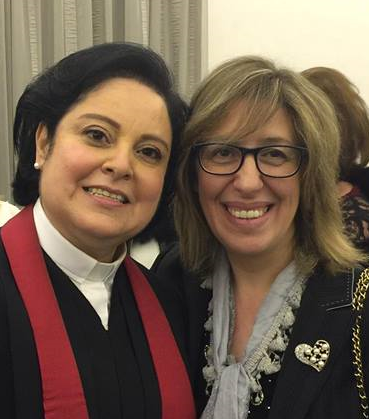
Images from top to bottom: The Rev. Rola Sleiman, and The Rev. Najla Kassab and Hala Bitar (who’s been ready to be ordained for several years.)

Raised Right

Sister, you know what’s right.  Just do right.  Maya Angelou

To be “raised right” at least in the South used to mean that you knew not to wear white before Memorial Day.  To be raised right meant that you wrote thank you notes and gave your seat to your elders whether that seat was on a bus or somebody’s livingroom.

I once knew a lifelong church member who conflated good manners with righteousness.  She took it upon herself to teach etiquette to her Sunday School class of elementary school students. Three of her students had found their way into Sunday School without their parents, so she assumed that those particular children weren’t being raised right.

She believed that social graces were more important than God’s grace.

Unfortunately the students in her class learned some unfortunate teachings.  They learned that some church people value actions that make you look good over actions that make your soul good, that make the world good – or at least better.  Eventually they all left our church and if they ever connect with a church again it would be a miracle.  They were children who needed a community that loved them unconditionally, a community that taught them that God loves them unconditionally.

This famous video with Maya Angelou is worth the three minutes and 26 seconds you’ll spend watching it.

Right might not be expedient, it may not be profitable but it will satisfy your soul.

Doing what’s right is an essential service during a pandemic, during a hurricane, during a political campaign.  It’s essential if we are going to be the people we were created to be.

“Raise up children in the right way and when they are old, they will not stray.” Proverbs 22:6

It’s not about etiquette. Although I’m a fan of good manners, it’s about doing the right thing.  Today is a good day to do the right thing.

Image is Sister Sookie’s Funeral by Phoebe Beasley 


If You Are Seeking a New Pastor and You Can Do This, Do This

You’ve seen those Galleries of Former Pastors in church buildings:  professionally-taken photos of mostly men line the hallways and parlor walls of church buildings.  Occasionally, there might be a woman, but most of the images are of male pastors who have served Since The Beginning.

These are excellent days to be bold in our faith – especially if we are seeking a new pastor.

Although there are pastor nominating committees who say that they are totally open to The Spirit in discerning their next leaders, they tend to seek leaders who look like their past leaders.  Male. Married to a woman. Skin color matching the current majority of members.

Please don’t tell me you hope to become “a more diverse congregation” and then call someone who doesn’t represent a demographic that affirms that hope.

There are more than 230 More Light congregations in my denomination (i.e. churches working “for the full participation of LGBTQIA+ people in the life, ministry and witness of the Presbyterian Church (USA) and in society.”) And very few of these congregations have ever had a pastor who identifies as LGBTQIA+.  This is curious to me.

If our congregation identifies as “More Light” and we are open to calling pastors who can be their true selves as leaders of our church, then why aren’t we calling LGBTQIA+ pastors?

The majority of our congregations in my denomination are White.  Most are 100% White.  If everybody in your community/town/county is White, then your congregation will be 100% White.  Of course.

And if our communities are increasingly Black, Brown, Golden, or a mixture of all skin colors, and we are serious about “reaching out into the community” then why haven’t we seriously considered calling a pastor who doesn’t look like the majority demographic?  

If you are a congregation who can call a Queer pastor (in a majority Straight church) or Brown pastor (in a majority White church) or a Spanish-speaking pastor (in a majority English-speaking church with Spanish-speaking neighbors) or a Korean-speaking pastor (in a majority English-speaking church with Korean-speaking neighbors) then please do it.

You are the ones who can actually do this.  So please do it.  And if you – predominantly straight White English-speaking churches – are looking for great candidates who happen to be LGBTQIA+ or People of Color who speak multiple languages, contact me today.  I will introduce you to some of the finest pastors in the world.

Image of the Wall of Fame found in a wonderful church in Grand Haven, MI. This post is inspired by SB.