Why I Write Letters to the Children I Baptize

A few days after my mother died in 1988, we were cleaning out her closet – which felt like a breach of privacy. But it proved to be a treasure chest of joys.

First – it smelled like her.  Her clothing would not keep the scent of her perfume forever so we breathed it in while we could.  We found Christmas gifts she had already purchased. (It was September.)  And – best of all – we found letters written to my siblings “to be opened on their 16th birthdays” written by the Rev. Wilkes Macaulay on the days of their baptisms.

Mom had forgotten to dole them out on C, M, & S’s 16th birthdays, but we had them now.  (I had been baptized by his predecessor.) Wilkes had written each letter about their baptism in hopes that – at the age of 16 – they would have confirmed the vows made for them when they didn’t yet know that they were loved by God.

Wilkes had just preached at Mom’s funeral and – unbeknownst to us – he would also preach at Dad’s funeral less than two years later, even though he was long retired. It was an immeasurably precious gift to us.

Because of that discovery of letters in Mom’s closet, I decided that I, too, would write letters to the children I baptized to be opened on their 10th birthday – believing that 16 was too long to wait.

I wrote baptism letters about who was there and what was promised and I included other details:  if they wore a special family baptismal gown, how I met their parents, if they’d laughed during the sacrament.  I would also tell them that, “now that they were ten and making some decisions for themselves, I hope they would also make faithful choices about who or what they would worship in their lives.

Heavy thoughts for a ten year old, but I’ve found ten year olds to be wise and thoughtful and ready for some deep conversation.

Several times through the years, I’ve received letters from ten year olds telling me that they opened my letter and giving me an update on what they are doing these days.  “You’ll be happy to know,” wrote one ten year old in 5th grade cursive, “that I have a really good life and my brother is not so bad.

Wilkes Macaulay was a pastor’s pastor.  Our families have known each other for over 60 years and we have experienced everything from church camp to weddings to funerals to conferences together.  While he was the pastor of the church of my parents’ and grandparents’ and great-grandparents’, my Aunt Jane headhunted him to be her pastor down the road.

Wilkes died yesterday in North Carolina at the age of 91 and he leaves behind a rich legacy of love and generosity.  He was one of my models for ministry.

I look forward to baptizing a baby this coming Easter Sunday – the daughter of two clergy friends who have their whole lives in front of them.  And I’ll be writing a letter about that day for A in hopes she opens it on her tenth birthday.

Thanks be to God for life and death and resurrection and hope – even in dark days.

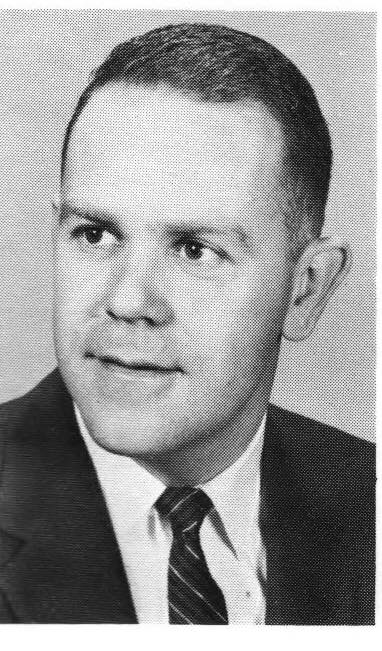
Image of Wilkes Macaulay (thanks Clay) when he was a young pastor in NC.  Much love to his wife, children, and grandchildren.

Women Need to ‘Step Up’?

Short post today as I head to the Association of Presbyterian Christian Educators Annual Event in Louisville.  [Note:  Some of the most brilliant women I know are members of APCE.]

When Recording Academy President Neil Portnow explained that more women didn’t win Grammy Awards this year because women need to step up.  Apparently he doesn’t know that many of those steps have been blocked for women, and not only in the music industry.  Today’s a good day to point a gifted woman or girl towards the  staircase going up to the next floor.  Or just move the barriers.

Have a good Tuesday.

We Will Disappoint You

There’s a great article in the newest issue of The Presbyterian Outlook by Victoria White (which you’ll have to subscribe to here if you want to read it) about the fact that we clergy people will disappoint someone this week.  It’s not something I ever heard about in seminary, but the truth is that:

  1. Church Members will – sooner or later – be disappointed by their congregations.
  2. Pastors will definitely disappoint their parishioners (and probably their own families.)

Good leaders will both embrace this reality and talk about this reality in the hopes of creating healthy boundaries.

Examples:

  • A couple I loved requested a spring wedding date and I happily agreed to officiate, overlooking the fact that our TBC’s birthday was also that weekend. My compromise involved officiating at the wedding but not attending the reception. I disappointed both the couple with whom I was very close and TBC who had hoped to celebrate all weekend with the family.
  • A parishoner left multiple voice mails in my church office asking me to get back to her even though my outgoing message stated that I would not be in the office that week, so please contact another staff member with emergencies.  She was furious that I was not returning her calls and she was not willing to talk with anyone else on staff.  What she didn’t know was that I was in court with another parishioner from 8 to 5 brutal hours every day that week and telling her that I was in court with a parishioner was too much information to share and none of her business.  I disappointed her that week and she never let me forget it.
  • As one of two Co-Moderators of the PCUSA right now, Denise and I receive multiple invitations for the same dates – often because many of the Mid-Councils meet on the same Tuesdays and Saturdays.  We cannot humanly accept every invitation even though we are told that we will disappoint people if neither or us can attend their anniversary/special event.

Disappointment is part of professional ministry just as it’s a part of any relationship.  As Victoria White notes in the Outlook article:

“The church needs to be in conversation with me about my schedule just as much as my family does.  I have found that many times churches are flabbergasted when they find out how often the minister chooses the church over their family.”

This is a recipe for resentment, my friends.  It’s healthier to talk about what’s needed to nurture strong family and social relationships and what’s needed to nurture strong work relationships.  Balance and boundaries make for a happy ministry together.

And if you hear someone in church grouse about how ____ is never available, I hope you’ll remind that person that even pastors have to prioritize their time.  We cannot possibly be available to everyone. (The pastor/leader is not God.)

Image source is unknown but this sculpture is everywhere in the public realm.

For God So Loved the World, God Didn’t Send a Committee

Ministry happens when committees, commissions, boards, and teams work with leaders to get things done, right?

This is how it’s been done for generations but – increasingly – committees are difficult to fill and the differences between those committees and “teams” are merely semantic.  Two conversations yesterday inspired me to notice how community organizing is replacing committee work to carry out effective ministry.

TBC met with former U.S. ambassador to the United Kingdom Matthew Barzun yesterday who inspired her and other graduate students about using their power for good.  (Using our collective power is essential in community organizing.) She left energized to study, work, and encourage others to make a difference too.  She has become an evangelist for life-changing ideas and developing relational power.

The Stated Clerk of my denomination has said that his hope is to shift us from committee-izing our ministry to organizing our ministry.  Nobody joins a congregation or other non-profit in order to attend committee meetings.  But we are inspired when invited to join a movement that makes organic changes that enhance human life.

There will always be a need for meetings to organize ourselves for action.  But the actions we seek are those that offer deep nourishment and substantive changes in the way we live.  What if we saw the mission of our work through that lens?

Instead of holding meetings of committees with a “have to do” agenda, what if we organized ourselves as being part of a movement?

Marching Because . . . Jesus

Over the weekend, there was a March for Life on Friday and a Women’s March on Saturday. The first was generally touted as a Christian gathering.  The second was generally reported as a secular event.  Although NPR noted that there were Christians at the Women’s March, most secular media did not report both events as acts of religious devotion.

But for many participants, they were indeed acts of religious devotion.

Of all the people I know who gathered in various cities for The Women’s March, most of them were marching because of Jesus.

Jesus didn’t say anything about abortion per se.  He said nothing about bearing arms and in fact, he chastised Peter for slicing a Roman slave’s ear the night of his arrest.  Jesus didn’t say anything about homosexuality.

Jesus did say this about the hungry, the homeless, the naked, the stranger, and the imprisoned.

Jesus said this about touching the untouchables.

Jesus said this about greed.

(And I could go on, but you get my point.)

I was asked in an interview once if – as a pastor – I would ever participate in a march on the National Mall, and I answered that question with another question:  Are you asking me if there’s anything I believe is worth marching for?  If so, that would be a big yes.   Isn’t there anything you would stand up and march for (or against) as a follower of Jesus?

  • My faith in Jesus demands that I speak up about injustice.
  • My faith in Jesus demands that I stand with the people Jesus stood with – the ostracized, the untouchables, the sick, the imprisoned.
  • My faith in Jesus requires that I not look the other way or say “that’s just the way things are” or “it’s none of my business” when I see or hear hatefulness.

It’s not just my job as a professional minister to notice the world’s suffering or to work to make earth as it is in heaven or to be Jesus’ hands and feet in this life. It’s my responsibility as a baptized member of Jesus’ Church.  (And if you are baptized, it’s your responsibility as well.)

I often hear that some preachers are too political.  The truth is that – as my RevGalBlogPals family notes – the pastoral is political.  Jesus was crucified because he was political.  And several of his followers were killed for being political in his likeness – from the first disciples to Bonhoeffer to King to countless others.  Each was speaking God’s Truth – and they paid for it with their lives.

Yes, the pastoral is political but Scripture is an equal opportunity offender in terms of Democrats, Republicans, Green Partiers, or Libertarians.  This is  especially true today in our politically torn country.

I trust that many of those who marched on the anniversary of Roe v Wade were led to march by faith.  I trust that many of those who marched on the anniversary of the inauguration were led to march by faith.

I also believe that Jesus would never call someone “an illegal.”  Actions might be illegal but people are not.

I believe that Jesus would take in refugees.  His own parents were refugees who fled to Egypt when he was a baby.

I believe that Jesus loves people that we are uncomfortable loving.  He regularly was a guest in the home of “unclean people” and I wonder if we are as willing to hang out with people we consider to be “unclean.”

The press often doesn’t know what to do with people of faith.  Yes, Friday’s march involved many people of faith.  But Saturday’s march involved many people of faith as well.

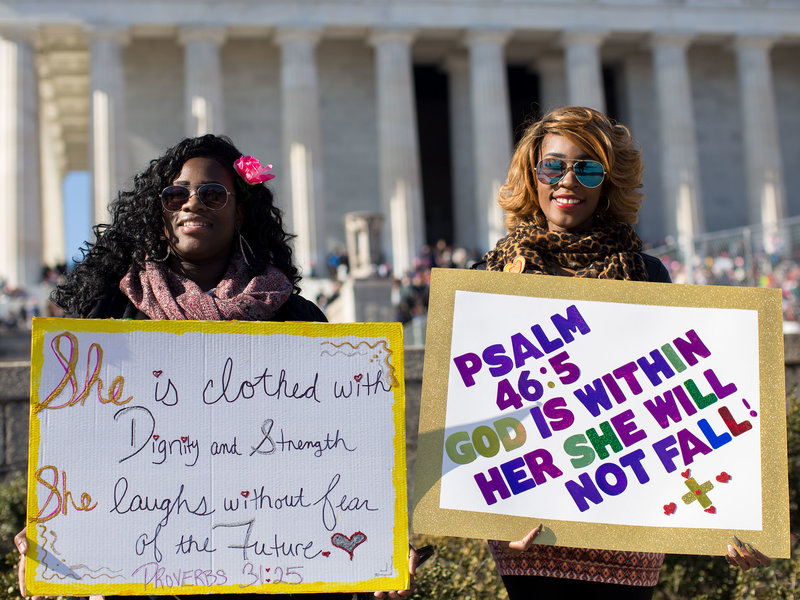
Image source here of women marching in Washington, DC on 1-20-18.  PS – Marching is one act of spiritual devotion.  Contacting members of Congress, voting, volunteering for non-profits that address human needs, and giving money to those organizations are also acts of spiritual devotion.  Pick one to offer today, in faith.

Missed Opportunities: Go Gumshoes!

SBC and I deeply bemoan the fact that the School Board of Joliet, IL missed a once in a lifetime opportunity in 2013 when they dedicated the Lynne Thigpen Elementary School – named for the wonderful actor Lynne Thigpen – and failed to name the mascot The Gumshoes.  Come on!  It was so obvious!  

Imagine that every science class, every art class, especially every geography class (!) doing their work as “gumshoes” – detectives committed to discovering the answers!  Where in the world is The Sphinx?  Machu Pichu? The Mona Lisa?  Honestly, this is among the worst missed opportunity I can imagine.

But I see this every day in Church.

  • A congregation meets – literally – beside an elementary school with a large free and reduced lunch population and they have zero relationship with that school.
  • A march is scheduled outside an urban church building and the elders decide to close the building that day (to prevent strangers from entering) rather than serve water and coffee out front and let guests use their restrooms.
  • The church building has a fellowship hall that nobody uses Monday – Saturday and there are homeless people sleeping in the streets.

I could go on and on.  We – as the Church – need to work on our own gumshoe skills to figure out how we might serve those in our community.  Sometimes the clues are so obvious.

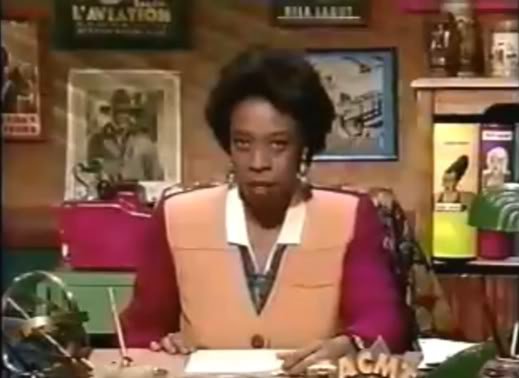
Image of Lynne Thigpen as The Chief in the television show “Where in the World is Carmen Sandiego?”  She died suddenly in 2003 and her hometown named their newest elementary school after her in 2013.  (But they missed the boat on naming the mascot.)

A Two Part Dream


Thanks to my friend SP-B, I have a two part dream today:

  1.  That all families – not just families with Black and Brown children – will have The Talk.
  2. That one day there will be no need for The Talk.

We – White People – need to talk about these things with our White children and remind them that racial bias is real.  Maybe one day it won’t be.

This Proctor and Gamble commercial was first broadcast last summer. It was also broadcast at the end of Blackish this week.  It should be shown during every newscast and sports event on every channel until we don’t need it anymore.

I Like My Steak Medium and My Church Well Done

[Note: Apologies to any vegetarian and vegan readers.]

“Medium” is my go-to for all meats:  salmon, burgers, pork, steak.  “Medium Church” – not so much.

I’m not sure what to say about a Rare Church today except that Well Done Church also seems to be Rare.

This is not to say that any Church perfectly executes their ministry.  The appearance of “Perfection” seems a little fake anyway.  I find that a Well-Done Church has the following distinctions:


  1.  Authenticity.  People genuinely care about each other more than they care about appearances.
  2. Curiosity.  People want to learn more – about God, about their neighbors, about themselves.
  3. But Curiosity is Not About “Getting Smarter.”  Often we seem to go to our Bible studies, our book discussion groups, our speaker series and then we go home smarter, but nothing changes.  A Well Done Church acts upon what they’ve learned together.
  4. It’s about God.  You can feel it.
  5. There is laughter.  It’s funny (not humiliating) when mistakes are made from the pulpit or in the parking lot.  No shaming and blaming.
  6. Things flow.  Although the Holy Spirit makes this happen, leaders also work together well to create worship that moves through the liturgy smoothly, lifting up special themes and foci.
  7. Hospitality is genuine and the circle is wide.  (This is sadly rare.)  We who think we are friendly are usually talking only to our friends.  The heavily pierced guy or the unfamiliar woman of a certain age sitting alone or the tall trans lady don’t experience hospitality in many congregations.

Although it’s easy to make a Medium Steak into a Well-Done Steak, it’s not easy to shift a Medium Church into a Well-Done Church because the issue is DNA rather than temperature.  Both take time.  But shifting a congregation’s DNA or culture takes an enormous amount of time and a particular devotion to make that shift.

It happens only by focussing on God and figuring out who God is calling us to be as The Church in our particular context.  It will involve people leaving.  It will involve hurt feelings.  But it will mostly involve a vision so clear that we cannot help but move toward it.

It’s monumentally easier to order a rare steak and be done with it.

Start with Uber

Not every community has Uber and some who do are still angry with them.

But I’m trying to figure out how White People might connect with people from other cultures when all their friends, family, and colleagues are also White.  Maybe we could start with Uber if it’s in your area.

My last four Uber drivers were from Jerusalem, Tunis, Addis, and Karachi respectively.  Three were Muslim.  All four were proud fathers.  Three were college graduates.

When I take an Uber from Midway Airport in Chicago to my home in the South Suburbs, I have a good 30 minutes to get to know my driver.  Weirdly, I don’t talk with people on planes, but when I’m in a car and there are just two of us, it feels bizarre not to talk with my travel companion.  Sometimes I sit in the front with the driver.  Sometimes I sit in the back, especially if the front passenger seat is filled with the driver’s stuff.

By the time we pull into my driveway, we have often shown each other photos on our phones of our kids.  A couple times we’ve prayed.  We shake hands and move on.  We exchange words of gratitude for the other. It’s very friendly.

It’s also impossible to leave the car denigrating “all Muslims” or “all immigrants.”  I’ve loved catching a glimpse of the lives of my neighbors.  I’ve appreciated the gift of hearing their stories.  I’ve marveled at how our lives are similar. There is almost always a connection.

We need to get our of our little lives and notice people whose accents, skin color, ages, and lifestyles are different from our own.  Often they are invisible to us.  Or their presence makes us shut down and keep to ourselves.

What if instead of fearing/ignoring/keeping away from people who are unfamiliar or different from us, we took the opportunity to learn something from each other?  Curiosity is an excellent tool for expanding our universe.

If not Uber, what would you suggest?


Religion and Politics and Words

Audience, Stage, Performers?Congregation, Chancel, Choir?

Spectators, Arena, Cheerleaders?

The different words we use to describe a worship gathering might illustrate semantic differences, or they might speak to our theology of worship.

Yesterday in the news, President Trump described a meeting with these words:  studio, performance, reviews.  Usually those words are used for television shows or stage acts, and political commentators made note of it.

People who have never crossed the threshold of a church building are more likely to see an audience and a stage and singers if they happen to stumble into a Christian worship gathering.  That makes sense.  Maybe most people seeking spiritual community would describe it that way.

On the one hand, we lifelong church people need to recognize how unfamiliar our language is to people who don’t do church.  But on the other hand, we need to recognize why we do what we do and hope our language describes what’s really going on.

Preachers, liturgists, church musicians and church singers are not performers – although all of us want to shine.  Charismatic spiritual leaders attract people.  But the deeper reasons why we lead in worship is not about us.

The same is true in politics.  Our political leaders are not performers although we gravitate towards charismatic leaders.  But the deeper reasons why they govern is not about them.

Maybe Oprah will run for president and maybe she won’t.  Some would say that she is already a spiritual leader.  But she – and all of us – were created for something bigger than ourselves.  I believe that God is watching us and notes who is being served.

Image from Architectural Artifacts in Chicago.