Hello Personnel Committees: When We Treat Our Staff Well, Amazing Things Happen

Dan Price of Gravity Payments (a credit card processing company based in Seattle) is one of my heroes.  Three years ago, he made it company policy that the minimum wage in his organization would be 70,000 annually – which is a liveable income in Seattle.
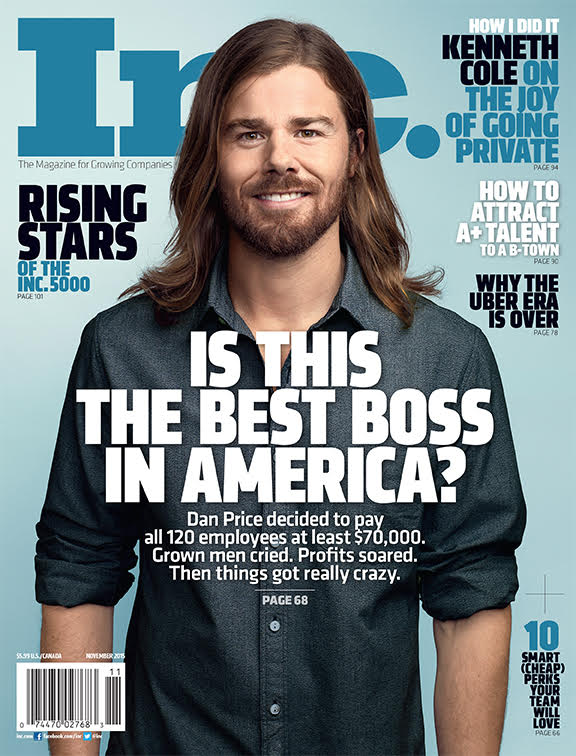
He didn’t intend to change the world” according to this article, but other companies paid attention.  When we treat our colleagues well, the organization benefits too.

Why?  You know why:

  1. People perform better when they are appreciated.
  2. People enjoy working with teams of trustworthy, encouraging, generous colleagues and supervisors, and happy staff = happy organization.
  3. It’s easier to hire  people when the office has the reputation for being a healthy place.
  4. Retention rates are high in happy organizations.

Although it’s self-serving, paying staff members generously (in salaries or benefits) might just increase profits as it has done for Gravity, Pharmalogics Recruiting, and Tower Paddleboards. (Read the article.)

For non-profits, money is often tight – yes – but there are other ways a church or denominational staff might know they are appreciated:  grant bonus days off, throw a surprise appreciation luncheon, give a small gift card after an especially difficult project or season.

If you find yourself on a Church or denominational Personnel Committee, ask yourselves:

  • Do we know what’s going on for the staff members we oversee?
  • What do they love about their work?
  • What’s driving them crazy?
  • What’s each staff member’s favorite beverage/ice cream?
  • Do we respond promptly when they have requests?
  • Are we keeping them in the loop?
  • When was the last time we said “thank you”?

Occasionally we in the Church take our best people for granted. Yes, we seek to hire and be servant leaders.  But the One whom we ultimately serve was quite lavish with the love.

Image of Gravity CEO and White Jesus lookalike Dan Price.

 

Millennials Don’t Buy Napkins?

I’m suspicious of any article that claims that Boomers love this or Gen Xers hate that.  I know Millennials who appreciate a nice napkin in spite of what Business Week says. 

There are solid reasons why younger generations are not buying houses, diamonds, or NFL tickets.  Craft cocktails might indeed be pushing beer out of favor. But this list also speaks to why Millennials are not as interested in joining the local church.

According to the Business Week article, “millennials are killing” these institutions (and there are church implications):

  • “Breastaurants” like Hooters.The number of Hooters locations in the US has dropped by more than 7% from 2012 to 2016.”  Could this mean that Millennials expect equality for women in ways that older generations have not?
  • Casual Dining Restaurants like Applebee’s. “Millennial consumers are more attracted than their elders to cooking at home, ordering delivery from restaurants, and eating quickly, in fast-casual or quick-serve restaurants.”  Could this mean that Millennials prefer quick in-and-out gatherings or intimate (like home) gatherings?
  • Bars of Soap. “Almost half (48%) of all US consumers believe bar soaps are covered in germs after use, a feeling that is particularly strong among consumers aged 18-24 (60%).  I have no idea what this means re: Millennials and the Church.  Pump soap in church bathrooms?  If only it were that easy.
  • Fabric Softener.  “According to Downy maker Procter & Gamble’s head of global fabric care, millennials ‘don’t even know what the product is for.’”  Millennials who didn’t grow up in church also do not know what baptism, communion, or coffee fellowship is for.
  • Gym Memberships. “While millennials like to workout, they’re ditching gyms in favor of class-centric centers.”  Spontaneity is key. Trying a class here and there rather than “joining” is a better fit.

Am I nuts to believe that Millennials still like breakfast cereal?

We in The Institutional Church are wed to many features that are decreasingly comfortable or meaningful or important to younger generations.  Are we willing to adapt how we are the Church for the sake of sharing the message of Jesus with those who are no longer (or never have been) with us?  I hope so.

It’s Still About: “What Do You Want to Be When You Grow Up?” (OR: How to Do an Excellent Personnel Evaluation)

I love everything about this post by Casey Thompson. 

Evaluation is not just a way to gauge the effectiveness of a ministry so that it might be tweaked toward perfection. Evaluation actually subverts the forms of our ministry. It actually returns us to the theological question at the heart of vocation, a question so fundamental that we start asking first graders so they’ll have enough practice answering it by the time it becomes pressing for them: “What do you want to do when you grow up?” How do you want to spend your time?

I remember sharing the following answers when asked as a child, a teenager, and an adult  “What I Did I Want to Be When I Grew Up?“:

  • An explorer
  • A writer
  • An architect
  • An athletic director
  • A tour guide
  • A hospital chaplain (because I was too scared to say “a pastor”)

The extraordinary thing is that I’ve done all those things in one way or another. (Hello professional ministry.)

In my professional life, I’ve both administered personnel reviews and been reviewed by others.  Among the worst personnel reviews I’ve observed or heard in over 30 years of professional ministry have included these general perspectives:

  1. You don’t do things like I do them, so you are incompetent.
  2. You don’t read my mind.  Why not?
  3. I just don’t like you.  Please go away.
  4. You are threatening me.  Please go away.
  5. I could do your job much better than you can.
  6. I need you to take the fall for that.
  7. We can’t afford our current staff, so plan to do your job and those other jobs, but we won’t be paying you any more salary.
  8. Things aren’t going well.  It must be your fault.
  9. We don’t exactly know what you do, but we assume you are not doing it.
  10. Because that one (powerful /cranky/scary) person is not happy with you, none of us are happy with you.

What I love about Casey Thompson’s post is the ingenious proposition that “evaluation actually subverts the forms of our ministry.”  Instead of grading by traditional metrics (Hmm.  Financial giving is down? Clearly you are not doing your job)  there is conversation about whether or not this is what you wanted to do when you grew up, if this is how you are called to spend your time.

It’s a variation on the question:  Did Jesus die for this?

  • Healing broken people, pointing out life’s awesomeness, plotting resurrection, connecting with the Holy:  yes.
  • Picking paint colors, arguing about money, keeping an institution alive:  no.

Here are some great questions to consider in the next personnel evaluation you are doing/receiving:

  • What gives you life about your work?
  • What keeps you from doing your best, most positive work?
  • How do you partner with others?  (Consider this with each person on our staff.)
  • How does this work play to your strengths?
  • What is soul-sucking/playing to your weaknesses?
  • How are we supporting you and what could we do to support you more fully?
  • How is your work bolstering trust and hope in our organization?

I would love to be asked these questions.

As I look to my own future, I am pondering what God is calling me to do next professionally.  It’s common for the Moderator (or Co-Moderator) of my denomination’s General Assembly to move on to a new call after the Moderatorial term ends and I’m starting now.  Things I still hope to do when I grow up?

  • Explore – what is God doing around here?
  • Write – process what God might be doing in ways that might resonate with others
  • Design structures – consider adaptive, transitional, healthy, safe structures to serve as tools for future ministries
  • Direct athletics – oversee the games and call them when necessary
  • Be a tour guide – point out cool features that some don’t notice right away; tell stories
  • Sit alongside broken people – because others have sat with me in mine.

I covet your prayers as I discern what’s next.  But in the meantime, let’s be more intentional in how we help others discern what they will do as they grow up too.

Image from the Jobs Page of the Yerba Buena Center for the Arts in San Francisco.  The art is Pleasure is Freedom by Favianna Rodriguez (2016)

Mouth-Gaping Awe

 ‘We have never seen anything like this before!’  Mark 2:12

Photos don’t do it justice.

HH and I drove five hours through the night Sunday and Monday to Carbondale, IL to see the total solar eclipse of 2017  – which, by cosmic favor, will also be blessed to have the total solar eclipse in its sky in 2024 as well.  

It took 13 hours to get home. Thirteen. Hours. But it was worth it.

It’s rare when we see something that we can’t sufficiently describe – unless we are Annie Dillard.  And it’s even rarer when we see something we’ve never ever seen before.  Those are the holiest of moments:  the first seconds of a child’s life, the last seconds of a beloved parents or spouse’s life, a total solar eclipse which light both high in the sky and all around the souls observing it.

I have never seen anything like that before.  A day later, I realize I need to process it a bit more.  It was as if I was in the presence of something holy. Especially when we see so many ordinary and unholy things, it takes a while – at least for me – to fully grasp it when I’ve seen something so extraordinary.

It’s not something I could fully imagine before yesterday, but it was so cool that I’d like to see it again.  Sign me up for Carbondale 2024.

Human Beings are longing for this kind of holy moment, I believe, even if we can’t put our finger on this deep desire.  We are so distracted or exhausted or depressed that we forget that Holy is something we can experience.

Strangers wander into church buildings occasionally hoping against hope that they will experience a connection or a cosmic breakthrough because they might just die without it.  But we can’t make those moments happen.  (Exhibit A:  The Darjeeling Limited.)

I have no idea what it was like for a bunch of people to witness a paralytic man being lowered through the roof (i.e. was it even okay to put a hole in somebody’s roof even for the sake of the Gospel?) much less observing him walk for the first time.  But I believe with all my heart that if we expect such miracles, they happen more often in our presence.

Preparing to experience awe is not something I do everyday.  But I’d like to do it more often.  What I’ve seen in Jesus’ Church over my life has included some breathtakingly holy moments.

Maybe preparing God’s people to experience awe is one of the things we are called to do more often.  And when we expect awe, we experience more of it.

PS – My appliance repair professional was just here to fix our icemaker and we just had an awe-filled conversation about his childhood.  I think I’ll just go have a little cry and pray now.  God is unspeakably good.

Image is from Southern Illinois University in Carbondale taken yesterday.

Preaching on the Solar Eclipse (Or Not)

From noon until three in the afternoon darkness came over all the land. Matthew 27:45

I was getting my car washed last week when I thought I overheard a woman say she was Presbyterian. Of course, my ears perked up.

Me: Did you say you were Presbyterian?

Carwash Lady: No, I was asking about participation at school.

Me: Oh. Sorry. I’m a Presbyterian. (In my head: what is wrong with me?)

Me: I’m a pastor. (In my head: nobody cares that you are a pastor.)

CL: Are you preaching on the solar eclipse this week?

Me: Um. No I’m not.

CL: Well, why not? You know a solar eclipse happened during the crucifixion of Jesus. If my preacher doesn’t preach on the solar eclipse this Sunday, I’m going to get up and leave.

Me:

Then her car was ready and she didn’t stick around to finish the conversation, thank goodness.

Three things:

  1. It never occurred to me to preach on the eclipse.
  2. I don’t remember the Bible mentioning an eclipse during the crucifixion.
  3. If there was an eclipse during the crucifixion, it was a doozy: 3 hours long as opposed to (at its darkest point) 2 minutes and 38 seconds in Carbondale, IL where HH and I will be today.

I’m told that observing this eclipse will change my life. I really hope that’s true.

I’ve also been told that the crucifixion of Jesus has changed everybody’s life, whether we acknowledge it or not. God loved us enough to die for us. And I totally believe that’s true.

Happy Solar Eclipse Day.

Back to School – It’s a Beautiful Thing

As a child growing up in a college town, my favorite time of year was the week The Students came back.  Franklin Street was crowded again and restaurants were full and everyone was excited.

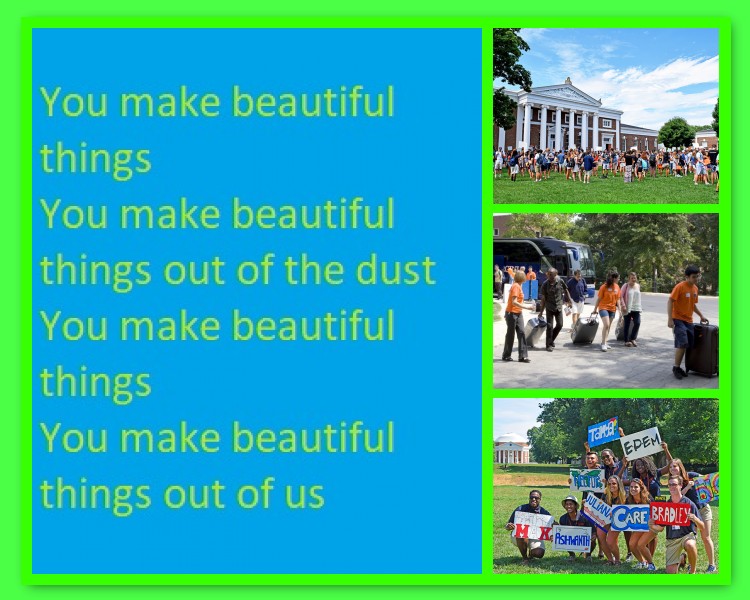
This is the week that students return to the University of Virginia in Charlottesville and it’s a beautiful thing.

Image lyrics are by Gungor.

A Traumatized Bird

Look at the birds of the air; they neither sow nor reap nor gather into barns, and yet your heavenly Father feeds them.  Are you not of more value than they? Matthew 6:26

On my way to church a couple Sundays ago, a male cardinal was stuck in the breezeway between our house and garage.  He swooped by my head as I was locking the kitchen door to go out and he was terrified.  I was not exactly a picture of calm myself. #OutOfNowhere

I opened the back door to help him fly out.  Then I opened the front door and he escaped. But you can tell from the photo – if you look closely – that he was feeling a bit stressed. His crest looked like a bad hair day.

This morning we had a totally bald cardinal at our feeder.  He looked like a tiny buzzard tentatively chomping on black sunflower seeds.

The online ornithologists out there said that he could be a victim of parasites or – more likely – trauma.  Maybe this bird was the one in our breezeway or maybe not.  But I can imagine that the trauma of banging up against glass doors for God-knows-how-long would cause one’s feathers to fall.

Trauma damages us too.  There’s no doubt about it.

I believe that a strong 21st Century Church will need skills in loving and serving the traumatized.  Whether our communities include war veterans, cancer survivors, abuse victims, addicts, families of addicts, or any other neighbors carrying heavy burdens, we are increasingly living among people who need lavish love.  We are increasingly called to reach out to the isolated and lonely.  We need tools for recognizing mental illness.  We need to understand the systems that perpetuate traumatization.

Who says the Church is irrelevant?


When Was the Last Time You Were Scared for Your Life?

When asked if she was more fearful of this past weekend than when she was as a little kid watching a KKK march, she replied, “Absolutely, I was.”  (Interview with the Rev. Traci Blackmon about Friday, August 11, 2017 in Charlottesville, VA)

I was home alone during Christmas break my first year of college when someone tried to break into our house in broad daylight.  He knew I was inside. He saw me through the window and I saw him.  He went from door to door, window to window trying to get in.  It was absolutely terrifying.  I called 911 and stayed on the phone until I saw the police car pull into my driveway and I literally leapt into the officer’s arms at my front door.  The guy got away.

On 9-11-2001 I was serving a church just down the road from the Pentagon.  HH was in a car on the way to Capitol Hill when the plane hit and we didn’t have cell phones to touch base. To this day, when I watch historical news coverage from 9-11, my heart starts pounding and I feel paralyzed.

When I heard the Rev. Traci Blackmon speak about the gathering in St. Paul’s Memorial Church in Charlottesville last Friday night, I got that same feeling of paralysis.

The plan was for religious leaders to gather at 7:45 pm for worship the night before a Unite the Right rally scheduled for Saturday.  Traci Blackmon was the preacher. But as the crowd was worshipping, another crowd of mostly white men wielding torches gathered outside the church building chanting Nazi slogans.

We were not allowed to leave the church because of this mass mob that was out on the streets with torches,” she said.

There are protests.  And there is terrorism.  This was terrorism.

When was the last time you were terrified to the point of fearing for your life? This is what we are dealing with here.  Supporting white supremacists is not just about threatening our way of life.  It’s about threatening life.

Please speak up against this kind of hate – especially if you are a white person and you voted for President Trump.  More than anything else God has ever called you to do, God is calling you to do this today.

Image from The Times of Israel of white supremacists outside St. Paul’s Episcopal Church across from the University of Virginia in Charlottesville on Friday, August 11, 2017.

Have You Stopped Watching the News? Or . . . Why Should We Care If We Aren’t Wahoos?

I have friends and family members who have “stopped watching the news.”  It’s too upsetting.  It’s negative.  It’s unending.  It’s loud.   While I kind of understand this, I also believe it’s a luxury granted only to those who are not touched personally by pain.

Our TBC is a University of Virginia graduate and we have cried with her over the sight of angry young white men wielding torches and chanting “Blood and Soil” on the campus that was once her home. She saw people she recognized in the news footage.  HH and I have friends who were roughed up while singing hymns.

HH and I have wondered if we would feel so enraged if we didn’t have a personal connection to Charlottesville.  I hope we would.

It’s true that human beings are more distraught over tragedies when we have a personal connection or when we can imagine the tragedy happening to us.

It’s also true that institutions like the Church have been complicit in creating systems of racism and the only faithful choice now is to break down those systems. “White supremacy and racism stand in stark, irreconcilable contradiction to God’s intention for humanity” and it will not be tolerated.  

@OmanReagan took a clip from the 19 43 US Dept of War propaganda film Don’t Be a Sucker and it’s gone viral post-Charlottesville. It’s essentially a video version of the famous Martin Niemoller speech known as “First they came for . . . “

I wonder how we in Church leadership could have failed so miserably to teach the Biblical message that we are called to care for people even if we are not related to them, even if they are strangers, even if they are enemies.  

What do we not understand about the Parable of the Good Samaritan?  What do we not understand about caring for people we don’t even know?  Who is my neighbor?  The wounded guy on the side of the road.

I wonder how people can so easily forget the name of Tamir Rice who was doing what many 12 year old boys do on a fall afternoon.  He was playing with a toy gun on a playground when police pulled up and shot him within two seconds of arriving at the scene.  The police then handcuffed his 14 year old sister on the ground while her little brother lay wounded.  No one treated Tamir for four minutes.  Perhaps it goes without saying that Tamir Rice and his sister were black.

Can we imagine this happening to a child in our neighborhood?  Can we imagine the outrage if a 12 year old white boy had been shot in a playground in leafy suburb and left to bleed while his teenage sister was handcuffed?  We are talking about a 6th grader and an 8th grader here.

But I’m shocked to talk with people – smart, well-educated people – who have never heard this story because they’ve stopped watching the news.  And the Tamir Rice story is old news.

There are strangers wounded every day that we are ignoring because it’s either too upsetting or it doesn’t concern us personally.

But unless we are aware of what’s going on in the world, we will have no incentive to fight it.  For the love of God – literally – we have got to stand up to white supremacy and gun violence and terrorism.  Someday it could be our own children.  But the point is that today it is our neighbor’s child.

Thanking God today for the lives of three of God’s children – our neighbors – who lost their lives last weekend in Charlottesville, Virginia:  Heather Heyer, Jay Cullen, and Berke Bates.


How Can I Possibly Love This Guy?

“They will know we are Christians by our love.” Peter Scholtes

“By this everyone will know that you are my disciples, if you have love for one another.”  Jesus in The Gospel According to John 13:35

I have feelings of hate for this person whose name I will not type.  I share his photo (left) only to note that while he looks somewhat like David Tennant’s Kilgrave in the first season of Jessica Jones, he also looks like the kind of ordinary person I might sit beside in church or stand in line with at the CVS.  He organized the nationalist rally in Charlottesville over the weekend.  I believe he is spiritually sick.

I also have strong unloving feelings for this person and this person.  I fear what I might do if I was in a room with either of them.

How can we possibly love people whose actions both display and propagate hate? I get it when those counter-protesting the white supremacists and terrorists who showed up in Charlotteville want to return punches for punches.  I get it when they yell epithets over Nazi chants.

But we who follow Jesus are commanded not even to hate the haters.  Jesus didn’t even want Peter to attack the high priest’s servant on the night of Jesus’ arrest.   An infinitesmally few Christians follow this commandment.  I can only think of a handful:  Martin Luther King Jr, John Lewis, all those others who were attacked as they tried to cross the Edmund Pettus Bridge in 1965.

How can I possibly love these utterly broken and sin-sick human beings who have desecrated the Grounds of UVA?  They are certainly not the first to instill utter hatefulness upon innocent people and they won’t be the last.

First, I must recognize that I, too, am a broken sinner with tendencies towards self-righteousness, hypocrisy, and ignorance.  And secondly, I must confess that there is nothing in me that wants to forgive evil or love my enemy … except that Jesus has commanded it.  It’s impossible without God.

And so I look to those who model love in Christ better than I do, hoping that one day I, too, will have the capacity to love those I consider to be evil.  It’s the only way to stop the madness.

It’s the only way to stop the madness.