Let’s Innovate Before We Have To

City WalmartWalmart continues to be the largest company in the world. Love them or hate them, they are not merely amazing innovators; they innovate before they have to.

Sam Walton started Walmart in 1962 but through the years, he was a master of innovation.  In the 1990s, Walmart went into rural areas while Kmart, for example, stayed in the suburbs.

It took Kmart 15 years to plant stores in rural areas.

As I was walking in the Chicago Loop last week, I noticed that Walmart has adapted once again.  Among the sweeping skyscrapers, a Walmart Neighborhood Market stood out on a busy corner.  Also within the city are a Walmart Express and even a Walmart Superstore.  Urban Walmart stores have been around for several years now.  By 2020, Walmart projects that there will be so many stores in the District of Columbia that 64% of the population will live within 2 miles of a Walmart.

So what can we learn as spiritual communities?  Most of our congregations have not brought innovation to our church kitchens much less to our worship practices, our mission priorities or our organizational structures. Why is that?

  • We tend to confuse “traditions” with “customs.”  We don’t want to mess with “tradition” which (we think) means that we don’t want to change the way we do the Christmas pageant.  Actually Advent is a church tradition.  The Christmas pageant is a church custom.  We can change customs to our hearts content.  (Advent, on the other hand, will always be the four Sundays before Christmas and the days in between.)
  • We fear making mistakes.  If our congregation shames people who make mistakes we will never try anything new.  Failure is immeasurably educational, though, and we need to do it more often.
  • We institutionalize customs.  We have a great chili dinner one year and somebody says, “We should do this every year.”  Before you know it, we’ve had a chili dinner for 17 years and nobody likes it much anymore but “we have to do it.  It’s what we do on the last weekend in October.
  • We innovate as as last ditch effort.  (And then it’s too late.) We could have easily restructured our educational program or our leadership model years ago when we had the capacity to make effective change.  But – for whatever reason – we didn’t do it.  Maybe we were complacent or we didn’t want to offend somebody in power or we didn’t see change coming.  But we missed our window and now our educational program or our leadership pool are so depleted that we can’t recover.

Last weekend, I visited a congregation of lively members who were clearly happy to be together, happy to work together, happy to serve.  One member joyfully said, “We never know what’s going to happen around here!”

Exactly.  Innovation is part of their culture.

And innovation is not important for innovation’s sake.  It’s important because the world is changing, our contexts are changing, our populations are changing. Waiting to change the way we are the church doesn’t serve the God who has called us.


Need help innovating?  Here are some ideas to check out.

Everyday Shame (There’s a Miracle for That)

I believe that the Wedding at Cana story is more of a shame story than a miracle Wedding at Cana Daniel Mitsuistory.  (Thank you MP.)  In a nutshell:  Jesus takes what is shameful and creates something beautiful.  Few things in 1st Century Palestine were more shameful than offering poor hospitality to guests (i.e. running out of wine at the wedding.)

Shame trumps guilt every time as the curse that keeps on cursing.

I can’t let go of this story from Chicago last week about the young woman who hid her pregnancy from her parents and was so ashamed/afraid to face them, that she dropped her newborn from her eighth story window.  Imagine the level of terror this 19 year old was experiencing.  She was willing to sacrifice her child in order to spare herself the insults or attacks or shunning of her parents.  Please pray for her as she has been arrested.

When shame is not addressed, it continues.

In a ridiculously incomparable segue, I also believe that many of our congregations live in shame storms.  Congregations remember the days when their choirs went on tour and their pews were filled and their youth programs were brimming with energy.  Some of those same congregations now patch together a much smaller group of singers and rope off the back pews.  There are many, many churches with no children much less any youth.  We lifelong church people might not say so, but to a certain extent, we are ashamed.

It’s not as crushing as the shame of an unwed teenager with conservative parents, but it causes similar fears.  We fear making choices because a “bad choice” could be the end of us. We fear taking risks because we don’t believe we can afford risks.  We cannot joyfully worship because there’s a cloud hanging over us.

Maybe we’ll just cover up the problem and it will go away.

But I’m here to tell that you that Jesus takes what is shameful and redeems it. It’s not just a Bible story.

If you are facing something shameful right now – whatever it might be – please know that there is someone out there who will walk with you.  If you are a congregation on the cusp of closing, know that this is not the worst thing. Water can still turn into wine, in a proverbial sense.  Sometimes dying churches can be transformed, but Jesus is the only one who can do it.  And sometimes Jesus’ people are so loving – no matter what we’ve done or who we are – that our lives can be transformed too.  Shame is never the last word.

Painting of The Wedding at Cana by Daniel Mitsui.

Red Flags

If you were looking for a new pastor, what “red flags” would you Red Flagslook for in hopes of avoiding a poor choice?

  • Doesn’t play well with others?
  • Binge drinks a couple times a year?
  • Has PTSD from an accident?
  • Married his ex-sister in law?

Part of my job involves doing “exec checks” on pastors interviewing to serve around here.  I contact my counterpart where those pastors are currently serving and ask about red flags.

As the pastoral candidate gets closer to being called to a church, there will be other checks: DMV, financial, criminal, theological, “fitness.”  But in the initial check I’m looking for immediate deal breakers.

Here’s what I usually ask:

  • Are there any red flags?  (Seems like a good, basic opening.)
  • Is this a happy person?  (I don’t care if a person has bad days or even depression.  But how is this person’s general disposition?)
  • What does he/she do to serve beyond his/her local congregation? (Tells me if the pastor collaborates with others in the wider Church or in the community.)
  • Is this person teachable?  (Knows-it-all-already pastors tend to be poor leaders for a 21st Century Church.)
  • Is there anything else we need to know about this pastor?  (This would be a good time to tell me she’s got an unaddressed addiction or he burned down the manse.)

[Important note:  Someone is my position can’t truly be a “pastor to pastors”  if I also do “exec checks.” What if I have information shared during a pastoral moment, and I’m asked a question about that issue during an exec check? Boundary problem.]

My question, actually, is:  What Would You Consider a Red Flag for a Pastor? Does it depend on the context?  The pastor’s age?  The pastor’s marital status?  I’d love to hear your thoughts on this.

What should I be asking during Exec Checks?  I’d love to hear your thoughts. What would you want to know about your future pastor?


One Way to Honor Veterans Today

My friend John Dale is an amazing U.S. Veteran.  He continues to serve vets through REBOOT Combat Recovery.  Check it out:

Of the 600+ graduates from their 12-week combat trauma healing courses, not one has died by suicide. A small donation of $22 a month (or one-time gift of $264) provides everything necessary for a military family to complete the course and heal from the wounds of war.

This is one thing we can do to honor our vets that has a positive impact on real people.  Please consider donating here today.

Thank you.

Brothers & Sisters in Christ: What’s Worth Protesting For or Against?

Missouri Protest

In our interview to serve a church in Our Nation’s Capital many years ago, HH and I – candidating as co-pastors – were asked if we would ever “march on the mall.”  One of us followed that question with another question:

Are you asking us if there is anything we would ever protest for or against?

Of course,” we answered.  “We hope we would stand up for what we believed was right.”  Suspicions were already high because I’d kept my own birth name. But as it turned out, the biggest “protest” we attended was an Earth Day Rally featuring James Taylor, Leonardo diCaprio, David Crosby, and Carole King and – honestly – we were there for the music, no matter how much we love the planet.

I’m far from being a brave marcher, unlike my colleagues getting arrested over protesting government budget cuts.

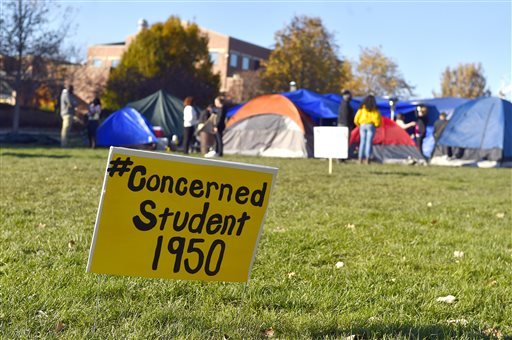
The situation at The University of Missouri is attracting both the ire and the respect of many people.  Two powerful university leaders – in fact the two highest ranking university leaders – have resigned after the football team and many others protested certain administrative actions and the lack of action.

Among the assorted actions protested: Failing to address issues of flagrant racism.

Just 116.5 miles from Ferguson, many people of Columbia, MO had had enough of  racial epithets shouted at Student Body President Payton Head, swastikas painted on a dorm wall, more racial epithets at a homecoming event.  But it was only when the football team refused to play – losing potentially a million dollars for the University – that leaders agreed to step down.

I’ve heard some say that “protests don’t achieve anything.”  Instead, we should be painting houses and feeding the hungry.  But think about it:  is there anything important enough that we would simply stand up in public and say:  “No more.”

This is risky, of course.  We risk offending somebody – maybe somebody in our family or somebody in our church.

But we are called to defend the weak and serve the disenfranchised.  Would we stand up for them for the sake of Christ?

Image from a Mizzou protest. The hashtag #ConcernedStudent1950 honors the year the University accepted its first African American student.

Brene Brown is Messing with My Brain

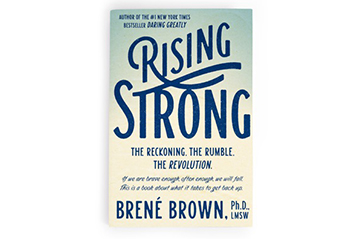
The middle is messy but it’s also where the magic happens.risingstrong

Integrity is choosing courage over comfort; choosing what is right over what is fun, fast, or easy; and choosing to practice our values rather than simply professing them.

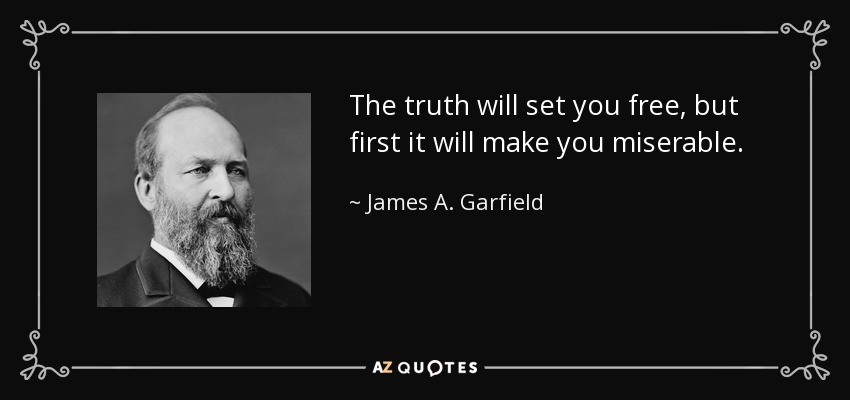
The truth will set you free, but first it will make you miserable.  

Actually, the last quote comes from Jesus and the 20th President of the United States. The first two are from Brene Brown’s new book Rising Strong.

I find myself in The Messy Middle.

God calls each of us, I believe, but I do not believe that God necessarily has a specific call in mind every time we need to make a decision.  Am I called to serve First Church on the Hill or Christ Church in the Valley?  It could be that one of those choices is The One.  Or it could be that God could use me well in either setting.  The point is that I remain attuned to God in all things.

Are you called to fulfill your passion for painting?  Or are you called to develop a passion from the situation at hand – whatever that situation might be?  And then you’ll get to paint.

This article from The Washington Post speaks to the quandary of pursing one’s passion – that rather (misleading) American thing we tell our kids.  The German word for “passion” is leidenschaft which literally refers to resilience.  In Polish, the word is cierpienie which refers to suffering.  Called to suffer doesn’t sound nearly as much fun as called to follow our bliss, does it?

I’ve been called to serve two congregations of churches and one “mid-council” of a denomination.  I’ve been lucky.  It’s been clear.

So what if one’s calling is not so clear?  Questions to ask ourselves:

  • Can we talk ourselves into “feeling called”? (yes)
  • Is a call supposed to feel “right” or is it supposed to feel a little scary? (yes and yes)
  • How do we discern God’s will for us?  (your guess is as good as mine)

There is prayer.  There is the gut check.  There is the pros and cons list.  Long walks help.  Wise council  helps.  Reading Rising Strong helps except when it doesn’t.

In the final analysis, if there is such a thing as following a specific call, I wonder if “it doesn’t matter” is the answer.  God uses whatever choice we make.

It’s just that some choices are so much more efficient than others.  Making a choice that leads to 40 years of wandering in the wilderness sounds exhausting. And yet what if that messy middle – the wandering- is exactly the point?

On this glorious fall day, I’d love to hear about your call.  Does God feel near or far away?  Does your current purpose in life feel courageous or comfortable? Are we practicing what we value?  Or are we spending our days doing what’s fun, fast, and easy?   Discerning minds want to know.

Know Your Cuts of Meat?

Meat Not MeatRemember when David Letterman played the audience participation game called
Know Your Cuts of Meat?   I was impressed when somebody could actually distinguish a Blade Roast from a Tip Roast.

But this post is not about meat.

Important note:  People are not cuts of meat.  Nevertheless, we sometimes treat new people as if they were.  I remember a friend telling me that the first time she visited a certain church and took a seat with her husband and two children, it was as if somebody yelled “Fresh meat!”  One woman asked her after worship if she’d like to teach Sunday School.  Someone asked her husband if he’d like to join the choir.  No thank you.

Our community, however, is comprised of many pieces and knowing as many of those pieces as possible is essential for a thriving ministry.

We could call it Know Your Constituents.  Any congregation serious about ministry inside and outside its walls should be able to identify the segments of people around them:

  • The Neighborhood – Do we know how many students receive free lunch at the school closest to our church building?  Do we know the unemployment rate for our county?  Are we aware that there is a high rate of domestic violence or heroin addiction in our town?  Do we know the names of the people who deliver our mail, patrol our parking lot, or supply our paper?
  • The Staff – Do we know that our office administrator has a law degree?  Do we know that our organist speaks French?  Do we know that our associate pastor grew up in Alaska?  Have we read our colleagues’ resumes so that we can appreciate their experience and background?
  • The Leadership – Have we met our elders for lunch near their workplaces?  Do we know that the Clerk of Session keynoted a national convention last summer?  Have we gotten to know our Deacons well enough to know that one is the retired head of the school board and another lived as a homeless person for two years?

The days are long gone (like 100 years ago) when the pastor was the smartest person in the room.  If we do not know our constituents, we risk underestimating them or making assumptions about who they are and what they know or don’t know.  I remember a new pastor who became so frustrated with his officers that – in the heat of a personnel conflict – he said, “If you don’t cooperate on this, I might consider hiring a lawyer.”  What he didn’t know was that almost everybody around the table was a lawyer.

We need to know our constituents.  Yes, this seems hugely obvious.  But many of us do not take the time or make the effort to know our people – both in the congregation and out in the neighborhood.  And when we don’t, it almost feels like we are treating them as less than fully human.  We see them so superficially that we don’t honor who they are.

Our people – friends and strangers – are assets that can teach us all kinds of things.  Pastors who get this are like gold.

Double Life

All of us lead a double life.  People would be shocked to know our secrets. Post SecretHeck, sometimes we don’t even acknowledge them to ourselves.

It’s hard to get this sad story about the Fox Lake, IL police sergeant out of my mind today.

  • What we thought happened:  The officer called in to report that he was in pursuit of three suspicious people only to be shot and killed (ostensibly by them.)
  • What actually happened: He killed himself in “a carefully staged suicide.”
  • What we thought happened:  He had been a huge supporter of a Police Explorer program that taught youth and young adults about law enforcement.
  • What actually happened:  He had been stealing money from the Police Explorer program for many years.

He adored his wife, he adored his kids, he adored his police Explorers,” a longtime friend said to the press.

I believe this part is true.  I believed his loved his family and the Explorers.  But he also had a shadow side that – tragically – will forever trump the eulogy delivered on his burial day.

Each of us is more than the worst thing we’ve ever done.

But it takes spiritual maturity and intentional reflection not to live a double life. I’m especially talking here to myself and to all my clergy friends, teacher friends, law enforcement friends, and government friends.  When we lead double lives PEOPLE ALMOST ALWAYS FIND OUT.  That sexual affair with somebody else’s partner, that grand mal of a lie we whispered, that cash we pocketed year after year.  And when our double lives are revealed, the layers of damage are thick with impact.

I can’t imagine how devastated that police officer’s spouse and kids are feeling today.  And those students whom he were mentored.  And the colleagues who had presented him with a posthumous Medal of Honor.  And the thousands of fellow officers who lined up along the funeral route in September.

When we were growing up, we always knew he was a hero, but now the whole nation knows him as a hero,” the officer’s brother said at the funeral. Sigh.

But this is all of us, folks.  All of us have stuff we’d rather not bring out into the light.  And yet, we have to try because the darker the secret, the harder it is to be free.

Images from Post Secret.

Q: How Many of Our Congregations are in Transition?

A: All of them.  

oak-autumn-leaf

  • Anxiety about Pretty Much Everything
  • Broken Pipes
  • Change in Pastor’s Family
  • Death of Church Pillar
  • Exponential Growth
  • Flood Recovery
  • Gossip Recovery
  • Haters Won’t Leave
  • Isolationists Won’t Connect
  • Jailed Former Pastor
  • Kids Suddenly Everywhere
  • Lawsuit against Church
  • Malfeasance
  • No Money
  • Outmoded Communications
  • Pastoral Change
  • Quarrelsome Leaders
  • Retiring Pastor
  • Sexual Misconduct
  • Theological Conflicts
  • Unintentional Interim Pastor
  • Victim Complex
  • Worship Style Conflicts
  • Xenophobia
  • Youth Group Crisis
  • Zero Dollars Left in Endowment

If one or more of those situations applies to your congregation, you are in transition.

Transitional ministry training is essential for all 21st Century Church Leaders because all of us are in the thick of it.  Here’s where you can learn more.

Rob Wolcott opened a lecture recently with these words: “Today is the slowest pace of change we will experience in our lives.”  Yep.

Complaining about change us so yesterday.  Tomorrow is about re-tooling ourselves for a new way of being the Church and thriving in it.  Let’s do this.

Brain Science & Leadership

Yesterday, I wrote that I’d like to have a deeper knowledge of brain science so IThe Brain by Katharine Dowson (2005) can be more like Leonardo da Vinci.  Or something like that.

As I write this from St. Louis  – where I’m diving deeply into transitional ministry education – it’s interesting how often brain science is mentioned.

Sisters and brothers, did you know that:

  • Our brains work in an “open loop system” which means that if I sense that you might threaten me, my prefrontal cortex will semi-shut down?  In other words, when we feel safe, our brains open up to be more creative.  (Thank you Rabbi S.M.)  This means it’s hard to be creative in a congregation of people who don’t trust each other.
  • Research suggests that negative emotions are like Velcro and positive emotions are like Teflon?  In other words, constructive criticism sticks to us and compliments slide off us faster than a fried egg glides off a polytetrafluoroethylene skillet .  (Thank you Ivey Business Journal.) This means it’s hard to forget that parishioner’s comment about your “disappointing sermon.”  But we easily forget the parishioner’s comment about how much the funeral homily meant to them.


I’m telling you: this stuff is fascinating.

Positive emotions bring out the best in people and so consider what it does to someone’s brain when he/she lives in constant fear, deprivation, and anxiety.  Or – in Church World – when parishioners believe that their heritage is being taken away or their spiritual practices are being challenged or their sacred assumptions are being crushed.

We. Need. More. Emotionally. Intelligent. Leaders.  

Emotional intelligence is a better predictor of pastoral success than straight As on a seminary transcript.  Emotionally intelligent people better manage their stress, diffuse anxiety, and promote a climate of optimism and adaptability which makes people feel more innovative.  It’s science, people.

Note:  while I’m learning this week, I covet your suggestions for further brain science and leadership studies.  (Thanks.)

Image source.