How We Eat. How We Used to Eat.

beach foodThe H & B Edmistons have been spending a week at the beach together now for 24 years.  We started the year after Dad died since we had sold our family home and needed a place to gather where we could all eat at the same table. This was an intentional move to give the grandchildren and future grandchildren of H & B time together every year without the drama that comes with holidays.  It’s just seven days of regular life – but at the beach.

We are four siblings, our spouses, our 13 children and one nibling spouse.

What we pack has evolved as the kids have been born and grown up.  But the biggest difference is in the food we eat.  Don’t get me wrong:  dessert preparation still amounts to a nightly professional bake-off.  But we are healthier as we’ve learned that kale and blueberries are super foods, and Ranch dressing is not.

Overheard on Day One this year:  “These chips are gluten free.”

These words were neither uttered nor considered in previous years, and it’s not just because we – the oldest generation –  are in our 50s and have gluten issues.  We are trying to eat healthier.

Even our desserts are healthier (frozen bananas) although my sister just baked a cake with Coca Cola as one of the ingredients.

Full disclosure:  we allow “beach cereal” (Cinnamon Toast Crunch) and Pop-Tarts for breakfast for the kids, just this one week.  But most of us eat a lean protein and berries.  Gone are the Oreos – that much is certain.

So, here’s my theological point (because there has to be one):  If the Edmiston family can shift our eating habits over the course of a mere 24 years, imagine how Middle Eastern culture has changed over the past 3000 plus years.

How can we possibly read the Bible without using source criticism, form criticism, textual criticism, historical criticism, rhetorical criticism, canonical criticism, redaction criticism  . . . ?

Naming

Dog 2We may or may not have a new dog to name. Suspense ensues.

On the way to the beach for vacation, we turned a bend on a country road to find a small lab mix eating a recently mashed turtle on the center yellow line. If we hadn’t been paying attention, we would have hit him. TBC’s screams saved his life. It’s the best thing ever to happen to Mr. Sweetheart.

We stopped and waved away other cars/potentially deadly crashers, chased the dog down, wrapped him in a towel amidst much licking and scratching, and proceeded to finding his home. After knocking on several doors and hearing that Mr. Cuteness had been wandering around for a few days, after multiple phone calls to everyone from the sheriff to vets to dog shelters, we took the Lick Master to our no-pets-allowed rented cottage. After wandering, he was clearly happy to be in our garage with regular walks, food, water, and love until we could take him to the local animal shelter this morning.

It looks like we are taking him to Illinois on Saturday unless his owner claims him this week.

And so, now we ponder what Sweet Dog’s name will be. It’s quite possible that friends will adopt him in Chicagoland, but it’s also possible that we will name him. And the suggestions are countless: Chase (because we had to chase him), Jackson (because he was found outside Jacksonville, NC), Onslow (name of the county), Wiley (because he’s slipped out of his collar twice, although we have a friend with that name and don’t want JW to think we named a dog after him.) Between “Who will be this dog’s family?” and “What will his name be?” the suspense is palpable.

What goes into naming a creature? The story goes that Adam was given the privilege of naming “each living creature” and then God named some rivers (Pishon, Gihon, Tigris, Euphrates.) And then the man named the woman.

Bestowing a name is tremendously powerful and holy. As we’ve pondered potential dog names, many have been cast off because:

  • “it sounds like something Gwyneth Paltrow would name a baby.”
  • “it doesn’t sound like something we want to yell outside.”
  • “it’s the same name as a parishioner.”

There are 17,000 to 18,000 new species of animals, plants, and fungi discovered each year and the discoverers are granted the pleasure of naming them. There is a beetle named after George HW Bush and worm named for Nikita Khrushchev. We are just talking about naming one dog.

Leading contender as of the last hour: Spence. Mr. Cuddly/Dr. Dog/Happy’s short life with us has been very Suspenceful.

And since it’s been a cloudy/rainy week so far at the beach, the suspense has been fun.


What If The Thing You Thought Would Crush the PCUSA Actually Leads People to Jesus?

imageWhen the General Assembly of my denomination voted (negligibly) to divest from three U.S. companies in Israel and (overwhelmingly) to approve an authoritative interpretation to officiate in same-sex marriages, there were so many people who were concerned that :

  • Global mission partnerships would be broken
  • Congregations would leave the denomination
  • Immigrant congregations would break from the denomination.

What if all of these things are true and yet . . .

  • Some new partnerships were created?
  • New congregations were planted precisely because of GA actions?
  • Immigrant congregations intentionally sought out a relationship with the PCUSA?

I’m just one person serving one corner of the church, but I’m here to say that – since the General Assembly decisions:

  • Three racial-ethnic pastors have approached me about becoming part of the PCUSA because of recent GA actions
  • Two pastors ordained in a conservative branch of the Presbyterian family have approached me about becoming PCUSA
  • My twenty-something children contacted me after the GA actions to share that their friends want to learn more about the PCUSA because of the recent votes of the General Assembly

What if what we fear actually brings growth and expansion of God’s Kingdom and glory to our Creator?.

ISO Someone Who Knows What I’m Going Through

arbThere are pathmakers in our midst who are original and brave and confident. And then there are The Rest of Us who need people who have traveled our pathways before us. They bring comfort and sometimes they even save our lives.

When our church suddenly and cruelly lost a four year old on Mothers’ Day many years ago, the mother of this precious child said, “I only want one thing: I need to find another mother who has lost a four year old. I need to know that it’s possible to survive this.”

I have found great comfort in knowing women who – like me – lost their mothers to breast cancer just as they were just getting to know their moms as adults. When I lived in Virginia, there was a group of us who understood each other in mysterious ways because we all lost our moms to breast cancer as 20 or 30-somethings. I remember one parishioner in our Moms Dead From Breast Cancer Club dropping by my office one day. As she poked her head in the door, she said, “I couldn’t get you out of my mind this morning. Are you okay?” It happened to be the fifth anniversary of my mother’s death and I believe something moved her to reach out to me. She’d been there.

While I’m a big fan of The Incarnation, I also believe that God works through people who have experienced what we’ve experienced:

  • The person who (maybe like us) lost her spouse leaving her with a young child
  • The person who (maybe like us) has been living with HIV for a long time
  • The person who (maybe like us) has had gender reassignment surgery
  • The person who (maybe like us) has parented a child who had gender reassignment surgery
  • The person who (maybe like us) has a spouse in prison

Yes, support groups are helpful but close relationships in which we can openly share the fears and experiences of our own intimate lives are invaluable. They make us feel like we are not alone.

Maybe you feel like “the only one” out there. But I’m convinced that God will use you to comfort someone else whose story is something like yours. You could be the only person who gets it for somebody else out there.

Image is the Coker Arboretum tunnel in Chapel Hill, NC.

A Skipping Heart

imageAfter my parents died, it was emotional to return to my hometown.  Whenever I  reached the Northgate Mall exit in Durham – a few miles from Chapel Hill – my heart would skip.  I was almost home.

Years later, after living in Our Nation’s Capital for 22 years, it was emotional to return after we left.  When I flew into National Airport, my heart would skip.  The Capitol. The Potomac. It signaled home to me.

So . . . as I flew into Midway Airport yesterday, I’d been sleeping in seat 2E on my Southwest flight when the pilot announced that we would be landing momentarily.  And I opened my eyes to see Lake Michigan over my neighbor in 2F and  . . .  my heart skipped for the first time since I’ve moved to Chicagoland.  After three years, I think I’m home.

Can Things Mean Whatever We Want?

I was wearing this necklace recently and someone asked, “What does it mean?”  I wonder if – because she knew I was a pastor – there’s an assumption that everything I wear (or at least the jewelry I wear) means something.image

If we wear a cross or a Star of David  or a little Buddha (does anyone do that?) people assume it means that we are of that respective faith.

Or maybe it doesn’t mean that at all.  Remember when wearing bejeweled crosses was a thing?  A fashion thing?

I love this necklace.  I bought it because it was pretty and light.  It’s a silver fan, according to the Stitch Fix receipt.  So . . . because it’s a fan – I could create a meaning for it:

  • “It fans me/cools me down/reminds me to slow my pace.”  
  • “It’s worn as a spiritual discipline to remind me of Sabbath.”
  • “It reminds me of my life verse:  ‘For this reason I remind you to fan into flame the gift of God which is in you through the laying on of my hands.’ ”  (2 Timothy 1:6 NIV)

Or I could wear it because I want to.

So it goes in our post-modern culture.

It used to be true that preachers taught doctrine (“This is what we believe . . .”) and now preachers are more like group spiritual directors.  In growing congregations, people come into our gatherings from a wide array of faith traditions/experiences.  The parables of Jesus, for example, are all fraught with meaning, but what it means to the person sitting in worship who grew up Missouri Synod Lutheran just getting out of an abusive marriage is different from what it means to the person sitting in worship who hasn’t been in a sanctuary since he was baptized as an infant.  Good preachers paint pictures and ask questions and inspire personal reflection with a solid core of (in my tradition) Reformed theology.

Increasingly it seems that we live in a culture in which Things Mean What We Want Them to Mean.  The choices for meaning are endless.  But because this is true, there is the temptation that nothing could mean anything.

Such are the thoughts of one pastor on the day we commend the ashes of a brilliant man –  whose brain lost its capacity for meaning – to the LORD.

This is post is dedicated to DES and his family.


What’s Emerging Now?

imageAlmost 5 1/2 years ago, Presbymergent was born when a group of PCUSA pastors met in Louisville face to face to discuss The Church.

Although we had connected digitally for a couple of years, it was the first time that many of us laid our eyes on each other up-close-and-personal. And after a fruitful and inspiring meeting, we did what churches did – both then and now:

  • We created an Executive Board
  • We left with great plans
  • We came up with a logo and a website (Thank you Adam Walker Cleaveland.)

This was before NEXTChurch was established, before Rob Bell left for California, before the works of Brian McLaren and Phyllis Tickle and Diana Butler Bass became must-reads in every traditional church library.

But – because we were better idea people than organization people – Presbymergent fizzled as an organization, except to open our arms to more and more Loyal Radicals.

So here’s my question: What’s Emerging Now?

Churches – even growing churches – still have pews and worshippers spend most of their sanctuary time sitting in them. Hymnals are still commonly used (and we Presbyterians even have a new version.) Many Sessions (i.e. boards of elders) still spend the majority of their time talking about Attendance, Building Management, and Cash (or the lack thereof.)

In 2007, to be an Emerging Christian involved loving Sufjan Stevens and candles. A lot. This article from 2008 speaks to this.

Just two years ago, another article tried to finish the sentence: You Might Be an Emergent If . . . . We had discovered The Wild Goose Festival and noticed that there are more females at the table.

But what is truly emerging for the PCUSA after that memorable February in 2009?

As far as the original Presbymergents go:

  • Some of us have left parish ministry to serve in non-profits, at least one seminary, and even a couple of Middle Judicatories in The Midwest.
  • Some have moved into intentional/neo-monastic Christian communities.
  • Some have been installed into pastorates in very traditional churches where we may not have imagined ourselves five years ago
  • All are still hungry, visionary, and hopeful as far as I can tell.

And today, thanks to organizations like NEXTChurch, more mainstream mainline churches are involved in moving us forward into the 21st Century. But what is it that we see emerging?

I see traditional worship done well with some creative additions. I see an increasing urgency as many churches still don’t get that church culture must change. I see that context is increasingly everything and we cannot force a culture that is not there. I see that it’s too late for too many congregations to change. (Because they waited too long.) I see many congregations that do not trust their pastors to lead them. I see disturbingly too few pastors equipped to lead a 21st Century Church.

And I hear way too many parishioners declare that “You can change everything – after I die or move away.”

What do you see and hear?

Forever grateful to Adam Walker Cleaveland, Troy Bronsink, Tim Hartman, Chad Herring, Eric Ledermann, Tom Livengood, Nanette Sawyer, David Parker, John Vest, Neal Locke, Landon Whitsitt, Jud Hendrix, Karen Sloan, Seth Thomas, Ryan Kemp-Pappan, Carol Howard Merritt, Jenny Warner, Shawn Coons, & anyone I accidentally omitted. In the words of JV: “Want to get the band back together?” Image Source.

That Feeling

leavingchurchLike you, I hear difficult things every day.  There’s the news (“Arizona Takes Two Hours to Execute Inmate“) and then there’s work (“I have nothing good to say about our church.“)  How do you handle it?

Some people tune out the world.  No more news – except maybe Jon Stewart or Colbert.

In Church World, some people simply drift away from their congregation, or maybe they make a long thought-out and prayerful decision to leave.

Ordinarily, I am blessed with the ability to compartmentalize these conflicts and voices and images, and I sleep very well at night.  But every once in a while there is That Feeling.  I have that feeling as I write this.

It’s the feeling I get when someone who once loved Church has come to a place of such disappointment or disinterest or misunderstanding that he/she has to go.  I totally get this but it makes my soul ache.

Church Brain

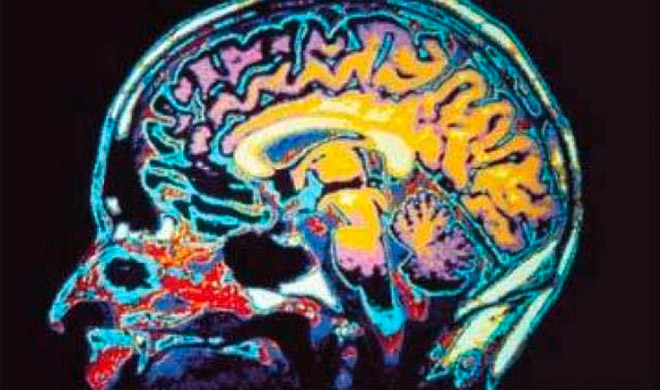
brain
We’re familiar with Bride Brain and Mommy Brain. Maybe you’ve read the scientific research on how our brains are wired for God.

Vacation is coming up in a couple of weeks and my reading list will include a couple of brain science books.  The human brain is hugely interesting to me and reading about the complexities of brain science continues to be spiritually informative.  I don’t understand how the brain works, but it’s so mysterious and fragile and unspeakably marvelous that my belief in a supernatural Creator only broadens.

The Bible never uses the word “brain.”  It’s not in there.  (Note: this is further evidence that the Bible is not a science book, but that’s for another post.)

Interestingly enough – kidneys (kelayot) are mentioned more than 30 times in the Hebrew scriptures. Poor Job’s kidneys are divinely “sliced open” as a result of his misdemeanors, committed or perceived.

And the heart – often paired with the kidneys in Scripture – is where human sin is born.

We now know that the brain has different parts with different functions.  And if “Bride Brain” involves women who become obsessed with how sparkly their rings are or with the ability to match their nail color with their bouquets, imagine what “Church Brain” looks like:

  • We stop connecting actions and consequences.  If we don’t unlock the front door of the church (because “everybody knows to come in the back door”) we forget that guests will not be able to figure out how to enter the building.  If we spend all our time writing a draconian Personnel Policy than supporting our staff, they will work elsewhere.  If we talk more about the roof than What Breaks God’s Heart in the community, we will become dry and faithless.
  • We lose the ability to suppress socially unacceptable responses.   That’s my parking space.  Those teenagers don’t know how to dress for church.  Can you believe she went back to work after the twins were born?
  • We lose the ability to imagine.  (Enough said.)
  • Our long-term memory plays tricks on us.  Remember when our choir traveled to Europe every summer?  (Actually they went there once and it broke the bank.)  Remember how Rev. __ was the ideal pastor?  (Actually his family would disagree.)
  • Our language recognition becomes compromised.  We forget words like grace, forgiveness, holiness, reconciliation.

I could go on and on but you get my point.  Tony Jones used to tell a story about a person who informed him that her church couldn’t move the pews in their sanctuary because they were immovable.  He asked for a screwdriver.

We who’ve been in the institutional church for a long time all have a touch of Church Brain.  This is why it’s essential to have friends who are not part of the Church – to keep us grounded, to open our eyes, to remind us how ridiculous some of our church drama really is.  This is why it’s important to step back and remember that the One who created our marvelous brains is the point of it all.

Image from Wired Magazine.

The Future of Small Town Churches

small townRemember in 2008 when Sarah Palin – while traveling through North Carolina – praised small towns for being “the real America”?  She apologized later, saying that she didn’t mean to imply that the rest of the country was less patriotic or less “real” as America.  I believe her apology was authentic.

But living in a small town and living in a city are very different.  One is no more real than the other, but they are culturally poles apart.

As my family travels each summer, we drive through small towns on the way to cities or coastal villages.  And every summer, somebody says, “I wonder how our lives would be different if we’d grown up in one of these tiny towns.”  Short answer:  Extremely different.

According to this article, published just last week, 24% of the world’s best educated people live in the top 100 largest metropolitan areas worldwide. The article points out: “To put this into perspective, these metropolises accounted for just 11% of the global population in 2013.”

This is not to say that there are not smart people – or even very well-educated people –  in tiny towns throughout the United States and the world.  This is not to say that there are no uneducated urban dwellers.  Obviously.

But anthropologists are increasingly saying that those of us with college and graduate school educations are sorting ourselves into more populated parts of the world.  The Washington Post declared that “a ‘nationwide gentrification effect’ is segregating us by education.”  The better paying jobs are in cities.  The amenities that add to the quality of life (restaurants, parks, recreation leagues, museums, theaters) are in cities.

Population researchers are starting to wonder what will happen if everybody with a college degree leaves Small Town America – especially for economic reasons.  The Post article even asks, “What happens to Toledo and Baton Rouge without (college graduates)?  Will this sorting become even more dramatic in the next decade?

And this brings me to the future of spiritual communities in small towns.

We know that – across the board in every size town/city, in every denomination – church attendance and church giving are down.  But issues unique to churches in tiny towns include these:

  • What happens when the pastor is the best educated person in town?  Actually this was often the case in the 18th and 19th centuries in this country.  And it could be true again in communities with seminary educated pastors and parishioners who have not had the opportunity or interest to seek higher education.  Certified local pastors (also called lay pastors or commissioned elders) might not have seminary degrees, but they are still trained for church leadership. Still, the dynamic of a pastor with a graduate school degree, much less a college degree leading a people with a different kind of education can impact the pastor’s feeling of isolation.
  • What happens when the economy dries up in a small town to the point that the community cannot financially sustain a church?  I’m not merely referring to the ability to pay a pastor’s salary; this is also about keeping a church building, paying for educational materials, and pooling funds to help those in need.
  • How do we encourage pastors to move to areas of the country with few amenities?  Many tiny towns offer no job possibilities for their spouses, no schools for their children.

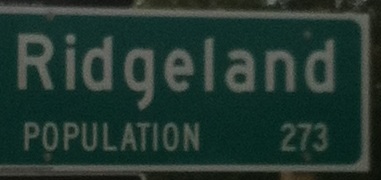
Every day, in my current ministry position, pastors contact me about wanting to move to Chicago.  Every.  Day.  They want to come to the city because their spouse has a job here or their grown children live here or they just love Chicago. It’s a great city full of life and art and recreation and beauty.  I assume that not as many people are clamoring to serve in Ridgeland, Wisconsin – Population 273.

Are we facing a future when many of our small towns will either not have churches?  Are we facing a future when many of our small towns will become suburbs or simply fade away?

Image from along the road in a lovely little town in Northwest, Wisconsin.