When the Pastor Dies

priest graveI just learned over the weekend that the pastor who held me in his arms to baptize me when I was four months old passed away in 2012.  He was 93 years old and had been retired for almost thirty years.

The grief of losing a nonagenarian spiritual leader is real, and yet it’s quite different than the feeling of losing a person whose voice you can still hear as you remember her sermons, whose face singing familiar hymns is still a fresh memory.

Two colleagues passed away over the last month – one last Friday and another in late January.  One from a terrible disease and another after an accident.  One retired early after her dire diagnosis, although she remained active in the community.  And the other was an active pastor serving a small church.

It’s a tender time for the families and friends of those two gifted pastors.  But it’s also a holy time for their congregations which will forever influence their spiritual lives.

How do we grieve our spiritual mentors well?  When the pastor has been the holder of our darkest secrets and the celebrant of our most joyous milestones, it feels strange to watch that same pastor fade away slowly or quickly.

For the pastor who knows he or she is dying, there is the temptation to keep smiling and never let God’s people see you doubt or cry or curse.  The truth is that dying is usually more difficult than being born ever was.  And it’s okay to doubt and cry and curse.  Sometimes it’s the most pastoral thing we can do.

For the pastor who dies suddenly, it’s a horrible jolt to everyone, especially the family.  It’s okay for the pastor’s family and friends to doubt and cry and curse too.  This doesn’t necessarily mean that they are losing their faith.  It just means that they are devastated and rocked.  And so are we.

I remember being in a worship service several years ago the Sunday after a pastor had suddenly died of a heart attack.  One of the liturgists announced that “if anyone wanted to be on the committee to nominate the next pastor” to let him know.  Really.  Their beloved pastor had not even been buried yet, but they were trying to keep moving.  Maybe it felt like the faithful thing to do.

But it was not faithful.  It was fearful.

Remember that axiom about not making any Big Changes after a loved one dies?  Don’t sell your house or marry the next person who invites you to brunch.

The same is true when the pastor dies.  It may take a long time before the congregation is ready to call someone new because rushing into the next pastorate may result in an unintentional interim situation.  But we fear our church losing traction or losing members or wandering aimlessly, and so we reach for something that feels solid.

But we still need time.  It’s okay to take time.

In memory of the Reverend Carlyle McDonald and in honor of special friends who know who they are.

One Church. Multiple Sites.

Wikipedia says that multiple-site churches started in the mid 1980s . By the 2000s there were thousands more. The only truly multi-campus (if you count churches without walls) community I know within a mainline denomination is Urban Village in Chicago – a United Methodist new church start up. Maybe you know of others.

But most multi-campus churches are part of new denominations like Vineyard Churches, although they call themselves a movement rather than a denomination. Mark Driscoll started his own denomination of sorts in that the Mars Hill Church now has fifteen locations in four states.

We could say that churches of the same denomination are all one church with imagedifferent sites throughout a specific geographic region I suppose, but all the churches in mainline presbyteries, associations, dioceses, and conferences (i.e. denominational regions) tend to be individual communities on their own islands. And instead of being connected – even to other neighboring congregations in their own denominations – we consider our neighbors to be the competition. Each congregation – even in the same denomination – has its own pastor, its own financial secretary, its own building manager, its own web designer, etc.

What if . . .

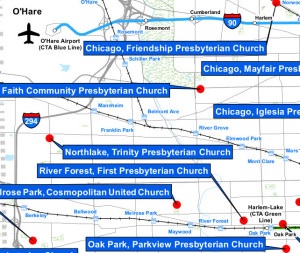
  • 3-4 churches in the same denomination saw each other as different “campuses” of the same church, sharing one building manager, volunteer coordinator, etc.
  • Churches within 5 miles of each other shared a common youth minister, web designer, and accounting manager, paid according to the size of the church. (i.e. congregations paid a pro-rated amount according to participation from their particular “campus.”)
  • The One Church with 3-4 Campuses offered gatherings 7 days/week, thus making multiple portals to community possible without exhausting any single “campus.” For example: Mondays – Faith on Tap near Congregation #1, Tuesdays – Book Study in public library near Congregation #2, Wednesday – Small Groups in the homes of members from all four congregations in a variety of neighborhoods, Thursdays – make dinner for a shelter close to Congregation #3, Fridays – Parents’ Night Out in Congregation #4’s building, Saturday – mission project somewhere (one week a Habitat Project that all four campuses sponsor, the next week Love Bomb a laundromat ); Sunday – worship at 9:30 am, 11:00 am, and 6:30 pm in 3 of the 4 congregations. The fourth congregation might serve hot chocolate in a park or something.
  • The four churches have staff meetings together, share pastoral care responsibilities (e.g. one pastor visits the parishioners from all four communities who happen to be in the same hospital.)

Today, some churches merge or form “sister relationships” with each other which is code for “our church is dying and we need someone to prop us up.” But what if connecting as one church with four sites was seen as a means of enhancing community and growing our capacity for mission?

One culture shift we need to make is becoming less prideful (“Our church is Big Deal Church on the Hill“) and more Kingdom-focused (“Who cares through which portal someone enters just as long as transformation happens?“)

Are we in denominational churches willing to take a leap like this?

Friends: I was remiss in not acknowledging the source of the image. Many thanks to LC. Thanks as well to my partner in dreaming – EH.

One Person. Multiple Spiritual Communities.

One of the prominent features of the historic Mainline Church seems to be that each congregation had their own rolls with their own members and those members were committed to that one particular church.

This has changed.

Perhaps the first time I realized this shift was about 20 years ago when a friend in rural Virginia told me that she attended the Sunday morning Bible study in the Baptist Church, worship in the Presbyterian Church and coffee hour in the Episcopal Church every Sunday.  I was a little shocked that she was not fully committed to just one of these three congregations.  Instead, she was connected to all three and her commitment was shared.

I later worked with a colleague who identified our congregation as just one of his spiritual communities.  He was also part of another church in town and he occasionally worshipped there.  And he also claimed a neomonastic community in another state as a spiritual home, as well as a couple on-line communities and a spiritual director who was from a completely different tradition.

Most of us who remain in the Mainline Church find that our congregations change weekly.  Maybe our membership includes interfaith or ecumenical couples and they spend this Sunday in our community but next Sunday they’ll be at the Catholic Church or at the Quaker meeting.  Maybe our membership includes busy families who gather for worship only once or twice a month when they aren’t in the minivan headed to a soccer field or a basketball court.

A Muslim friend of mine once introduced me as “the pastor of her Presbyterian Church.”  Sometimes she visited an Episcopal Church.  But actually she was Muslim.

So here we are in a very different world.  Yes, there are still many church people who gather with their longtime congregations – and perhaps sit in the exact same pew – every week.  But there is a shift happening in which commitments are looser and more varied.

Just as we church people used to offer most of our charitable giving to a single congregation, we now spread out our financial contributions to more than one organization.  And trends seem to be that we also spread out our time among multiple organizations – church, but also school, sports teams, informal meet-ups, work-related groups, and social groups – when 50-75 years ago, church was our primary spiritual and social outlet.

At least this is what I’ve noticed.  Today,  church connections continue to shift.  Maybe I’m a member of the Lutheran church but I also attend a Bible study with Roman Catholic friends every once in a while, and I also occasionally attend a Faith on Tap gathering in a local bar.  And all of it’s church.  My church.

Can we be okay with this?  Do we need exclusive devotion from our members?  Can we share parishioners with other congregations?  Do we mind if our people can only participate occasionally?

What do you think?

I Have a Secret. Please Trust Me

Pastors carry around a lot of secrets.

Some of them are the personal secrets of an individual (“I have liver cancer but I don’t want anyone to know.”). Some of them are corporate secrets. (“The elders fired the secretary because she had embezzled money from the church.”)

Secrets can be kept for good reasons: to protect the innocent, to maintain privacy, to allow others to tell their own story in their own time, to prevent shaming.

This happened many years in a Marshall’s store while I was trying on a cheap pair of shoes:

Church Lady Who Was Once A Member Of My Church: Jan! I didn’t know you shop at Marshall’s.

Me (what I wanted to say): Well you shouldn’t be surprised. My salary’s not a secret.

Me (what I actually said): I love Marshall’s!

CLWWOAMMC: Did you hear that Pastor___ got fired?! I am so upset about it! I think the other pastors must have been jealous of him. He was the only one who was truly a pastor to me. He was the only one who cared! I think they just woke up one morning and fired him for absolutely no reason. I am so upset about it. I really am.

Me: (what I wanted to say). Actually Pastor ___ was caught assaulting a woman in the sanctuary after a meeting last weekend. You heard me right- the sanctuary.

Me: (what I actually said): You need to trust your leaders.

There are many reasons why leaders are not trusted. Basic trust in authority is rare, in these days of both conspiracy theories and valid examples of untrustworthiness.

Relationships help us trust each other.

Years after this conversation in Marshall’s, terrible things were said about me regarding the firing of a loved church staff member for very good reasons. The elders kept the reasons for the sudden firing a secret to protect the former employee from shame. But the rumors were ugly and I was the target.

I came upon a local businessman about that time who was not part of our church. He knew me well after years of a friendly relationship and he told me the things he’d heard about me. (Greedy bitch was my favorite.). The stories were all over town. He had told them that that wasn’t the Jan he knew and that there must be more to the story.

This is what relationships do. They temper. They invoke trust. They keep us moving ahead.

Pastors need to be trustworthy.
Parishioners need to trust their leaders. But it takes time and patience to have faith in each other. God helps.

20140212-121332.jpg

Image from The Post Secret project of the thousands of secrets sent on post cards.

What if We Had More Seminary Professors Who’ve Been Pastors?

imageA couple weeks ago, at our Presbytery’s Clergy Retreat, Phyllis Tickle explained why we are in the throes of a Great Emergence.  One of the more controversial comments she made was that our children are Biblically illiterate because their mothers and grandmothers are no longer home to share Bible stories to the children in the routine of daily home life.

Without getting into all the issues I have with this assessment (as much as I appreciate Phyllis) the truth is that my mother and grandmothers – both devout Christians and active in women’s church groups – never told me Bible stories while we baked cookies or set the dinner table or weeded the garden.  Not to discredit my mom and grandmothers in the spiritual nurturing department, but they just didn’t do this.  My father and grandfather didn’t do this either.  If I asked questions about Bible stories, they answered them.  But it was at my prompting.

Actually this blog post is not about this.

But I was talking about this with one of my colleagues, and we realized that most seminary professors don’t do this either.  They don’t tell the stories that help us make narrative connections between daily life and Scripture.

Obviously Church History professors tells fascinating stories about our church mothers and fathers and Bible professors use Greek and Hebrew exegesis to make interesting Bible stories even more interesting. But it was up to us – the students – to ask questions as they might relate to daily life in the field.

Then I remembered that my best seminary professors had had experience as parish pastors and they told different kinds of stories.

Of the dozens of seminary professors who taught me, only three had experience as parish pastors.  Isn’t it weird that many of the people who are teaching people to be pastors have never themselves been pastors?

Again – my best seminary professors had also served as pastors. One Bible professor, when sharing something about the Synoptics, said, “I used this story for a child’s funeral in my first church.”  And that’s what I wrote in my notebook.  A practical application to Biblical scholarship.  Another worship professor shared his favorite liturgical ideas from his parish experience and why they’d worked so well.  Again, that’s what I wrote down.

As pastors, we have the opportunity to be with people in the daily toils of their lives – from the milestones of marriage, birth, and death to the ordinary events of life.  Someone gets a new job.  Someone starts dating again.  Someone takes up gardening.  Someone gets a new puppy.  Someone gets her tonsils out. We know these things about people.  It’s our task to connect life events with the holy, and it helps to be mentored – if not in our families of origins  – then  in seminary so that we might know better how to coach people to make those holy connections too.

Do any of you see a trend towards expecting seminary professors to have parish experience?

Image source.

Denominational Political Stands (& Who Really Cares?)

In the name of social justice, my denomination (and maybe yours) takes stands imageon things:

  • We are against homelessness.
  • We are against hunger.
  • We like apple pie. Note:  This is not really one of our official stands, because some of us like pecan or coconut cream more than apple.

In a recent meeting of Presbyterians, we were debating drones.  Some people pointed out that drones cause so much collateral damage that they are immoral.  Others stated that they are less dangerous than having boots on the ground.  One faithful man asked, “Are all of us willing to send our sons and daughters instead of a drone?”

My son was at the meeting but he’d left the room to get some water.  When he returned and heard that people were debating drones, he leaned over to me and asked, “How many drones do the Presbyterians really have?

He was half serious.  Why in the world were the Presbyterians taking a stand on drones when 1) nobody really cares what Presbyterians think about drones  and 2) do we really think we can come up with a stand on drones that every Presbyterian might agree on?

We can’t even agree on who gets to be an elder or deacon.

On the one hand, I understand that we want to have serious theological conversations about real life issues, but where do we begin and end?

  • What’s our policy on twerking?
  • What about plastic surgery?
  • Do we have a common opinion about letting our kids play football?
  • Are we taking a stand about Viagra?

I could make a case that each of those “issues” have spiritual ramifications and moral consequences.

The truth is that we Presbyterian Christians don’t all agree about war and peace, health care and diet, and smoking and drinking.  Heck, we don’t agree about these things in my own little family.

So why do denominations take such stands that often divide us and exclude us?  Anybody have wise answers on this?


Note:  I’ve edited this a bit since it first went out this morning, mostly because I felt my first version was too flippant.  Global issues are important and are not to be taken lightly, and I don’t want to give the impression that they are.  Nevertheless, I still wonder about the pros and cons of taking stances on complex issues as if we have one voice.  (This is also why we have Minority Reports at General Assemblies, but if few people understand our official stands, fewer still understand minority reports.)

Getting Installed

Protestants and Catholics do it. Jews and Muslims too. Even Sikh religious leaders are “installed” into their offices. It’s as if we are part of the furniture.

installationPeople install new showers, new ovens, new software. People also install other people into positions that, in my denomination, we call “permanent” although nobody is really ever permanently installed.

Just after lunch this Saturday, I will be installed for the third time in my life.

The first time, I was a single 20-something with a black lab puppy installed into a small church in a small town in upstate NY. The second time, I was a married 30-something with an 8 month old installed in a church where I would raise my family for the next couple of decades in Northern Virginia. And this third time, I’m a 50-something empty nester working with 98+ churches in Chicago.

It occurs to me that this could be my last installation. Or maybe not.

I’m just recently believing that it’s possible that – although my parents died young – maybe I won’t. Maybe I’ll live long enough to have a second career after retiring from professional ministry one day. Something involving coffee or wine or travel writing would be lovely.

So here are my questions, if you happen to be a non-clergy person reading this (which frankly would surprise me):

  • Do you feel “installed” in your current job? If you happen to be a dentist or a teacher or a mechanic or a chef or whatever, is there anything about your position that makes you feel “installed”?
  • Was there a ceremony to commemorate your official start?
  • Did you take vows in front of your colleagues and those you serve to declare your intentions?

I didn’t think so.

Clergy are not the only ones installed in the Church. Musicians, educators, and officers are also installed in many congregations, marking our special calling and the commitment to use our gifts to God’s glory and to the benefit of others.

Imagine how cool it would be if everybody – from the person who cuts my hair to the bus driver to the bartender to the prison guard- got to be “installed” in some way, recognizing that – no matter what we do for our daily work – we have a responsibility to our community. Imagine having to state our intentions: that we promise to try to do what we do really well. How great would it be if everybody was asked to do what we do with energy, intelligence, imagination, and love?

So, I’m getting installed Saturday and hope you also have that experience sometime, at least once. It reminds us that the work we do has consequences in the world.

Fashionable Brokenness

I loved this comment in yesterday’s post from TheVeryHungry:

I’ve also noticed a recent trend towards accepting certain more fashionable kinds of “brokenness” (a big buzz concept right now) and I think it would be worthwhile for all of us, including the church to explore what kinds of unraveling we do not find comfortable or OK.broken glass

There are definitely different kinds of brokenness and some are more fashionable than others.

It’s increasingly okay – in some circles at least – to share that we suffer with addictions or difficult marriages or depression.  Some of us speak more openly about our brokenness.  It’s not fashionable to be a heroin addict, exactly, but it’s deemed okay to disclose that we struggle with it in hopes of receiving compassion and support.

There is unspeakable brokenness as well.  Exhibit A: Ariel Castro.  Even his family didn’t know the basics of his brokenness much less the depths of it.  It’s not fashionable/okay to be a pedophile or a person who beats his spouse and/or children.  People addicted to child pornography or torture videos keep that information to themselves.  People who eat people don’t share this as a prayer concern in Bible studies.

One of the ongoing issues for Church World specifically is accountability.  It’s one thing to love unconditionally all the broken people who come through our doors.  But it’s another to say “it’s not okay” when church people are bullies or abusers or haters.  Sometimes we confuse unconditional love with unconditional tolerance.  As followers of Christ, it’s our calling to increasingly seek to be Christ-like.

Years ago, an elder threw a hymnal at me on his way out of an Ash Wednesday Service, and I could “understand” him as an angry guy who got no respect at work, for whom the cultural shifts were disrupting his world.  (e.g. A woman had served him communion wearing pants which, in his world Is Not Done.)  Nevertheless, it’s not okay to throw things at people and he was told so.

So, are some forms of brokenness more fashionable than others?  Yes. Nevertheless even those of us who are not alone in our coke addictions or alcoholism or mental health disorders or abandonment issues would probably rather not have our particular brokenness if we could choose.  Even fashionable brokenness hurts.

Numbing Out

fogAs a new pastor in my 20s, I sat up one night with a 30-something mom of two young daughters whose husband had just died in a car accident. These were the first words out of her mouth after the horrible news sunk in: “I wish it was a year from now.”

This struck me at the time as a hopeful comment. She trusted that time would bring healing eventually. But then again, maybe she just wanted to numb out for a year and wake up when it was over.

As a victim of the latest upper respiratory bug floating around Chicagoland, I just wanted to sleep over the past four days, believing that when I woke up – poof – the sore throat and achy bones would be gone.

If only healing our other bugs were so easy.

Sometimes we crawl into bed in hopes of waking up better, after the pain of profound disappointment or shame or confusion or sadness or mental chaos. And if we can’t sleep, we can always numb out via other means.

This article was published in The Washington Post yesterday in response to Philip Seymour Hoffman’s overdose in particular and the global drug problem in general.  It explains some of the basics about this latest tragedy.

Many of us deal with various levels of mental illness. Some of our brokenness is situational, involving layers of personal grief. And some of us were born with chemically quirky brains, and worse.

All of us would like to go to sleep and wake up happier or more content or less anxious or totally healed. I wish we who are addicted could stop eating and drinking our feelings. I wish we didn’t turn so quickly to pills or needles when we are emotionally hurt.

But we like fast and easy fixes. And we don’t want to trouble others with our pain. And some people consider it more fun to deal with our pathologies pharmeceutically. It feels like “recreation” instead of hard work.

But our souls cannot be healed with sugar or alcohol or narcotics or hallucinogens. The world cries out to be loved in spite of our brokenness.

It kills me that the church has the reputation of being so judgmental and lame and irrelevant. Because the world could really use a worldwide community of people who unconditionally love each other and teach others how to love unconditionally.  If only.

God, Amy Chua, and Me

triple_PackageChua and Rubenfeld contend that successful groups share three traits: a superiority complex, feelings of insecurity and impulse control.” (From The Triple Package: How Three Unlikely Traits Explain the Rise and Fall of Cultural Groups in America by Amy Chua and Jed Rubenfeld

I have a very clear memory of being about 8 years old on a Sunday afternoon in the kitchen of the NC homestead where my Grandparents and Great Aunt lived. We were “making a party” which is what happened on lazy Sunday afternoons after dinner. My Grandmother, Aunt Grace and I were assembling platters of cookies to serve whomever happened to have gathered that afternoon in the front sunroom.

While arranging cheese straws and merengues, my Aunt Grace leaned over and whispered into my ear, “Don’t ever forget: The Edmistons are better than everyone else.”

Me: ?!

Thinking back, I sometimes wonder if this really happened, but when I reported it to my Dad later that day, he just chuckled. Oh Aunt Grace.

Amy Chua would call this moment crucial in my development because it would ostensibly give me the necessary Superiority Complex one needs to ensure my personal success.

What was confusing about Aunt Grace’s secret wisdom to me was that we Edmistons were all Sober Presbyterians who had been taught to shun ostentation, sacrifice ourselves for our neighbors, and consider ourselves miserable offenders against God’s perfect law. Amy Chua would consider this helpful as well because it would give me the also necessary Inferiority Complex needed to succeed.

The Edmistons fell short when it came to the third piece of The Triple Package: Impulse Control. Hence our love of cheese straws and merengues. And cake, pie, ice cream, and – occasionally – more potent addictions.

As I posted elsewhere recently, I’d give good money to see a debate between Amy Chua (who infamously wouldn’t let her daughters have sleepovers as children) and Brene Brown (who calls herself a Shame Specialist.) The Chua-Rosenfeld daughters have both been accepted to Harvard, so hurray for them. Honestly, that is a worthy goal along with financial prosperity and healthy cholesterol levels. And I’m okay with families who choose to raise their children in intentional ways that are not like the way HH and I have intentionally chosen to raise our children. We are all trying to figure this out in our own ways.

Our family has a different Triple Package, I guess. We believe that our children (and yours) are created in the Image of God. We also believe that neither we nor our children (nor you and yours) are God. And I suppose the third characteristic of our child-raising was that following Jesus is the best way to live. So there you have it.

When our daughter was in Middle School and was invited to a young man’s bar mitzvah, several of us parents – whose daughters were all attending the festivities together – referred to this young man as “The Total Package” because he was smart, good-looking, and kind to his mother. It became one of those family references we would repeat often in the years to come: So and so is ‘The Total Package.’

In all seriousness, though, I would lift up this as The Total Package to which I hope our children and all of us would aspire:

  • An understanding that we are each extraordinary and gifted Children of God, created in God’s Image,
  • An acknowledgement that we are not the center of the universe and the world is not about us,
  • A desire to make the world on earth as it is in heaven because that’s what we were created to do and be.

This kind of life leads to a different kind of success, if you ask me.