A Church’s Most Important Hour of the Week?

clockSunday Morning Worship is not the most important thing a church does each week. I don’t mean to offend, but the notion that Sunday Morning Worship is the most important thing we do together is killing us.

The reality is that most parish pastors spend the great majority of their time each week preparing for that one hour when the congregation gathers for worship.  In holy preparation, pastors do some or all of the following:

  • exegete Scripture,
  • write a sermon and accompanying liturgy,
  • conjure up a Children’s Story,
  • coordinate the music,
  • oversee publication of the bulletin,
  • make the slides,
  • ensure that there will be ushers/money counters/nursery volunteers.

Corporate worship comprises only one (or maybe two) hours of the week but the majority of our efforts are poured into that brief slice of time on The Lord’s Day. But even the most inspiring worship experience does not spiritually mentor and equip most people.  Too many of us compartmentalize our faith into basically two pieces:  Sunday Morning and The Rest of the Week.  We come in, sit down, sit still, and leave smarter/holier/at peace.  Often, we don’t even experience peace.

Exhibit A:  The parishioner who sat through worship and then yelled at another driver in the church parking lot on her way home.

Being a follower of Jesus is not about “coming to church” on Sunday.

What’s More Important that Sunday Morning Worship:  those times when God’s people connect out in the community.

Exhibit A:  Jesus met people in homes, by drinking fountains, on the road, at the beach, at festivals.  And their lives were changed – sometimes in infinitesimal ways and sometimes in enormous ways.

Yes, Jesus taught in synagogues and in the temple, but mostly he connected with people in ordinary places.

The most important hour of the week for Church is when:

  • relationships are nurtured,
  • new leaders are mentored,
  • broken people are loved,
  • Jesus is recognized.

We have met for generations in sanctuaries on Sunday mornings at 11 (or 8:30 or 9:30 or 10:30 or 5:30) for corporate worship.  In a perfect world, we have gathered to proclaim and receive the gospel, praise God, confess our sins, find inspiration, and be spiritually fueled in order to go out and serve.

In the real world, corporate worship has often been about seeing our friends, experiencing stirring music, hearing an elegant sermon (or a mediocre one), and going out to brunch after.  We all know that people can sit beside each other in pews for generations and not really know each other.

How can we better become The Church?  Small groups, dinner clubs, circle meetings, prayer partners, game nights, cook outs, mission trips, retreats, service projects, craft projects, parties.  And maybe even during corporate worship on Sunday mornings.  But honestly, it doesn’t usually happen on Sunday mornings.  Or it doesn’t happen solely on Sunday mornings.

So – church professionals – why are we spending so much time on what happens on Sunday mornings?  Our parishioners expect it, of course.  But corporate worship is not the main thing.  It’s the dessert.

There’s Goes My Senate Confirmation

PastrixAt this very moment  – in the bowels of a government warehouse someplace – there is an ancient wiretap tape of me and a former boyfriend breaking up over the phone.  In the throes of break-up crying – with a short intermission in the middle to go throw up – former BF informed me that our conversation was being taped by guys in a white van outside his house because their church was harboring Salvadorean refugees.  “Oh great,” I sniffed.  “There goes my Senate confirmation.”

My past has made me a better pastor.  But here’s a question:  Is it necessary to have an interesting/sordid/irreverent past to be an effective follower of Jesus/pastor?

I love that Nadia Bolz-Weber’s Pastrix has hit #17 on the NY Times Bestsellers list, and I attribute this fabulous news to these truths:  1) she has a great story and 2) she looks like Nadia Bolz-Weber.  Her story includes addictions and tattoos and a sailor’s vocabulary.  It’s also beautiful and redemptive.  And it’s as dramatic as Paul’s story about the road to Damascus  – but more relatable.

I wonder about those who’ve grown up sheltered and wholesome in perfect-ish families with no history of depression, addiction, abuse, missteps, or poor choices.  What do they do when someone comes to them with a tale of brokenness and imperfection?  Is it possible for them to hear those stories without judgement or pity?  Can they walk alongside someone if they have absolutely no experience of betrayal or confusion or utter despair?

My own life is fairly tame compared to your average convict/heroin addict/soldier/pickpocket/meth dealer.  I have no cool tattoos.  I have no stories involving prison.  I used to drive a minivan.  But the measure of pain in my life and occasional brushes with utter despair have made me a better pastor.  You?

PS Please read Pastrix.

What Retired Pastors Would Like to Say to Active Pastors

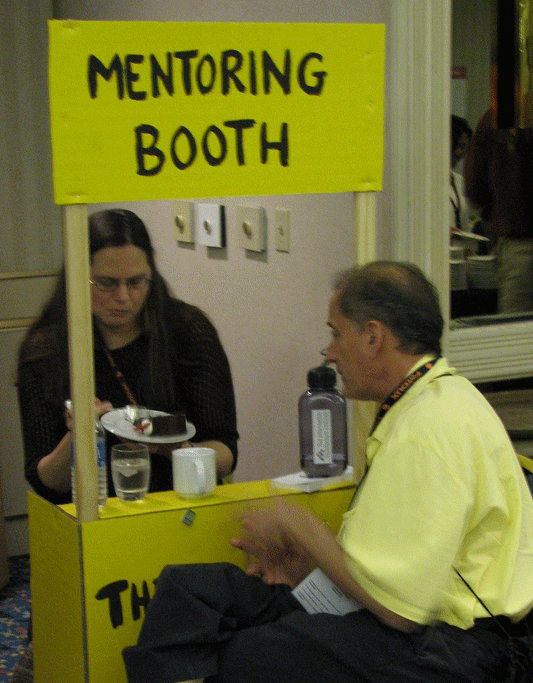
As promised, this post is a follow up on yesterday’s post.  I enjoyed a lovely Mentoring-Booth-Lana_aka_Blunch yesterday with about 35 of our retired clergy people and their spouses during which I asked them to answer this question:

What Would You Like to Say to Active Pastors?  (And here is what they shared.)

  1. Hang in there.  Things are very different now from when I was serving the church and you are going to have to work harder to figure it out.
  2. Do something risk-taking or cutting edge.  (This pastor shared that he served as pastor of the first interracial congregation in Texas.  He raised his family in a tough context, but it was worth it.)
  3. Ask yourself if anything about your current ministry scares you.  If not, it’s time to move on.
  4. Remember the saying about preaching with a Bible in one hand and a newspaper in the other?  Talk in your sermons about how much trouble we are in, both in terms of global and interpersonal conflicts. Ask your congregation and yourself, “Is our Jesus big enough to handle these things?”  If you don’t think so, read your Bible more closely.
  5. Don’t preach cookie cutter wedding and funeral homilies.  Make it personal.  These are great opportunities to build community
  6. Take advantage of connecting with retired pastors.  We need the intellectual stimulation and maybe you could pick our brains about something.

If you are retired from professional ministry, what would you add?

If you are actively serving a church, what else would you like to hear from retired clergy?

Image Source.

What I’d Like to Tell Our Retired Pastors

Today, our Board of Pensions is generously hosting a luncheon for Potterour retired pastors and – gratefully – there will be no drama over the Walgreen-CVS Express Scripts controversy this year.  Or so we can only hope.

We have a lot of retired clergy in our Presbytery and they are gifted, valuable, fun, and interesting.  Our retired clergywomen – especially those who have been ordained for 40+ years – have stories that all our 20 and 30-something clergywomen should probably hear.  Jaw dropping/inspiring.

The agenda today is about Medical and Pension benefits, but I would love to have an occasion during which we could have a healthy, honest talk about the relationships between clergy currently serving congregations and their retired predecessors.  Because my job is to share information that is often tough to hear, this is what I imagine saying, on behalf of my actively serving colleagues:

1.  Please do not introduce yourself as the pastor of your former church.  Even if you say, “I’m the former pastor of Big Church on the Hill” or “I retired from St. Stella’s Presbyterian” it’s not helpful.  It looks like you still identify, first and foremost, with that particular congregation and the fact is that the congregation needs to move on for the sake of its future ministry.  Please just say that you are retired, and if interested, someone will ask you where you used to serve.  Then, feel free to share that information.  But when you start with your former church’s name, it looks and feels like you are still connected in a way that keeps the church back there.

2.  Please continue to keep fresh and share your wisdom.  Ask our retired clergy who serve on important commissions in our Presbytery.  They have the exquisite opportunity to share their wisdom while hearing about 21st Century Church World.  It’s fantastic . . . unless you are that guy who can’t stop talking about how great it was in the 1960s when your church had 500 members or how kids today have bad theology and don’t know what they are doing.  Really, don’t ever say those things.

3.  Consider co-mentoring a new pastor.  This is for you if – and only if – you are hungry to learn.  Good mentors never act as if they know everything or have cornered the market on pastoring.  Honestly, you still have so many things to learn and you have so many things to teach.  But nobody will want to be mentored by you if you are patronizing or unteachable.

4.  Don’t ever drop in on events in your former church.  Just don’t.  If there’s a party for the 90 year old Christian educator and she was also on your staff back in the day,  it doesn’t mean you are automatically invited to the party. If there’s a ribbon cutting for the new homeless shelter in the new wing of the building, you should not show up unless specifically invited by the current pastor.

5.  If you lose your mind for a minute and ignore #4, for the love of God, do not make the event you’ve crashed about you.   Do not burst in on the scene and start telling stories about how you are the one who thought up the homeless shelter idea.  Do not regale the staff – many of whom have never worked with you – about how you remember the party for the Christian Educator when she was only 80.

6.  If you are lonely, feeling purposeless, achy, cranky, or worried about the future of Christendom, please give me a call.  Do not take these maladies out on your former church.  I will try to help you recalculate, as my Garmin daily offers.

7.  Remember that it’s a good thing for life to move on.  Without necessary losses, life becomes stagnant and sad.  Yes, losing our life’s work, our friends, our loved ones, our abilities, our “power” is also very sad – because all transitions involve some measure of grief.  But we are people of faith, aren’t we?  We are enormously blessed to be in a denomination that cares about its retired servants.  We have opportunities for new ventures.  We belong to God.

Fun plan:  At the Retirees’ Lunch today, I’m going to interview people to find out what they’d like to tell active clergywomen and men.  Stay tuned.


What Makes You Light Up?

sparklerMy job makes me light up.  Not every duty or every task, but – in general – I love what I do every day serving the institutional church.

One of my responsibilities involves working with people preparing to do professional ministry as pastors, chaplains, teachers, and community organizers.  We talk with them about vocation, theology, and practical ministry. It’s often nerve-wracking for them – and for us – but what we are looking for includes The Spark.

We want our candidates to light up when they talk about serving God’s people.

What we never want to see:  rolled eyes, lifelessness, indifference, smugness, haughtiness.  No one is authentically hyped about every aspect of ministry/life, but if you really want to express the reality that God is calling you to something priestly, we need to see a glint of Holy Light.

For some people, it happens when they talk about preaching.  For others, it’s pastoral care.  Some love, love, love conflict resolution.  Others wake up pumped to teach people who are hungry to learn.

You can’t fake this kind of thing.  (If you try, we will notice.)  The Spark is not something we learn in seminary.  It’s not something anyone but God can give us.

What makes your face light up, in terms of the work you do – whether you work in a church setting or in a post office (or pharmacy, coffee shop, nursery school, laundry, etc.)?  Sadly, there are too many pastors who – for various reasons – no longer light up.  What about you?

Note:  27 years ago today, I met the guy who still makes my face light up.

Dates

Ba de ya – say do you remember
Ba de ya – dancing in September
Ba de ya – never was a cloudy day

EarthWindAndFireSeptember7InchSingleCoverMy Mom died of metastatic breast cancer 25 years ago today.  Interestingly enough, two other friends also lost their moms on September 16th. Two other friends became moms on this day.

Tomorrow – September 17 – is the 27th anniversary of my last first date.

I am not a sentimental person about many things.  But dates matter to me.  I eat dessert for dinner every August 28th.

When expecting children, I remember looking at calendars with potential due dates in mind, and realizing that one of those dates would soon be extraordinary for the rest of my life.

It’s overwhelming and impossible to remember everyone’s special dates, but one of the best gifts we can offer people is to remember “their dates.”  Pastoral care tip:  keep a calendar with important death dates and connect with survivors.  You don’t even have to mention their loss.  Just a low key “I’m thinking about you today” will suffice.  Believe me, you won’t be reminding them afresh of  a memory they’d forgotten.  They’ll know why you called.

Grateful today that I have the capacity to remember.

A Church Without Meetings?

meetings-and-emotional-patterns-fania-simonLast night Nadia Bolz-Weber wowed a big crowd in Chicago, promoting Pastrix and, when asked about her home life, she shared that she’s home almost every night when not traveling.  She doesn’t do meetings.

This is not the case for most pastors.

We do council meetings, staff meetings, premarital counseling meetings, family funeral planning meetings, baptism preparation meetings, conflict mediation meetings, deacons meetings, elders meetings, presbytery/association/conference/committee meetings. Meetings R Us.  (I bet Nadia does meetings too; they are simply good meetings and they don’t happen at night.)

My job description literally states that I must be able to sit through long meetings.  Really, it does.

Some of my friends really wanted to join us to hear Nadia speak last, but they couldn’t because they had meetings.  And one of the things they missed was her insight that people who like meetings are the ones who go to meetings which means that decisions are made in our spiritual communities by meeting-lovers which perpetuates the custom of having meetings and more meetings.  Exhausting.

One Lent, the church I was serving gave up all meetings.  All.  Meetings.  It was heavenly . . . except for those for whom it wasn’t.  Several people hated the fact that we weren’t having meetings because they “didn’t know what was going on.”  Looking back, I wonder if meetings, for them, was their opportunity to:

  • Be in charge of something.  (For some church people, it’s their only “power.”)
  • Keep an eye on the pastor.  (What does she do, if she’s not in meetings with us?)

For the record, I am pro-meeting if:

  • Something concrete will accomplished.  (i.e. No talking in circles.)
  • There is a predetermined start time and an end time, and we strictly keep that schedule.
  • Everybody participates and feels heard.
  • We can agree to cancel meetings if there is no reason to meet.  (These are not reasons to meet:  “We always meet on the second Monday.”  “We need to discuss ___ for the third time.”  “___ missed our last meeting and we need to catch him up on our progress.”
  • It’s fun.

Meetings can build community.  Or they can suck out our souls.

It used to be true that pastors were advised to be out at meetings no more than three nights a week.  Actually, three nights out a week is crazy . . . unless you are doing something fun/engaging/nourishing.  Honestly, if we are out more than one night a week – for a meeting –  it’s too much, at least on a regular basis.

There are good meetings and there are not-so-good meetings.  Of the meetings you attended/ran in the past week, how would you rank them?

Me:  In the past seven days, I’ve attended six meetings.  I’d say that five of them were really good.  You?

Image source.

What Ruins Your Day?

starbucksOn Monday, I ordered a skinny mocha at the Starbucks Drive-Thru on my way to work and about halfway to the office, realized I was drinking a caramel macchiato.  I can hear you now as you shake your angry fist and curse the heavens:  ‘No!  Not a wrong drink order! No!”

I accepted the tragic fact that I’d just consumed 130 more calories than I’d planned.

On Tuesday, as I drove through Starbucks again, my barrista friends told me that the Caramel Macchiato Orderer had angrily telephoned them when she got to her office demanding a refund.  They had Ruined. Her. Day.  She had consumed sugar free chocolate instead of caramel with her coffee drink.  Lord, have mercy.  Christ, have mercy.  Lord, have mercy.

I remember once when one of our kids went to school forgetting it was Red Day but he had worn blue.  And it ruined his day.  Actually, I totally get this – if you are five years old.

What ruined our day 12 years ago has been resurrected in countless ways.  It brings those of us together who remember where we were.  It warms our hearts to recall the heroism.  It also takes very little for my heart to race and my throat to choke up when I think back to that day.  I am bracing myself to visit the 9-11 Museum in NYC when it opens.

But even terrorism doesn’t wholly ruin any day.  The days belong to God and God can redeem even the very worst day.

Nevertheless we remember humbly

  • those almost three thousand souls who perished 12 years ago today.
  • the Four Little Girls who died 50 years ago Sunday when terrorists bombed the 16th Street Baptist Church in Birmingham.
  • the eight Iraqi police officers mistakenly shot and killed in Fallujah by US forces 10 years ago tomorrow.
  • the 1400+ victims who died 3 weeks ago in Damascus after suffocating gas was propelled into their neighborhoods.
  • the 27 people who died 9 months ago tomorrow at the hand of Adam Lanza in Newtown.

By grace even these tragedies shall not ruin us.

Safe From Scorekeeping


Rate Me

Anand Giridharadas of The New York Times wrote Sunday about his experience of being rated by an Uber cabbie recently.  Not only would he – as the consumer – be rating the cabdriver as an Uber customer, but he realized upon leaving the taxi, that the cabdriver was also rating him.  Great.  One more thing to compete over:  Who is a better taxi passenger?

We are already assessed by employers and teachers, often by the numbers. Some of us have Klout accounts that rate our social media influence between 0 and 100.  President Obama’s Klout score is 99.

According to Giriharadas’ article, there’s a dating service in NYC that matches people based on their their Klout score.  Ugh.

Imagine if we pastors decided to rate our parishioners.  Again, ugh.

All of us in professional church ministry are aware that some parishioners can be counted on to help at a moment’s notice and others cannot.  We know who the Type A parishioners are, and yes, they Get Things Done.  We know which people are committed and which seem less so.  Actually, I have a pastor friend who serves a New Church Plant and this pastor holds individual annual evaluations with each member to assess his/her spiritual growth, financial commitment, etc.

I’m not interested in this and honestly, I doubt that many people in our spiritual communities would 1) care and 2) stick around if most pastors tried to do this.

But the truth is that we do keep score in church.  We judge each other, often mercilessly.  We often eat our own.

Imagine a world in which church was the one community where people didn’t keep score.  Imagine a totally safe environment where we figure out together how God works.

Thinking about Rally Day 2014

Rally DayMany churches celebrated the start of a new program year yesterday with Rally Day.  Or “Kick Off Sunday.”  Or “Welcome Back Sunday.”   For anyone reading this who is not a Church Person, Rally Day is when:

  • New Christian Education Classes start for the fall.
  • Weekly Worship returns to the fall/winter worship schedule.
  • The choir returns.

All good stuff, friends, except that those who are not Church People don’t really care.  Even some church people don’t really care.

If we hope to be a 21st Century Church, let’s re-think Rally Day for 2014.  It’s never too soon.

If we take seriously our commission to make disciples of all nations, we can’t be congregation-centric.  A new kind of Rally Day seems to be called for.

Here are some ideas from churches with a missional culture that I’ve known and loved :

  • Rally Day as a community appreciation for First Responders (fire fighters, police officers, EMT volunteers.)  This works well in terms of a positive 9-11 remembrance.  Invite all the local First Responders to a party in their honor in a grocery store parking lot or a very public local park.  Get local businesses to donate things (moon bounce? popcorn machine?  smoothies?) and approach others to donate gift cards to give to those who protect your community – who are probably either volunteers or paid very little. One church I know gives $100 grocery store gift cards to each of their local First Responders.
  • Rally Day as a community service event: “Jesus Has Left the Building” Day with 3-5 pre-planned opportunities for serving the community.  After gathering at the church building, individual teams then choose one project and then leave to go serve as a small team by weeding a community garden, picking up trash on the highway, visiting a nursing home, serving dinner in a shelter, making sandwiches for volunteer fire fighters.  Something for everyone.
  • Rally Day as a massive community Love Bomb.  Where do people gather on Sunday mornings who are not church people in your town?  Go there.  Take popcicles or coffee or water bottles or whatever.  Be careful with food that not’s pre-packaged.  (Would you take a hotdog from a random stranger in a park?)

The point of all this is basically to get out into the community.  See who’s out there.  Who are they and what do they need?

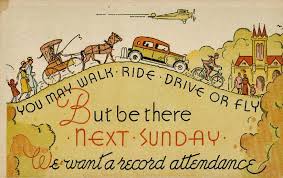
The point is not to recruit new members or market your church or guilt people who are not sitting in pews at 11 am on Sunday mornings.  Unlike the image posted above, the point is not to achieve “a record attendance.”

Imagine a different kind of Rally Day this time next year.  Yes, it might be double the work to do both a traditional event and a missional event. But the future church focuses on two communities:

  1. The people who indeed sit in the pews on Sunday mornings.
  2. The people who are out in the world living their lives.

Both are broken in their own way.  Both are sinners and saints.  Both need community.  Both deserve to be loved unconditionally.

Image source.