Reprise: What Hospitality Looks Like

Keba Konte SF community art installation

NOTE:  I often feel like I write about the same things over and over.  But I can’t figure out how to convey to churches that they need to step up in the compassion department.  Seriously.  Church people can be clueless about the very things we are supposed to be about.  How can we convey this?  #nag

Every church believes it’s “friendly” of course.  But how hospitable are we, really?  How would you answer these questions in terms of how your spiritual community usually responds?

A guest comes into worship for the first time.  She bravely (and tearfully) discloses, during the time of sharing prayer concerns and celebrations,  that she’s recently been diagnosed with lung cancer.  She has lived in the neighborhood for five years but now finds herself in need of a supportive community.  What happens next?

A. People nod and offer supportive facial expressions.  The newcomer’s concern is prayed for by the leader during corporate prayers.

B. The church member who happens to be sitting next to her immediately moves closer and introduces herself, adding “May I take you out for lunch today after worship?”

C.  A deacon or other church leader passes her a note during worship that says,  “How can we support you?  My name is ____.  Please share your contact information and we can talk about ways we might be able to help.  Anything from being a sounding board to driving you to your appointments.

**********

A new family in church is looking for the sign up to prepare dinner for another family in need.  What happens next?

A.  The Lady-in-Charge guarding the sign up sheet says, “We don’t need you to sign up.  Thanks but no thanks.”

B. The Lady-in-Charge beside the sign up sheet says, “I don’t think we’ve met.  Thanks for signing up.

C. A church regular randomly standing near the sign up sheet says, “You guys are awesome for making dinner for the Kelly’s.  Do you need directions to their house?  Also have you heard about the First Friday softball game in the park?

**********

A man who’s just getting involved after being a member for a couple years attends a meeting to help plan the upcoming mission dinner.  The others at the meeting are all long-term members who have worked on this annual dinner for decades.  When no one volunteers to chair the dinner, he speaks up and offers to do it.  What happens next?

A.  Crickets.  The others all look at each other as if to say, “This guy will have no idea what to do.  I’d rather do it myself than have to hold his hand.”

B.  After he suggested that the main dish being something Haitian (since the mission dollars are going to Haiti), last year’s dinner chairperson says bluntly, “No one would eat that.  We always serve ham.”

C.  Although few of those gathered have ever had Haitian food, they encourage the new idea.  Last year’s dinner chairperson says, “What do you need us to do to help?”

Here’s the thought that often eats away at me:  I witness not only a lack of hospitality in most of the congregations I visit, but I also observe basic meanness on a regular basis.  Yes, we in Jesus’ body are as gossipy, cranky, self-centered, and petty as the rest of the world, but the difference is that we are trying not to be like the rest of the world.  Aren’t we?

Image is the installation of a community art project created to welcome strangers to a park in Oakland, CA.


Shameful Confessions & Paula Deen

Last Supper in ButterThere are things I’ve done in the past which are now excruciating to admit:

  • Went out in public wearing matching red, white, and blue Mother-Daughter outfits with TBC.
  • Dated and almost married an abusive man
  • Missed a wedding I was supposed to officiate leaving the bride and groom without benefit of clergy standing under a festive tent.

Oh, and there are other, much worse things that I’m too mortified to share one-on-one, much less for people  to read about here.  And I don’t even have a Smithfield Ham contract to lose.

God bless Paula Deen. Diabetic, southern, butter-loving Paula Deen.  She has a brother named Bubba.  Of course she does.

Paula Deen has said things she regrets regarding race and culture. Actually all of us have.  We just haven’t been subpoenaed to talk about it.

An African American friend of mine confessed the other day that she grew up referring to “Jew Town” as a section of Chicago where the merchants would cheat you.  She said that she didn’t even realize it was offensive until she was about 20 years old.  Someone had to explain it to her.  I’ve said things just this ignorant, and worse.

Paula Deen has more than enough money to survive without the TV show and the ham contract, but how can she redeem herself?  How can any of us redeem ourselves when we’ve said and done things that are grievous to other people?

Starter suggestions:

  • Read Bruce Reyes-Chow’s new book.  Then talk about it.
  • Participate in social groups, discussion groups, and worship gatherings with people who are not like us racially, culturally, ethnically, sexually, spiritually.  Do not go to pick fights or challenge people.  Make friends.  Listen.
  • Volunteer to serve people we don’t understand.  If we find homosexuality uncomfortable, make cookies for a homeless shelter for gay kids and listen to their stories.  If we feel resentful towards people who don’t speak our language, volunteer to help refugees coming into the country and help them figure out how to buy bus passes and register their kids for school.  If we complain about “lazy unemployed people” then volunteer at a job training center to teach interviewing skills or resume writing.

Paula Deen will be fine and yet I am ashamed alongside her.  Sometimes when we fall, there’s something we’re supposed to notice down there on the ground.

Image is The Last Supper sculpted in butter.

Do You Hate Your Job? (Anonymous Comments Welcomed)

I remember talking to someone who longed to go to seminary.  Her then-job wasCleaning Croc something behind a desk at an airport and she hated it.  “You are so fortunate that you like your work,” she said to me.

Two things:

  • I acknowledge that I am a person of privilege, most especially because I lived in a town with excellent public schools, could afford to go to college and then graduate school and then more graduate school.
  • I don’t just like my job.  I really love my job.

Every time I hear a parent or teacher advise a young person to “do what they love” and the job will follow, I feel a little queasy.  I agree that doing what they love is huge.  But it’s also possible that they will never be able to get a job in a field they love.

I am the mother of three young adult kids who majored in three non-lucrative fields:  film, linguistics, and urban planning.  And yet they are all – miraculously – doing work they love in their fields.  I’ll say it again:  miraculous.

According to this story from yesterday’s news, “a little more than half of workers (52 percent) have a perpetual case of the Mondays—they’re present, but not particularly excited about their job” in the United States.

Two things:

  • A lot of people would be happy to take your job, 52%.
  • All of us with jobs have certain responsibilities that we don’t love.

I don’t love writing Board of Pensions letters.  But the other responsibilities often rock my world.  Crazy fortunate.

You?

Image source.

Finessing Old Age

Edmiston Farm 2012I am 57  – which is rather old to many in our culture.  There are things I can do, gifts I can share, experiences I can draw upon.  But maybe my role is to step aside and make it possible for someone younger to do things, share gifts, offer their experiences.  It is a tricky situation, because I still both want to serve and have gifts to offer.  So what’s a seasoned pastor to do?

I love creating opportunities for spiritual development.  I love preaching and God talk and Faith on Tap and praying with people and hearing stories and telling stories.  I (rather disturbing) love to mediate conflict.  I hear about new church initiatives and would love to jump in and do them.  But it’s someone else’s turn.

My role in this chapter of my ministry is to make it possible for people from about 25-5o to do what God is calling them to do.  They can mentor me as – I hope – I can mentor them.  I’m a digital immigrant longing to learn new things.  And if you ask me, I’ll share what I’ve learned after all these years about dealing with church bullies, firing staff members, shifting paradigms, figuring out what makes God’s heart break in your neighborhood, training officers, tweaking officer roles, and equipping the saints for 21st Century ministry.

My Dad’s only sister is now in her late 80s.  She has outlived her six brothers – the three who were older and the three who were younger.

Aunt Jane was once the Go-To person if you wanted to serve a church in North Carolina.  She would have gone to seminary if women had done such things 70 years ago.  Now she is hospitalized after a stroke which happened after a fall.

Her season as a congregational and Presbytery leader is over, but it’s important to honor her contributions and remember the small and great things she did to show the love of Jesus – among them: saving the life and soul of a troubled kid whose principal wanted him forever expelled from school.  She literally planted herself between the student and the school administration.  And now he is a college professor.  She served on countless committees and commissions, taught classes, traveled to China, and mediated family disputes.

Once she read Scripture at my ordination.  Now people read Scripture to her in the hospital.  Once she took me on my first trip to Montreat.  Many years later, I was called to my second church because of those Montreat trips.

Her granddaughter is a recent seminary graduate, and she will lead the next generation of Jesus’ disciples.  Aunt Jane was so, so proud to watch S. go to seminary.

Why do people live past their prime, well into the years when their minds are no longer sharp and their legs are no longer strong?  Because there is still work to be done.  Maybe my Aunt Jane has work to do that only God can ascertain.  Maybe her children and grandchildren and great-grandchild need this time with her.  Maybe there are doctors and nurses and friends who are still learning from her.

Our job is to artfully live out whatever season we find ourselves in.  For my Aunt Jane – who agrees that old age is not for sissies – it’s a new season.  And it’s a new season for me too.  And it’s a new season for my first cousin once removed who just graduated from seminary.  And it’s a new season for you, perhaps.

Image is looking out on the Edmiston farm – in honor of our first Cousins Day without Uncle Bill.

Talking About Hard Things

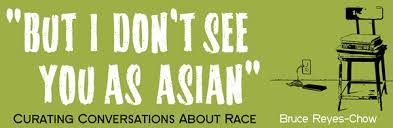
Bruce Reyes Chow book on race

I strongly recommend that everybody – everybody – read Bruce Reyes-Chow’s new book But I Don’t See You As Asian: Curating Conversations About Race.  Picture hundreds of spiritual communities reading this as a One Book-One Church selection.  The conversations would shift our culture.

This book  – the result of a successful Kickstarter  project – is witty, sharp, insightful, and important.  Bruce discloses his and his family’s own experiences as a multiracial family, sharing those many cringe-worthy comments that Good Christian People invariably say.  He points out that all of us are guilty of downplaying our privileges and avoiding difficult conversations.  But there is something urgent about this book.

We need this.  Now.

I work in a city with these demographics according to 2010 census figures:

  • 32% black (including Hispanics), 45% white (31% non Hispanic white + 14% white Hispanics), 5% Asian (including Hispanics), and 3% from two or more races(including Hispanics).
  • The ethnic makeup of the population is 28% Hispanic (of any race) and 72% belong to non Hispanic background (of any race).
  • In 2000, 21.7% of the population was foreign born; of this, 56.3% came from Latin America, 23.1% from Europe, 18.0% from Asia and 2.6% from other parts of the world.  Chicago has the fifth highest foreign-born population in the U.S.

And yet we cannot get enough Spanish-speaking leaders to serve our Spanish-speaking congregations.  We need new African American and African pastors to replace those who retire or move away.  We have a huge population of Assyrian refugees moving here from Iraq but not enough resources to serve them spiritually.

What is preventing us from creating new communities for our neighbors in Chicago – and in cities and towns across the U.S.?  What’s to keep us from supporting new generations of leaders who look more like the city demographics than we do?  Lots of things, but here are a few that come to mind immediately:

  • Distrusting people of other races even/especially in church.  Even in our multicultural congregations without a majority race, there are unspoken tensions. What if our church becomes too white?  We must remain a Korean church!  These Africans will want to change the way we do things.  
  • Insisting that we are all the same.  We are not all the same and that’s not only okay; it’s God’s creative will that we are all different.  It’s a spiritual practice to cross boundaries and love The Other which is something Jesus did every day:  Samaritans, Unclean folks, Syro-Phoenicians, lepers, tax collectors, rich, poor, uneducated, elite.  We are called to connect with people who are not like us.
  • Failing to acknowledge that white is the default race. For now.  Life is easier for us in ways we rarely appreciate.
  • Congratulating ourselves for supporting poor (often minority) peoples, giving from our superior place to “them” and preferring charity at arm’s length over authentic relationships.

Imagine being able to share our misconceptions, fears, and questions about race with each other in safe conversations.  Imagine church being the community where we can learn that and talk about the fact that not all blacks play basketball and not all Asians are good at math.  Imagine being able to talk together about race through the lens of Jesus.

Read this book with me and let’s figure out how to get started.

About Last Night

After a late night Presbytery meeting last evening, here’s what I learned:ClaraStVaastArtDecoPulpit

  1. Don’t sit on the first pew in a sanctuary with a high pulpit.  (Sore neck this morning.)  
  2. A diverse agenda makes for a good meeting.  (We examined five candidates for ordination, made a covenant with the Chicago Muslims, and released a congregation and their pastor to another denomination.)
  3. It makes most of us happy when a congregation that disagrees fundamentally with the theology and polity of our denomination finds a home in a new denomination.  (Yes, some are angry.  Many are sad.  But most of us are happy for our brothers and sisters to find  a denominational home where they can thrive.)
  4. It’s inspiring to hear our colleagues preach.  (Yes, it’s awesome to invite A Big Name to preach, but we have extraordinary preachers in our midst and I’d like to hear more of them.)

It was a good evening to be a Presbyterian follower of Jesus.

Image is the art deco pulpit in the Saint-Vaast Cathedral, Arras, France.


The Gospel According to Niall Ferguson?

crumbling church buildingYou may have heard of Harvard history professor Niall Ferguson.  TCP and I heard him speak last night here and it was one of those delightful one of events that breaks me out of Church World.

According to Niall (which I was hoping was pronounced ‘Nile’ but alas is pronounced ‘Neel’):  A rich United States is good for the whole world.  But the U.S. is not as wealthy today because:

  • We’ve breached the contract between generations. (“Those over 70 consume more than double what those under 20 consume via Medicare, Medicaid, Social Security.)
  • Regulation in business – especially small business – has exploded.  (“Since 1993, over 81,000 new regulations have become law.”)
  • The Rule of Law has shifted to The Rule of Lawyers.  (“The tort system needs only stupid judges and opportunistic litigants to thrive.“)
  • Associational life has been diminished.  (See Bowling Alone.)

He lost me a bit when he praised Margaret Thatcher.  And I disagreed with him on some other things as well.  But – here’s where we move to Church World – some of Ferguson’s points inform the 21st Century Church:

  • Does our budget reflect our desire to raise young followers of Jesus?  Examples: The sanctuary is freshly painted and clean, but the nursery and children’s classrooms are dingy and filled with broken furniture and toys.  There are no people under 40 in the congregation and there is no plan for reaching out to those who are not yet with us.
  • Is everything over-regulated and institutionalized?  Examples:  We have to have a chili dinner every October.  Ms. B has to be the  Vacation Bible School Director every summer.  We always have old hymn sing-a-longs every Sunday in August.
  • Have we become Pharisees in terms of how we run things?  Examples:  We nit pick over meaningless things in order to hinder more important work.  I once worked in an office that had a rule about bringing dogs to work.  But you could bring your cat.   And we talked about this policy for an hour. Really. 
  • Are we about activities instead of relationships?  Examples:  we have calendars full of church activities but nobody really knows anyone else.  Conversation is cordial, but there are no deep relationships with each other.  Or with Jesus.

Professor Ferguson is not a theologian, but everything is spiritual.

Who Casts the Vision?

Notice how Jesus never said to his disciples:                                                                     “So how should we do this whole “God’s will be done on earth as it is in heaven‘ thing?

world view eye frymire As I meet with Pastor Nominating Committees, there is the conversation about when the vision should be cast (before the new pastor comes or after?) and who should cast it (the “Vision Team” that works before the new pastor arrives or the new pastor?) It’s got to be the pastor.  The new pastor needs a sense of the congregation before she/he begins, of course.

  • Is it clear that the congregation has No Idea how to be a 21st Century Church?
  • Is it – sadly – clear that they do not want to be a 21st Century Church?
  • Or do the people really want to grow/change/follow the way of Jesus but they need a fearless leader to shepherd the way?

These scenarios make a HUGE difference in terms of how things will go with said new pastor. Surefire way to guarantee disaster:  Church leaders who have their own ideas about the church’s vision, especially when their vision focuses on:

  • The congregation’s historic past.
  • The church building.
  • What a successful church looked like in the 1950s-1970s.
  • Bullying other leaders.
  • Character assassination of the pastor who challenges the elders’ own vision/power in the congregation.

I remember sitting through a challenging church meeting as the pastor shared his vision (sadly in a demanding & defensive way) and an elder who had worked as a “professional church consultant” shared her vision (saying that the pastor “worked for them” and served the vision of the lay leaders.)  It was ugly. The elder/’professional church consultant’ chalked up the conflict to denominational differences.  It was a union church comprised of several denominations.  But actually the conflict was about Who Casts the Vision? It’s got to be the pastor, whose eye is on:

  • what Jesus taught
  • what love looks like in God’s reign
  • what breaks God’s heart in the neighborhood and world
  • the context (i.e. where this church lives)

And then – the congregation works together toward this vision. And what if your pastor’s vision is self-serving/reckless/nuts?  Then maybe you need a new pastor.  Although keep in mind that Jesus’ disciples thought he was nuts from time to time.  Your pastor is not Jesus, but you can tell if you pastor is trying to follow Jesus.

Intentional Leadership Training

Where and how did you learn to be a leader?  

Follow Me CosgroveSeminaries teach Biblical exegesis, preaching skills, history, theology, and bedside manner.  But not many teach people how to lead.  This is the basic assessment of a few Presbytery leaders as we meet for a brief retreat.

Among the ponderings:

  • There’s more to leading that telling people what to do.  Benjamin Zander would say it’s an art – and he’s right.  It involves “a new way of being” which can be taught, but must be embodied.  Truth:  many seminarians, much less ordained pastors are not keen on embodying a new way of being.  Honestly, we have a hard time convincing some seminarians to get spiritual direction or take Clinical Pastoral Education.
  • Every pastor will have to do the following at some point in professional ministry:  hire people, coach people, fire people, re-direct rogues, finesse shifts, handle institutional crises.  Most of us learn how to do this on the job.  Many of us do it poorly and often the church suffers – perhaps to the point of no return.  Truth:  we might take continuing education as pastors, but it’s rarely about learning how to fire someone, mentor leaders, or manage a fiery crash.
  • Every pastor needs a mentor.  Our retreat group loves the idea of matching each new pastor with a “90 Day Mentor” for the purposes of hanging out, sharing how things are going, answering essential questions like “What do those acronyms mean?”  “Where’s the best place to get a sandwich?”  Just for the first 90 days.  If  it’s helpful, you can continue or find another mentor.  Truth:  Most pastors (I have been one of those pastors) want to jump in, not take any advice, refuse to talk with seasoned pastors for fear they are out-of-touch.  They are too busy for mentoring and they want people to believe they have arrived ready-to-go. No assembly required.
  • Some of our pastors are such terrible leaders that we wish we could help remove them from professional ministry.  Yes, it’s true.  At least in in our denomination, we cannot remove a pastor unless he/she has engaged in serious misconduct of a sexual or financial nature.  Truth:  There is other misconduct that might require moving a pastor out of leadership like bullying, pastoral incompetence, divisiveness, making church about him/her.
  • It’s not about us.  It’s not about perpetuating an institution.  It’s not about job security.  It’s not about creating a community with all our favorite people/toys/activities.  Truth:  Spiritual leadership is about expanding the Kingdom of God.  

Any suggestions on your favorite resources for training leaders?

Image Source.

Not All Angels Are White

Black angelA friend of mine from Cuba gave me a small figurine of a dark-skinned angel playing a pan flute.  “Not all angels are white,” she reminded me.

Although 78% of the U.S. population is white according to the United States Census as of 2011, remember that as of 2012, non-white births outnumbered white births.  Even if you live in a predominantly white neighborhood somewhere in the United States, this is changing.  Not all neighbors will be white.

For my 50th birthday, HH gave me one of those DNA cheek swab kits that can tell you all about your mitochondrial heritage.  I was sure that I had some Middle Eastern blood in me considering how much I felt at home in that part of the world.  But the truth is that I couldn’t be whiter.  My people came from Northern Europe.  We are a pale people.

HH and I relished the fact that our children grew up in the DC area among kids from everywhere. They were minority students in their high school.  And yet “white” is the default skin color for most of us – Zadie Smith being a notable exception.

A couple of things I’ve learned recently:

  • Many of my clergywomen of color friends have no illusions that they will ever serve a congregation that is comprised of brothers and sisters of their own race.  African American clergywomen friends have found that African American congregations do not want to interview them much less call them.  Same with some of my Asian American clergywomen friends.  They might be Korean and raised in predominantly Korean congregations, but those same Korean congregations will not hire them.
  • Multicultural congregations long to call multicultural church staffs but we do not have enough pastors of color to fill those positions.
  • All of us need multicultural sensitivity training.  We will still be racists, but at least we will be enlightened racists.
  • 11 am on Sunday mornings is still the most segregated hour of the week, but it’s not quite as segregated as it used to be in many spiritual communities.

What’s going on in your congregation in terms of multicultural relationships?  What do you hope might happen in terms of connecting with people who don’t look like we look?

Image found on Pinterest.