
Enjoy these days as we celebrate liberty and pray for peace everywhere.
Image is The America Windows by Marc Chagall.

Enjoy these days as we celebrate liberty and pray for peace everywhere.
Image is The America Windows by Marc Chagall.
Posted in Uncategorized
 Please don’t judge me for reading Vanity Fair (and an occasional People Magazine when I get my toes painted.)
Please don’t judge me for being in a sorority in college. Yes, I wore pink and green. At the same time.
Please don’t judge me for eating premium ice cream with 16% butterfat. I inherited both my dad’s love of ice cream and his naturally low cholesterol levels, thank goodness.
As I wrote in yesterday’s post, part of life and especially part of being in a healthy spiritual community is being told things we don’t want to hear. Today I’d like to pitch the notion that we should invite people to judge us.
Personnel evaluations are good. Constructive feedback is good. But both require trust and honest conversation. Sadly, annual reviews and constructive criticism are rarely done well in the church:
After many years in my previous congregation, I asked three trusted members to tell me the truth about my ministry. Tell me when I have lost focus. Tell me when it’s time to go. Tell me when I’ve been unfair. We met regularly to review how I was doing.
It meant so much to know that they would always tell me even the things I didn’t want to hear. I invited them to judge my ministry, my priorities, my attitudes. It was a rare and blessed partnership that helped immensely.
Imagine inviting trusted people to judge us for the sake of the kingdom.
Image source of Deborah the Judge.
Posted in Uncategorized

Part of being a community of faith is holding each other accountable. Exceptions: When the church itself is guilty of sexism, racism, abuse, or bigotry of any kind. But in those cases, you need a new church.
In my denomination/tradition, we have a commission that oversees church transitions and other ministry issues, and we have another commission that helps prepare candidates for professional ministry. Sometimes we have to tell people what they don’t want to hear. But it’s what we’ve been elected by the Presbytery to do. We have been elected to do these things on behalf of the whole body.
Churches have the reputation of being havens of pastoral support and unconditional love. Mostly this reputation comes from idealistic people who don’t know what they are talking about.
Yes, there are wonderful human beings in our churches and we might aspire to be a Christ-like community, but we are often terrible at being Christ-like communities. Many of us believe that following Jesus = being “nice.” And it doesn’t seem “nice” to hold people accountable, but this is an essential part of being a community.
I’ve found that some folks are shocked – shocked! – when their spiritual leaders remind them that
Many Christians expect to be coddled by their spiritual communities. They do not expect to be asked to change behavior that hurts themselves or others. They do not expect to be told “no.”
But church is not about being told that nothing has to change – either individually or corporately. We are called to worship, pray, serve, and break bread together. But we are also called to admonish each other when necessary, in hopes of becoming better equipped to serve God.
It’s never easy to hear what we don’t want to hear. It’s almost impossible to hear what we don’t want to hear when we don’t trust the source. And when we have the attitude – even in our spiritual community – that “nobody can tell us what to do” then I wonder why we are part of that spiritual community in the first place.
Question: Can you name a time when you’ve been told in your church community something that you didn’t want to hear? And how did it go?
One of mine: I was 28 years old and starving for friends my own age, so I thought I’d join the Tommy’s Tavern Softball Team in the town of my first call. But the elders told me I couldn’t because it wouldn’t look right for the pastor to be seen in Tommy’s Tavern. Made me unhappy.
What about you?
Posted in Uncategorized
 I am the mother of three white kids, but they grew up in the world David Brooks describes in A Nation of Mutts.
Some of you know the story about our TBC being invited to introduce President Obama when he visited their high school in 2009. The faculty had been asked to select a minority student to introduce the President, and they had picked our daughter – a white blonde. She was, in fact, a minority student in that school as the faculty knew, but upon seeing her head shot, The White House requested someone who looked more traditionally “minority.” (Note: The young man who replaced her as The Presidential Introducer insisted that she join him after he was invited to visit the Oval Office later that semester – such a generous thing to do.)
As David Brooks writes in yesterday’s NY Times, very soon the United States will be “a nation of mutts, a nation with hundreds of fluid ethnicities from around the world, intermarrying and intermingling.” Expect our children or grandchildren to be friends with kids named Enrique Cohen-Chan or Amira Zhang or Tasanee Adebayo.
The truth is that most of our churches remain predominantly white and filled with Smiths and Kowalskis and MacDonalds and Romanos and deVries. Some of us say that our congregations reflect who actually lives in the neighborhood – which is why they are predominantly white or predominantly brown. But I’ve found that we actually live in more cross-cultural communities than we realize. We just haven’t noticed. Or we haven’t wanted to notice.
Conversation with church elders after eating in one of six Mexican restaurants on Main Street in their small town:
Me: Do you have many members from Mexico?
Elder: Mexicans? There are no Mexicans in town.
Me: Actually all the restaurants up the hill are Mexican restaurants, and they seem to be run by people from Mexico. Everybody spoke Spanish in there.
Elder: Nobody speaks Spanish in our town.
It’s hard to welcome The Other if we don’t even notice them.
Teaching multiculturalism is standard in today’s public schools. But our churches are way behind the curve. By the time our congregations notice the need for cross-cultural literacy, third and fourth generation people will want to connect with organizations that teach their particular heritage, according to sociologists. But we in the institutional church could still be trying to figure out how to welcome The Enrique Cohen-Chans of the world.
Image is one of my favorites: Prom 2007.
Posted in Uncategorized
Jesus said, “He that is without sin, cast the first stone.” And then he knelt and drew or wrote in the dirt. When he stood, all of the accusers had gone and Jesus asked the woman if any of them had condemned her. She said none of them had condemned her. Jesus then said, “Nor do I condemn you,” and “go and sin no more.” John 7:53 – 8:11
Today there will be Gay Pride Parades throughout many cities. Some of my sisters and brothers in Christ will be horrified. Some will be inspired.
Some of us imagine Jesus drew a line in the sand when confronted with the woman caught in adultery and the people who believed the faithful thing to do was to stone her, for the love of God. Some of us imagine he drew a wide circle. The truth is that we don’t know what Jesus drew in the dirt. But I choose to believe that grace abounds for all of us.
Happy Pride Day, everybody. Peace be with you.
Note: This is my new favorite anthem – new to me, but written in 2008. Words by Gordon Light. Music by Mark A. Miller
Posted in Uncategorized
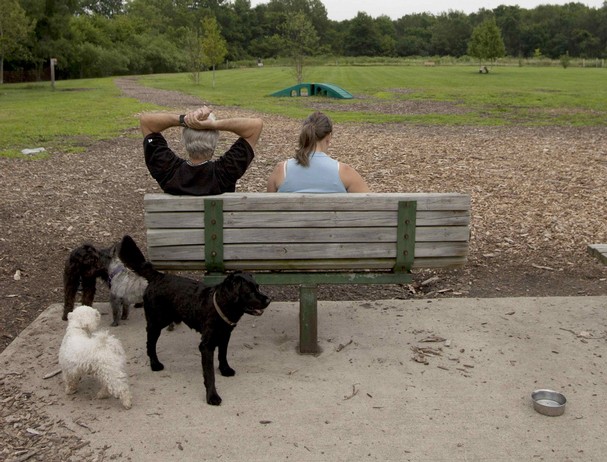 We have our granddog for a couple weeks while FBC moves to Brooklyn, so we joined the dog park. Yes, you have to join it here – no freebies from the park service. They want to be sure all the dogs have the proper shots and that Someone Knows Who They Are (in case a dog or owner breaks the rules.) There is literally a locked gate and only members get keys.
Our dog park has a large Time Out Pen for the unruly or the potentially unruly. Puppies can also hang out there to be trained, but since you can’t train puppies among dogs with bad attitudes, I never see a puppy in there.
The owners that make up The Dog Park Family are remarkably like your average church congregation.
Me: Good morning! How are you?
CM: Just fair.
Me: Not having a good day.
CM: Today’s about as good as any day. Some days are worse.
Note: I would be annoyed with the perky lady too. But I spared him from sitting down on the bench beside him and trying to fix his life. Or maybe I should try to get to know him better. I’d kind of like to hear his story but I don’t think he likes me.
A lot of people don’t know this dog park is even here, which is a shame because it’s pretty great. There’s even equipment for older dogs who need exercise but can’t run anymore.
Most people care only about their own dogs and don’t connect much with other people’s dogs. Except for that talking lady.
As for me and HH, we joined but we are just trying it out. We won’t be here for many more weeks.
Posted in Uncategorized

NOTE: I often feel like I write about the same things over and over. But I can’t figure out how to convey to churches that they need to step up in the compassion department. Seriously. Church people can be clueless about the very things we are supposed to be about. How can we convey this? #nag
Every church believes it’s “friendly” of course. But how hospitable are we, really? How would you answer these questions in terms of how your spiritual community usually responds?
A guest comes into worship for the first time. She bravely (and tearfully) discloses, during the time of sharing prayer concerns and celebrations, that she’s recently been diagnosed with lung cancer. She has lived in the neighborhood for five years but now finds herself in need of a supportive community. What happens next?
A. People nod and offer supportive facial expressions. The newcomer’s concern is prayed for by the leader during corporate prayers.
B. The church member who happens to be sitting next to her immediately moves closer and introduces herself, adding “May I take you out for lunch today after worship?”
C. A deacon or other church leader passes her a note during worship that says, “How can we support you? My name is ____. Please share your contact information and we can talk about ways we might be able to help. Anything from being a sounding board to driving you to your appointments.”
**********
A new family in church is looking for the sign up to prepare dinner for another family in need. What happens next?
A. The Lady-in-Charge guarding the sign up sheet says, “We don’t need you to sign up. Thanks but no thanks.”
B. The Lady-in-Charge beside the sign up sheet says, “I don’t think we’ve met. Thanks for signing up.”
C. A church regular randomly standing near the sign up sheet says, “You guys are awesome for making dinner for the Kelly’s. Do you need directions to their house? Also have you heard about the First Friday softball game in the park?”
**********
A man who’s just getting involved after being a member for a couple years attends a meeting to help plan the upcoming mission dinner. The others at the meeting are all long-term members who have worked on this annual dinner for decades. When no one volunteers to chair the dinner, he speaks up and offers to do it. What happens next?
A. Crickets. The others all look at each other as if to say, “This guy will have no idea what to do. I’d rather do it myself than have to hold his hand.”
B. After he suggested that the main dish being something Haitian (since the mission dollars are going to Haiti), last year’s dinner chairperson says bluntly, “No one would eat that. We always serve ham.”
C. Although few of those gathered have ever had Haitian food, they encourage the new idea. Last year’s dinner chairperson says, “What do you need us to do to help?”
Here’s the thought that often eats away at me: I witness not only a lack of hospitality in most of the congregations I visit, but I also observe basic meanness on a regular basis. Yes, we in Jesus’ body are as gossipy, cranky, self-centered, and petty as the rest of the world, but the difference is that we are trying not to be like the rest of the world. Aren’t we?
Image is the installation of a community art project created to welcome strangers to a park in Oakland, CA.
Posted in Uncategorized
 There are things I’ve done in the past which are now excruciating to admit:
Oh, and there are other, much worse things that I’m too mortified to share one-on-one, much less for people to read about here. And I don’t even have a Smithfield Ham contract to lose.
God bless Paula Deen. Diabetic, southern, butter-loving Paula Deen. She has a brother named Bubba. Of course she does.
Paula Deen has said things she regrets regarding race and culture. Actually all of us have. We just haven’t been subpoenaed to talk about it.
An African American friend of mine confessed the other day that she grew up referring to “Jew Town” as a section of Chicago where the merchants would cheat you. She said that she didn’t even realize it was offensive until she was about 20 years old. Someone had to explain it to her. I’ve said things just this ignorant, and worse.
Paula Deen has more than enough money to survive without the TV show and the ham contract, but how can she redeem herself? How can any of us redeem ourselves when we’ve said and done things that are grievous to other people?
Starter suggestions:
Paula Deen will be fine and yet I am ashamed alongside her. Sometimes when we fall, there’s something we’re supposed to notice down there on the ground.
Image is The Last Supper sculpted in butter.
Posted in Uncategorized
I remember talking to someone who longed to go to seminary. Her then-job was something behind a desk at an airport and she hated it. “You are so fortunate that you like your work,” she said to me.
Two things:
Every time I hear a parent or teacher advise a young person to “do what they love” and the job will follow, I feel a little queasy. I agree that doing what they love is huge. But it’s also possible that they will never be able to get a job in a field they love.
I am the mother of three young adult kids who majored in three non-lucrative fields: film, linguistics, and urban planning. And yet they are all – miraculously – doing work they love in their fields. I’ll say it again: miraculous.
According to this story from yesterday’s news, “a little more than half of workers (52 percent) have a perpetual case of the Mondays—they’re present, but not particularly excited about their job” in the United States.
Two things:
I don’t love writing Board of Pensions letters. But the other responsibilities often rock my world. Crazy fortunate.
You?
Posted in Uncategorized
 I am 57 – which is rather old to many in our culture. There are things I can do, gifts I can share, experiences I can draw upon. But maybe my role is to step aside and make it possible for someone younger to do things, share gifts, offer their experiences. It is a tricky situation, because I still both want to serve and have gifts to offer. So what’s a seasoned pastor to do?
I love creating opportunities for spiritual development. I love preaching and God talk and Faith on Tap and praying with people and hearing stories and telling stories. I (rather disturbing) love to mediate conflict. I hear about new church initiatives and would love to jump in and do them. But it’s someone else’s turn.
My role in this chapter of my ministry is to make it possible for people from about 25-5o to do what God is calling them to do. They can mentor me as – I hope – I can mentor them. I’m a digital immigrant longing to learn new things. And if you ask me, I’ll share what I’ve learned after all these years about dealing with church bullies, firing staff members, shifting paradigms, figuring out what makes God’s heart break in your neighborhood, training officers, tweaking officer roles, and equipping the saints for 21st Century ministry.
My Dad’s only sister is now in her late 80s. She has outlived her six brothers – the three who were older and the three who were younger.
Aunt Jane was once the Go-To person if you wanted to serve a church in North Carolina. She would have gone to seminary if women had done such things 70 years ago. Now she is hospitalized after a stroke which happened after a fall.
Her season as a congregational and Presbytery leader is over, but it’s important to honor her contributions and remember the small and great things she did to show the love of Jesus – among them: saving the life and soul of a troubled kid whose principal wanted him forever expelled from school. She literally planted herself between the student and the school administration. And now he is a college professor. She served on countless committees and commissions, taught classes, traveled to China, and mediated family disputes.
Once she read Scripture at my ordination. Now people read Scripture to her in the hospital. Once she took me on my first trip to Montreat. Many years later, I was called to my second church because of those Montreat trips.
Her granddaughter is a recent seminary graduate, and she will lead the next generation of Jesus’ disciples. Aunt Jane was so, so proud to watch S. go to seminary.
Why do people live past their prime, well into the years when their minds are no longer sharp and their legs are no longer strong? Because there is still work to be done. Maybe my Aunt Jane has work to do that only God can ascertain. Maybe her children and grandchildren and great-grandchild need this time with her. Maybe there are doctors and nurses and friends who are still learning from her.
Our job is to artfully live out whatever season we find ourselves in. For my Aunt Jane – who agrees that old age is not for sissies – it’s a new season. And it’s a new season for me too. And it’s a new season for my first cousin once removed who just graduated from seminary. And it’s a new season for you, perhaps.
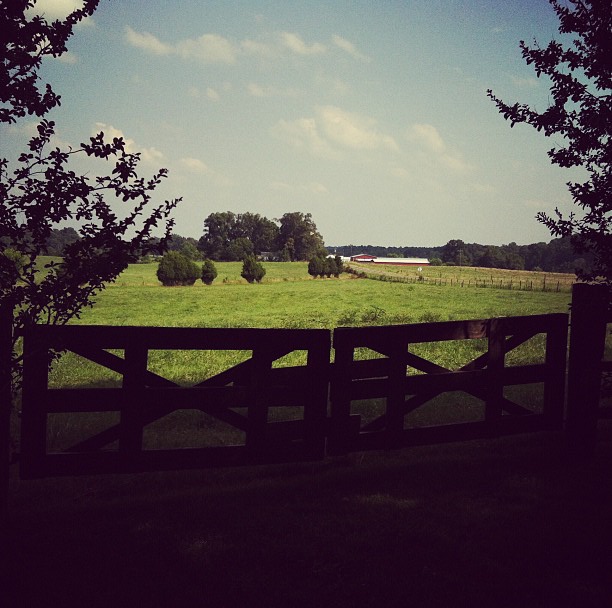
Image is looking out on the Edmiston farm – in honor of our first Cousins Day without Uncle Bill.
Posted in Uncategorized


