What I Continue to Learn from Cindy Bolbach: We Hate Cancer

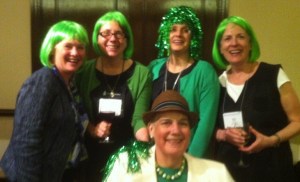
Cindy Green WigsNote:  It’s Cindy Bolbach Week in my head, so I’m thinking of her wisdom as we approach the 3rd Sunday in Advent.  

I hate cancer.

Breast cancer is my special enemy.  I also have profound hatred for Non-Hodgkins lymphoma, liver cancer, cancer of the uterine lining, and . . . really, all of it sickens me.

I’ve watched cancer steal the body shapes, appetites, hair-dos, energy levels and souls of people I love.  I have – most devastatingly – observed cancer sapping the faith of previously faithful people.

What Cindy has taught me is that There Is A Will To Live beyond common wisdom and understanding.  I’ve witnessed hopefulness when no thinking person would still have hope.  I’ve participated in gallows humor that kept us sane.

The exquisite E. (the tiny one) has shared that her father – the forester – knew when pine trees were about to die because they produced an enormous number of pine cones just before their lives ended.  Human beings do this too.

And yet, even when it looks like cancer has won, it hasn’t.  There is something beyond this life.  I really have to believe this.

What I Continue to Learn from Cindy Bolbach: Not All Hymns Are Equal

John Calvin was the Mascot when Cindy Bolbach stood for Moderator of the 219th General Assembly in 2010

John Calvin was the Mascot when Cindy Bolbach stood for Moderator of the 219th General Assembly in 2010

Note:  It’s Cindy Bolbach Week in my head, so I’m thinking of her wisdom as we approach the 3rd Sunday in Advent.  

Yes, yes, we all know that new hymns often use fresh lyrics set to popular music. Supposedly Ein’ Feste Burg was the tune of a drinking song in 16th Century Germany, but in truth Martin Luther wrote the tune himself – along with the lyrics to A Mighty Fortress – probably while drinking a hearty German beer.

John Calvin wrote I Greet Thee, Who My Sure Redeemer Art set to a tune in the French Psalter about the same time that Luther was composing A Mighty Fortress.  Maybe he was drinking a glass of French wine during the process, or maybe not.

These are two of the greatest hymns ever written.  And here’s my point:  great hymns are written by great theologians.  Recently a seasoned pastor told me “There are no good new hymns anymore because there are no good new theologians.”  I respectfully disagree.

All of us are theologians.  Even atheists are theologians. (Simple:  There is no god.)  But the deeper our faith, the more profound our theology and the most creative among us can put that to poetry and music.

Not all popular songwriters are deep theologians, but there are some amazing songwriters today who stir something in us which connects us to God – maybe not with resounding organ sounds but – still – with deep meaning.

Jesus Is My Boyfriend music doesn’t do it for me and I don’t see that message as sound theology.  But everyday, theologians continue to write amazing music and lyrics.  And some of us are still stopped in our tracks by those 16th Century favorites.

What I Continue to Learn from Cindy Bolbach: Elders Rule

Cindy Seriously AwesomeNote:  It’s Cindy Bolbach Week in my head, so I’m thinking of her wisdom as we approach the 3rd Sunday in Advent.  

We in the Presbyterian Church (USA) call clergy and elders Teaching Elders (clergy) and Ruling Elders (non-clergy).  This ticks some people off because they say (and, to be fair,  it’s true) that ordinary, non-churchy people have no clue what a “Teaching Elder” is.  They know the terms Pastor, Priest, Clergy, Minister (the most misused term), and even Teaching Pastor, but most people don’t know the Greek word for elder, etc.

Nevertheless, we Presbyterians believe that both kinds of elders are equal in calling and this designation (Teaching Elders & Ruling Elders) notes this.  This is who we are as Reformed Christians who lift up the priesthood of all believers as one of our Essential Tenets.

My favorite Ruling Elder served as Moderator of the 219th General Assembly of the Presbyterian Church USA.  She is brilliant, witty, generous, and without question a minister in the Church of Jesus Christ.  She reminds us all that Ruling Elders rule.  Which brings me to the ecclesiastical whirlwind known as Advent.

Every parish pastor I know is Very Busy right now.  In addition to the usual unrelenting duties of Ordinary Time, Advent piles on the extra worship services,  hanging-of-the-greens, pageants, concerts, staff parties, and – like clockwork – more pastoral care needs.  From the person who wonders if he should ask his beloved to get married in 2013 to the person who is retiring to the family whose losses are more profound in this season, there is always more pastoral care in these last weeks of the calendar year.  All Teaching Elders I know are overwhelmed with holiday ministry.

So, here’s my question:

How many Ruling Elders – who are obviously also leaders in these busy days in the life of a church – are also finding their ministerial responsibilities increased?  I have the sense that many of our elders are not particularly busy leading their congregations.  Sure, they have responsibilities like decorating and preparing for family events.  But I wonder why Teaching Elders are the only ones who feel like this season gives them more ministerial duties.  What would happen if Ruling Elders took some of these tasks because . . . they are Ruling Elders and it’s their job?

What if our ruling elders were equipped to:

  • Visit the sick without feeling less official than a Teaching Elder who visits the sick?
  • Teach Advent classes because they were confident in their own theological chops?
  • Coordinate one of the extra worship services because the Teaching Elder relinquished that responsibility knowing that the Ruling Elders can do this well?

Advent doesn’t have to be a vortex of craziness for clergy – and aren’t we missing the point if we insist on it being a crazy season?  In Reformed Churches, at least, Elders Rule.  Let’s lead our congregations in preparing for the Coming of the Lord together.

Believing (Difficult) Truths

But speaking the truth in love, we must grow up in every way into him who is the head, into Christ.  Ephesians 4:15

How do we get people to believe us when we share the truth in love?

The Key by Jackson PollockIt’s an age-old question, especially for those of us whose job it is to hold people accountable or help shepherd them into a healthier and more faithful way of life.    Every day I deal with people in churches who deny that there is any dysfunction in their community/congregation/institution.  It’s not that I want to be negative or that I look for the dirty laundry.  But it’s really important to face The Truth so that we can become what we were created to be.

Examples:

  • A church program is totally controlled by One Person who wields Great Power, and even though it no longer feeds anyone’s soul (except the person in power) it continues because people are afraid to challenge the viability or the effectiveness of the program. So: they never challenge the bullies or the power players.
  • Patterns in spiritual communities are obvious to everybody except those in the communities.  They just can’t see it or they don’t want to see it.  And so they keep hiring the same dysfunctional staff people or they refuse to make the necessary shifts or they choose to argue about silly things instead of Important Things. So:  they keep making the same mistakes over and over again.
  • Pastors continue to perpetuate tired patterns, refuse to do something bold and scary,  and fear obeying God because of what that might mean.  So:  they stick around too long, doing damage as they pretend that there is no good reason to make a change.

Sometimes I tread carefully as I share what I see in a church’s life.  Sometimes I just come right out and say it.  This often doesn’t go well, because people don’t want to hear that Changes Are Necessary.  How do we help people notice what’s really true about ourselves (me included)?

Image is The Key by Jackson Pollock (1946)

Opinion on Gay Marriage Shifts . . . Or Not

Short post today with some real questions:New Yorker Cover

  • Why is acceptance of GLBT marriage growing so quickly in the United States?  
  • Why is most rejection of GLBT marriage based on religious beliefs?

These questions are based on yesterday’s Gallup reports you can read here. Discuss.  I’m really interested in your ponderings on this.

Image source.

The Church of Misfit Toys

Misfit_toysI used to be part of a church comprised of openly broken people.  One person said we were like characters from the Island of Misfit Toys.  Unlike many of our traditional congregations, this was a church in which people fearlessly shared their depression, their doubts, their relationship conflicts with each other.

The truth is that all churches everywhere are filled with broken people.  Disabilities Are Us.

How we treat the weakest among us reveals our  truest selves.  There are congregations that prefer their brokenness to be invisible and their imperfections to be hidden.  But how are the lepers and the lame supposed to be healed if don’t know them or we pretend they aren’t with us?

The most ridiculous comments I’ve heard in response to discussion about installing an elevator or ramps in a church building:

  • Exactly how many people really use crutches or wheelchairs around here, anyway?  (Note:  Not many because They Can’t Get Into The Building)
  • It will ruin the classic looks of the building to add a ramp to the entrance.
  • The handicapped should not get special treatment.  Why should the whole church have to pay for something that helps just a few people?

Really.

I don’t know every detail about the UN Disability Treaty but the basics are that the disabled should enjoy the same rights and fundamental treatment as their fellow citizens throughout the world.  A no brainer.

155 nations of the world have already signed it and 126 nations have ratified it.  And our own political leaders from Bob Dole, John McCain, and George W. Bush to John Kerry and Barack Obama have pushed for its passage, but – shockingly –   the U.S. Senate didn’t pass it yesterday.  This is nuts.

A friend contacted me recently about her “honeymoon-is-over” experience as a new pastor in her first call.  The issue was about installing a ramp from the parking lot to the side door of the church building.  Her elders had just voted it down “for aesthestic reasons.”  They chose landscaping over their members in wheelchairs and their new pastor was crushed.  “Can I really be their pastor if they can’t even love the weakest among them?”

Her options:

  1. Quit or threaten to quit because she can’t serve people who so obviously miss the point. Prepare to be unemployed and humiliated.
  2. Be the prophet and try to shift their way of thinking and their culture with provocative Bible studies and sermons.  Prepare to check your anger so you don’t scare everybody.
  3. Accept the fact that this will be a slow transition from “the church is for us” to “the church is for people who aren’t yet with us.”  Prepare to be frustrated.

This is a snippet of the life of a pastor who is trying to preach Good News to the poor, while dealing with people who don’t even realize that they, too, are poor, broken, and disabled.

Aren’t we all?

Image from the popular Christmas TV show Rudolph the Red-Nosed Reindeer of toys from The Island of Misfit Toys.

The Barrista is Named Lucy

It takes a long time to feel at home in a new town.  I have spent the majority of my life in four places:  Chapel Hill (22 years), Boston (3 years), Schaghticoke, NY (5 years), and Our Nation’s Capital (22 years.)

Downtown Flossmoor

I know people – usually in military families – who have moved every year for decades.  And I know people who have never lived away from home except for their college years, and after college they moved back to the general vicinity where they grew up.  There are lots of reasons why people live where they live.

We now live in Chicagoland.  It’s really wonderful and I say that as a person who has loved every place I’ve ever lived, including a summer in Guatemala and a year in Europe.  I’m very fortunate that way.  But it takes a long time to feel at home in a new place.

When my parents were alive, they always called the town of their childhoods “home” as in “we are going home for Christmas” even though they’d lived in Chapel Hill for more time than they’d lived in the towns where they grew up.  Home is still – in a profound way – the town of my childhood and the town of my children’s childhoods.  I love the overwhelming familiarity of having lived in a place for so long.   And I miss my local dry cleaning lady and the staff at the local Caribou.  I miss knowing exactly where I can find my favorite salad dressing.  I miss the writing table at my favorite sermon-writing place.

But last Sunday, as I was getting coffee at my local coffee shop, the barrista staffing the drive-thru said into the speaker, “Hi, my name is Lucy. What can I get you today?”  And I said, “Lucy is one of my favorite names,”   and when I drove up to retrieve my Skinny Mocha, she said, “Well now you can call me by name.”  I almost burst into tears.  “My name is Jan,” I said.

I believe in call.  I believe that just as God called Abram from Ur  – and everything he’d always known  – to Canaan  – where he was a stranger – God called me and HH from the East Coast to the Midwest where neither of us had ever lived before. But just because God did it doesn’t mean it’s easy.  I totally get why people stay in the same church or the same geographic area for the sake of their families for decades if not for the entirety of their work lives.  I would like to have done that too, but it wasn’t our calling – at least for now.  I mourn being away from our kids, our friends, that dry cleaning lady.  But we are slowly connecting with new friends.

A word for churches calling pastors far from “home” – be patient.  We happily moved to serve here and we are so happy we did.  But there are layers of grief we are still dealing with after leaving pretty much everything behind.

Thank goodness for Lucy, the barrista I now know by name.  She has no idea, but she changed my life last weekend.

Photo of my new downtown.

Do I Look Christian Enough?

Magi Christmas Stamp 2012This is the kind of post that will make some of my emergent Christian and non-church friends roll their eyes.

I don’t know about you, but in the coming weeks, my faithfulness will be questioned by other believers.  Just as some Americans will judge politicians of being unpatriotic if they don’t wear a flag pin on their lapels, some Christians will judge me if . . .

  • I use Santa stamps instead of Jesus stamps on my Christmas cards.  (Actually, this year’s Jesus stamp is of the magi and they are lovely.)
  • I say “Happy Holidays” instead of “Merry Christmas.”  One of our annual family conversations is about what the Christmas card greeting will be:  Peace on earth?  Happy Holidays?  We like Winter?  We send lots of cards to non-Christians.  Will they be offended if our card says, “Merry Christmas“?
  • I play secular songs instead of Christmas carols.  White Christmas = bad.   O Holy Night = good.  And what to do about ostensibly Christian songs that are terrible?   Exhibit A:  Little Drummer Boy
  • We don’t set up a home Advent Candle, creche set, or yard angel.

I’ve noticed the looks from faithful friends when I tell them we watch the Bourne trilogy on Christmas Day instead of The Nativity Story with that actress from Whale Rider.   And for the record, we tend to use the religious postal stamps and we do have a small creche set in the living room.

But none of these things matter if this is all we do “for Christmas.”  If the sum of our Christmas practices involve saying “Merry Christmas” or sending cards or placing a blow-up Nativity Scene on the front lawn, then we are the weakest of believers.  Do we really believe that any of these practices expand the reign of God on earth?

This story of the police officer in NYC who bought boots for a homeless man is actually a Christ-like act, and who knows if Officer dePrimo is a part of any church.  He is a practicing Christian in the way he lives his life if he is doing a Christ-like thing.   Saying “Merry Christmas” versus “Season’s Greetings” makes no difference if we don’t, ourselves, make a difference in the image of Jesus.

My Dream Presbytery

Our Presbytery – like many organizations – is pondering the future and we have a V2P group working on it.  V2P = Vision to Praxis

It will take a chunk of time to figure out how to be a different, more effective church for the 21st Century, but I’ve been thinking about My Dream Presbytery.
For what it’s worth, this is some of what I see:

  • The Presbytery Offices are incubators for gathering, sharing, resourcing with support services (wireless, copiers) for those who lead spiritual communities with no building (i.e. they meet in coffee shops, bars, schools, etc.)
  • The Presbytery staff includes an experienced team who can specifically teach 21st Century Church skills like setting up Third Space Ministries, shifting financial stewardship culture, redesigning church buildings to become more effective tools for ministry, and coordinating co-mentoring relationships between new and “seasoned” pastors.
  • Rock Star Coaching Teams are set up to start new faith communities alongside dying churches so that if/when those churches indeed close, there is a presence in place to serve the needs of the specific neighborhood in which they gather together.  Buildings are sold or kept according to the needs of the new missional community.
  • Churches are coached to break out of their buildings and offer multiple portals for entering their congregation in community spaces – preferably partnering with other churches.  Example of what this looks like: Monday Parenting Group meeting in public library;  Tuesday God Talk in coffee shop;  Wednesday small group in back room of a bar;  Thursday Bible study in diner after work; Friday game night in someone’s home; Saturday community work project in a laundromat, school, street corner, nursing home; Sunday worship in gathering space.
  • Presbytery Educational Events look more like TED Talks than workshops.  Call them TAG Talks (Theology, Art, & God) or FIT Talks (Faith, Ideas, Theology), or LEAD Talks (Leadership, Education, and Development) but they would be pithy, fast paced talks on provocative subjects that have obvious or not-so-obvious links to spiritual communities.  Imagine 3 talks per meeting all about  a common theme (What I’ve Learned in the Past Year Doing This Weird New Thing, Spiritual Life & Debt, Herding Cats) presented for  – if we want to mimic TED Talks – 18 minutes each.

This is what I think about all the time.  You?

A New Normal Small Group?

Anybody want to start a New Normal Small Group in 2013?

I’ve been thinking that the TV show The New Normal would make a good small group conversation.  The Godparent episode in particular would be excellent to spark a conversation about our children’s spiritual lives, our own spiritual lives as parents, what it really means to be a person of faith, etc.  Yes, this is a sitcom, and yes, it can be silly and fairy tale-ish, but it can also be so poignant.  Issues like being who we were born to be, loving family members who fundamentally disagree with us, figuring out our God-given calling, and discovering what makes a family are timeless and yet timely subjects.

Our lives constantly involve adjusting to Our New Normal.

  • We’re diagnosed with cancer and our New Normal involves searing pain and unrelenting exhaustion.
  • Our partner leaves us and our New Normal involves financial hardship and paralyzing loneliness.
  • We get laid off from work and our New Normal involves taking a job at Starbucks paired with a job at Subway.
  • We can’t find work where we live and our New Normal involves moving to an unfamiliar place away from family and friends.

It would be interesting to get together and talk about The New Normals we find ourselves trying to navigate.

And this is also an ancient experience as well.  The Bible includes the stories of many people adapting to dramatic shifts in their circumstances, often led by God or tumult or both.  Imagine a New Normal Bible Study featuring Job, Ruth, Abraham, Esther, Mary, and Paul.  Each of them found themselves in situations they would not have chosen for themselves, but life shifted.

I am fascinated by how we adapt to these shifts ourselves.  How does God help us?  How does God factor into our New Normal?  Without being churchy, this strikes me as something with profound spiritual ramifications and possibilities. Anybody with me?  

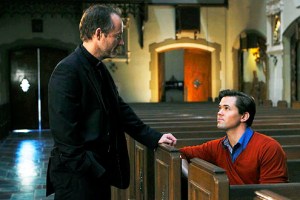
Top image from The New NormalThe Godparent episode.  Bottom image is Chagall’s Ruth.