The Barrista is Named Lucy

It takes a long time to feel at home in a new town.  I have spent the majority of my life in four places:  Chapel Hill (22 years), Boston (3 years), Schaghticoke, NY (5 years), and Our Nation’s Capital (22 years.)

Downtown Flossmoor

I know people – usually in military families – who have moved every year for decades.  And I know people who have never lived away from home except for their college years, and after college they moved back to the general vicinity where they grew up.  There are lots of reasons why people live where they live.

We now live in Chicagoland.  It’s really wonderful and I say that as a person who has loved every place I’ve ever lived, including a summer in Guatemala and a year in Europe.  I’m very fortunate that way.  But it takes a long time to feel at home in a new place.

When my parents were alive, they always called the town of their childhoods “home” as in “we are going home for Christmas” even though they’d lived in Chapel Hill for more time than they’d lived in the towns where they grew up.  Home is still – in a profound way – the town of my childhood and the town of my children’s childhoods.  I love the overwhelming familiarity of having lived in a place for so long.   And I miss my local dry cleaning lady and the staff at the local Caribou.  I miss knowing exactly where I can find my favorite salad dressing.  I miss the writing table at my favorite sermon-writing place.

But last Sunday, as I was getting coffee at my local coffee shop, the barrista staffing the drive-thru said into the speaker, “Hi, my name is Lucy. What can I get you today?”  And I said, “Lucy is one of my favorite names,”   and when I drove up to retrieve my Skinny Mocha, she said, “Well now you can call me by name.”  I almost burst into tears.  “My name is Jan,” I said.

I believe in call.  I believe that just as God called Abram from Ur  – and everything he’d always known  – to Canaan  – where he was a stranger – God called me and HH from the East Coast to the Midwest where neither of us had ever lived before. But just because God did it doesn’t mean it’s easy.  I totally get why people stay in the same church or the same geographic area for the sake of their families for decades if not for the entirety of their work lives.  I would like to have done that too, but it wasn’t our calling – at least for now.  I mourn being away from our kids, our friends, that dry cleaning lady.  But we are slowly connecting with new friends.

A word for churches calling pastors far from “home” – be patient.  We happily moved to serve here and we are so happy we did.  But there are layers of grief we are still dealing with after leaving pretty much everything behind.

Thank goodness for Lucy, the barrista I now know by name.  She has no idea, but she changed my life last weekend.

Photo of my new downtown.

Do I Look Christian Enough?

Magi Christmas Stamp 2012This is the kind of post that will make some of my emergent Christian and non-church friends roll their eyes.

I don’t know about you, but in the coming weeks, my faithfulness will be questioned by other believers.  Just as some Americans will judge politicians of being unpatriotic if they don’t wear a flag pin on their lapels, some Christians will judge me if . . .

  • I use Santa stamps instead of Jesus stamps on my Christmas cards.  (Actually, this year’s Jesus stamp is of the magi and they are lovely.)
  • I say “Happy Holidays” instead of “Merry Christmas.”  One of our annual family conversations is about what the Christmas card greeting will be:  Peace on earth?  Happy Holidays?  We like Winter?  We send lots of cards to non-Christians.  Will they be offended if our card says, “Merry Christmas“?
  • I play secular songs instead of Christmas carols.  White Christmas = bad.   O Holy Night = good.  And what to do about ostensibly Christian songs that are terrible?   Exhibit A:  Little Drummer Boy
  • We don’t set up a home Advent Candle, creche set, or yard angel.

I’ve noticed the looks from faithful friends when I tell them we watch the Bourne trilogy on Christmas Day instead of The Nativity Story with that actress from Whale Rider.   And for the record, we tend to use the religious postal stamps and we do have a small creche set in the living room.

But none of these things matter if this is all we do “for Christmas.”  If the sum of our Christmas practices involve saying “Merry Christmas” or sending cards or placing a blow-up Nativity Scene on the front lawn, then we are the weakest of believers.  Do we really believe that any of these practices expand the reign of God on earth?

This story of the police officer in NYC who bought boots for a homeless man is actually a Christ-like act, and who knows if Officer dePrimo is a part of any church.  He is a practicing Christian in the way he lives his life if he is doing a Christ-like thing.   Saying “Merry Christmas” versus “Season’s Greetings” makes no difference if we don’t, ourselves, make a difference in the image of Jesus.

My Dream Presbytery

Our Presbytery – like many organizations – is pondering the future and we have a V2P group working on it.  V2P = Vision to Praxis

It will take a chunk of time to figure out how to be a different, more effective church for the 21st Century, but I’ve been thinking about My Dream Presbytery.
For what it’s worth, this is some of what I see:

  • The Presbytery Offices are incubators for gathering, sharing, resourcing with support services (wireless, copiers) for those who lead spiritual communities with no building (i.e. they meet in coffee shops, bars, schools, etc.)
  • The Presbytery staff includes an experienced team who can specifically teach 21st Century Church skills like setting up Third Space Ministries, shifting financial stewardship culture, redesigning church buildings to become more effective tools for ministry, and coordinating co-mentoring relationships between new and “seasoned” pastors.
  • Rock Star Coaching Teams are set up to start new faith communities alongside dying churches so that if/when those churches indeed close, there is a presence in place to serve the needs of the specific neighborhood in which they gather together.  Buildings are sold or kept according to the needs of the new missional community.
  • Churches are coached to break out of their buildings and offer multiple portals for entering their congregation in community spaces – preferably partnering with other churches.  Example of what this looks like: Monday Parenting Group meeting in public library;  Tuesday God Talk in coffee shop;  Wednesday small group in back room of a bar;  Thursday Bible study in diner after work; Friday game night in someone’s home; Saturday community work project in a laundromat, school, street corner, nursing home; Sunday worship in gathering space.
  • Presbytery Educational Events look more like TED Talks than workshops.  Call them TAG Talks (Theology, Art, & God) or FIT Talks (Faith, Ideas, Theology), or LEAD Talks (Leadership, Education, and Development) but they would be pithy, fast paced talks on provocative subjects that have obvious or not-so-obvious links to spiritual communities.  Imagine 3 talks per meeting all about  a common theme (What I’ve Learned in the Past Year Doing This Weird New Thing, Spiritual Life & Debt, Herding Cats) presented for  – if we want to mimic TED Talks – 18 minutes each.

This is what I think about all the time.  You?

A New Normal Small Group?

Anybody want to start a New Normal Small Group in 2013?

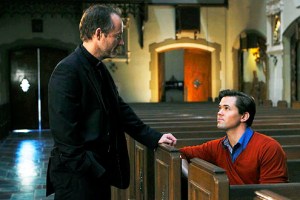
I’ve been thinking that the TV show The New Normal would make a good small group conversation.  The Godparent episode in particular would be excellent to spark a conversation about our children’s spiritual lives, our own spiritual lives as parents, what it really means to be a person of faith, etc.  Yes, this is a sitcom, and yes, it can be silly and fairy tale-ish, but it can also be so poignant.  Issues like being who we were born to be, loving family members who fundamentally disagree with us, figuring out our God-given calling, and discovering what makes a family are timeless and yet timely subjects.

Our lives constantly involve adjusting to Our New Normal.

  • We’re diagnosed with cancer and our New Normal involves searing pain and unrelenting exhaustion.
  • Our partner leaves us and our New Normal involves financial hardship and paralyzing loneliness.
  • We get laid off from work and our New Normal involves taking a job at Starbucks paired with a job at Subway.
  • We can’t find work where we live and our New Normal involves moving to an unfamiliar place away from family and friends.

It would be interesting to get together and talk about The New Normals we find ourselves trying to navigate.

And this is also an ancient experience as well.  The Bible includes the stories of many people adapting to dramatic shifts in their circumstances, often led by God or tumult or both.  Imagine a New Normal Bible Study featuring Job, Ruth, Abraham, Esther, Mary, and Paul.  Each of them found themselves in situations they would not have chosen for themselves, but life shifted.
I am fascinated by how we adapt to these shifts ourselves.  How does God help us?  How does God factor into our New Normal?  Without being churchy, this strikes me as something with profound spiritual ramifications and possibilities. Anybody with me?  

Top image from The New NormalThe Godparent episode.  Bottom image is Chagall’s Ruth.

Adventures in Boundary-Breaking

A few years ago, I was getting a physical when my doctor asked about one of her other patients – who also happened to be one of my parishioners.

Me:  (Lying on an examination table)

Doc:  How is N getting along?  Does she get out much after her surgery these days?

Me:  She’s okay.  (Thinking:  Really?  We’re talking about N?)

Maybe it was because my doctor was considering the two of us on the same team of N’s professional health care providers.  She handled physical health and I handled spiritual health.  Or maybe she simply had serious boundary issues.

I observe broken boundaries every day.  And honestly, I struggle with figuring out boundaries myself.  We make choices about boundaries all the time.

  • Is your dentist also your parishioner?
  • Is your spouse also your parishioner?
  • Does your spiritual community include your lawyer?  Your plumber?  Your daughter’s French teacher?
  • What should be the boundaries of a former pastor who has retired in the church neighborhood and has grandchildren in the Christmas pageant?
  • What if a retired pastor’s spouse wants to stay in the congregation where her long-time friends are?

After leaving my first congregation in NY – where I served for five years fresh out of seminary – that congregation never saw me again.  That sounds really harsh, doesn’t it?  But it’s true.  I sent Christmas cards to a several people who also sent cards to me.  One parishioner occasionally visited us when she was traveling through to Florida at our new home in Virginia.

But this feels wrong.  I was told that when a pastor leaves, she leaves.  The same is true now that I’ve left my second church as well.  But what about genuine friendships?  What about the community my children have left behind?  And what about supporting the new pastor and letting him/her bond with the congregation without my interference?

I hear retired pastors talk about their former churches and it’s clear that they miss that life.  The preaching and teaching and officiating the sacraments.  I miss this too, even though I’m not retired from parish ministry.  I’ve just traded one church for 98.  It’s different, obviously, but I still get to enjoy a glimpse of life as a parish pastor.  But at what point – if ever – can I connect with old friends who are former parishioners again?  Maybe never?  What’s healthiest for the church?

As church culture continues to shift, along with the expansion of our digital culture, figuring out healthy boundaries will be an ongoing adventure.  Any wisdom from your experiences?

Image is Highways and Byways by Paul Klee (1929)

Everybody Needs a Priest Hole

The movie Skyfall includes a reference to a Priest Hole.

I’d never heard of a Priest Hole (unless we’re talking about the mouth of a long-winded preacher) and so I looked it up after we got home.  Apparently during Reformation England when Roman Catholic priests were being hunted down and killed, secret rooms were built behind fireplaces and under floor boards to hide them from Protestant enforcers sent by Queen Elizabeth I.  Nicholas Owen was martyred and later canonized for designing many of these secret spaces.

Who doesn’t need a priest hole sometimes?

My work involves staffing the commission that shepherds seminarians into professional ministry, and we were talking yesterday about essential tips for new clergy.  Some tell new pastors to get a dog so you have an excuse to go home (to walk the dog) after a long meeting.  Some say that it’s essential to get exercise in the middle of the day to process the  unrelenting shifts from sacred (caring for people with intense emotional/spiritual issues) to banal (organizing the worship bulletin, picking Advent hymns.)  Some insist that – if you can possibly afford it – hire someone to clean your house so that you don’t have to dust and vacuum on your one day off.

What all these things have in common is escape.  Sometimes we need to escape, to hide, to protect ourselves.  Pondering this phenomenon, I wonder if the need to escape is only true for pastors and priests serving traditional institutional churches.

I have bi-vocational clergy friends who escape the vicissitudes of professional ministry by doing their other jobs: working construction or teaching piano or serving coffee.  And what about other kinds of professionals?  Teachers and health care workers and police officers and bankers?  Don’t they also need an escape?  Or do we clergy types believe our work is more stressful, more demanding, more draining?

Maybe we all need a priest hole where we can pray and celebrate whatever liturgy feeds our souls.  I suppose my priest hole is a coffee shop or my sofa when the house is empty.  What’s yours?

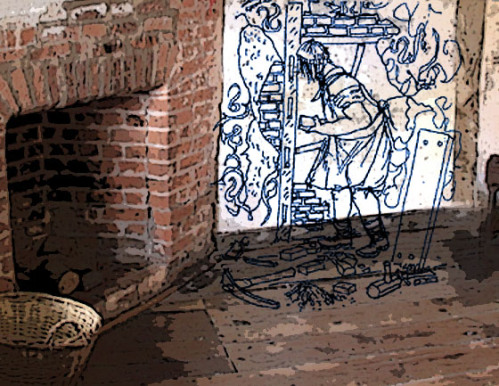
The image is a drawing of Saint Nicholas Owen at work designing a priest hole behind a fireplace.

When the Pastor is Sick

I was sick for a couple weeks in October and it turned out fine.  Just a bad cold and a test for whooping cough (it was negative), but – while most people were patient and willing to step in to help – a couple of people became a little ticked off.  My illness inconvenienced people.  It slowed down a few projects and placed others on back burners.  I’m grateful that all is well and caught up now.

In my late 40s I was diagnosed with a rare gynecological cancer that involved surgery and twelve weeks of recovery, which was tricky because 1) I didn’t really want to share the details of my lady parts with parishioners and 2) some people were Not Happy With Me for being sick.  It meant I missed meetings and other church events, and  – essentially – couldn’t take care of their needs.

There are some well-known accounts of pastors dealing with illness:  Craig Barnes was treated for cancer when he first became Head of Staff at National Presbyterian Church, documented in his book When God Interrupts.    Some of us know pastors who have struggled with both temporary and terminal illness.  Like health professionals, pastors and priests are often terrible patients.  We like to be in control.  We like to be the helpers, if not the saviors (although, of course, we already have a Savior.)

A couple friends who have experienced being The Sick Pastor have shared tips to help their congregations minister to them.  It’s quite possible that these tips could be helpful for anyone who wants to care for friends struggling with illness:

  • Give your pastor permission to be sick.  Let her take it easy.  Encourage him to follow up on all the therapy appointments.
  • Offer to bring meals, pick up laundry, run errands, but also understand if he/she occasionally declines.  It’s overwhelming when a whole congregation tries to help.  Maybe one person could be the lead organizer and set up a schedule for everyone.
  • When dropping off meals, make it quick.  Don’t use the opportunity to get a pastoral care appointment in while delivering your casserole.  In other words, don’t make this about you.
  • Please don’t give advice on “a new doctor you’ve heard about” or “a new treatment you read about” unless specifically asked.
  • Remember that pastors also have spiritual needs.

Sometimes the pastor doesn’t get well and sometimes he/she does.  It’s especially traumatic when a person who is called to preach has an illness that takes away the ability to speak, when a pastor who reads or listens to prepare for teaching becomes blind or deaf.  Be gentle with pastors dealing with these layers of loss.

Pastors and priests get sick just like everybody else.  And these are good opportunities who remember who we are and whose we are.

This post is dedicated to GFW.

Image source.


Happy Thanksgiving!

I’m thankful.  Praying for peace for all families this Thanksgiving.

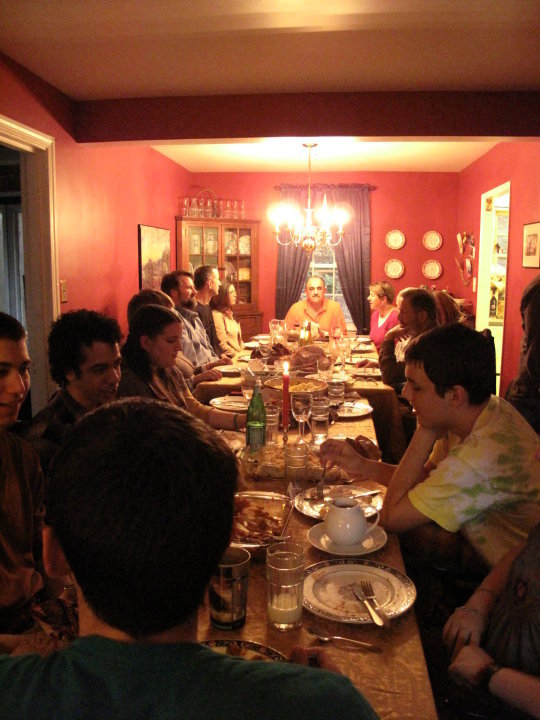
Image is from Thanksgiving 2009 in Arlington, VA

Thanksgiving for Doubts

An old friend preached a fiery sermon after his wife’s cancer diagnosis – fiery in that he expressed his anger, his fear, his doubts.  It was a powerful message that was met with two basic responses from the congregation:

  • Group A –  (aka The Loud Group) “What kind of pastor would tell us he has doubts after everything he’s preached about God?”
  • Group B – (aka The Quiet Group) “Finally somebody besides me has doubts.”  “Finally, a pastor who doesn’t preach platitudes.” 

One of the divides in the 21st Century Christian Community involves A) believers who express certainty about their faith and theology and B) believers who freely express their doubts and openly talk about the gritty, earthy side of faith and life.  Peter Rollins speaks to this and I, for one, am grateful for his ministry of speaking the hard truth that we are broken, unknowing, and unknown.  Check out this conversation with him on Living Compass.

Real faith comes with doubts and shaking fists.  For that I’m thankful.

What I’m Thankful for: Presbytery Edition

I’ve been on the job as the Interim Associate Executive Presbyter (i.e. Denominational Middle Judicatory Staffer) for exactly 1 year, 2 months, and 24 days.  Maybe this job sounds deadly boring to you, but I kind of love it.   And  this Thanksgiving Week, I’m especially grateful for:

  • Churches that defy all odds and do something completely fresh.
  • Church members who get that we are called to wear aprons, not bibs.
  • Pastors who protect their days off and the members who support them.
  • My closest colleagues who make me feel like I can do this.
  • The doorbell at the Presbytery office that plays random tunes we apparently cannot control (e.g. Happy Birthday to You, Take Me Out to the Ball Game, Jingle Bells.)  It makes me laugh in the middle of the day when a visitor rings the bell and we randomly hear “My Country Tis of Thee” or “Row, Row, Row Your Boat.“)

I’m also grateful for the losses we endure – church closings, pastors moving on, letting staff go – because those are maybe the only ways we will shift and change. New seasons are good, even if they look absolutely terrifying.

Happy Thanksgiving to all.

Image is about what can grow even out of ashes.