Peggy, Joan, Tracy – And Marriage

For a long while I couldn’t watch Mad Men.  It was just too depressing.  (Fodder for a different blog post.)

But we started watching Season 5,  and the story arcs involving Peggy (the feisty –  if dowdy  – career woman who has never married) and Joan (the sultry secretary who married for security, then became a de facto single mom) are nothing less than brilliant.

And then along comes Tracy McMillan who has written a book for single women:     Why You Are Still Not Married. (ouch)  Maybe one answer is:  I don’t want to be married.

I write this as a married woman (25 years this August) even though – at the age of 30 – I was pretty sure I would never marry.  I was a happy single person and had unknowingly tapped my inner Peggy Olson in terms of doing what I wanted to do without a husband.  At 27, I was ordained and serving a congregation – twice engaged but never married.  At 28, I was kind of dying to get married – so lonely while serving a tiny church in a rural village.  At 29 I was wondering if I’d ever have a date again.  At 30 I freaked out a little – especially when someone at a cousin’s wedding reception asked me why I wasn’t married yet.

Do you have some kind of personality disorder?” she asked as my champagne glass moved perilously close to her face,  before my sister gently placed her own hand on top of my champagne glass, as if to say, “Don’t bother.”

A year later, I was married.  It was honestly shocking how quickly my life shifted. By my fifth wedding anniversary, there would be three children.  And now, twenty five years into this, I like having someone to wake up to and share a life with.  But I think it would also be fine if I’d never married.  Maybe.  Who can really say?

Between the 1960s and the 2010s, marriage in the 21st Century has shifted considerably.  Check out Mark Regnerus’ marriage and divorce stats here.  We’ve all seen this on Facebook as a response to criticism of gay marriage as a threat to traditional marriage.

Back to the pain of watching Mad Men and reading Tracy McMillan’s commentary on marriage:  there is no wholeness in these people.  Married or single, gay or straight, we are created to live in shalom – wholeness and peace.

Just as the Early Church was known for treating women and children in a counter-culturally compassionate way, the challenge continues in the 21st Century Church.  Tracy McMillan’s article/book is unnecessary if the church successfully encourages women to be the people they were created to be.

Remembering the Dead – and What It All Means

I don’t come from a military family.  My dad was preparing to go to Korea but that conflict ended before he was sent to Seoul.  One of my uncles was a WWII vet but he returned home without injury.

I’ve served parishioners who returned from war as heroes and were buried in Arlington National Cemetery as old men.  Other friends returned with PTSD and they don’t talk about it.

The last member of my family to die in a war was my great-great grandfather Samuel Robert Edmiston who died on September 17, 1862 at Antietam – and he was fighting against the United States.  So Memorial Day does not have intimate bearing on my soul, in terms of having a close cousin or friend or brother who lost his life fighting for our country.

But Memorial Day has broad impact on us – as long as we remember why people have died fighting wars.  Just as MLK Day becomes merely a 3-day weekend if we forget the words and actions of Martin Luther King, Jr and other civil rights heroes, Memorial Day is about picnics and (finally) getting to wear white again, unless we remember that real people died for something greater than themselves.  And they had families and friends whose lives were altered forever.

Remembering them with thanks today.

To the Maiden Protesters

It stings – as both a pastor and a native of NC –  to have another story about a North Carolina pastor who has said some outrageous things.  A protest is planned at his church tomorrow – Pentecost Sunday.  My prayer is that the Holy Spirit will be poured out upon the congregation and their pastor as well as the protesters who will join them in Maiden, NC.

My fear is that people who disagree with the Rev. Worley will react with vengeance and the same kind of divisiveness that he preaches.  Rev. Mark Sandlin offers one good idea for fighting Worley’s words in a positive way.   But, nevertheless, I’d like to remove the wickedness from his “wickedly beautiful response” and offer merely a beautiful response.

Between 1000 and 2000 protesters are expected to meet at 9am at the Maiden Elementary School to march over to the Providence Road Baptist Church on Pentecost morning, and my hope is that they will resemble Jesus more than Rev. Worley.  I would love for them to sing hymns (“We are Singing for the Lord is our Light“) and offer hospitality.  Imagine  joyous people worshiping outside the church walls – as well as inside the church walls – and the “outsiders” are sharing lemonade, coffee, and prayers to those with whom they disagree.  It wouldn’t be easy to offer authentic hospitality but I believe this is part of what Jesus means when he calls us to carry our own crosses.  Loving our enemies is what God commands.

It won’t help for the Christians outside the walls to match the venom of those inside the walls.   Worley’s words are so offensive and ugly.  But please don’t match ugly for ugly.

Blessings on all who will gather in Maiden Sunday morning.  I pray you will express yourselves in the likeness of Christ.

A Few Things I Learned This Week

This is what I picked up serving God’s people in Chicagoland this week:

– “The best new church development pastors are in their 40s and the church plant is their third call.”  (From a New Beginnings consultant)

About a third of those preparing for professional ministry in the Presbytery I serve would like to start a new church as soon as possible.  (From my own observations staffing the Commission on Preparation for Ministry)

Sometimes the bus doesn’t arrive, no matter what the sign says. (From waiting for a bus for 45 minutes before walking to the train station.)

A lot of good people don’t know the difference between being Faithful Church People and being a disciple of Jesus.  (From reading comments shared in a recent local study.)

We can disagree and not hate each other.  (From this book.)

Thoughts?

Image Source.

I Can’t Wait for the Future

FBC wears this t-shirt which cracks me up.  The future we imagine might be full of cool new toys or it might involve something darker.  But part of our job as professional ministers involves telling the story of a different future. 

I’m not talking about a “hang-in-there-because-heaven-will-be-great-even-though-our-current-state-is-miserable” theology.  I’m talking about heaven on earth and what that might look like for our spiritual communities. 

Our staff is reading this book by Zaffron and Logan, and it teaches some of the same concepts as the PCUSA’s New BeginningsWhat is the future story of our community?  Are we stuck in a default future?

I’ve noticed that people get angry and/or frantic when I point out to them that their church is dying and probably will close in the next 3-5 years.  Note to self:  Don’t use a hammer when conveying this message. 

People don’t want to hear this news for complex reasons:  it’s critical of them and the way they do/have always done things; it’s overwhelming because they are too tired to make big changes; they don’t want to make big changes; they just want the church of their personal histories to be there – same as ever – when they die.  The congregations that make the leap from what they want the church to be to what God might want the church to be is a brave one.  It might be the ultimate in faithful discipleship.

I Worship Money

Columbia University graduate Gac Filipaj, Class of 2012
Source: AP

If we base what we really worship and trust on how much effort, how much thought, how much concern is expended on it with each breathing hour of each day, I must confess before you and the One who made me that I worship and trust money more than God.  I wish this was not true.

I talk with God a lot.  I praise God in the car on long drives and first thing each morning.  I spend my life trying to connect people to God.  But honestly, I worship money.  It’s The American Way.

As the mom of three young adults who’ve committed their lives to film, linguistics, and urban farming as opposed to “more profitable” employment endeavors, I totally get the relief that parents feel when their children are called to aeronautical engineering or brain surgery.  We want our kids to be able to support themselves and maybe even take an occasional vacation. And yet, it is – in the end – about a calling.  Some of us are called to the law and some are called to the dirt.  But we let money get in the way.

This interview between  Michel Norris and recent Columbia University graduate Gac Filipaj struck a nerve.  As an immigrant to this country, Mr. Filipaj has duly noted that most Americans are hugely concerned about money.  Yes, issues like student debt, unemployment, under-employment, fore closings overwhelm the news each day.  But many of us let money rule our hearts and goals to the point that our true selves get lost.

Gac Filipaj  – who worked his way through Columbia working as a janitor a la Good Will Hunting – majored in classics.  After Ms. Norris noted that majoring in classics is not exactly a lucrative course of study, Mr. Filipaj responded this way:

You were born in United States and you speak money first.  . .  I’m not doing it for the money.

What are we doing for the money?  And is it worth it?

Money is a good tool for sustaining ourselves and others, but it’s a terrible god.  If it rules us – and it rules many of us – life will sour,  sooner or later.  I haven’t heard any graduation speeches highlighting this particular truth, but – really – life is much sweeter when money doesn’t control us.

That’s easy for me to say when I am employed and able to cover my mortgage. Of course we need money to live.  But how can we help each other shift, even in slow ways, to a place where we make choices based on what feeds our souls?  Does it embarrass anyone else that “being American” means speaking the language of money first and foremost?

Are Your Closest Friends Your Church Friends?

I know someone who is recovering from surgery and she’s blessed with a wide assortment of generous friends who brought food, drove her to follow-ups, spent the night, bought her groceries, and entertained her cats.  One person lives half way across the country and dropped everything to come be with her.  Although she is part of a church community, nobody in her support network is in her church.  No Venn Diagram necessary.  They are completely separate entities.

I have another friend whose closest friends are exactly the same as her church friends.  When she moved, the church friends moved her.  When she was sick, the church friends brought soup.  When she was pregnant, the church friends threw a shower.  One of her first tasks as a new DC person was to find her tribe and she immediately went the church route.  Her best friends are her church friends.

The difference is clearly about relationship.  If you are part of a church in which people truly know each other, hang out together apart from Sundays, and can express their ugliest frustrations and doubts as well as their generic “prayer concerns” without being cast out or judged, then real friendship will ensue.

I remember a new church member – a while back – who, on the day she joined the congregation – said, “I have friends already.  I joined a church to figure out what I believe.”  It sounded strange to me.  Why wouldn’t you figure out what you believe with your friends?

Jesus modeled being friends with “the other” which implies that it’s not only okay, but it’s actually Christlike to have friends who don’t do church.  The hope is that people who don’t follow Jesus notice in our behavior what it looks like to follow Jesus.  Or something like that.

So what about your experience?  Are your closest friends part of your spiritual community?

Ruining It for Everyone

We noticed last weekend in Williamsburg, that pineapples figure prominently in decorating.  We saw pineapples on fountains, door knockers, statuary, and paintings.  Pineapples are, of course, symbols of hospitality, but we did some research to figure out if Colonial Williamsburg “invented” the pineapple as a hospitality symbol.

Nope.

According to Wiki – Answers (which is not like researching it in Swem Library, but time was limited), Christopher Columbus was presented with a pineapple by the locals on the island of Guadelupe in 1493 as a Welcome to Our Island gift.  And then Columbus killed them.

Actually, the story is more complicated than that, but what is indeed true is that Columbus named the island Santa María de Guadalupe de Extremadura even though the island was already called “Karukera” (The island of beautiful waters) by the Arawak people who had lived there for almost 1200 years.  And never mind that Columbus is credited by some historians  as “inventing the pineapple.”

And so, now the truth has somewhat spoiled pineapples for me – at least as symbols of welcome.  They remain delicious but I can’t forget that there is a dark back story.

This is one of my problems as someone trying to shift the Institutional Church into the 21st Century.

As I visit congregations with all the accoutrements  of The Traditional Church, hearing from them how important it is for their pastors to wear robes, stoles, and collars, for their children to attend Sunday School, and for their sanctuary to have pews, I find myself being – if not an ecclesiastical Debbie Downer, then at least an ecclesiastical Howard Zinn.

The origins of clergy attire can be traced to the late Roman Empire. The first Christian leaders dressed like everybody else.

Sunday School was “invented”  – if you will – in the late 18th Century.  This means, of course, that there was no Sunday School as we know it for the first 1800 years of Christianity, and so if someone says, “We can’t be a church unless we have traditional Sunday School,” please remind them that Sunday School is a fairly new thing.

Pews were introduced into church sanctuaries in the 14th Century.  Check out this post by Dan Kimball on the subject.  When I visited cave churches in Goreme, Turkey a few years ago, it was clear that people sat in a circle around the room/cave.  Imagine a house church at the Flintstones’ house and you get the picture.

The beautiful part of being the church is that it is fluid and free and all about becoming/being a community of faith.  Even if our priests are bedecked in perfect clergy tabs, and our Sunday School program is stellar, and our pews are carved by artisans, we aren’t the church unless we are a community of faith seeking to make disciples of all nations and loving God and each other.  My heaviest burdens come from meeting with wonderful people who don’t yet realize that being the church has nothing to do with stained glass windows, especially if they don’t love their neighbors.

So, I really don’t mean to ruin it for everyone, but I long for all of us to know the truth and let the truth set us free.

Moms

I’ll be spending Mothers’ Day with my kids at the college graduation of SBC.  My mother-in-law will also be there.  But my own mom will not be there.  She passed away from breast cancer about the time I became a mother myself, and it broke me in a very real way.  Mothers’ Day has been a day of mourning for about 23 years.

The best moms are teachers, cheerleaders, healers, spiritual guides, and much more.  The worst moms are destroyers and much more.

Parents make such a difference.  We can really  screw up kids’ lives and it’s an underrated miracle when we don’t.

Just love ’em,” my Dad used to say, but figuring out the most loving thing to do is an ongoing and arduous task.  When people say that “Motherhood is the toughest job in the world,” I shiver a bit.  It sounds too self-righteous or defensive to me.  Being a human being is the toughest job in the world.  It’s also the most glorious.

Being human means taking in this amazing life God has given us.  Learning and growing and being the people God created us to be.  On the way to Williamsburg for this graduation, driving east through the hollows and notches of West Virginia, I said to HH that it would have been fun to major in geography or geology and learn how those hollows and notches were formed.  What’s so wonderful about attending our children’s college graduations is that – by grace – they have connected with people whose ponderings match their own.  They’ve worked under professors with unique expertise and curious minds who have mentored them.  It has been one of my greatest joys to witness this in my children’s lives.

And so, instead of missing my own Mom on Mothers’ Day this year, I will try to celebrate being a mom.  I’ll try.  It’s not been about me – all these Mothers’ Days Past.  But as we celebrate another graduation, I’m so, so grateful I’ve been able to be the mother of some extraordinary human beings.  Thanks be to God.


Spiritual Tourists

I once preached in an historic church sanctuary and – in the middle of my sermon –  I noticed a small tour group in the balcony.  The tour guide was wearing a baseball cap and carrying one of those red pointer lights so that she could point out the architectural highlights of the space.  I am not kidding.  To her credit, she did not have a megaphone.

What they don’t teach in seminary is how to deal with a tour group in worship.  And increasingly we have spiritual tourists in our worship gatherings. 

It used to be true that everybody in the pews self-identified as Christian.  They ascribed to The Apostles’ Creed and “believed the same thing.”  Of course, I think if we had hypnotized those people, we would have found out that their theology was more diverse.  I remember one nonegenarian – a life long Christian – disclosing before she died that she “never believed in the resurrection of the dead.”  She also had a hard time with the Trinity.  And yet she stood and recited the creed each week like a new confirmand.

In my previous congregation, a small group of Turkish Muslims from the Rumi Forum regularly sat in the pews on Sunday mornings to meet Christians and make interfaith connections.  Although they didn’t sing the hymns or receive communion, they occasionally brought Turkish treats for coffee hour.  On Ashura they brought Noah’s pudding for everybody.   Nice. 

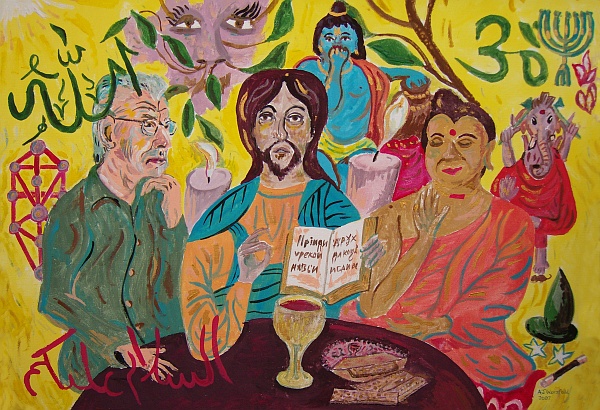
This is not to say we were or wanted to be an interfaith spiritual community, but the truth is that – on any given Sunday – many of our worshipping congregations include people who would not consider themselves Christian.  There might be a Jewish spouse sitting there to support the family.  There are definitely seekers and spiritual anthropologists in the pews in many of our congregations. 

Our job as preachers is to proclaim the Word as we always have, but recognizing that some (many?) in our pews are not believers.  For more information on this shift from a Believe-Behave-Belong culture to a Belong-Behave-Believe culture, re-read the appropriate chapters in Phyllis Tickle or Diana Butler Bass’ books.

People want, first and foremost, in our disjointed culture to belong to a community.  I love what Rob Bell said in Velvet Elvis about our 21st Century duty to be Tour Guides, interpretting where God is in daily life.  This happens best in a community, I believe, and we start by welcoming people into our community, even if they seem to be Hindu or agnostic or Muslim.  We teach them what Jesus said and did.  We show the love of God. 

Two last things:

Almost every church sanctuary uses the standard stage/audience architectural arrangement.  (We usually call “the stage” a chancel and the “audience” a congregation.)  Outsiders come in and it looks, to them, like an auditorium or a theatre, and so – accordingly – they expect the person up front to perform.  A sermon and worship leadership is not a performance.  In the PCUSA we are called Teaching Elders for a reason.  We teach and we lead, but we give our people the wrong idea if they come to assume that it’s a one way experience.  We teach them to be observers, an audience.  In my opinion, responsive litanies don’t make the point clear enough.  Being part of the worshipping community involves participation.  If you are present, you belong.  And you are expected to do more than sit there and applaud stirring music.  We want you to engage, reflect, speak, sing, pray – in whatever way you choose.

Secondly, too many of our churches today are indeed museums of what once was.  Tourists come in to see the extraordinary art crafted in carvings, fixtures, windows, and murals.  But there is no connection to God’s glory or the profound spiritual meaning of those details.  They tell a story, and we pray that the story is about more than a 20th Century industrialist wanting to build a monument to himself.  It’s our job to tell a different story.  To be Spiritual Tour Guides – and not only in sanctuaries. 

Where is God in all this?  What’s the meaning of all this?  I believe people are wondering.