What If We Were Really a Connectional Church?

My denomination calls itself A Connectional Church.  This means we share in ministry and governance.  We – as a collection of churches in regional groups called Presbyteries and as a national group called General Assembly – are connected in terms of money, property, mission, and relationship.

But – honestly – we aren’t all that connected.  Many of our congregations live as individual communities, maybe even seeing ourselves in competition with other individual communities that happen to be across town or in the next neighborhood.

Imagine what might happen if we were actually A Community of Communities that supported each other?  Examples:

  • Very few congregations will say that they have extra money but actually many of our congregations do have assets.  We just choose to spend it on ourselves with a survival mentality (e.g. “What if we need that money to replace our roof?) But imagine if Little Church on The Corner gave a chunk of their endowment to help Little Church on The Hill hire a part-time educator.  Imagine if two medium-sized congregations pooled their resources to send a group of kids from a third congregation on a mission trip.
  • Few congregational leaders know the congregational leaders from neighboring churches.  Imagine if a team of teachers who have figured out a new way to teach kids trains the teachers in another church who are looking for a new way to teach kids.  What if the local mission coordinator from Church A hangs out with the local mission coordinator from Church B and they share what they’ve learned?  Imagine people trading leaders who specialize in a specific ministry to equip others.  (e.g. We have a stellar Financial Giving Ministry.  You have an amazing Middle School Small Group Ministry.  Let’s share what we know.  And make some new friends.)

Our church culture has become so individualistic that shared ministry feels counter intuitive but it’s an ancient church practice.  We can do more together.

What if we were truly a connectional church in the New Year – not just in terms of sharing resources but also in terms of connecting relationally?  How would that change your congregation?

Body Gel Inspiration

One of the funniest people I know – even when she has cancer – begins 2012 cancer-free.  Check out her blog here.  D’s Christmas letter was an inspiration and she sums up her life’s philosophy by quoting the label of her favorite shower gel.  It’s indeed a good quote to live by.

Products from coffee to  shoes sometimes try to do more than serve our basic caffeine and foot needs:  they attempt to move us spiritually and emotionally.

Church is also – sometimes – a product.  Many have written about the consumerism around spiritual communities.  If a congregation fails to serve our needs, we go elsewhere.  I believe this is the biggest misconception of what church is all about.  It’s not about coming into a sanctuary on a Sunday morning, hearing an inspiration sermon, going out to brunch, and then being done for the week.  It’s about what happens next in our offices and classrooms and shopping trips and carpools.

This is old news, obviously.  But I am struck by the many people who loved and cared for D in lavish ways through her cancer year who would not call themselves church people.  They weren’t just around for the fun parts of loving a friend (bringing milkshakes,  watching movies, getting their own attention for Being Good Friends.)  They were inconvenienced and they made sacrifices.  This looks more like following Jesus than perfect attendance in Sunday School.

The shower gel label is inspiring.  But it was more inspiring watching people rally around a person who needed them.  So here’s my simple inspiring ditty for today:  notice someone who needs you and then serve them.   It’s not as easy as you might think.

Home By Another Way

Not only is it my favorite Epiphany song, but it’s my basic theology as well.  Home by Another Way.

When the family was “home for the holidays” they also referred to other places as home.  “Home” in our family could be one of three towns in the Commonwealth of Virginia, a college town in North Carolina, a small town in Pennsylvania, or our new residence in Illinois.  Is it possible to have multiple spiritual homes?

I’m not talking about multiple homes as in John McCain has multiple residences.  I’m talking about multiple spiritual homes as in places we feel nourished and at peace.

My life’s work involves helping people find spiritual homes.  I want churches – spiritual communities –  to be thriving and healthy and Christ-like.  Nothing says “home” like being loved unconditionally.  Nothing says “home” like  a community where people live together, pray together, share together, reach out into the neighborhood together.  Karl Rahner once said something like this: “Every time a  new family is created, a new church is created too.”  Spiritually healthy families worship together, serve together, share life together.  This goes for blood-related families as well as spiritually-related families.

While it used to be true that people were members of One Church to which they pledged their allegiance as well as their money, time, and talent, today people seem to have multiple churches.  In other words we have a variety of spiritual communities that feed us, inspire us to serve, know us.  We may or may not be official members of these communities. My friend M identifies a variety of spiritual communities as his assorted “homes.”

It’s sort of like my own family.  We have many spiritual homes.  We don’t “own” them.  But we belong to them in a very real way.

God’s Child of Tomorrow

I’ve heard people say that one thing The 21st Century Church can offer to the world is space for silence.  We can not only offer space for silence in our sanctuaries and retreat centers, but we can teach people how to be silent.  Clearly, the bells and whistles of multi-media worship will not be helpful in this endeavor.

Pico Iyer wrote recently in the NY Times that the next generation is going to need (wait for it) . . .

stillness.

He, Malcolm Gladwell, Marc Ecko, and assorted other creative thinkers met with advertising people about a year ago to consider “Marketing to the Child of Tomorrow.”  What the next generation will need are black hole moments when they can escape from mass communication devices and find freedom from noise.  Iyer concedes that many (most?) people will seek this stillness for selfish reasons.  They will simply need and want to be calm for their own sakes – to rest deeply, process fully, and focus more clearly on life.  It’s the same reason why so many people who don’t self-identify as religious or spiritual people turn to yoga and meditation.  They want space to stop and take in the moment – or ponder many moments – without distraction.

We have always been prone to wander in our thoughts and practices, but – having just come from lunch at a lovely Thai Restaurant with a huge television mounted on the wall – we live in a world with constant distraction from The Moment.

On the same day the Times published the Pico Iyer article on the joy of stillness, there was a front page article on the news that U.S. pharmacies have a shortage of ADHD meds.  There more people seeking pharmaceuticals to keep them focused and calm than there are pills to fill those prescriptions.  ADHD is obviously a medical/chemical problem for some.  But the article notes that distracted college students turn to the same meds to help them fix their attention on their work.

It’s not enough for us to play Taize music and light candles.  One of the challenges for the church is to teach people how to pray, how to meditate, how to focus on God.    Remember that even the first twelve disciples – all ostensibly faithful Jews who would have prayed in the temple and with their families as boys – asked Jesus to teach them how to pray.

Lifelong church people – much less those who have never crossed the threshold of a church building – need space for,  lessons about and practice engaging with God in prayer.  God’s children of tomorrow will need it more than ever.  For that matter, God’s children of today need this too.

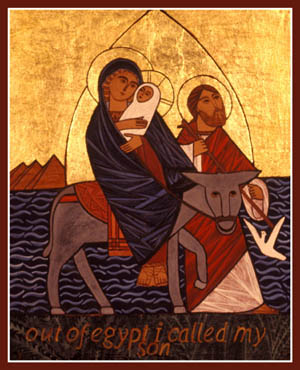
Some people pray to God by focusing on icons.  Source for the icon above is here.

What 2012 Will Bring

Happy New Year Everyone.

When I was a small town pastor, the  town funeral director perennially tried to convince me to join him in a wager regarding  who would die in the new year.

Funeral Director:  Come on, Jan.  Who’s going to kick it first this year?  Charlie?  Wilma?  Horace isn’t look too good, is he?

Me: I’m not doing this.

FD:  Ten bucks that Horace is dead by February.

The joys of a small town.

I think about my friend the funeral director each January 1st as I ponder what I most look forward to in the new year.  Here are my top anticipations:

  1. SBC will graduate from college.  Two down.  One to go.
  2. Assorted nibs will also graduate from high school and college.
  3. The magnificent MaryAnn McKibben Dana’s book on Sabbath in the suburbs will be published by Chalice Press.  Trust me, you will want to read this book.
  4. The extraordinary Katherine Willis Pershey’s book Any Day a Beautiful Change: A Story of Faith and Family will be published by Chalice Press.  Again, you must trust me.  Pre-order.
  5. The 220th General Assembly of the PCUSA will gather in Pittsburgh.  What I don’t look forward to: Administrivia and overtures passed that a) don’t matter and b) don’t matter.  What I look forward to: more people getting it that a) the Constantinian Church is gone forever and b) this is a good thing.
  6. Adam Walker Cleaveland and Sarah Walker Cleaveland get to experience the first year of their son’s life.
  7. There will be glorious and heart-tugging surprises:  babies born, new love expressed, vows made, death bed words spoken.

I love the future.

Favorite Discoveries of 2011

Here is my annual list of random favorite things I discovered in the past year.  I am a late bloomer, so forgive me if you discovered these gems many moons ago.

1.  The Presbytery of Chicago.  After 20+ years of membership in another presbytery, I found myself in a new place in 2011 in more ways than one.  To quote Stefon, POC has everything:  A mega-church in search of a new head of staff, a church that meets in a train station, a missional community that meets in an art gallery, big churches meeting in small spaces, small churches meeting in large spaces, dying churches, living churches, dying churches that look like living churches, living churches that look like dying churches. I get to work with them all now.

2. The First Ambassador to South Sudan.  Susan D. Page moved to Juba, South Sudan in 2011 but she was raised in Flossmoor, IL and grew up in the church HH now serves.  Trust me when I say she is a rock star.  We pray for her as she serves what must be one of the toughest diplomatic posts in the world.  And congratulations to South Sudan for becoming a country in 2011.

3. Aging.  Although 2010 was officially my first empty nest year, I lived without HH and our dog for the first six months of 2011 and then . . .  I left my own nest.  This has aged me.  I feel older now.  I outlived my Mom as of April Fools’ Day 2011 – celebrated with a Jan’s Not Dead Yet Weekend.  I also get a senior discount at IHOP now.  There are moments when this all feels slightly traumatic, but really – it’s not so bad.  We can talk privately about menopause.

4. These are like crack.  The perfect after dinner treat.  Or before dinner.

5. LB.  She was always a good friend.  She is an even better friend since we moved from D.C.  L.B. is one of many examples of someone who doesn’t really do church, but she exemplifies what it looks like to love people lavishly in the image of Christ.

6. Gay weddings.  They are just like straight weddings.  Really.  It will not be the end of the world if we can officially officiate.

7. The iPad.  Elegant.  Gorgeous.  Makes me want to wear a black turtleneck.

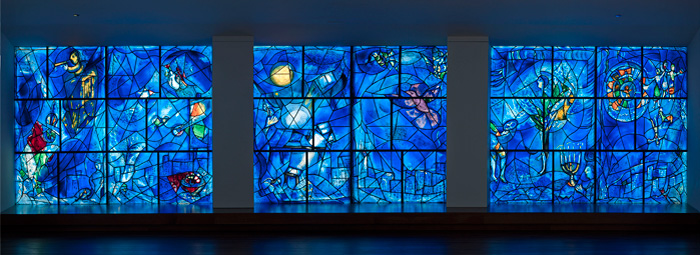
8. Chagall’s America Windows at the AIC.  My new favorite place to sit and stare.

May you have discovered beautiful things in 2011.  Looking forward to the New Year with you.

Beautiful Music

On this Christmas Eve, I am especially thankful for two creative men who passed away in 2011.  Their creativity involved music that stirred my and many other souls.

I thank God for Chip Stam who died on May 1st.  He sent me and probably a hundred others his Worship Quote of the Week for the past 20+ years.  When I couldn’t remember the lyrics of a worship song he’d taught me in college, I emailed him and he sent along the link – even when he was wretchedly sick with lymphoma.  He introduced this hymn to me which has become one of my favorites at Christmas.  Feel free to sing along:

Thou who wast rich beyond all splendour,
All for love’s sake becamest poor;
Thrones for a manger didst surrender,
Sapphire-paved courts for stable floor.
Thou who wast rich beyond all splendour,
All for love’s sake becomes poor.

Thou who art God beyond all praising,
All for love’s sake becamest man;
Stooping so low, but sinners raising
Heavenwards by thine eternal plan.
Thou who art God beyond all praising,
All for love’s sake becamest man.

Thou who art love beyond all telling,
Saviour and King, we worship thee.
Emmanuel, within us dwelling,
Make us what thou wouldst have us be.
Thou who art love beyond all telling,
Saviour and King, we worship thee.

I thank God for Reynolds Price who died on January 20.  He was a genius. That’s basically all I can say.  He co-wrote songs with James Taylor including this one.

Source of all we hope or dread
Sheepdog, jackyl, rattler, swan
We hunt your face and long to trust
That your hid mouth will say again let there be light
A clear new day

But when we thirst in this dry night
We drink from hot wells poisoned with the blood of children
And when we strain to hear a steady homing beam
Our ears are balked by stiffled moans
And howls of desolation from the throats of sisters, brother, wild men
Clawing at the gates for bread

Even our own feeble hands 
Aim to seize the crown you wear
And work our private havock through
The known and unknown lands of space

Absolute in flame beyond us
Seed and source of Dark and Day
Maker whom we beg to be
Our mother father comrade mate

Til our few atoms blow to dust
Or form again in wiser lives
Or find your face and hear our name
In your calm voice the end of night
If dark may end
Wellspring gold of Dark and Day
Be here, be now

Thanks be to God for these saints.

Big Weekend

Many church sanctuaries will be full this weekend.  Especially on Saturday – Christmas Eve – pews might even be packed.  I’ll go out on a limb and predict that Saturday night will be a bigger draw than Sunday morning.

Even for those with minimal understanding of or devotion to Jesus, Christmas draws us in.  It could be the music, the children, the candles, the Eucharist.  It could be the familiar story.  It could even be the promise that something holy could happen and some of us long for the holy.

May something holy happen to us in the days to come.  Or maybe I should say, it would be amazing to have something holy happen to us again this weekend.

Holy Christmas to you.


We Long for What the Church Could Be

Years ago, a colleague whom I greatly admire was thriving as the new pastor of an historic church.  When receiving accolades from other pastors, he responded this way:  “It’s not me.  People are just beginning to realize what the church could be.”

One of the most memorable snippets from Rob Bell’s Velvet Elvis is the story from pre-Mars Hill days when he and a few friends sat around and talked about What The Church Could Be.  You can listen to Rob Bell’s last sermon A Letter to Mars Hill here.  Or you can read it here.

I can’t write anything as profound as this last sermon.  But in a nutshell, as he looked out upon that congregation, and saw An Idea That Had Come to Life.

Last weekend, I had the privilege of hanging out with people who are preparing to be professional pastors.  Three of those people stayed after everyone else had left because they wanted to talk with me about What the Church Could Be.  I have appointments in the next weeks from others who were there who want to sit  in a coffee shop and dream about What the Church Could Be.

This is the future of the church.  It’s always been the future of the church.  From the first Pentecost after the first Easter, we’ve received glimpses of What the Church Could Be.  This is what keeps me in the institutional church.

Jesus came to show us What the Church Could Be.  It’s our reason to live.  It’s everlastingly interesting.

Pageantry and Theatre

Church Friend #1:  Since our pastor retired, our worship numbers are down
significantly.  We didn’t realize how many people came just to hear him preach.  And then they went to brunch.

Church Friend #2:  That’s not really church, you know.

Many of us have participated in Destination Worship to hear a great preacher preach.   A friend just told me over the weekend that she would be visiting Texas for Christmas and while she’s in Houston she will definitely go hear Joel Osteen.  Because he’s Joel Osteen.  (Maybe not everyone’s idea of a Great Preacher but we’d all agree he is a famous preacher.)

I’ve traveled to Grandville, MI to hear Rob Bell preach.  I’ve made several pilgrimages to hear BBT.  I’ve made special efforts to hear other fine preachers deliver God’s Word.  My faith has been impacted by their teaching and I have a richer understanding of scripture from those sermons.  But I can’t say that my experience was truly “church.”

My friend Steve Knight wrote earlier this month about Participatory Church.   For generations, many of us believed that being a Christian meant spending Sunday mornings in a church sanctuary, sitting in a chair or pew, hearing a sermon and then going home  (or to brunch) comforted or smarter or stirred spiritually.  And that’s that.

Jesus taught something completely different.

It’s easy to go hear a fine sermon and then return home and forget about it until next week.  It’s easy to go get a shot of inspiration and then continue life as usual.  But being a church together, being The Body of Christ together involves a commitment, relationships, a change of perspective and priorities.  Way harder.

Advent is often about theatre and pageantry in the institutional church.  Concerts and “special music” fill those weeks before Christmas.  Consider The Church Christmas Pageant.

Who doesn’t love a Christmas Pageant?  The kids are cute.  The pews are full. The story is familiar.  It creates happy memories and brings people together.  What’s not to love?

My hope is that this perennial favorite is more than a sentimental exercise.  I hope it touches souls and points us to something holy and beautiful.  But to be honest, sentimentality often wins.  We prefer easy worship.  We go.  We hear and watch.  We come away spiritually moved or entertained or informed.

But that’s not what it means to be the church together.  Jesus asks for more.