Can Your Pastor Be Your Friend?

Maybe this is a girl thing.

When I was a single twenty-something pastor, living only with a black lab in the manse, a church friend phoned after 11 pm to tell me about a movie she’d watched on TV.   

After doing this several times, I asked her not to call after 10 because I needed to sleep, and her response shocked me:

But you’re my pastor and you have to talk with me anytime I need you.”

I responded that if she had a pastoral emergency, she could call anytime.  But if she was calling to talk “as a friend” I needed her to let me get my sleep.  I was the first clergywoman in that town and I probably looked more like a girlfriend than a pastor.

Female physicians and attorneys have told me that their female patients/clients sometimes see them as girlfriends.  These women sometimes share personal information and don’t notice that comparable information isn’t being shared by the professional they’ve gone to visit for medical or legal services. 

More than once in my parish ministry, someone would ask if we could meet for coffee on a Friday to talk and when I said, “Friday is my day off,” she would invariably say, “Great!  It’s my day off too.”  And when I would awkwardly explain that I tried not to do church work on my day off, it hurt her feelings.  I never meant to hurt feelings, and I considered church people to be friends, but I’ve found that there are “friends” and there are “friends.”

Eugene Peterson believes that clergy and parishioners can be friends, and I agree.  But most pastors cannot share their deepest, darkest issues with most parishioners.  When I’ve disclosed a personal sadness or worry, many church friends have not wanted to hear it.  They have come to me in hopes of disclosing their own sadnesses or worries.  That’s what they pay me for.

Other church friends totally get that we clergy are human beings and not holy pillars of perfection.  We go on dates, struggle with temptations, have bad hair, and get tired and cranky.  We make mistakes and sometimes we make big mistakes.  The mistakes of a pastor are bigger than the comparable mistakes of parishioners – for better or for worse.  But it’s true.

Can clergy be friends with parishioners? Yes.  But keeping those boundaries can be tricky. 

Tomorrow:  Can Pastors Be Friends with Former Parishioners?

If Our Religion is Football . . .

I grew up in Chapel Hill, North Carolina and believe me, I know what it’s like to worship college sports.  It’s my heritage and my history.

But as I’ve pondered the Penn State situation and those who have grown up loving the Nittany Lions, I’ve been trying to get my head around choosing to protect an institution over a child. 

Just to reassure myself re: my parenting skills, I had this conversation with TBC last week:

Me:  So, you walk into the showers in the gym and you see an adult having sex with a kid who looks about 10 years old.  What do you do?

TBC:  I grab the kid and call the police.

Me:  (sigh of relief)

Even so, HH reminded me that in a hierarchical culture, people are afraid to report their superiors, even of heinous behavior.  But I have come to believe that most of us are afraid of getting involved – whether the situation involves our superiors or strangers or even friends.  Consider this crime in Bethesda and this one in Charlottesville in recent months.

I’ve been wondering if it boils down to what we worship.  I believe that all of us have a religion.  For some, our religion might really be football which sounds ridiculous, but there are honestly those whose highest fidelity is to their home team . . . or their homeland . . . or their home.

What we worship rules our schedule, our finances, our habits. 

Our religion might be financial success or popularity or acclaim.  Maybe we would even risk our lives for these things. 

Maybe we ultimately worship our children  . . . or our parents.  We would sacrifice everything for them.  They are our ultimate purpose and reason for living.

Maybe we  have a different ultimate purpose.  We want To Do Good. We would camp out in city parks for weeks for the sake of financial justice.  We would give up our vacation time to teach children in Haiti.  We would spend our day off volunteering in a food pantry.  These actions don’t require faith in God.  Or they indeed might have something to do with God. 

We who say we believe in Jesus are called to follow Jesus, to do what Jesus did.  It is our religion.  Our way of life.

Sometimes we get confused and we actually worship the institutions around this religion.  We lose sight of Jesus and focus instead on the customs and accoutrements that might have been – originally – about glorifying God, but became about us.  Following Jesus has nothing to do with what we’ve come to consider must-haves for legitimate worship.  Good and holy people believe that Sunday School, pipe organs, and pews are all necessary to be the church.  I, for one, appreciate those things, but none of them are required to follow Jesus.

I believe that the Penn State fans are good people.  I believe that the University staffers are good people.  But because of Jesus, I can also believe that the boys who were abused have a future that is better than we can hope or imagine.  Resurrection is real.  God redeems even evil.  I have experienced this personally and it’s true.

Thank You Veterans

My favorite college basketball team is playing another fine team on the USS Carl Vinson on Veterans’ Day.  It’s not just about basketball though; it’s a small way of appreciating men and women in the U.S. Navy.  Through the years they have served everywhere from Haiti to the Persian Gulf. 

People are called to serve and it can be satisfying and noble.  But they also like to be appreciated.  So especially today, we appreciate our vets. 

(Note:  Check out the cool camo uniforms to be worn during the game – 7 pm EST on ESPN.)

What Will It Take?

I toured a magnificent church building recently.  Built in 1900 with a Hogwarts look (i.e. Gothic), the windows are magnificent tributes to God, the archways are sweeping, and  – from what I understand – the pews are essentially empty every Sunday.  The sanctuary appears to be able to seat between 500 and 700 people with multiple balconies and nooks in addition to rows of pews in the nave.

One might say that church is dying, although the remaining members would say they AREN’T DEAD YET.  They treasure the history and architecture of their once thriving church space.  But estimates say it will take at least $5 million to repair and restore this building and nobody knows where that kind of money will come from.  The current members don’t have it.  And there’s no evidence that a millionaire has bequested his or her fortune to this church for future refurbishment.

What will it take for that congregation to thrive again?

  • For the current congregation to leave  – or stay with the agreement that they will even unscrew the pews from the floor and make the space totally different for a different kind of congregation?  (I’m picturing sofas, carpets, small round tables, a coffee bar and space for a multitude of musical instruments where the choir loft used to be.)
  • Closing the church and selling the property to a different church community?
  • An infusion of money – lots and lots of money?
  • A different pastor?
  • Different officers?

There is so much that church could be.  I can see it in my head.  I can imagine it in my dreams.  What will it take for this church to do something bold for the sake of the Gospel?

Do you know this church?  And what would you suggest for them?

Personhood

Be it Enacted by the People of the State of Mississippi : SECTION 1. Article III of the constitution of the state of Mississippi is hearby amended BY THE ADDITION OF A NEW SECTION TO READ : Section 33. Person defined. As used in this Article III of the state constitution, “The term ‘person’ or ‘persons’ shall include every human being from the moment of fertilization, cloning or the functional equivalent thereof.” This initiative shall not require any additional revenue for implementation.
 
I treasure Psalm 139.  I also treasure Galatians 5.  While our nation lives under the Rule of Law, we often disagree within the Church of Jesus Christ about the rules.  Do men who follow Jesus have to be circumcised?  Some say yes and others say no.  But Paul reminds us that the Rule of Love trumps all others. 
 
This is why I oppose Initiative 26 in Mississippi.  Choices about life and death should be based on love, and sometimes the most loving thing to do is allow a girl who has been raped to have an abortion should she become pregnant from that violence.  Sometimes the most loving thing for a couple to do is to plan their family using birth control that Initiative 26 would render illegal.  Sometimes the most loving thing for a pregnant teenager to do is to arrange for her child to be adopted by a longing couple.  By grace, God have given us choices.  Sometimes we make the wrong choices, but the One who made us created free will.
 
So, there you have it, in my humble and imperfect opinion.

Who Are These Women?

Manhattan is the home of Redeemer Presbyterian Church where Tim Keller preaches stirring sermons to thousands each week.  The New York Times positively featured Keller and Redeemer in 2006, and – most excellently – Redeemer has helped plant at least 17 other churches.  One of those churches was featured last week in The NYT  here.  Sounds very cool.

But here’s the rub:  these congregations are all members of the Presbyterian Church in America – a group of Reformed Christians who broke off of the mainline Presbyterian Church (what is now the PCUSA) over the issue of the ordination of women and other theological matters. 
This is a church that not only does not ordain women, but when a woman was “accidently” ordained to the office of deacon at Redeemer in May 2009, assorted apologies and explanations were quickly made.  Read in this blog post about The Accidental Ordination. Keller explains here that he believes that the deacons mentioned in scripture were actually the wives of male deacons. 

So here’s my basic question:  Who are these women streaming into these PCA congregations?  From all accounts, the women of Redeemer PCA and those skinny jeans-wearers over at Resurrection in Brooklyn are smart, sophisticated, strong women.  Why would they join a church that does not give them the authority to use the gifts God gave them?  They can sing in the choir, serve as ushers, and volunteer in the mailroom or kitchen.  But they cannot preach, teach men, or be ordained to the offices of elder or deacon.  Why would 21st Century women in The Big City tolerate this?  Why would any women?

I understand that many women and men do not believe that the Bible supports the leadership of women.  But, from what I understand, many of those who participate in Redeemer are not theologically conservative.  They simply like the preaching, the music, the community.

I have a friend who served as an elder in her Presbyterian (PCUSA) church, but when she moved to a new city, she joined a Presbyterian (PCA) church.  She was so gifted in ministry, so wise, and when I asked her why she’d joined a church that wouldn’t allow her to serve as she’d served before, she said she just “loved the worship.” 

A friend who became Greek Orthodox after serving in several offices in the Presbyterian (PCUSA) church of her youth said “it was a relief” not to be able to serve anymore.  She wouldn’t be called on to be a leader and that was fine with her.  She was tired.  No longer did she have to attend meetings and make decisions.  All she had to do was bake an occasional batch of cookies or volunteer at the Greek Festival.

I wonder about the women of those growing congregations in NYC.  Maybe they are just tired and it’s a relief not to have to serve as a leader with any spiritual authority.  Or maybe they just like the worship and don’t want to think about what it means to belong to a community that doesn’t recognize her gifts.

Read This Book

I’m coming off a long five days of conferences and gatherings and so I’ll make it short and sweet:

Read this book.

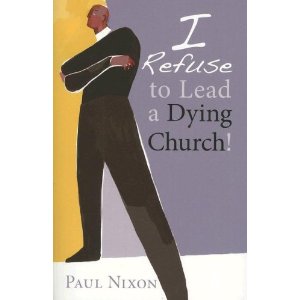
Paul Nixon is a United Methodist pastor who sums it all up here. What if all of us in professional ministry refused to lead dying congregations?  If God gives us gifts for apostolic leadership, why would we waste those gifts on ministry that doesn’t give God our best? 

A note to tired pastors:  there will also be a need for palliative care in congregations that are indeed dying and if your gifts are hand-holding and  marrying, burying, baptizing, and preaching comforting sermons, there are parishes that will need this leadership too.  But keep in mind that you are tending to the dying.  Let them go.

And the next question is:  how do you know your church is dying? 

It’s not about size.  I’ve worshipped recently with a congregation of less than 100 that is clearly alive, bold, and community-focussed.  And I’ve worshipped with  large congregations that haven’t done anything bold in decades.  Their building is a fortress.  Their ministry is drudgery.  A church is dying when there is no evidence of an urgent sense of discipleship.  Paul Nixon explains it well. 

So, read this book and let’s get moving.

Jesus Was a Refugee

In the shuttle on the way to the conference I’m attending this week:

Guy headed to Lockheed Martin Conference:  So, are you in town for a conference?

Me:  Yes, outside Fort Worth.  It’s a church conference about minitry to refugees.

GHTLMC:  You mean those illegals who want to take over our country?

There is a lot of misunderstanding about refugees.  Yes, they are immigrants, but no, there are not illegal and they are fleeing their homeland.  The man I had dinner with last night cannot return to Iraq where he was once Moderator of the Presbyterian Church because people want to kill him.  

Even Jesus was a refugee if you remember.

These are people who have fled because of race, religion, nationality, or participation in a particular social or political group.  There are throngs of them in the world today, and if you are like me, when you see crowds of wandering people, you see problems.  You don’t have to be an MBTI introvert to avoid them. 

I’m reminded at this conference, that when Jesus saw crowds he felt compassion rather than annoyance or fear.  Jesus saw people not problems. 

Imagine if we were on the run from our own country, and after a long trip to a strange place, someone met us at the airport, took us to a furnished apartment with familiar native food ready to eat on the stove and helped us figure out how to catch the bus and get language lessons.  Imagine how much we would appreciate and love those people, how much we would appreciate that country that welcomed us generously.

This is the work of Jesus.  Check this out – even if all you can do is donate old towels.  But we can probably do more.

All Saints Day by Kandinsky

I totally love All Saints Day.  It could be because it’s the theme of one of the greatest hymns of all times .  It could also be connected to my personal obsession with the dead after sitting with many people on the cusp of eternity as they breathed their last  breath.

 
I love the name of Nadia Bolz-Weber’s congregation  which is perhaps the perfect church name.
 
I love remembering friends and strangers who have died since last All Saints’ Day.  Their names and faces come to me often in this season. 
 
I love reading well written eulogies.  Mona Simpson did her brother proud.
 
I love the way The Washington Post subtitles their obits.  From Monday’s paper, we could read about William Randolph Sengal – Alexandria Pastor and Virginia Conn – Writer and Editor.   One of my all time favorites was: Marie Raabe –  Munchkin Wife.  The obit went on to explain that “Marie was survived by her husband Meinhardt Raabe – best known as the coroner in the Wizard of Oz who declared that the Wicked Witch of the East ‘was not merely dead but was really most sincerely dead.‘ ” 
 
I love remembering the saints.

Exegeting Reformation

I remember a church that applied for a grant to tranform their congregation.  They wanted $10,000 for a new church sign.  If only they had a new sign people would come . . .

On this Reformation Day, we might believe that Reformation involves incorporating a screen in worship or lighting candles or beating drums.  But what really transforms a congregation is a change of heart, a change of perspective.  Maybe we once worried about Doing the Cool Thing or Doing the Media Thing or Doing the  New Thing.  But what really reforms and transforms a congregation involves changing our perspective, changing our paradigms, changing our priorities.

What if we shifted from the usual worries about the ABCs – Attendance, Building, and Cash.  And we focussed on the NOPs – The Neighborhood, Organization, and Paradigm Shift?  I’m seeing amazing Reformation.