Question of the Day: How Do We Support Young Pastors?

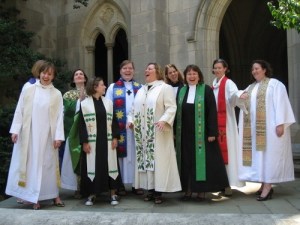
Photo from the Young Clergywomen's ProjectAlmost 30 years ago, I was a 20-something pastor in the PCUSA.

I graduated from seminary with $30K in debt and a desire to serve wherever God sent me.  My family included only a black lab,  so I could move anywhere.  Although I was basically a city person, most of the interesting city church positions were – at least in my perception – the domain of young male colleagues who had been specially groomed to climb The Ladder.

I was called to serve a little church in a little town.  Another clergywoman in that Presbytery helpfully commented to me that those tiny rural churches had such low self-esteem that they would even take us women.  But I loved that church in a tiny village  and I think they loved me.  My salary was $9000 a year for a FT position (and it grew to $16,000 after a few years.)   Note again my seminary debt and do that math.

Today’s young pastor graduates with even more debt – most likely – and they are probably  better at math than I was.  Those with true calls may opt out of professional ministry even before they begin or they might give parish ministry a try and find that:

1) while the minimum clergy salaries (and they will be paid the minimum right out of seminary) are much higher today, they will earn much less than others their age with professional graduate degrees

2) they might not care about making big money, but they don’t want to default on their loans either, and they will need enough money to live a simple life

3) they might find that the loneliness, the frustrations, and the hours are too difficult to continue in parish ministry.

Three years after my ordination, my denomination gathered other pastors who’d been ordained the same year I’d been ordained.  They’d found that many Young Pastors leave professional ministry by the fifth year, and so – all over the country –  there were Young Pastors meeting 3, 4, and 5 years after ordination to prepare for our next call and find companionship.  Many of us were happily serving our churches.  Many were also exhausted and Sabbath-challenged.

Sadly, the denomination discontinued this program at least 15 years ago for lack of funding.

Young pastors today tell me that – while there are indeed openings out there . . .

  • many of them are in rural towns (and they have spouses who need to find work so larger towns and cities are their only option)
  • many positions are part-time which require an additional part-time job to make ends meet
  • many positions are with congregations that do not want to be 21st Century churches (although they might declare that they want to grow, change, etc.)
 
Herein lies One Big Problem:  almost all pastors worth their salt – of all ages – want to serve churches that are passionate about mission, community, and discipleship.  We might describe this with different words, but we who are willing to follow God anywhere want to serve among other people who want to follow God with as much devotion.  We are less interested in institutionalized church customs and more interested in growing disciples.  But we can’t find churches that are willing to make this great leap.
 
 
Too many American Church People want to hear a stirring sermon and then go home and live life as usual.  Too many want easy mission projects and minimal financial commitment.  Too many congregations want to pay people to do ministry for them, when scripture teaches that the pastor is called to equip others to be ministers.
 
 
A final story about pastors seeking calls:
Several years ago, there was a conference call with about ten pastors in my denomination who were all part of the Emerging Church conversation.  Most of those on the phone were still in seminary decrying the fact that they couldn’t find   any churches that seemed ready for a 21st Century kind of ministry.  I’m talking  Missional Ecclesiology, making disciples of all nations.  That kind of thing.
 
 
One of my young future colleagues said, “The problem is that there is nowhere for me to go.”  He believed it was an age thing.  But I couldn’t help but insert my own two cents:  “There’s no place for me to go either.”
 
 
The truth is that God has plans for us all.  The plan might involve a large number of congregations closing in the coming years and funds becoming available to start new churches.  The plan might involve a total shift in the way we are the church.  The plan will be great and holy and surprising because that’s how God rolls.  I choose to be more excited than terrified about this.


Question of the Day: What About Older Pastors Who Need to Keep Working?

Our denomination collects The Joy Offering each December to benefit church
workers with financial needs.  Many of these gifts go to older pastors who find themselves struggling with too little financial support in their post-parish years.  Especially in this economy, many of us could find ourselves in need of financial help post-retirement even into the next decade or so.

My friend Carol Howard Merritt wrote recently about the The Young Clergy Crisis and I totally agree that many of my under 40 friends are struggling at least as much as some of my over 70 friends.

Older clergy have obviously paid off their seminary loans but are trying to figure out how to afford to retire, or even how to pay off their mortgages.  Younger clergy – many of whom started as associate pastors  –  find that associate pastor positions have been eliminated.  And tiny churches can’t afford FT pastors.

[Note: Tomorrow’s Question of the Day will be about our youngest pastors.]

In my own blessed 50-something demographic, I find myself doing ministry that  includes:

  • Helping congregations in search of pastors and
  • Helping pastors in search of church positions.

It makes me happy to be the matchmaker, although the Holy Spirit is obviously in charge.

Several pastors seeking paid positions in the church are over age 65.  Maybe they still have mortgages, or maybe they’ve used their savings to help their children, or maybe they’ve depleted their savings to pay medical bills.  Several of those who come through my door have sick spouses who haven’t been  earning a paycheck themselves for many years and things have been tight for a long time.

Yes, we have tiny churches who basically want a chaplain and they might hire an 80 year old pastor.  But more often, congregations want a high-energy pastor who will bring fresh ideas.  I know some high-energy pastors over the age of 70 – don’t get me wrong.  But I worry that their inability to retire is taking work from younger clergy.

And this is not just an issue for the septuagenarian and older crowd.  We all know pastors in their 50s and 60s who find themselves holding onto church positions even though their energy is low, their technological skills are dated, and their leadership gifts are a bit Old School.  But they can’t afford to retire quite yet.  Maybe they won’t be able to retire for another couple of decades.

So, what do we do about this?  As our society is growing older and living longer, I wish I had answers.  Any ideas?

Question of the Day: What About Church Mission During the Holidays?

I asked this question over the weekend:

Is there a way to keep congregations from congratulating themselves for their assorted Mission Projects – especially in the holiday season – when the giving is sometimes (often?) for themselves?

Several years ago, I delivered the gloves, socks, and mittens to our local shelter which had adorned our “Giving Tree” in the church parlor.  People had bedecked the tree with cute pink acrylic gloves and packages of Costco socks.  Not many fleece-lined men’s sizes really, but lots of children’s items.  When I got to the shelter and was guided to the Donations Room, I saw that it was already full.  “Yeah, the donations have far outpaced our need,” the volunteer shared.  “Most of these items were given last year. Too many people buy cheap, child-sized gloves and  socks without realizing that most of our residents are large adult men who need heavy-duty socks and gloves.”

Why don’t donors know this?  Because we haven’t asked.  We like to leap in to help without understanding exactly what is needed.

Several Advents ago, we decided to collect gift cards for those in need rather than buy them presents.  You know the usual drill:  notes on trees or bulletin boards say something like, “8 Year Old Girl.  Size Medium.  Likes Dolls.”  And then someone collects all the presents for The Needy Family and delivers them.  The problem with this begins with humiliation and ends with gifts that don’t fit the recipient – and not only in terms of  sizing.  Imagine that you are a parent that aches over the fact that you can’t afford to replace your child’s too-small shoes, and then strangers come in and Help You.  Yes, your daughter likes dolls, but she likes fashion dolls, not baby dolls – which is what has  been lovingly bought and wrapped for her because a kind church person imagined the dolls she might have liked long ago.

But this is not about what the kind church person wants.  This is about the people who have less than what they need.  This is not about congratulating ourselves on finding a deal on a woman’s sweater for A Needy Person that might not fit that woman’s body or style.

Yes, even homeless people get to have style.  Those who are struggling financially get to have dignity.

Sharing gift cards allows struggling parents to choose their own children’s gifts.  They know what their kids want and need. And then they get to bring those gifts home – whether home is a shelter, a small apartment, or a car.  (Note:  It’s important to use our brains when we give gift cards.  Chain restaurant gift cards might be appreciated.  A person living in a car would probably appreciate gas station cards.  Target and Grocery Store gift cards are always good.  Wii and Blockbuster cards are probably not so helpful if you live on the street.)

This article says more about wanting to help people but not understanding how to do it well.
“Gift cards are impersonal!” we say, but most of us have impersonal relationships with The Needy.  We don’t personally know them, so why pretend we do?  Or better still:  Have a personal relationship with a poor person. Truly be friends.  Walk alongside them.  Make their poverty your own.  This would be the genuinely God-like way to spend Christmas.   It’s what God did.

Glitter on the Highway

Thanks to BSE for this image and to the B52s for putting a tune in our heads.

I haven’t written a blog post in over a week – except for the ones in my head – because the days have been long and when I get home at night I honestly want to curl up with a glass of wine and watch Revenge.  There, I said it.

 At the risk of regurgitating Every Big Idea that’s run through my mind, here are some of my Questions of the Week:

  • What happens when a pastor no longer believes in God?  Or what if he/she believes in God but theology has become so mysterious that articulating clear doctrines of faith seems almost idolatrous?
  • What happens when dying churches refuse to let go?  Do you just come in and shout, “Enough!”
  • How can we get churches to stop having Stewardship Campaigns and start talking about faith and money?
  • What do we do for older pastors who still have mortgages and can’t retire?
  • Is there a way to keep congregations from congratulating themselves for their assorted Mission Projects – especially in the holiday season – when the giving is sometimes (often?) for themselves?

 These are some of the questions I ask after some busy days in one middle judicatory of the institutional church.

The Exit Interview

Note:  All of us serving in professional ministry will leave our current call – either by our own death, the death of the church, firing, or moving to a new call.  It’s good to prepare for this.

I’m a fan of Exit Interviews.  It’s essential – and fun – to reflect on what worked, what didn’t work, what mistakes were made. 

I never had an exit interview after 22 years in the church I loved,  but it wasn’t because we didn’t try.  The schedules were tight and then I moved to Illinois.  That’s just how it went.

I was part of the exit interview this past week for a wise and accomplished pastor in the PCUSA.  We talked about what worked, what didn’t work, and what mistakes were made.  We pondered his and the congregation’s future.  We remembered that – in his first years following a long-term pastor – it’s wasn’t easy.  And it won’t be easy for the pastor that follows him.

And then we asked him to sign a covenent saying – among other things – that

  • he would not officiate at wedding, funerals, and baptisms after his retirement
  • he would not offer pastoral care to the congregation after his retirement
  • he would maintain friendships but not engage in conversations that involve congregational matters after he retires.

It was not easy for him to sign this covenant.  In fact, he seemed a little miffed.

It’s come to this:  that we have to sign agreements NOT to serve our former congregations.  This particular pastor admitted that it would rip him up inside to know that a former parishioner had died, was suffering, enjoyed a divine victory and he would not be able to respond.

I totally get this.

The spouse of one of my former parishioners died suddenly this week and I am a bit of a wreck.  The church is in very good hands.  The grieving family is in very good hands.  But it rips me up inside not to be able to comfort the widow and her children.  I baptized one of their kids.  The other was in confirmation with my own children.  It’s not easy, but it’s the right thing to do in terms of that congregation learning how to love and follow a new leader.

I feel for the retired pastor whose spouse and children have not retired.  I feel for the pastor who – after 20+ years in a community – retires and suddenly has no faith community.  I feel for the congregation that still feels connected to their last pastor. 

In a healthy church, everybody is a grownup and relationships remain unimpaired.  But it’s important to maintain good boundaries, and especially to remember that the church is not about the pastor.  It’s about Jesus.

And so we feel sorrow and we grieve former relationships.  But – after new relationships have been nurtured and solidified – old friends can once again share good memories of a ministry that brought goodness and growth.  At least, this is my hope.

Third Place Ministries

When I was a child, our church building was My Third Place after home and school.  I was in that building every Sunday morning for about three hours and again in the evening for youth group or confirmation.  In the summers I was there for camp and Vacation Bible School.  I loved the playground.  I loved the front yard.  Eventually my wedding pictures were taken there.

These days, living in a new time zone, I’m still in search of my Third Place – the place where I’ll spend most of my time after home and the office.  I really miss not having that familiar hangout where people know my name and I can sit and stare into space or write or have casual conversations.  I miss Busboys.  I miss the staff of the Shirlington Caribou.  I miss my secret Starbucks hideout in Georgetown.  I will find my Third Place; I just haven’t found it yet.

Sociologist Ray Oldenburg coined the term “Third Place” in his book The Great Good Place: Cafes, Coffee Shops, Bookstores, Bars, Hair Salons, and Other Hangouts at the Heart of a Community.  While there are still communities in the United States where a church building is still the Third Place for the majority of the townspeople, others find more community in neighborhood barber shops or cozy breweries or local gyms. 

We who love the church and grew up in the church must remember that, increasingly, we are the minority.  Many people not only did not grow up in a church, but it would not occur to them to walk through sanctuary doors in search of community.  Many of us church people are in denial about this. 

I always marvel at the outdoor banners that churches post to advertise their carol sings and chili dinners, hoping that strangers will join them.  At least in the congregation I once served, it was rare –  if ever – that a stranger joined us unless he/she was the guest of a member.  Most people walking from the bus stop to the Starbucks down the block would never consider coming inside to check out what was going on in our church building.  And it wasn’t because we didn’t try.  It’s just that a church building  is not the first place some of our brothers and sisters would expect authentic fellowship.

For a long time now, my heart has yearned for those people who are Not Yet With Us.   I’ve spent a lot of time thinking about them.  They are spiritual souls in search of peace and redemption and purpose.  But they are in coffee shops, soccer fields, or shopping malls on Sunday mornings.  And so – like Jesus – we go to them. 

One of the considerations for the 21st Century Church – like the First Century Church – is that we must be missional  – out in the world in those Third Places.  Or maybe we can create Third Places that are new gathering places for the church.  Many of our newest seminary graduates are ready to serve in these venues, and I – for one – long for th0se venues too.

Cultivating a Culture of Counterintuitiveness

Jesus was a counterintuitive genius: 

  • The last will be first and the first will be last.
  • Blessed are the meek for they shall inherit the earth.
  • Love your enemies and pray for those who persecute you.
  • On the sabbath his disciples were hungry and they plucked heads of grain to eat.
  • Jesus stretched out his hand and touched the leper.

We, on the other hand, are somewhat addicted to the habitual, the sensible, the standard operating procedure.  This is why we continue to staff governing boards with Church Pillars and plan the same events every season.  While – in this season – typical congregations will hang the greens and Christmas carol and organize children’s pageants, some counterintuitive congregations will forgo the usual worship service on Sunday, December 25th and ask people to stay home with their loved ones praying with personalized home liturgies.  Others will suggest that – instead of gathering for Christmas Eve in the sanctuary – they gather in livingrooms with non-Christian neighbors for prayer and singing.

My New Year’s Resolution (it’s never too early): To cultivate a culture of counterintuitiveness in the church. 

The Presbytery I serve owes a scary amount of money.  THE DEBT.  I heard about THE DEBT prior to moving here and I’ve noticed that many people see everything that happens in the church through the lens of THE DEBT. 

I’m done with this – after only 3 months on the job.  Yes, there is debt but has anybody noticed WHY we have debt?  This particular Presbytery chose to Do The Right Thing some years ago, which involved taking on a debt for the redemptive purposes.  It was a matter of justice and holiness.  It was an effort made to heal what was broken.  Debt was accepted for the sake of the weak and hurt.  And we probably would have taken on even more debt if anybody thought it might help.

Here’s another counterintuitive idea:  I would love to see the angriest pastor on “the right” and the angriest pastor on “the left” covenant with each other to hang out once a week in 2011 to pray for each other, to hear about each others’ pets and hobbies and loved ones. 

Here’s another counterintuitive idea:  Sell your church building – especially if it’s a drain on your financial resources.  Meet in a comfortable Third Place (more about Third Place Ministry tomorrow) and set up a church incubator space for multiple church staffs and other non-profits to use through the week for screen time, study, conversation.

Other counterintuitive ideas?

Spiritual Osmosis (& Why It Doesn’t Work)

Continue reading →

Happy Thanksgiving

Tomorrow morning, I set out to drive over several rivers (Calumet, Kankakee, St. Joseph, Ohio, Allegheny, Monongahela, Potomac) and through many woods to spend Thanksgiving in Virginia.  I’m bringing five pies and a sweet potato casserole (for Thursday) plus two containers of frozen soup, a spinach lasagna, and pumpkin-walnut muffins (for before Thursday.)  Can’t wait.

I am enormously thankful.

Happy Thanksgiving everyone.  No more fresh posts this week.

They Said “Yes”

Have you ever been in a large meeting – church or secular – and the group is approving an institutional policy and your eyes start to glaze over as you read it?

A person or committee has written it, there is often a first reading, tweaks are made, details are discussed, questions are asked, and then the community finally votes it up or down.  At least this is how it’s supposed to work. 

Often, it actually goes like this:  the policy is written, nobody really reads it a first or a second time, nobody asks questions, people vote without really knowing what they are voting for. 

We might seriously want a Safe Boundaries in the Church Policy or an Administrative Leave Policy, or even a Bringing Our Pets to Work Policy.  But either the details bore us or we basically trust that what’s in there is good stuff.

And then, perhaps, we are surprised about the repercussions down the road.  Because we didn’t really know what we were saying “yes” to. 

I don’t think this happened last Saturday.

On November 19, an institution near to my heart approved a policy that Changes Everything – at least in terms of ecclesiology – in our particular midst.

The Presbytery of Chicago said “yes” to the new Policy Guidelines for Worshipping Fellowships, Pre-NCD Worshipping Fellowships, ad New Congregation Developments.  (I’ll include a link when the approved version is available digitally.)  It’s 16+ page permission-giving document which  acknowledges that traditional membership doesn’t work for all new communities, that some congregations are born organically, and that the leader might be called something other than pastor.  He/she might be called an evangelist, a convener, a mission worker.  It’s not that there are no rules about starting new churches.  It’s just that the rules are flexible enough to work in a 21st Century culture.

I’m so thankful.