Read This Book

I’m coming off a long five days of conferences and gatherings and so I’ll make it short and sweet:

Read this book.

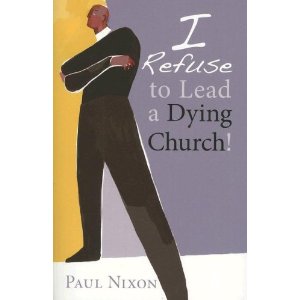
Paul Nixon is a United Methodist pastor who sums it all up here. What if all of us in professional ministry refused to lead dying congregations?  If God gives us gifts for apostolic leadership, why would we waste those gifts on ministry that doesn’t give God our best? 

A note to tired pastors:  there will also be a need for palliative care in congregations that are indeed dying and if your gifts are hand-holding and  marrying, burying, baptizing, and preaching comforting sermons, there are parishes that will need this leadership too.  But keep in mind that you are tending to the dying.  Let them go.

And the next question is:  how do you know your church is dying? 

It’s not about size.  I’ve worshipped recently with a congregation of less than 100 that is clearly alive, bold, and community-focussed.  And I’ve worshipped with  large congregations that haven’t done anything bold in decades.  Their building is a fortress.  Their ministry is drudgery.  A church is dying when there is no evidence of an urgent sense of discipleship.  Paul Nixon explains it well. 

So, read this book and let’s get moving.

Jesus Was a Refugee

In the shuttle on the way to the conference I’m attending this week:

Guy headed to Lockheed Martin Conference:  So, are you in town for a conference?

Me:  Yes, outside Fort Worth.  It’s a church conference about minitry to refugees.

GHTLMC:  You mean those illegals who want to take over our country?

There is a lot of misunderstanding about refugees.  Yes, they are immigrants, but no, there are not illegal and they are fleeing their homeland.  The man I had dinner with last night cannot return to Iraq where he was once Moderator of the Presbyterian Church because people want to kill him.  

Even Jesus was a refugee if you remember.

These are people who have fled because of race, religion, nationality, or participation in a particular social or political group.  There are throngs of them in the world today, and if you are like me, when you see crowds of wandering people, you see problems.  You don’t have to be an MBTI introvert to avoid them. 

I’m reminded at this conference, that when Jesus saw crowds he felt compassion rather than annoyance or fear.  Jesus saw people not problems. 

Imagine if we were on the run from our own country, and after a long trip to a strange place, someone met us at the airport, took us to a furnished apartment with familiar native food ready to eat on the stove and helped us figure out how to catch the bus and get language lessons.  Imagine how much we would appreciate and love those people, how much we would appreciate that country that welcomed us generously.

This is the work of Jesus.  Check this out – even if all you can do is donate old towels.  But we can probably do more.

All Saints Day by Kandinsky

I totally love All Saints Day.  It could be because it’s the theme of one of the greatest hymns of all times .  It could also be connected to my personal obsession with the dead after sitting with many people on the cusp of eternity as they breathed their last  breath.

 
I love the name of Nadia Bolz-Weber’s congregation  which is perhaps the perfect church name.
 
I love remembering friends and strangers who have died since last All Saints’ Day.  Their names and faces come to me often in this season. 
 
I love reading well written eulogies.  Mona Simpson did her brother proud.
 
I love the way The Washington Post subtitles their obits.  From Monday’s paper, we could read about William Randolph Sengal – Alexandria Pastor and Virginia Conn – Writer and Editor.   One of my all time favorites was: Marie Raabe –  Munchkin Wife.  The obit went on to explain that “Marie was survived by her husband Meinhardt Raabe – best known as the coroner in the Wizard of Oz who declared that the Wicked Witch of the East ‘was not merely dead but was really most sincerely dead.‘ ” 
 
I love remembering the saints.

Exegeting Reformation

I remember a church that applied for a grant to tranform their congregation.  They wanted $10,000 for a new church sign.  If only they had a new sign people would come . . .

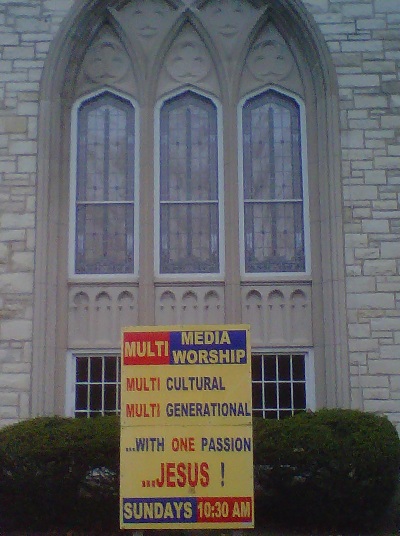
On this Reformation Day, we might believe that Reformation involves incorporating a screen in worship or lighting candles or beating drums.  But what really transforms a congregation is a change of heart, a change of perspective.  Maybe we once worried about Doing the Cool Thing or Doing the Media Thing or Doing the  New Thing.  But what really reforms and transforms a congregation involves changing our perspective, changing our paradigms, changing our priorities.

What if we shifted from the usual worries about the ABCs – Attendance, Building, and Cash.  And we focussed on the NOPs – The Neighborhood, Organization, and Paradigm Shift?  I’m seeing amazing Reformation.

Traumatic Things

Imagine you’ve been a pastor for twenty years.  And in those twenty years you’ve been intimately involved in dealing with:

  • The motorcycle wreck death of a 20 year old you taught in confirmation class
  • The stillborn birth of a couple’s long-wanted child
  • The suicide of a middle aged deacon
  • The institutionalization of a young adult after he attacked his sister
  • The court martial of a young man in the Marines
  • Numerous cancer protocols, unsuccessful fertility treatments, and heart bypass surgeries

You get the picture.  Although the examples above are not necessarily from my own experience, they are familiar experiences for most pastors. 

During a CPE (chaplaincy training) residency fresh out of seminary I did 23 baby funerals in one month.  It convinced me to go into parish ministry where people would call me when healthy babies were born. 

Ministry can be traumatizing.  I’ve known pastors who reached their limit with one final, excruciating horror:  the kidnapping of a child of the church, the sudden death of a two year old,  the car accident that wiped out a family.  It’s not something we talk about in seminary:  how to handle pastoral care for a lifetime of trauma shared with people we love.  We minister alongside them.  We learn their most intimate hopes and fears in pre-marital counseling.  We baptize them and their children.  We bury their parents and spouses and children.  We love them, and when they face a tragedy, it’s as if it’s happening to us.  Yes, I know all about self-differentiation.  But sometimes tragedy impacts us.  Or clobbers us.

We are not the only ones with this responsibility to care for the traumatized.  And there are those who are standing by to help us with our own trauma.

It’s an enormous privilege to share painful experiences with people, just as it’s a privilege to share the joyous times.  But as pastoral care is increasingly shared with trained elders and deacons – as it should be – we professional clergy are finally blessed with others who help take some of the weight off our shoulders and share the pastoral caregiving.  The best pastors are not threatened by sharing pastoral care with other church leaders.  In fact, it’s our job to teach others how to care for the traumatized.  It’s part of our self-care too.

Space: A New Frontier?

Worship space matters. 

While I can make a case that 1) God can and should be worshipped in all places and spaces, and 2) God is more impressed by holiness than flying buttresses, I personally find certain spaces to be more conducive to worship than others.  It doesn’t have to look like this.  It could also look like this or this or this.  Space feels worshipful if community is gathered and nourished there.  A sanctuary could be gloriously constructed.  But if there is no community, the church might as well close.  It’s no longer really a church anyway.

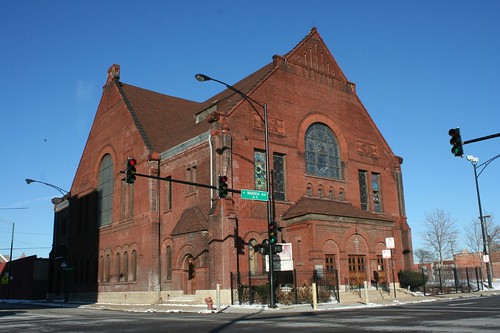
As church buildings that look like this and this are swiftly closing, my prediction is that the proceeds from selling their real estate will never again be used to buy space that looks traditionally churchy.  I especially feel for the struggling congregations that built mega-buildings only to find that they don’t now or didn’t ever really need that space; they just wanted to be like the megachurch down the street. 

The space where we worship is one of the new frontiers for faith communities in the 21st Century – especially for the formerly mainline church.  As we close the church with the traditional building on the corner, I’m hoping we are wise enough to start up the new church in the bar or the diner or the art gallery down the street.

Something Beautiful

Honestly I’m too tired to be creative tonight and so I’ll just sit and stare at something beautiful.  That’s the best I can do tonight.  Have a good Wednesday.

Fat Pastors?

The majority of pastors are either overweight or obese, according to a 2001 Pulpit and Pew study at Duke Divinity School.  

(Ten years later, I wonder if we are even heavier.)

This factoid from Pulpit and Pew was recently shared at a church event during which we were served mega muffins for breakfast, chips & cookies with our sandwiches for lunch, and candy bars  for mid-afternoon snacks.  What’s wrong with this picture?

The general population is overweight in the United States.  But according to a 2010 Centers for Disease Control study, only (only?) 37% of Americans are obese and these numbers have held true for about five years for men and ten years for women.  In other words, if we believe these studies, clergy are heavier than the average American.  We are also more depressed and susceptible to heart disease apparently.  But today’s post is about donuts and cupcakes.

“If you feed them, they will come.”  We chuckle over this  adage at church meetings as we sample the lemon squares at coffee hour.  Church food tends to be heavy in the carb department and about as healthy as Lucky Charms.

But it may be harder to change the church food culture than the order of worship in our traditional congregations.  After all, no church has “salad committee.”  We continue to offer consecrated casseroles – delicious lasagna and macaroni and cheese-  to the sick.  The New York Times reported in 2005 that Radiant Church in Arizona spends $16,000 on Krispy Kreme donuts every year.

This post is not meant to make those of us who need to lose weight feel terrible about ourselves. The point is to ask how we might encourage congregations and their pastors to be healthier. 

Strawberries after worship anyone?  Better ideas?

Setting People Free

Calling the Disciples by Eric De Saussure

As I preach to different congregations each week, I have a recurring nightmare:

I drive to an unfamiliar church building, in an unfamiliar neighborhood, thinking that worship begins at 10 am but when I arrive I learn that worship actually begins at 9:30 and while the people were waiting for me to arrive, they just sat there.  Waiting.

There is a corresponding fantasy that goes like this:

I drive to an unfamiliar church building, in an unfamiliar neighborhood, thinking that worship begins at 10 am but when I arrive I learn that worship actually begins at 9:30 and while the people were waiting for me to arrive, they started worship.  One person led the singing and another led in announcements and prayers.  One was prepared to share her faith story if I never showed up. 

I find that some church people know they are free to worship and serve and welcome guests and share their faith and some church people do not know this.  They erroneously believe that 1) they need a pastor to tell them what to do and/or 2) they can irreparably mess up if they do something the wrong way.

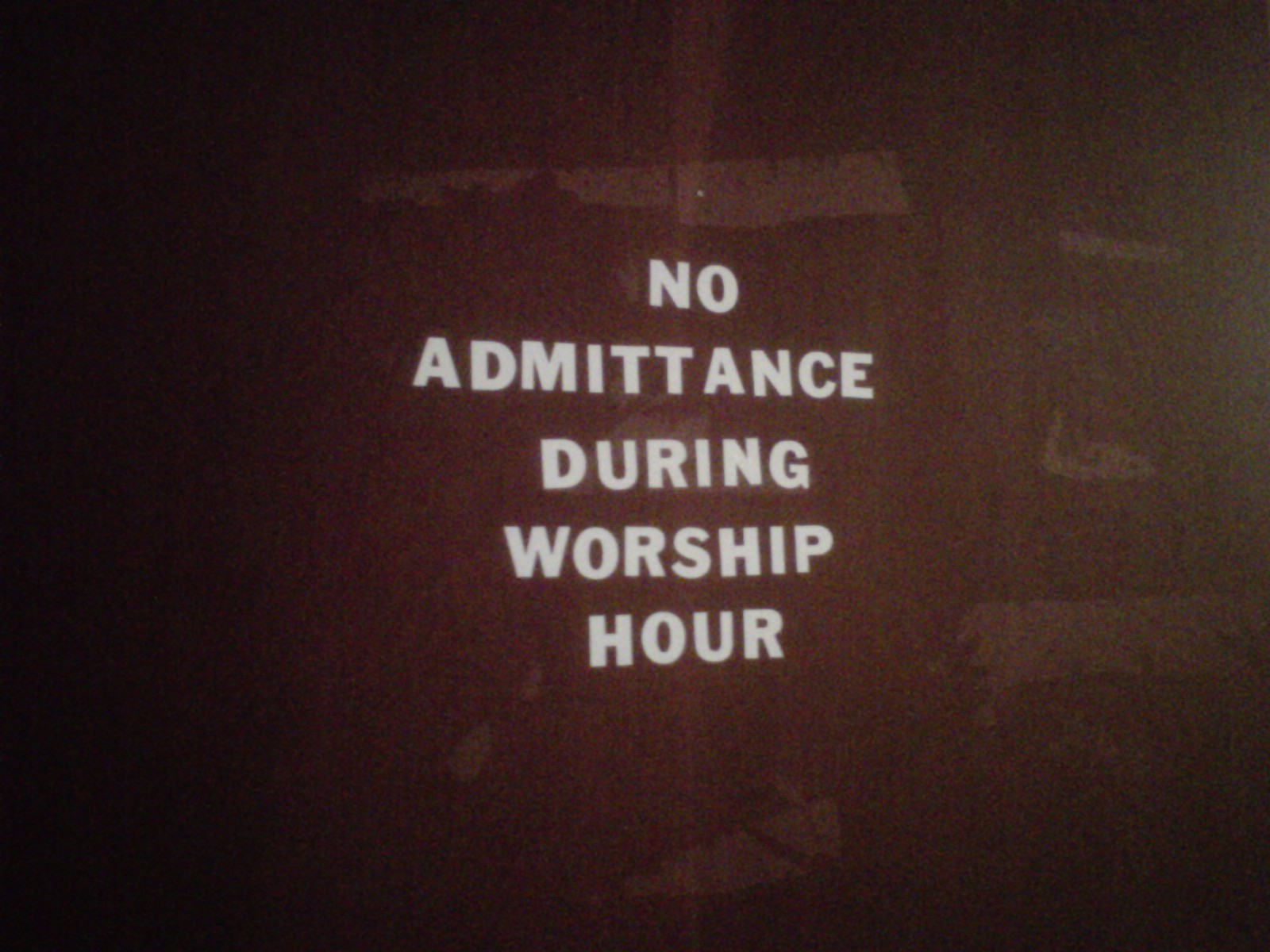
I’ve now seen sanctuaries with masking tape Xs on the carpet to ensure that the liturgist stands in The Right Place.  I’ve seen volunteers chastised because they didn’t arrange the cookies The Right Way.  I’ve witnessed  people staying out of worship because they arrived late and this sign greeted them:

And I’ve seen – like this past Sunday morning – a vast array of elders leading everything from the pastoral care to the pastoral prayers.  It’s not that they don’t need a pastor; it’s that the pastor (or somebody) has taught them how to lead and has set them free to do it.  That’s what I call a healthy church.

Are Long Term Pastorates a Boundary Problem?

Last Friday I spent the day at the required Boundary Training  which has historically been about preventing sexual or financial misconduct.  But this workshop expanded the definition of inappropriateness and/or misconduct to include Staying Too Long in a parish.

Hmm.

Last spring, I left a parish after 22 years, and although I can’t seem to find a numerical definition for what constitutes a “long term pastorate” 22 years probably qualifies.  In fact anything past 10 years and certainly 15 years could be considered “long term” in our fast-paced, transient culture. 

Ed White of The Alban Institute  who has supported long pastorates for years says, “I used to think that long pastorates were a good thing.  I now think that they’re not just good, but necessary.”   After 10, 15, 20 years a pastor’s relationship with a congregation is sealed with history, loyalty, and devotion.  Especially if a pastor has been present for multiple generations of family milestones and years of community involvement, a congregation can find stability and deep transformation in those years together.  It takes a long, long time to change the culture of a church, especially if that church has experienced trauma or weak leadership.  And this shift from a 1950s Church to a 21st Century Church has been compared to turning an ocean liner.  It takes time.

But what if staying too long becomes a problem? What if it borders on misconduct?  It might be unintentional misconduct, but misconduct all the same in terms of a congregation’s health.

Frankly, I worried about this in the last years with my last parish.  I looked at other positions through the years, but nothing else felt like a call.  I did not feel called out of that congregation until circumstances nudged the move.  Was it healthy to stay for 22 years?  I don’t know. 

But what I do know, after just six weeks in my new call, includes this:

  • Churches can become complacent when the pastor is not only present for 20+ years, but when the pastor does too much of the ministry for the congregation.  Christendom nurtured a culture in which churches paid people to do the ministry for them even though the Bible teaches that a pastor’s job is not to do the ministry but to train others to do the ministry.
  • Our denominations offer incentives for pastors to delay retirement which makes it tough for younger pastors to move into those leadership positions.  Those nearing retirement worry about outliving their savings and churches can become stagnant if those pastors basically retire in place. 
  • Some of us pastors find it hard to give up “the power” of being the center of a congregation’s life.  It’s fun being The Beloved Pastor or The Institutional Memory, even if it’s no longer healthy for us to be there.
  • Pastors who have “always been there” can become an idol. 

It all comes down to the word “healthy.”  There are healthy long term pastorates and there are unhealthy ones.  There are pastors who consider themselves to be the center of the church and there are beneficent dictators and there are humble servants.  Maybe those of us who’ve served for multiple decades have a little bit of all those characteristics.

It’s not just about spiritual relationships and intimacy.  It’s also about theology.  God calls us to make earth as it is in heaven.  And that takes a long time.