When You Feel Like a Freak

I went to the grocery store after work Monday night and it was a mob scene.  Something was clearly happening in the parking lot.  It looked like a radio station was broadcasting live from our neighborhood grocer and some people had even brought those folding chairs I used to take to soccer games.  Apparently there would be Fabulous Prizes.

I went inside to purchase my Greek yogurt and paper towels.  No time to wait around for Fabulous Prizes.

After covering my grocery list, I was returning to the car when the DJ said, “And the winner is:  Patsy Pace” or something like that and Patsy Pace was waiting there in the parking lot and she was Thrilled because she’d won 2 tickets to a Toby Keith concert.  And then the DJ said on the loudspeaker, “Who’s excited about the season premiere of Dancing with the Stars tonight?!  And whose going to be home watching the new Two and a Half Men tonight?!  And- don’t lie to me now – who’s going to be home with a six pack watching that new Playboy bunny TV show?!”  And people cheered.

I kind of felt like a freak.  No wonder church pews are empty for many of our congregations. There is a huge disconnect between these very nice people hoping against hope for free Toby Keith tickets and the very nice people who will offer an earnest exegesis of Exodus 17:1-7 this Sunday.  I don’t mean to be classist or judgemental in any way, but – in truth – I am.  Most people don’t care about Biblical exegesis.  They are trying to survive and – occasionally – they hope to get free concert tickets.  It takes a special commitment to want to change the world because we’ve had a personal encounter with the Holy. It’s a shift that changes how we feel about racing home to watch “Two and a Half Men.”

It sounds very judgemental and  even obnoxious.  But I’m looking for a different kind of life.  Yes, I need my grocery staples.  And I’m all about free stuff.  But what does it say about my ministry if I can’t connect with people who are  trying to survive out there? 

Just wondering on a random Tuesday.

10 Reasons to Go Digital at Your Next Big Church Meeting

The last time I attended a Big Church Meeting (i.e. Presbytery Assembly, Conference Meeting, Association Meeting, Diocese Meeting) the convener’s first words were:  “Please turn off all digital devices.”  In fairness to her, she could have meant turn silence your phones and pagers (although I’m not sure anyone uses a pager anymore.)

There are excellent reasons to use our smart phones, iPads, laptops, etc at these meetings.  I’m talking, of course, to digital immigrants here.  Digital natives clearly don’t need to be told but – sadly – the demographic for most institutional church meetings are people over the age of 45. 

This week when my new favorite ecclesiastical organization convenes, my hope is that everybody will have their digital devices turned on.  Yes, some people will be playing Sporcle or making their Peapod orders, but most of us will be engaging more deeply in the business at hand. 

If you need convincing, here are my Top Ten Reasons to go digital for your next Big Church Meeting.

1- It saves paper.  No need to print out the ream of paper digitally sent to us with assorted motions, policies, and statements.

2- It saves time.  Instead of asking a basic question in the microphone, you can ask others tweeting the meeting.

3- It helps with context.  I was new at my last Presbytery meeting and when people stood to make reports, I googled them to figure out who they were and what church they served.

4- It streamlines debate.  Before standing up to ask a question, I can ask a friend in the room via text-messaging and get my answer.

5- It improves debate.  I’ve been to meetings when someone tweets, “Who’s going to stand up and make the point that …”  Sometimes it’s good to have fresh voices.

6- It includes people who aren’t present.  I’ve tweeted meetings for one particular church geek in California who likes to hear what other Presbyteries are doing. 

7- It makes the meeting more fun.  Yes, it can be tempting to be snarky ( “Why is he still talking?“) but I’ve honestly experienced this very rarely.

8- It clarifies information.  If you miss what someone said, or you didn’t hear it clearly, you can ask someone else to repeat it. Best example:  When Phyllis Tickle referred to “Snoopy Dog” at The Great Emergence Conference in 2009, several clarified via tweets that she meant “Snoop Dog.”

9- It makes us pay attention more intently rather than less.  Again, when we have the opportunity to read a policy while simultaneously reading comments on the policy while having access to  background on the policy, focus is required.  And even  Jesus was a multitasker.  Remember this story?  Or this one?  He lays hands on the children, teaches the rich young ruler, throws in a couple parables and sayings all in one elegant sweep.

10- It connects people.  Many of us first met friends and colleagues via twitter, blogging, Facebook, Google +, etc. etc.   Isn’t this the point?  Connecting to each other and to God?

Special note to my Presbyterian friends:  if we are truly a connectional church and we aren’t connected via 21st Century methods, we’re begging to be obsolete as a Christian community.

Photo of hash tag art.  Source here.

Something to Think About Over the Weekend

From a conversation I had recently:

New Neighbor:   ___ told me you have a new job!

Me:  Yes, it’s great.

NN:  ____ said if you don’t leave the institutional church after this, you probably never will.

Me: (weird look on my face)

Me:  Actually it’s kind of wonderful.  I get to deal with things that would definitely make some people want to leave the institutional church.  But my job involves making the way clear for people to do what God is calling them to do.

NN:  Yeah, but church people love power games.

Me:  (in my head)  Yep, some people are @X*!& or they have their theology is the Christian version of this guy or they had some horribly scarring fraternity hazing experience that makes them want to haze people too.

Me: (what I really said) Well, that’s true.  But my job is permission-giving within the parameters of our theology and norms. 

NN:  (weird look on her face)

Happy Friday.

What Exactly Do You Do All Day?

I once started a random Tuesday morning listening to my office answering machine messages only to be blasted by someone who was furious that I hadn’t gotten back to her the day before.  She had called on Monday morning –  the previous day -asking me to call her later that same day.  When she didn’t get a return call by 3, she called again, very upset that “I was ignoring her.”  And then she had called late Monday night even more furious that I had failed to respond to her message.  “What have you been doing all day that you have been too busy (insert sarcastic tone here) to return my call?”  

The truth is that I couldn’t tell her where I’d been doing Monday without possibly breaking a confidence.  I had been in court with someone about a very sensitive issue and it was too small a congregation and too small a town to say much about that.  Anybody could have easily guessed who was in court and why.  No, I couldn’t check my messages.  I was a character witness and needed to stay in the courtroom all day.  And no I didn’t go by the church building to check messages after court because I was exhausted and went straight home to bed.

These kinds of things – private pastoral things – happen all the time if you are a good pastor.  But the problem is that most people do not see us in courtrooms or offices or jail cells.  And if they don’t see us working, they may not believe we are working. 

I once knew a church volunteer who expected me to be in the church building when she was in the church building.  Otherwise, I must not be working.  Many good pastors actually work the most hours out in the world – in hospitals and coffee shops and homes.  Nobody follows us around and watches what we do.  We only work with an audience on Sunday mornings or when we teach classes and lead meetings. 

Sometimes we can’t even tell people what we did on a given day.  And – just like a new parent whose day flies by without much obvious accomplishment after a mountain of small tasks were achieved – there are some days in a clergyperson’s life when administrivia wins.  No sermon was written.  No visits were made.  But, by golly, 30 e-mails were answered and two monthly reports were written and the mail was sorted. 

In my current job, I hear parishioners who share that their pastors “don’t do anything.”  That’s possible.  But it’s also possible that their pastor could be sitting with a mentally ill person in the hospital or driving a homeless family to the shelter in the next town.  Sometimes pastors do things that most parishioners can’t even know about.

And this is why it’s lovely to send your pastor a token of your appreciation when he or she retires or moves on.  (See yesterday’s post.)

Icon by Christina Saj

Saying Thank You – Clergy Edition

I know a church who gave their departing pastor $100,000 as a thank you gift.

I know a church who – when asked how they’d like to thank their pastor as she leaves – said (in her presence) “Do we have to?”

BBT – after being named one the top preachers in the English speaking world –  was famously given a ceramic chicken when she left her first church.  I honestly can’t remember what my first church gave me when I left them.  But I’m sure it was lovely.

There are many schools of thought on this, and now that my job includes reminding communities to thank their pastor when he/she leaves, I’m pondering this quite often.  Among the things I’ve been told both in my new job and long before:

– “Why should we give our pastor a parting gift?  We’ve been paying her salary and benefits for ___ years.  I don’t get a cash bonus when I change jobs.”

– “We’d like to give him a cash love gift when he retires.  How about a week’s salary?”

– “My sister makes nice Bible scenes on pottery.  We’ll be giving her a pitcher with a nice Bible scene and a cake.”

– “We’ve decided to name the fireplace in the fellowship hall after her.”

Yes, we all have funny stories about parting gifts for pastors.  Actually some stories are quite disturbing.  But what is the pastoral and theological thought behind these plans to bid farewell to a ministry that may or may not have meant something eternal to people? 


Saying Thank You – Volunteer Edition

How does your church community thank volunteer staff members?   I’m talking about those invaluable office volunteers who handle mass mailings and track visitors, the treasurers and financial secretaries, the church library helpers and candlestick polishers, the teachers and choir members. 

How does your congregation thank them?

My personal experiences include both the lame and the lovely.

The lame:

– A former Building & Grounds volunteer chairperson was given a framed photograph of the building upon “retiring.”  Through non-glare glass and double matting, she would forever remember this ark of an edifice replete with leaky toilets and broken boilers. 

– Framed photo of the pastor.  No. Kidding.

– Nail Christmas ornament.  It almost says, “Yes, it’s Christmas and we remember Jesus’ death as well as Jesus’ birth this season, and we appreciate you, but get back to work on that playground equipment as soon as you can.” 

The lovely:

– One exceptional volunteer may as well have been on the paid staff.  Actually, he occasionally worked harder than the paid staff,  even though he had his own FT job along with car payments, student loans, and rent.  We gave him $1000 as a love gift even though our small church “had no money.”  We found some.  He more than deserved it.

– I know churches that give restaurant gift cards for officers rotating off their boards.  Who doesn’t love a night out.

– Poinsettias at Christmas.  Roses at Valentine’s Day.  Lilies at Easter.  Not so original, but nice. 

– One year we gave Jesus Walking on Water floaty pens to all the teachers.  1) the teachers loved them and 2) our teachers also walked on water.

A huge part of volunteer management involves thanking those volunteers, but after recruiting them, training them, evaluating them we are – foolishly – too weary to appreciate them.  To print their names in the bulletin or offer applause at an event is nice.  But we can do better.

Please share:

– What does your church do to appreciate volunteer church staff?

– How do you appreciate church leaders of all kinds?

– What are the best – and worst – gifts for volunteers who go beyond the call of duty to serve?

OR do you adhere to the It’s-Their-Duty-to-Serve-so-Thank-You-Gifts-Are-Unnecessary school of community life?  Feel free to confess this.

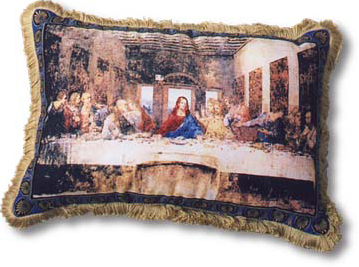
You, too, can order a Last Supper Musical Pillow  (pictured above) for your volunteer choir director here: 

http://www.ship-of-fools.com/gadgets/home_garden/110.html

Welcome to this Ministry

How was your current pastor (or education and music leader) welcomed when she/he started with your congregation?  The act of welcoming in those first days is an important introduction to the community and everybody wants to feel like somebody is glad they’ve come on board.

On my first day of the new position, several of us went out to lunch.  It was great and it was exactly what I needed.  My point here is that I’m not expecting churches to shower the new person with gifts like he/she’s won the grand prize in a game show.  I’m talking about little things that make life easier for the stranger who will become your pastor or other spiritual leader.  Good ideas:

– If the person is totally new to the area, a small notebook with recommended barbers, auto repair shops, dentists, and tree surgeons.  A neighborhood Angie’s List if you will.

– A basket of local treats like a couple of gift cards to local restaurants, a mug from the independent coffee shop on the corner, a recipe book from the women’s organization.

– A written institutional memory – or if you have some time – a homemade video featuring members with a tour of the building & grounds (“This tree was planted in memory of a great lady in the congregation who died in 2003.”  “This room is named for the first pastor who was from Scotland – hence the tartan wallpaper.”)   A video would be more interesting than a notebook, and it would give a very personal introduction to life in your congregation.

–  And speaking of videos – a fun video with brief interviews about why you’re excited that ___ is your new pastor and your hopes for him/her.  Interview the kids, the young adults, the old adults, the Roman Catholics across the street, the local mechanic, whomever.  People could just say, “Hi I’m ___ and I just joined the church last summer but I’m glad you’re here.  Welcome!”  or – if you want to be funny/bold  “Hi, I’m ____ and this is my spouse ____ and we are the ones who always complain about the AC.   So we hope you’re cold-natured.”

How has your congregation welcomed a new person to your church staff?  Or how have you been welcomed if you serve a congregation? 

Good and not-so-good (i.e. what NOT to do) ideas are encouraged.

That Day

I can’t bring myself to watch the 9-11-01 Remembrance shows. 

There are many things I still remember so vividly that my heart starts pounding and my throat gets dry when I share those memories.  I can still hear the voices, feel the ground shake, get that sick feeling when you can’t reach someone and fear the worst.  The plane that hit the Pentagon flew past our church building like a bullet.  I didn’t see it myself,  but our mild-mannered sexton was outside with landscapers and he screamed.  The plane was so low that it skimmed the treetops and even hit street lights on its way down Columbia Pike.  And then we felt it. 

I remember frantic emails about church members and loved ones who were in the Pentagon or the Towers that morning.

I remember picking up the children of federal workers from day care because the workers were in lock down – especially if they worked for the FBI or CIA.

I remember picking up my own children – schools closed early and there were no buses – and one of our middle schoolers said that when the Principal asked all students with parents working at the Pentagon that day to report to the library half his class left.  They would be meeting grief counselors in the event their parents did not pick them up.

I remember one elementary school principal who – after getting all her students to their families – learned that her own husband had perished in the Pentagon.

I remember a stranger who cried in our sanctuary all day but wouldn’t speak.  After several hours, she finally stopped crying and told E. that she’s witnessed the plane fly into the Pentagon on her way to work. 

I remember that we had a wedding scheduled for that Saturday and the bride and groom wondered if they should go through with it.  The groom’s family was coming from California. The bride’s family was coming from Europe.  And all flights were canceled. 

I remember that the groom’s family had  immediately rented an RV that Tuesday and drove across country.  And unbeknownst to the bride, her family had arrived early in the US to visit old friends.  They too rented a car and drove to DC.

I remember – after the wedding – driving to N.C. to preach at the ordination of a friend and, on Sunday, as we lined up to enter the sanctuary, The Almost-Reverend M said, “This is a terrible day to be ordained.”  And someone else said, “Actually, this is the perfect day to be ordained.”

I remember that we played the same song over and over and over again on a stream as people came into our sanctuary to pray and cry.  In the Lord I’ll be ever thankful.  In the Lord, I will rejoice.  Look to God; do not be afraid.  Lift up your voices, the Lord is near.  Lift up your voices, the Lord is near.  It helped us get through that day.

You can hear it here: http://www.youtube.com/watch?v=SGS26r7dKZQ 

(Note: WordPress hyperlink still on the fritz and the slides of snowy London are distracting.  Just close your eyes and listen.)

ISO 20-Somethings on COM

30-somethings would be good too.

To be clear: 

1) I appreciate and love my brothers and sisters in Christ of every age with whom I’ve spent literally hundreds of hours in church meetings. 

 2) Nobody joins a church for the meetings. 

As a longtime parish pastor and now as a Presbytery staffer, I’ve sat through lots of meetings – including meetings of the wider church.  One of the joys – and I mean that – of being in a connectional church is that we are indeed connected. 

The hope is that we are connected by relationship more than bureaucracy.  But the bureaucracy quotient increases as the size of an institution increases.  Bureaucracy means meetings.  Lots of meetings.

I’ve noticed – not surprisingly – that there is a dearth of human beings under the age of 40 at these meetings.  Why?  There are lots of reasons:

– Important meetings are often at 2:00 on a random Tuesday and the only lay leaders available are retired people. 

– Evening meetings are tough for people with young children.

– Saturday meetings are tough for people with young children.

– Millennial generations have a higher propensity to consider bureaucratic meetings to be pointless, frustrating, soul-sucking, etc.

So how do we engage people younger than, say, 55 that we want them to participate in policy-writing and decision-making?  I really don’t know.

Ideas?

Never Again

No, this is not a post about 9-11, although that post might be written later this week.  This is about the New Church Plants of the 21st Century and what – imho – will most likely never happen again.

It used to be true that groups of Presbyterians or Episcopalians or Lutherans or whomever found themselves in a growing community without their flavor of church (think post-war Washington, DC in the late 1940s.)  Maybe a group of friends threw together a Vacation Bible school one summer because there wasn’t one within walking distance of their apartment or new split level home, and they had so much fun that they decided to form a new church.  (Actually, I used to serve that church.)

Or maybe an established church in the neighborhood was so overwhelmed with new members (Baby Boomers everywhere) that they planted a new church themselves just a mile away.  You couldn’t have too many churches in the same zip code.

Later it was true that – as new housing developments sprang up in what were once fields out in the country – dioceses and presbyteries and conferences and associations recognized that those new burbs would need churches and so they parachute-dropped a charismatic pastor into that new neighborhood and a new congregation was soon established, and it grew and grew.

As recently as ten, fifteen, twenty years ago, this model still worked.  At least in some parts of the country, churches were planted in new neighborhoods and they thrived under strong leadership.  Yes, some attempts to starts new congregations faltered.  In fact most New Church Starts are not successful.  But occasionally, one catches a spark and flourishes.

In many areas – as we all know – megachurches sprang up in the past 20 years, often first meeting in a gifted teacher’s living room and eventually needing a massive warehouse or abandoned shopping mall to accomodate the hundreds and then thousands of people pouring into worship services.

I’m being ridiculously simplistic and over-generalizing here, but my point is this:  Those Days Are Over For The Institutional Church.  Sure, there could be a new megachurch or two popping up somewhere in 2015.  And this is not to say that many established churches, founded in 1950 or 1970 or even 1870 will not continue to thrive and serve in extraordinary ways.  But the days of multiple new churches in one neighborhood are over.  The days of dropping a fresh faced pastor into a new condo development and establishing a sustainable church replete with a shiny new building in less than 5 years are over.

Again, please hear me out.  Congregations that are already established can and will continue to do ministry well in their neighborhoods IF they are missional communities committed to adaptive change.  But the majority of new spiritual congregations will look more like Broad Street Ministries in Philadelphia or Wicker Park Grace in Chicago.  (Sorry but the WordPress hyperlink is on the fritz.)  Those congregations are fluid and open.  Membership stats are loose and worship is marked by art (often led by a curator rather than a preacher) and conversation (rather than a sermon.)  In Holy Grounds Alexandria (again I can’t hyperlink) we called it grappling. 

This may be painful for those of us who love membership rolls to accept but searching millennial generations are not going to join First Church on the Hill and sign up for the mission committee.  Sure, there will be young adults who grew up singing from hymnbooks who will seek out a church like the one they knew and loved as children, but even those brothers and sisters in Christ will want something more emergent.  Traditional in worship style perhaps but emergent in culture.

How do we make this shift in our thinking and our planning?  Baby steps.  While continuing to serve traditional congregations, we encourage the creation of missional communities that meet in nontraditional spaces:  art galleries, bars, coffee shops, diners, movie theatres, parks.  We’ve already seen them out there if we’ve been paying attention.

This is the future of new church developments if you ask me.