I am on study leave this week in Torch Lake, Michigan and although I will be Zooming into three (just three, my friends) meetings, I will otherwise be radio silent.

Grateful for this time of rest and study before Pentecost.

I am on study leave this week in Torch Lake, Michigan and although I will be Zooming into three (just three, my friends) meetings, I will otherwise be radio silent.
Grateful for this time of rest and study before Pentecost.
Posted in Uncategorized
A lot of us are talkers.

Although I am a Myers Briggs Introvert, I can talk with the best of them and I talk for many reasons: I have things to say, I’m trying to fill an awkward silence, I’m curious, I’m nervous.
At a family wedding over the weekend, the bride was coming down a beautiful long staircase while the organ played O God Beyond All Praising and I whispered to my brother, “This is one of my favorite hymns.”
Why did I need to say that? Was it a way of making the moment a tiny bit about me? What is to show that I know my old hymns? Why couldn’t I just be quiet and enjoy the majesty of the moment?
We’ve all experienced the scenario of someone telling a story and then someone else needs to top it or share a similar story. Why do we do this?
In these days of Zoom Meetings – especially in breakout rooms – I’m finding that even when we break into smaller groups to have more personal conversations, some people still dominate the conversations. When one person speaks more than once during a limited time frame, others will not have the chance to speak. As someone reminded me in (yet another) Zoom meeting yesterday, “People who speak more than once in a breakout room or in a large meeting with time limits are actually preventing others from speaking.”
Learning how to speak in meetings is an essential practice. Sometimes we need to teach each other:
Notice in church meetings what’s going on. Is this meeting primarily a social time without much agenda but it lasts for an hour because people want to chat? Have we veered off the agenda and the moderator either hasn’t noticed or can’t reel people back on task? Are people talking over each other? Are there private conversations happening in the corner? Is there a person who never speaks up? Is there a person who always speaks up (sometimes to the detriment of actual discussion and debate)?
No church board meeting should last longer than a worship gathering unless the board is dealing with a crisis. And those attending the meeting need to come prepared so that we aren’t talking about matters that were discussed previously.
A lot of us are talkers and we would be wise to consider how our practice of talking needs to change.
Have a lovely weekend. I’m on study leave next week and hope for some nourishing one-on-one conversations as well as some quiet time.
Posted in Uncategorized
What I’m hearing from COVID-weary Pastors these days:
They don’t want to attend Bible study. They don’t want to return to live in-person worship. They don’t want to plan summer programs. They don’t want to serve on boards or committees. They might never “be back” when life returns to “normal.”
I’m reminded of certain pirates who are also vegetables who entertained my children long ago:
We are the Pirates Who Don’t Do Anything.
We just stay home and lie around
And if you ask us to do anything, we’ll just tell you
We don’t do anything!

Full video here.
Pirates, by definition, selfishly take the labor and handiwork of others without respect. I confess before you and God that during COVID I have often taken things without respecting the work and creativity that was generated by the hands and imagination of others. I’ve sat in my pajamas sipping coffee on Sunday mornings enjoying the music and liturgy and sermons of hardworking church professionals without even singing along. I’ve watched YouTube worship gatherings without making a financial contribution. I’ve rarely been asked to contribute a prayer or a litany. I have become a freebooter.
Because of virtual worship, congregations have not had to recruit and train greeters, ushers, nursery volunteers, or fellowship hour hosts. No one has come early to set up the coffee on Sunday mornings and unlock the doors. There hasn’t been a call for new choir members or Sunday School teachers. We who’ve relished sleeping in on Sundays haven’t had to do anything we haven’t wanted to do.
Maybe what we need to do is not about supporting the institution of traditional Sunday morning worship. Maybe what we need to do involves serving outside the walls of the church building: tutoring, weeding, cooking, cleaning, painting, and listening. Or if your church building has the capacity to host people who are hungry, homeless, addicted and lonely, get to work right there in the place where you also gather for in-person worship.
God calls us to be Jesus’ hands and feet in the world. Maybe we don’t really need ushers and coffee hour hosts, but we do need people who want to give of themselves to bring healing and wholeness to a broken world.
Pastors are exhausted from pulling worship together on a dime in the middle of a pandemic. They were doing it to nourish us during a dry time in hopes that we might be inspired to serve others in Jesus’ name. But we’ve become accustomed to sitting in our pjs like the pirates who don’t do anything.
Don’t be a pirate. It’s time to be honest swashbucklers (i.e. daring adventurers) in the name of Jesus.
The silly song “We Are the Pirates Who Don’t Do Anything” was written by Michael Nawrocki and Kurt Heinecke (1997). Veggie Tales were created by Phil Vischer and Mike Nawrocki.
Posted in Uncategorized
Being in deep debt feels like drowning. Not being in debt feels like breathing. And we don’t talk about these things because of the shame around debt and – in some cases – the shame around not being in debt when your friends are.

One of the reasons why the financial advisor Bernadette Joy is so effective in leading people out of debt is because she openly shares her own story about being $300,000 in debt and how she paid it off in three years. You can read about it here. She carried enormous shame about her debt but by sharing her story (and of course the happier ending) she gives others permission to share their own stories shame-free. Sort of a “we’re all in this together” mentality. It’s very supportive and I speak from personal experience.
There is nothing holy about poverty. And living in poverty and/or deep debt does a number on our ability to carry out our calling in life whether we are pastors, teachers, police officers, or McDonald’s workers. Pastors should be earning enough to live without worrying that the electricity will be turned off. And sometimes we Pastors are being paid enough (not a lot, but enough) but the debt we’ve brought with us makes it impossible to support ourselves.
Debt relief is a spiritual practice.
And yet, very few of our congregations offer debt relief classes or financial training. Many of us didn’t get this from our parents and if we find ourselves having made poor decisions about money, we are too ashamed to talk about it – especially in church.
Think about what it means to be too ashamed to talk about something with anybody in our church community. This is one reason why our congregations are failing.
Instead of being a community of sinners grappling with our own mistakes, embarrassments, shame, and brokenness, we have become a community of people who seem to have it all together. We don’t dare share during “the prayer concerns” that we have tens (or hundreds) of thousands of dollars in debt. And so it doesn’t get addressed and it impacts our souls.
Imagine being the kind of church that allows for people to share their deepest shame without fear of hearing about it in the parking lot next Sunday. Imagine congregations walking with people through their financial fears so that everyone can find freedom to build financial security. Financially secure followers of Jesus are able to financially encourage others and create vital ministries that addresses the world’s brokenness.
Here’s a start: get a small group of trusted people in your church to take a finance or debt reduction class together. And maybe just one class can help make a very uncomfortable topic a little more comfortable. Ideas for classes here and here (Skill Pop virtual classes are about $20 and Bernadette Joy sometimes teaches Crush Your Debt courses.)
I wrote this piece because I want every adult to conquer debt – in Jesus’ name. We can do a lot of good with the money currently going to credit card companies.
Posted in Uncategorized
One of the True or False Church Addiction Test questions by Tom Bandy in Kicking Habits: Welcome Relief for Addicted Churches is this:

True or False: “Debt freedom always leads to church decline.”
It’s True – “Sound debt management is the key to thriving church development.”
I know congregations with no debt who are failing and I know congregations with debt who are thriving. Money is obviously a tool of ministry, but what is “good debt” and what levels of debt will kill a congregation?
I’m not a money person (i.e. English major) but I’m learning to love money issues. What happens to a church that receives a million dollars from a member’s will, especially when the membership doesn’t believe their financial contributions are needed anymore? Sometimes a large endowment = subsequent poor stewardship practices.
The point is not the money. The point is doing ministry. The point is the spiritual discipline of making a financial contribution based on our commitment to God’s Church whether they have millions in the bank or not.
Regarding churches with millions of dollars in the bank: what’s your plan? Millions of dollars can build transitional housing, build a shelter for abused women, or build a hospital in Haiti. Again: what’s your plan?
If our plan is to build up reserves “for a rainy day” please look out your windows right this minute..
It’s pouring rain out there. It’s literally raining on the heads of the homeless. It’s literally stormy for kids who’ve aged out of foster care. It’s brutally cold for those seeking a community of people who will love them unconditionally.
I’m not the person to comment on what percentage of debt is healthy and faithful. But I can tell you what thriving congregations are doing: they are not afraid of debt if they know that they have a mission that the congregation buys into. They do not fear debt when they’ve discerned that God is calling them to serve their neighbors in new way, even if that means razing and then rebuilding their church space. I find their faithfulness contagious to the point of knowing that God will make congregations successful when they understand who they are and why they exist.
Would love to hear your comments on your congregation’s debt. And tomorrow: Why Personal Debt Is a Spiritual Issue.
Posted in Uncategorized

Our FBC was sharing the other day that – as a video guy – he is often asked to make a film fast and cheap, and also, it should be really good. FBC always says, “You can pick two.”
If a project is fast and cheap, it won’t be good.
If a project is good and cheap, it won’t be fast.
If a project is fast and good, it won’t be cheap.
This translates into ministry and mission as well. Can we all agree that:
We in church often want fast: bake sale, car wash. Something we can throw together without much effort.
We also want cheap: Maybe Elder Dave’s brother can fix it. He wouldn’t charge much.
We also want good: Lives are changed.
In ministry as in film making, we can pick two:
Whether we are talking about feeding the hungry, building affordable housing, bringing equity to our justice systems, or changing our congregation’s culture from one that serves ourselves to one that serves our neighbors, we need to either take the time needed, spend the money needed, and/or put in the effort needed. And prayer is always a good idea.
What kind of church are we willing to be? Are we simply going through the motions?
Where is God leading us? And do we want fast, cheap, or good? We can pick two. The non-negotiable additional pick: faithful.
Posted in Uncategorized

I read a lot of Personal Information Forms (also called resumes) for pastors seeking new positions and what’s impressive to some people is not necessarily impressive to people who read these things for a living. For example PNCs are sometimes impressed by the following:
So, here’s my translation of the such an impressive resume:
Some pastoral candidates are good writers but they are less effective in person. Others might be charismatic but they are slackers. And still others might seem awkward in interviews, but they are The Real Thing and they’ve been seeking a new call for so long now that they are really nervous. (The guys who play golf with the mayor got all those other positions.)
There are some amazing pastors out there who are not considered “impressive” because they are too young or too old, too brown or too Asian, too female, too queer, too bald, too “community college” or too inexperienced. The truth is that they might also be extraordinarily impressive in the way they envision what your congregation could be if you are authentically interested in 1) being the Church and 2) changing the world for good in the name of Jesus Christ.
Ask good questions. Look for a spark. Enjoy the process. And please, please, please ask God to reveal the unexpected gems who are called to be your next Pastor.
Posted in Uncategorized
It’s embarrassing every time I’ve replayed conversations in my head when I said things out loud with the intention of making myself look smart/woke/anti-racist. People of Color must lose their minds when they observe White People saying things like:
Congratulations everybody. But that can’t be the end of the story.
What is your family learning about being part of a school community full of people who don’t live in your comfortable neighborhood? How is your perspective changing by being exposed to Authors of Color? Is your new lawyer a trophy or are you treating him as your legal mentor? And now that you know that there are slave graves on your church property, what are you going to do about it?

Can we talk about repentance? Yes, it’s a churchy word that most people know from signs like this one.
The real meaning of the word “repent” involves stopping and turning in a new direction. “I was once in a group of friends who used coke on weekends and now I stopped that practice and I’ve turned to weekends on hiking trails instead.” It’s not enough to stop a certain way of acting or thinking. We need to take steps in a completely different direction in order to progress into a new way of life.
My theological tradition is big on confession. We believe in confessing our personal sins. (“Ugh, I’m so sorry I lost my temper at work. God, help me stop doing that.“) And we believe in confession the corporate sins of the world. (“Ugh God, this world is on fire. Forgive me for failing to put out the fires I have the power to extinguish.”)
My parents never enslaved anyone. Neither did my grandparents or great grandparents. I never forced Native People off my land, nor have I taken somebody’s property just because I had the power to take it. And yet . . .
I am called to confess the sin of White Privilege and White Supremacy which has enhanced my life by virtue of my skin color while making the lives of Brown and Black people more difficult. Yay if we have read Resmaa Menakem or Ibram Kendi but if all we do is read a couple books, and nothing changes about how we are living our lives – who cares?
I love it when dominant cultures acknowledge the past suffering of those with less power. It’s like admitting that – Yes – this happened in our church, in our county, in our nation’s history. But acknowledgement is just the beginning.
We have some corporate confessing to do.
We have some repentance (stopping and changing directions) to do.
We have some repair work to do.
Churches: thank you for remembering that your campus was built on the land of Native Americans. Thank you for remembering that there are enslaved people buried in your cemetery. Thank you for remembering that your church overcharged the immigrants who came to town to pick tomatoes all those summers ago. We are not finished yet in terms of our response, and it’s not too late.
Posted in Uncategorized
I’d like to write something about this, but I have no idea what to say. Some relationships look perfect-ish. Some appear to be difficult. But we just don’t know, do we?

As I’ve sometimes said in wedding homilies, it’s an underrated miracle when two people fall in love with each other at approximately the same time and craft a life together that’s happy and satisfying for a lifetime. I pray today for those who have never experienced that miracle and those for whom their plans didn’t turn out the way they expected. For the broken hearted and the estranged, for the disappointed and the hopeful, we pray to the LORD.
Portrait of Melinda and Bill Gates by Jon R. Friedman in the National Portrait Gallery, Washington, DC (2018)
Posted in Uncategorized
She was between 20 and 30 years old and she died in approximately 1 BCE. For many years archaeologists not only assumed she was male; they thought she was a male priest considering the markings on her sarcophagus. She was between five and six months pregnant and her burial accessories included “a rich set of amulets.” And although she was Egyptian, she now resides in Poland. You can read about her here.
Turns out she was placed in a sarcophagus which was not her own. This happens 10% of the time says Archaeologist Wojciech Ejsmond. Interesting. (But that’s for another post.)
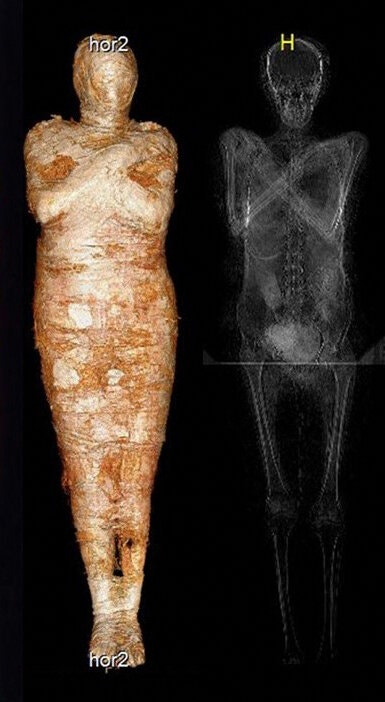
We in the Institutional Church ofter refer to the Church being dead or dormant somewhat like a mummy.
And during this Eastertide, we might remember that Jesus himself was embalmed by those who loved him. But he was apparently never a mummy because . . . Resurrection. (Again, the conversation about bodily resurrection is for another post.)
So, here’s my point:
Some of our congregations are in the process of preparing for death because of what Carey Niewholf talks about:
Some congregations have unwittingly embalmed themselves with relics and they don’t even know it. I know congregations with more money in their cemetery fund than their mission fund.
Some congregations have died even though there was new life there than never had a chance. Cue the wise and wonderful MaryAnn McKibben Dana : “The Church is not dying. It’s pregnant.”
The kindom of heaven shall be like a fertile royal who gives birth again and again to a new generation of the faithful. Truly I tell you, even the embalmed will reveal new life.
Posted in Uncategorized

 A Church for Starving Artists