Our FBC was sharing the other day that – as a video guy – he is often asked to make a film fast and cheap, and also, it should be really good. FBC always says, “You can pick two.”
If a project is fast and cheap, it won’t be good.
If a project is good and cheap, it won’t be fast.
If a project is fast and good, it won’t be cheap.
This translates into ministry and mission as well. Can we all agree that:
Followers of Jesus are called to make a positive difference in the world.
There is a lot of work to do (i.e. the world is a hot mess.)
We in church often want fast: bake sale, car wash. Something we can throw together without much effort.
We also want cheap: Maybe Elder Dave’s brother can fix it. He wouldn’t charge much.
We also want good: Lives are changed.
In ministry as in film making, we can pick two:
We can do fast and cheap ministry, but it won’t be good.
We can do good and cheap ministry, but it won’t be fast.
We can do fast and good ministry, but it won’t be cheap.
Whether we are talking about feeding the hungry, building affordable housing, bringing equity to our justice systems, or changing our congregation’s culture from one that serves ourselves to one that serves our neighbors, we need to either take the time needed, spend the money needed, and/or put in the effort needed. And prayer is always a good idea.
What kind of church are we willing to be? Are we simply going through the motions?
Where is God leading us? And do we want fast, cheap, or good? We can pick two. The non-negotiable additional pick: faithful.
I read a lot of Personal Information Forms (also called resumes) for pastors seeking new positions and what’s impressive to some people is not necessarily impressive to people who read these things for a living. For example PNCs are sometimes impressed by the following:
The list of Doctor of Divinity degrees from one or more institutions of higher learning listed under Formal Education.
Photos of the candidate shaking hands with a famous person or teaching a class by the Sea of Galilee or preaching from a tall steeple church pulpit.
A list of community honors from Father of the Year to Rotarian of the Year to Bank Employee of the Year (from those pre-seminary days.)
References which include the names of Senators, CEOs, and Nobel Prize winners. Maybe they were members of the candidate’s previous churches – or they went to college together or they were Rotarians together back in the 90s.*
Under hobbies and other interests, the candidate has noted that he’s climbed the Alps, written a couple novels, and solved ecclesiastical version of the Mid-East Crisis.
So, here’s my translation of the such an impressive resume:
Doctor of Divinity degrees are usually given honorarily if the pastor spoke at a graduation service or served a congregation that donated money to that institution of higher learning. Former Moderators of the General Assembly have several of these by virtue of preaching at Presbyterian colleges and seminaries during our terms. We didn’t earn them. They are a kind gesture.
Send a small head shot if you wish, but we don’t need to see that you met President Reagan once. Preaching by the Sea of Galilee might give somebody the impression that you are just like Jesus.
Community Honors are lovely and it’s also true that you might have received honors – again – for speaking at an event or giving a chunk of money away.
References should be people who can speak to your work. They’ve heard you preach, teach, administer, lead, and relate to people in an effective way. We don’t care if they used to run AT&T. [*Note: when I was in college and trying to get a waitress job at Hilton Head, I put Dean Smith down for a reference. He knew nothing of my hospitality skills but I was friends with his kids. I did help him with a load of laundry once. “She’s really good with Clorox.” And I thought his name could help me get a job. This was an obnoxious idea.]
If you have a long list of extracurricular activities, I might wonder if you ever spend time with your family – or your own congregation.
Some pastoral candidates are good writers but they are less effective in person. Others might be charismatic but they are slackers. And still others might seem awkward in interviews, but they are The Real Thing and they’ve been seeking a new call for so long now that they are really nervous. (The guys who play golf with the mayor got all those other positions.)
There are some amazing pastors out there who are not considered “impressive” because they are too young or too old, too brown or too Asian, too female, too queer, too bald, too “community college” or too inexperienced. The truth is that they might also be extraordinarily impressive in the way they envision what your congregation could be if you are authentically interested in 1) being the Church and 2) changing the world for good in the name of Jesus Christ.
Ask good questions. Look for a spark. Enjoy the process. And please, please, please ask God to reveal the unexpected gems who are called to be your next Pastor.
It’s embarrassing every time I’ve replayed conversations in my head when I said things out loud with the intention of making myself look smart/woke/anti-racist. People of Color must lose their minds when they observe White People saying things like:
“We’ve decided to send our (white) child to an inner city school.”
“My book group only reads books by Authors of Color.”
“We hired a new lawyer and he’s a smart Korean man.”
“Our 250 year old church spent the last year doing research on who’s buried in our slave cemetery.”
Congratulations everybody. But that can’t be the end of the story.
What is your family learning about being part of a school community full of people who don’t live in your comfortable neighborhood? How is your perspective changing by being exposed to Authors of Color? Is your new lawyer a trophy or are you treating him as your legal mentor? And now that you know that there are slave graves on your church property, what are you going to do about it?
Can we talk about repentance? Yes, it’s a churchy word that most people know from signs like this one.
The real meaning of the word “repent” involves stopping and turning in a new direction. “I was once in a group of friends who used coke on weekends and now I stopped that practice and I’ve turned to weekends on hiking trails instead.” It’s not enough to stop a certain way of acting or thinking. We need to take steps in a completely different direction in order to progress into a new way of life.
My theological tradition is big on confession. We believe in confessing our personal sins. (“Ugh, I’m so sorry I lost my temper at work. God, help me stop doing that.“) And we believe in confession the corporate sins of the world. (“Ugh God, this world is on fire. Forgive me for failing to put out the fires I have the power to extinguish.”)
My parents never enslaved anyone. Neither did my grandparents or great grandparents. I never forced Native People off my land, nor have I taken somebody’s property just because I had the power to take it. And yet . . .
I am called to confess the sin of White Privilege and White Supremacy which has enhanced my life by virtue of my skin color while making the lives of Brown and Black people more difficult. Yay if we have read Resmaa Menakem or Ibram Kendi but if all we do is read a couple books, and nothing changes about how we are living our lives – who cares?
I love it when dominant cultures acknowledge the past suffering of those with less power. It’s like admitting that – Yes – this happened in our church, in our county, in our nation’s history. But acknowledgement is just the beginning.
We have some corporate confessing to do.
We have some repentance (stopping and changing directions) to do.
We have some repair work to do.
Churches: thank you for remembering that your campus was built on the land of Native Americans. Thank you for remembering that there are enslaved people buried in your cemetery. Thank you for remembering that your church overcharged the immigrants who came to town to pick tomatoes all those summers ago. We are not finished yet in terms of our response, and it’s not too late.
I’d like to write something about this, but I have no idea what to say. Some relationships look perfect-ish. Some appear to be difficult. But we just don’t know, do we?
As I’ve sometimes said in wedding homilies, it’s an underrated miracle when two people fall in love with each other at approximately the same time and craft a life together that’s happy and satisfying for a lifetime. I pray today for those who have never experienced that miracle and those for whom their plans didn’t turn out the way they expected. For the broken hearted and the estranged, for the disappointed and the hopeful, we pray to the LORD.
Portrait of Melinda and Bill Gates by Jon R. Friedman in the National Portrait Gallery, Washington, DC(2018)
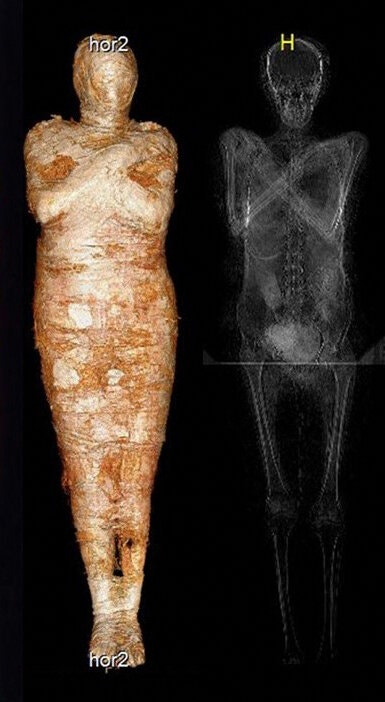
She was between 20 and 30 years old and she died in approximately 1 BCE. For many years archaeologists not only assumed she was male; they thought she was a male priest considering the markings on her sarcophagus. She was between five and six months pregnant and her burial accessories included “a rich set of amulets.” And although she was Egyptian, she now resides in Poland. You can read about her here.
Turns out she was placed in a sarcophagus which was not her own. This happens 10% of the time says Archaeologist Wojciech Ejsmond. Interesting. (But that’s for another post.)
We in the Institutional Church ofter refer to the Church being dead or dormant somewhat like a mummy.
We are God’s Frozen People.
Carey Niewhof has identified “7 Subtle Signs” of impending church death here.
Revelation 3:1-6 (The truth about dying churches goes way back.)
And during this Eastertide, we might remember that Jesus himself was embalmed by those who loved him. But he was apparently never a mummy because . . . Resurrection. (Again, the conversation about bodily resurrection is for another post.)
So, here’s my point:
Some of our congregations are in the process of preparing for death because of what Carey Niewholf talks about:
No passion from leaders.
No innovation.
Management over leadership.
Maintenance over mission.
Fixation on being “my church.”
No permission-giving to young leaders.
Weak relationship with God.
Some congregations have unwittingly embalmed themselves with relics and they don’t even know it. I know congregations with more money in their cemetery fund than their mission fund.
Some congregations have died even though there was new life there than never had a chance. Cue the wise and wonderful MaryAnn McKibben Dana : “The Church is not dying. It’s pregnant.”
The kindom of heaven shall be like a fertile royal who gives birth again and again to a new generation of the faithful. Truly I tell you, even the embalmed will reveal new life.
When people don’t stay in their lane, crashes happen and sometimes those crashes stop all movement forward.
One of my coaches taught me that Clear Roles make all the difference in healthy organizations. As I work with congregations, I see this is true.
Not healthy:
Church Treasurers who believe it’s their role to determine if the pastor deserves to be paid that week.
Clerks of Session (in Presbyterian lingo this is the keeper of board meeting minutes, etc.) who believe they have the authority to veto the Pastor or make plans without the Pastor.
Pastors who believe it’s their role to decree what the congregation believes.
Parishioners who believe it’s their role to keep Pastors in their places.
I appreciate my colleagues in that we are constantly checking in with each other about boundaries. Am I in your lane? Is this something I should be doing or is that on your plate? Is this project something you have time to do, or would you like us to hold off until summer? Do we need to change your position description to add that responsibility?
The worst is when the Christian Education Committee is doing the work of the Mission Committee who is stepping on the toes of the Worship Committee who interferes with the Flower Committee who doesn’t care that the Pastor won’t allow flowers on the communion table.
In a healthy church, colleagues can talk with each other about who does what and it’s not about power; it’s about good boundaries and effective ministry in the name of Jesus.
“As I have defined it, love is the antithesis of laziness. Ordinary laziness is a passive failure to love.” M. Scott Peck
There’s the congregation that would rather settle for a low-energy, ineffective pastor rather than go through the process of calling a new leader.
There’s the Pastor Search Committee that would rather pick the organist’s cousin George who is “available right now” to be their Pastor rather than go through the process of finding a really good match for who they are and what they need for this moment in time.
There’s the Nominating Committee who picks the same people for the same roles over and over again whether those people are still the right ones for that position or not because it’s too much effort to discern who else might be called to serve who’s never served before.
There’s the Pastor who knows the congregation needs to re-boot and re-think their purpose, but he’s close to retirement and doesn’t want to stir the pot for his last years in professional ministry.
There’s the Personnel Committee who knows that they need a different kind of youth leader who knows how to make LGBTQ kids in the neighborhood feel welcomed, but they dread the pushback from the congregation, so they go for the “safe” candidate.
Long, long ago in a culture far, far away long – before Brene and Nadia, long before Oprah was Oprah – “everybody” read a book by M. Scott Peck called The Road Less Traveled: A New Psychology of Love, Traditional Values, and Spiritual Growth. It’s worth checking that book out again.
Dr. Scott Peck pitched that our most common sin was laziness. Humans are simply lazy. We are too lazy to care about our neighbors, too lazy to do the work that will make the future better, too lazy to be who we were created to be. We just don’t want to make the effort.
I see this every day in The Church. [Note: I also witness great acts of service, breathtaking moments of generosity, and impressive feats of grappling with hard situations.] And I see lots of laziness.
Everybody’s tired. Yes.
And everybody wishes things could be different but we don’t want to do the work.
Signs of heaven:
A Pastor Nominating Committee wrestles with who they are now and what their church and community need now and they not only do the work to call the right pastor; they are also willing to back up their/God’s choice when other folks complain that the new pastor is too young/old/white/black/female/queer. The truth is perhaps that the naysayers don’t even want to take the time to consider why this new pastor – who doesn’t look like what they expected – is clearly the person God chose.
A Church strives to include voices not usually heard when discerning the next chapter of their contributions to the neighborhood.
The Big White-Steepled Church on the Hill that’s doing just fine in terms of their mission goals and finances chooses to risk conflict by confronting their uncomfortable past which includes founders who were slaveholders and former pastors who were segregationists.
The Church struggling to thrive in this culture makes the courageous choice to do what’s best for the community (rather than what feels safest for themselves) and allow their church property to become something new to serve the neighbors.
You’ve already read my Signs of Laziness.
Fortunately, I see more Signs of Heaven than Signs of Laziness – but there are too many signs of laziness out there and what The Lazy among us don’t realize is that lazy choices kill congregations.
Lazy choices kill congregations.
The easy way out. The easy hire. Don’t do it. Show me one time God ever took the easy way.
Love is the antithesis of laziness. Love does the work because it’s not about us. It’s about figuring out what God might want to do with us and our community to fulfill the best and highest Plan for this world.
I stayed up late last night to watch The Academy Awards mostly because it was fun watching people get dressed up and sit face to face fully vaccinated at a party. Frankly, some of the choices were not my favorites (Chadwick Boseman and Viola Davis were robbed) but comparing the different roles of – say – the five Best Actor nominees is like comparing apple and oranges and grapes and pears and pomegranates. All delicious but so different.
I was thinking about some of the stellar performances of my colleagues in ministry which involve drama, comedy, animation, and editing – not to mention best sound tracks and costume design. For example:
Best Directing goes to those pastoral leaders who lovingly move their congregations from a Constantinian model of ministry to an Entrepreneurial/Disciple-making model of ministry.
Best Performance in a Drama goes to the elders and deacons who keep ministry vibrant after a congregational trauma (e.g. the pastor is struggling with terminal health issues . . . or runs off with a liturgical dancer.)
Best Soundtrack goes to the music leaders who create a Christmas Pageant using lyrics from Hamilton (First Presbyterian in Brooklyn did this a couple years ago and it was amazing) or the youth leaders who write a play about Amos re-working lyrics by H.E.R.
I witness extraordinary performances by the priesthood of all believers every day. And then it occurs to me that these are not “performances” at all. They are authentic acts of service and love.
I’ve known professional ministers and other leaders of faith who were acting the part. God help us.
There are the pastors who preach one thing and do another. (The #ChurchToo movement has stories that rival anything Emerald Fennell could create.) There are elders who perform acts of respectability but privately they are gaslighters and bullies. There are teenagers who pretend to be pious for their parents but they are hiding secret lives. And there are church members who threaten to “stop giving” to the church if they don’t get their way, only to find out that they don’t make any financial contribution. These are performances.
True ministry is about God and living an authentic life that shows what God’s love looks like. True ministry happens when pastors offer selfless pastoral care to the families who slander them behind their backs. True ministry happens when the church nursery workers are as respected as the Senior Pastor. True ministry happens when people are spared shame. True ministry happens when “people who don’t deserve it” are blessed with a safety net.
True ministry is not about performance. It’s about spiritual leadership in a broken world. As much as I like watching actors act, those performances are a distraction. The stories in our actual lives are just as rich and disturbing and funny and colorful. And every day we are given the opportunity to dwell in those stories in a way that makes the world the way it was created to be. It can be real. Or it can be a performance.
Someone burst my bubble over the weekend and it was not comfortable. I was holding forth on something and a person refuted my position with some pretty good facts and her personal experience. She had some good points.
The lovely thing about bubbles is that we can create new ones easily.
Yesterday at about 5:00 ET many of us felt like bursting. And then maybe we did. The Chauvin verdict burst that bubble that says that Black people killed by White police officers will never get justice. But keep in mind that it took watching the murder of a Black man by a White man live in real time and then on video for justice to prevail.
And keep in mind that millions of people in this country did not care one way or another. They did not feel like bursting. They were probably walking the dog or cooking dinner and the verdict had no impact on their mood or emotions.
It’s so easy to stay in our bubbles and never be exposed to what’s outside our safe floating orb. This article by Shira Ovide points out that
“Online services like YouTube, Netflix and TikTok digest what you have already watched or its computer systems infer your tastes and then suggest more of the same. Websites like Facebook and Twitter expose you to what your friends like or to material that many other people already find engaging.”
We don’t need more of the same. We need to get exposed to different voices.
This goes for those of us who watch Fox News and those of us who watch MSNBC and those of us who “don’t watch the news anymore.” This goes for those of us who read the WSJ and those who read the NYT and those who read The Mooresville Tribune.
In my own bubble, I’m looking ahead to pondering how we in Charlotte will remember the 100th anniversary of the Tulsa Massacre knowing that most of the White people in Charlotte have never heard of the Tulsa Massacre. I’m writing an article on White Supremacy knowing that many people I love believe White Supremacy is only about the KKK. To be perfectly honest, I’m trying to bring you into my bubble and I need to explore yours as well.
Breaking bubbles and breaking barriers will never happen as long as we believe we have The Truth on our side. Wherever you are today, I hope you have the opportunity to talk with someone who disagrees with you about something.
May our bubbles burst today. It might not feel good. But we need it.
I would be happy to never again hear the term, “Think outside the box.”
What is this proverbial box and where did it come from?
Actually we are the ones who built the box. At any given meeting about church growth/outreach/community engagement/evangelism meeting, these are the suggestions I hear church people make (with my personal response):
Let’s have a neighborhood Open House. (Nope.)
Let’s have a “Come as you are” Sunday. (Nope.)
Let’s open our doors to the homeless. (Nope.)
Let’s have a bake sale. (Nope.)
Let’s knock on doors in the neighborhood. (Nope.)
Let’s hand out flyers at the next community event. (Nope.)
Let’s build a Family Life Center to attract the local kids. (Nope.)
Let’s have a Bring-a-Friend Sunday. (Nope.)
Let’s create a Five Year Plan for growth. (Nope.)
These events are not only part of that box we built; they also illustrate a dated, ineffective way of being the Church today. Note that most of these ideas reflect a “come to us” rather than a “go out” mentality. Note that each of these ideas imply a quick fix that conflates having events with being in relationship with.
[Note about The Five Year Plan: Five years ago we had no idea there would be a pandemic. Five years ago, Trump had not yet been elected President. Lots of things change in five years. Strategic plans are meaningless without 1) knowing what the culture is and 2) being extremely fluid and willing to edit the plan.]
A better way seems to be reverse engineering. Let’s say that our mission goal is to serve our neighbors who are residents of the men’s shelter near our church property.
Instead of starting with the usual “how to begin?” we start with what we hope the end result will be;
Instead of this:
We want to serve our homeless neighbors.
We go to a shelter and hand out invitations to come to worship and after we’ll have a one-time meal.
Those who come (assuming some shelter residents show up) are welcomed warmly and we enjoy a meal together.
We might or we might not ever see those folks again.
Try this:
We want to make a positive sustainable impact for our homeless neighbors.
We contact the men’s shelter nearby by and ask how we might serve these neighbors.
They suggest that our church volunteers serve dinner on the first Friday of each month because that’s their current need.
We sign up to do what they need: serve dinner on the first Friday of each month.
We are intentional about doing more than serve food; we introduce ourselves by name and we remember the resident’s names. Volunteers are trained in how to do this, if necessary.
We authentically get to know the residents and hear their stories. We nurture relationships to the point of including residents in ideas for menus. We ask them what they need as the months get warmer. We listen to what they say.
They say it’s really hot on the streets in the summer and they basically are looking for cool places to spend the day.
We give gift cards for McDonald’s, Dunkin Donuts, or DQ to each resident the next first Friday.
We continue to build relationships. We ask the residents and the staff of the shelter how else we might partner.
See the difference?
With the first way we begin by offering something easy (handing out invitations) in hopes of a transaction (they come to our church.) How much we would congratule ourselves if they joined!
With the second way we begin with the why. Why do we want to connect with our homeless neighbors? Then we ask what’s needed. We don’t make assumptions. We are not in the business of pitying “the needy.” We are in the business of making earth look more like heaven.
Future options might include attending a local job fair, learning what jobs are in need, finding grant money to pay for training for those jobs. One of our churches in Charlotte Presbytery did this. They learned that there was a need for trained forklift operators at a local job fair. They offered grant money from the denomination to train 32 people in forklift operation and all 32 got fulltime jobs as forklift professionals with benefits in 3 months.
Start with a mission goal and work in reverse. What do we need to do to make ____ happen?











 A Church for Starving Artists