Cozy

Proof that sometimes I dally: I’m finally getting around to choosing my Star Word for 2020.

Many of my friends choose “Star Words” for themselves during Epiphany (which is in January for you non-liturgical readers.) It’s a spiritual practice in which we take a single word printed on a cutout star and it becomes “our word” for the new year. Words like: Strong. Open. Patient. Generous.

The word is supposed to remind us and encourage us and inspire us.

If we had known in January 2020 what we know now, we might have chosen different words. Words like: Protest. Safe. Unmute.

I finally chose my word – 11 months late. It’s Cozy.

Cozy is the lens through which I am going through these days:

  • Is this shirt cozy?
  • Will this plant make my home cozy?
  • What would make this meal cozy?

When TBC was teaching young children in a DC elementary school a few years ago, they were talking about foods people eat in Haiti and it so happened that Haiti had just endured an earthquake.  TBC explained to her students what was going on there and one child suggested that they send help to Haitian children. “What should we send?” TBC asked and the student said, “Cozy things.” (They made a quilt of squares designed by the children and sent it to a school.)

Cozy = comfortable and comforting. Cozy means flannel and soup and long hugs.

Feeling cozy is also a privilege that’s not possible for many, many people: prisoners, those living in war zones or on the streets.

Jesus never said we would feel cozy.  He actually said the opposite.  (“I did not come to bring peace, but a sword.”) Ouch.  

Peace – with Jesus – is not about personal comfort.  It’s about deep confidence in the hope that love will ultimately win. It’s about bringing the reign of God to all people and when God is in charge there is true justice, love, compassion.

Breonna Taylor was cozily sleeping in her own bed.  I think about that a lot. 

As we watch election returns tonight (and tomorrow and next week — however long it lasts) some of us will be watching from the coziness of our sofas and some will be in very uncomfortable places.  But no matter what happens, we are called to share comfort with each other.  The comfort of safety.  The comfort of full bellies.  The comfort of clean living conditions.  The comfort of liveable wages.

Cozy is my word, but the point is that it can’t be just for me.  
 

My Dad & Mrs. Merzbacher

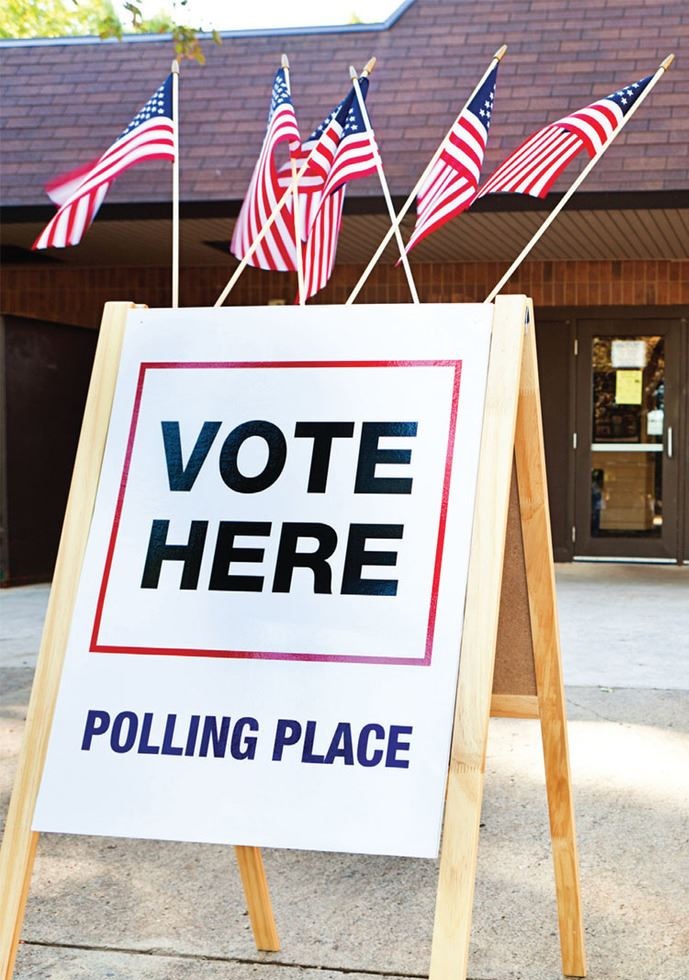
For the first several elections of my life, I voted at a local branch of the fire department in Chapel Hill. I went to college in my hometown and so – although I was “away at college” – I voted near my childhood home throughout my freshman through senior years at UNC. There was a free city bus.

My Dad was always there when the polls opened which was either 6 am or 7 am. I can’t remember. But what I know for sure is that Mrs. Merzbacher was sitting there overseeing the election.

As Dad prepared to vote, he always asked Mrs. Merzbacher if I had voted yet.  And because I hadn’t (because I wasn’t even out of bed yet) she always said, “Not yet.”  And then he would phone me in my dorm room and say, “Mrs. Merzbacher said that you haven’t voted yet. Don’t forget to vote.”  (This was before the electorial equivalent of HIPAA.)  I hadn’t voted yet because I hadn’t opened my eyes.

Mrs. Merzbacher was a national treasure who passed away five years ago today.  And because yesterday was All Saints’ Day – as we remember all those who have died in the past year, especially those who have died of COVID-19 – I want to remember her and all those who have made it possible to vote in this country.  Thank you poll workers.  Thank you activists who ensure that people can vote safely.  Thank you election volunteers.

Please vote tomorrow if you haven’t already done so.  These are crucial times and we are privileged to have this opportunity.  Don’t pass it up.

Thanks Dad.  And thank you Mrs. Merzbacher.

A Scary Story for These Days

[I shared this metaphor with my therapist recently and she asked if she could use it. (Of course.) I decided to share it with you as well.]

It’s almost dawn and you are asleep in bed when you realize that there is someone in your home. You hear people walking towards your bedroom and your phone is out of reach, so you hide in a closet.

Outside your closet you can hear voices saying, “Hey, we’re out here trying to help you. Are you okay? It’s safe to come out.”

But you are too scared. Can you trust those voices?

  • Maybe they are police officers who noticed something strange in your home.  Maybe the officers noticed that your front door was wide open or windows had been broken.  And the officers came inside to investigate.
  • Maybe it’s people who have entered your house to rob you or assault you and they know you’re in there.  And they are trying to trick you by saying, “We’re here to help you” when actually this is not true.

You are sitting in that dark place, holding your breath terrified what’s going to happen.  It could go either way.  Even if they are police officers outside your closet door, it doesn’t mean you’ll be safe.  The officers could be a threat to you too, depending on who you are or who they are.

And so you wait. And your heart is pounding.  But you don’t know what’s going to happen.  It could be dangerous out there.  Or it could turn out to be okay.

This is what it feels like the weekend before Election Day for many people in the United States.

We are waiting.  Our hearts are pounding.  We don’t know what will happen next week.  It could be dangerous out there.  It might literally kill us. Or it could turn out to be okay.

Be strong and courageous. Do not be afraid or terrified because of them,  for the Lord your God goes with you; God will never leave you nor forsake you.

Like this verse from Deuteronomy, the Bible is filled with verses about God’s protection.  The reality is that terrible things happen even when we pray, even when we try to live a life that pleases God.  And yet love will always win.  Even when it doesn’t seem possible, love will ultimately win.  Scripture teaches us this too.

I’ve recently talked with People of Color who have stocked up on food and supplies so that they don’t have to go out into a world that might be violent in the coming days. I’ve talked with teachers who work with DACA kids who have opportunities to go to college on scholarship but they worry that someone will arrest them or their parents at any moment.  I’ve talked with Muslim Americans who remember that this current administration once issued a Muslim ban.  What could happen in a second term?  I know people from Puerto Rico who – upon being ravaged by multiple storms – were visited by a President who threw paper towels into the crowd rather than ensure the return of electrical power.

People are terrified on both political sides.  And some of us are stirring up that terror.  That’s not my intention here.  My intention is that we would remember the vulnerable who will be most impacted by the election results.

Please pray for those who are living in fear today and who might be living in deeper fear this time next week.  Please be the Church for them.

And may we all drop our weapons whether they are rocks or words.

The Changes Are Permanent (Or – How Things Will Never Return to “Normal” and It’s Okay)

There are moments in our lives when – if we are paying attention – we realize that life is about to change forever and it will never be the same: a child leaves for college (and is actually able to leave and live away from home), a child or sibling or parent gets married, a family member is born or dies.

Although I don’t want to freak you out, the changes congregations have made because of this pandemic are here to stay. There is no “when things are normal again.” I’m not sorry.

For decades, the culture has been changing:

  • Fewer people have been “going to church” since the mid-1970s. And it’s not because preachers are too political or younger generations are uncommitted or families are too busy.
  • Church Membership has become less important than spiritual community-building.
  • Gathering in a church building has never been the point.
  • Spiritual practices (how to pray, how to read the Bible, how to serve our neighbors) are no longer passed on from generation to generation without intentionality.
  • Knowing about Jesus is in no way the same as knowing Jesus.

The congregational changes we have made will be permanent.  At the very least, our congregations will have a both/and future in terms of virtual or in-person worship experiences,  classes, and meetings.  I’m seeing online church gatherings comprised of people who live in other states, who belong to other congregations, who do not self-identify as having any faith, who self-identify as having a completely different faith.  This is a good thing.

But “how will our churches survive financially?” you ask.  If the Tuesday night Bible study is filled with people who are not members of our church, how will be be able to 1) keep track or 2) ask for financial support?  

How will we pay for church buildings if we are not using our buildings?  How will we pay for church staffing if our leaders are serving people who aren’t members?  

I’m looking at other possible permanent changes in the not-so-distant future:

  • Pledging money to our churches will no longer be transactional.  Instead of donating money in exchange for getting first dibs on registering our children for the church pre-school or the privilege of using the sanctuary for weddings or funerals, we will pledge money to support an impactful mission that helps people beyond our own circle of family and friends.
  • Church property will either be sold to fund community ministries or will be used for new hands-on mission initiated by the Church: affordable housing, affordable childcare, job-training for people in transition, mental health facilities. A congregation that merely meets on Sunday mornings doesn’t need a campus of multiple classrooms and offices.  Our church buildings are not trophies; they are tools for mission.
  • It won’t be enough to be better informed.  Good for you if you joined the anti-racism book group.  Congratulations if you know there are two creation stories in Genesis.  It doesn’t matter if your efforts don’t bring transformation. Jesus’ disciples didn’t learn how to follow Jesus for their own self-improvement.  Jesus expected their lives to change so that the world would change.

I’m sorry if this brings you pain.  It pains me a bit too.  (I love a good pipe organ.)  But here’s the crucial question:

Are we willing to give up all the old ways we’ve been the Church for the sake of the Gospel?  Put another way, are we willing to address what breaks God’s heart in this divided, broken, cold world in the name of Jesus Christ – even if it means that the way we’ve been the Church will never be the same again?

What’s Going On Inside?

Some of you know the story about my friend who wouldn’t let anyone into her house.  It was a beautiful – even palatial – home with lovely landscaping on a sunny street.  Even her longtime friends  – people who’d known her for 50 years – would confide in me that they had never been inside her home.

She in no way seemed to be a hoarder.  In fact, she was fastidious about her appearance and her whole life seemed steady and happy.

When she was sick, I took casseroles over and when she met me at the door, she wedged it open just enough to take my lasagna and thank me.  I remember seeing a fine chandelier hanging from the ceiling in the entryway but that was all I could see.

After several years of attempts, this thing felt like a challenge.  I really wanted to see the inside of her house. I brought TBC with me, armed with the Girl Scout Cookies my friend had ordered.

(And now here comes the True Confessions part of this story.)

I instructed young TBC that – when this friend opened her front door – TBC should wedge the door open with her little foot.  It worked.

While handing the bag of Thin Mints through the doorway and then preventing the door from closing quickly, we saw the inside of this house.  Finally.

It was empty.

I don’t know why, but it was empty. No furniture, lamps, rugs, nothing.  The home of this perfectly kempt woman was devoid of any sign of daily living in there.  She was the opposite of a hoarder.

We almost never know what’s really going on inside.  Inside a home.  Inside someone’s head.  Inside another person’s body.

I always feel for people with back problems because we often can’t see any sign of the pain – outwardly.  (We tend to castigate these people who park in handicapped spaces without benefit of a wheelchair or even a limp.)  The truth is that we have no idea what’s going on inside their bodies.

Even for those of us who call ourselves “an open book” there are things nobody knows about what’s going on inside except for God.  This is a long way of saying that we need to be gracious and cognizant of the fact that we don’t know what’s behind a closed door – literally or figuratively.

  • The perfectly happy family is certainly imperfect.
  • The angry child is actually scared or in pain.
  • The impressive organization might be teetering on collapse if we look closely.
  • And the small congregation might be rock solid in terms of deep peace and abiding faith.

This is the perfect time to be lavish grace-givers.  God knows we need to address our fear, our anger, our anxiety, and our irritability with grace towards ourselves and each other.  Grace is what God offers us and grace is what God expects us to offer each other.

Breathe.  The pandemic will be over some day.  And the election will be over soon -ish.


Adventures in Dexterity

I remember once asking a friend who worked as a flight attendant if she ever felt like a waitress on the airplane. (These were the days before restaurant employees were called “servers” or “wait staff.”) She was a little offended by my simplistic take on her work and she said something like this: “Yeah, I guess I’m a waitress who can open the emergency door of a 747 upside down under water.” Got it.

Post-shoulder surgery, I have become a master of using only my non-dominant arm.  I use my feet, my good shoulder, my lap and my forehead to do all kinds of things that my right arm used to do.  I’m feeling very dexterous these days.  And – because of modern medicine – I’ll actually get to use my right arm again eventually. (Please stop what you are doing this second and thank God for physical therapists and occupational therapists.)

These days demand extreme dexterity.

  • Parents are bouncing toddlers on their knees while taking Zoom calls.
  • Teachers are creating lessons that keep students interested while also juggling lessons for their own children at home.
  • Church leaders are generating a constellation of options for worship and educational offerings.
  • Hospitals have established innovative ways to treat patients while protecting their own safety.

21st Century Church leaders have been encouraging The Church to be nimble, adaptive, and innovative for decades now.  Leave it to COVID-19 to force us into pastoral dexterity.

The thing is: pastoral dexterity is exhausting.  It’s harder to work out in stilletos than in sneakers.  Seriously, there are fitness classes that encourage participants to exercise in heels.  It’s a tougher workout AND it’s also dangerous.  Wearing high heels in general increases the chances of straining muscles, so imagine what could happen if we wear stilletos to wash the car or rake leaves.

I am not thrilled with the reality that I need someone to cut my food for the next several months any more than I want to learn how to sleep in new positions.  But this is life and – whether we like it or not – this is Church.

Question to discuss in your church leadership meeting:  Where in our ministry are we rheumatic as a congregation (either we can’t move or it hurts to try) and where are we Simone Biles?

Most of our congregations cannot do the spiritual equivalent of this.  But we can do better.

What intimidates us as a congregation?  Have we forgotten that we can do all things through Christ who strengthens us?  It’s a real thing.

Image of Heel Hop class in 2013.

Is It Well With Our Soul?

Leadership is the art of the possible. – Jon Meacham in The Soul of America

Everybody seems to be concerned about The Soul of the United States. Real Question for international readers: Do people who live outside the United States discuss their country’s soul?  What is Ghana’s soul?  What is the soul of the Philippines?

Episcopalian Jon Meacham wrote The Soul of America – The Battle for Our Better Angels two years ago, and  in 2020 people are still pondering what this means:

  • Joe Biden – “This campaign isn’t just about winning votes. It’s about winning the heart and, yes, the soul of America.”
  • The Trump Campaign – ‘A recent Trump campaign ad with the words “Save America’s Soul” challenged the Democrats’ desire “to reclaim the soul of America.”
  • Joy Harjo, the current U.S. poet laureate and member of the Muscogee (Creek) Nation: “It is like everything is broken at once. We are at a point of great wounding, where everyone is standing and looking within themselves and each other.”
  • Marlo Tucker, California Director of Concerned Women for America: “It really comes down to what do you stand for, and what do you not stand for.”
  • Frederick Douglass (in 1844) “The real and only-to-be-relied-on movement for the abolition of slavery … is a great moral and religious movement.  The work of which is ,,, the fixing in the soul of the nation …

(Source for these quotes here and here.)

People of the United States: what exactly is the soul of our nation?

Throughout Election Year 2020 I’ve heard that we are both the greatest nation ever and also a country that’s lost it’s way.  We are a nation that has – historically – not loved its native peoples, its new immigrants, and those who arrived on slave ships as much as we’ve loved wealth and power.  

What kind of soul do we have?  And what kind of soul do we want?  

Elections tend to peg people as if we are purely “for” or “against” things.  Most of us fail to do our research and we equate real journalism with tabloid journalism or we real misleading headlines while passing over the stories.  It’s easy to be an irresponsible citizen.

I will admit that I have personally learned more from observing poor leadership than observing stellar leadership, but that doesn’t mean that we should keep poor leaders around.  If you haven’t voted already, please consider voting for the best leaders.

For some, strong leaders are humble, self-sacrificing, and empathetic.  For others, strong leaders are hard-nosed and uncompromising.  The truth is that sometimes we need leaders who will cry with us and sometimes we need leaders who will not back down in the face of injustice.

Even throughout my recovery, people tried to contact me for reference checks for pastors.  It’s hard to offer a clear-headed assessment of a leader while on meds, but it’s even harder to offer a sound assessment when I don’t know the congregation and what kind of leader they need.  What’s the soul of your congregation?  It’s not an easy question to ask – even in the Church.

If I may be so bold, I’d like to repeat what one of my colleagues said several months ago regarding the soul of our nation and what we need in a leader:

After a particularly tumultuous time in a congregation because the previous pastor was – let’s say – guilty of misconduct or bullying or disruptive personal issues, it’s always best to choose a transitional leader who will be steady and calm.  (Thank you RM.)

We, the people need to recover and reclaim our “why?”  Why do we exist?  Do we exist for ourselves?  For each other?  For those in need?

For this reason, I am praying that we will elect leaders who are steady and calm and who will help us reclaim our “why?”  Why are we – the United States – a country concerned about our soul in the first place?

(The fact that we are concerned makes me love my country even more.)  Please vote.

What I Learned After Two Weeks on Ice

Ice is an underrated miracle and it’s helped me survive the past two weeks. I had surgery on October 6 for a torn rotator cuff that also turned out to be a torn biceps and a couple other issues. One arthroscopic hole turned into ten, and – even so – all is well,

A couple things I learned while spending my days on painkillers and an ice machine:

  1. Inspiration is not just for people on the cusp of jumping off emotional cliffs. When you are on painkillers, your dreams are more interesting and your daily living may or may not be impacted. I heard that there was a plan to kidnap the Governor of Michigan and I first thought that was the Hydrocodone talking. But it wasn’t. I found much-needed inspiration in these tumultuous times in several movies and television series while on ice: The Last Dance, The 40 Year Old Version, and The Way I See It were all life-changing for different reasons. I cried watching all three (and that probably was the Hydrocodone talking.) People seem to be craving inspiration.  There is beauty and meaning out there and it brings meaning to share beauty with others.   
  2. It’s okay to take a break from regular life.  I took two weeks off of work for the first time in a long time and everybody survived/thrived.  Seriously, I took no work texts, read no work emails, and didn’t answer the phone.  Sabbath is a commandment and sometimes it takes a scalpel to make it happen.  (Don’t wait for a scalpel.)
  3. Sometimes we hurt ourselves without realizing it. When the doctor asked when my shoulder was injured, I couldn’t identify the moment. There was no accident, no memorable crash.  During Sitting-With-Ice Time, it occurred to me that when I moved back in February, it took more out of me than I’d realized.  I was only moving from the fifth floor to the fourth floor of our building.  Easy, right?  Apparently it took it’s toll in quiet ways – until it didn’t feel quiet anymore.  Sitting quietly to ponder the past can be very revealing.

Eugene O’Neill wrote his classic play The Iceman Cometh in 1946 and it speaks to what’s happening in 2020. Broken people. Disillusionment. Real hopes. False hopes. Political chaos. 

Relationships are crucial in these days and care for our neighbors is more important than ever.  Thanks to all of you who were such loving neighbors while I was out of commission.  I appreciate you.

How can we be better neighbors?  How can we support those who long for inspiration?  How are we encouraging Sabbath (before hospitalization is needed)?  How can we offer healing for those who are hurting?

This is the mission of the Church.  We have been called to serve others in the name of Jesus.  Let’s go.

My Yoke is Not Easy (But My Burden Is Still Light)

It”s possible that as you are reading this, I’ll be in the midst of rotator cuff surgery – or I’ll be recovering from it.  People tell me that this will not be fun – especially since the surgery is on my dominant side.

The word “shoulder” shows up 45 times in the Bible – and it refers to lots of activities:

I tend to use my shoulders for lesser duties, but even so, I’ll miss using it over the next several weeks so no blog posts for a while.  I covet your prayers – especially that I can adapt to the pain and new sleep positions.

I will especially miss holding a phone and a coffee cup at the same time, but my life is pretty sweet if that’s the worst of it.  Enjoy these fall weeks and I’ll be back when the doc okays it.

Image source.

The S Word

“We’re, relatively speaking, very unaccustomed to sacrifice anymore in this country.”

“If you told my grandparents or I’m guessing yours or many other people listening that they had to sacrifice for six weeks, that would save hundreds of thousands of lives and get the economy back, you know, these are people who lived through a 10-year depression. They lived through who knows what kind of turmoil in their own country if they came to the U.S. They lived through a 6-year world war.” Andy Slavitt

I’m a fan of immediate gratification.  I’ll admit it.  If I’m really thirsty, it’s easier for me to buy a bottle of water than wait for 30 minutes until I get home.  And yet I’m working on sacrificing the present for the future rather than sacrificing the future for the present.

This is a post, though, about making sacrifices for the good of the whole rather than for our own good.

According to Dr. Andy Slavitt who directed the Centers for Medicare and Medicaid Services under President Obama,  COVID-19 could be gone – GONE – here in the United States if only everyone – EVERYONE – would wear a mask for the next 4-6 weeks.  It seems to be a small sacrifice if it means eliminating this virus and saving lives.

But as Dr. Slavitt said in an interview last week, We’re, relatively speaking, very unaccustomed to sacrifice anymore in this country.”

The individuality and selfishness and distrust of science and politicalization of everything is ruining our culture.  We see it everywhere:

  • The person who refuses to wear a face mask while shopping.
  • The person whose life purpose is to perpetuate their own personal way of life.
  • The person who cares first and foremost about their job, their family, their health without any regard for the job, family or health of others human beings.
  • The person who plays K Pop full blast at a public pool without ear buds as if everyone loves BTS as much as he does. (This might have happened at our pool.)

It’s almost as if some people think that the world is just about them.

“Duty” is a Greatest Generation word but I know people in each generation – including the Zs – who recognize that we human beings have a duty to consider other human beings when we make choices – whether those choices involve daily decisions or sweeping political decisions.

Unfortunately our sense of duty has been tainted by politics (COVID-19 is a hoax) and misinformation (BLM is a Marxist organization) and white supremacy (immigrants are taking all our jobs.)

As a person of faith I believe that in life and in death we belong to God.  A Muslim friend recently said those exact words to me after his mother died of COVID-19.  People of many faiths believe we are on this earth to be God’s people and to love the people God created.

Sacrifice is not a bad word.  In fact, it’s a word we need to teach our children and our neighbors and our enemies in the way we live our own lives.

It’s 2021 Pledge Season for congregations who raise funds that way and for other non-profit organizations.  I remember talking with a young woman with an amazing job and an amazing life who was so beautiful – truly – that at least two men joined our church just to get to see her once a week.  She asked me about “this pledging thing.” And I told her what percentage many people in the congregation were pledging.

That’s crazy,” she said.  “That’s so irresponsible.  People need to care for themselves first and foremost.”  I’ve never forgotten that conversation over coffee.  She was a lifelong church person who missed the part in the Bible that speaks of service – even service to the point of death.

We are called to care for each other.  Please wear a mask.  And consider voting for people whose policies will protect the vulnerable and the weak.  Thank you.