Freezer Burn from InLighten Films on Vimeo.
For many church leaders, there’s nothing scarier than stewardship. Check this out from Inlighten Films. Password if needed: inlighten
Happy Halloween
Freezer Burn from InLighten Films on Vimeo.
For many church leaders, there’s nothing scarier than stewardship. Check this out from Inlighten Films. Password if needed: inlighten
Happy Halloween
Freezer Burn from InLighten Films on Vimeo.
Posted in Uncategorized
[Note: My apologies to those of you who don’t eat pork.]
Yesterday at our Presbytery meeting we were hosted by a congregation known for its exquisite hospitality. Usually the meetings start with coffee. Yesterday the meeting started with coffee and homemade ham biscuits with a choice between “City Ham” and “Country Ham.” Some of us chose both.
A lot is written about hospitality in congregations, but we sometimes conflate rules of etiquette with letting people know they are included. Hospitality is less about the right fork and more about including the newcomers, the visitors, the lost, and the ones who don’t particularly want to be there.
Each of those people can be found in church meetings.
Many of us are busy at these kinds of meetings. And yet the first priorities must be about people rather than process. Yesterday, I witnessed:
We crave authentic community in these days and it’s not about being in a crowded room. It’s about being with people who see us and appreciate us and celebrate with us and cry with us. It’s about looking around and seeing people who don’t look like us or speak like us, but caring about what happens to them. This is Church at its best.
Posted in Uncategorized
Prior to the 5th Game of the World Series, I wondered if a time would come when crowds yelled “Lock Him Up.” My deep hope has been that people opposed to this President would not lower themselves to his standards. Yes, it’s true that Hillary Clinton has not ever been found guilty of a crime and yet many people in this country consider her to be crooked. It seems only just to yell the same to the President even though he has not ever been found guilty of a crime at this point in his life. And yet there are many in the country who consider him to be crooked. We’ll see what’s proven in a court of law if that should indeed come to pass.
I – like you – have watched and re-watched the President’s experience from a luxury box at Nationals Stadium last weekend. I admit before God and you that I felt a tinge of appreciation for those who booed him. And yet I want to embody something different from those who “go low.”
This opinion piece struck a nerve for me. I don’t want people to boo. I don’t want them to yell “lock him up.” I want us to “go high.”
And yet, as a person who has experienced my own assaults and betrayals, I never want the rapist or the betrayer to win. I want love to win.
What do we do with this?
Posted in Uncategorized
People say they do not want to hear politics from the church pulpit.
And yet Jesus was crucified for political reasons. He received the death penalty from Roman authorities for sedition. Calling himself “Lord” was a crime against the emperor.
Following Jesus is political and it’s important to remember that:
Can we all agree that God is on the side of the poor, the imprisoned, the stranger, the sick, the hated, and every kind of person because all of us were created in the image of God? Can we who call ourselves Christian all agree on this?
It’s not about “political correctness.” It’s about what Jesus said. Does anyone disagree with Jesus’ comments on “the least of these”?
What we decide to do about the poor, the imprisoned, the stranger, the sick, the hated, and all the others with whom we share a planet is where politics come into play. Different political persuasions have different ideas about the government’s role in each of those issues.
Differing about politics is one thing. Differing about who is created in the Image of God is another thing.
Let me try to explain.
Two male friends got married to each other in 2011 and by 2016, they had adopted a child.
It was clear that – on social media – their family and friends were supportive of their family. People obviously love their child. And yet many of the couple’s friends and family were planning to vote for Donald Trump who has a history of not supporting LGBTQ rights. On social media before the 2016 election, they asked the people who love them not to vote for Donald Trump.
Their request was not about Donald Trump’s political policies on taxes or the environment or public education.
Their request was about the belief that a vote for Donald Trump was a vote against the existence of their family.
I have another friend who is white and his spouse is a brown immigrant from Central America. He is preparing for the fact that many of his friends and colleagues plan to vote for Donald Trump again and he is hurt by this because he believes that a vote for Donald Trump is a vote against his marriage, his wife, and the existence of his future children.
We can disagree on politics and it’s probably healthy that we do. And yet – if we recognize the humanity of every individual that God created as people of faith- how can we condone:
Politicians have many ideas about how to solve the ills of the world and I personally have never found one with whom I agree 100%. I have voted for candidates from both major parties. What I’m looking for is a candidate who – at the very least – recognizes the sacredness of other human beings – including their political enemies.
What I’m looking for is someone who can help me understand in a non-political way how we can elect leaders who do not acknowledge the inherent value of each person. Again, I don’t want to pick a fight about politics here. I just want to understand how we can continue to elect leaders who denigrate the very existence of some people and some families because of who they are.
Comments welcomed. (Thanks.)
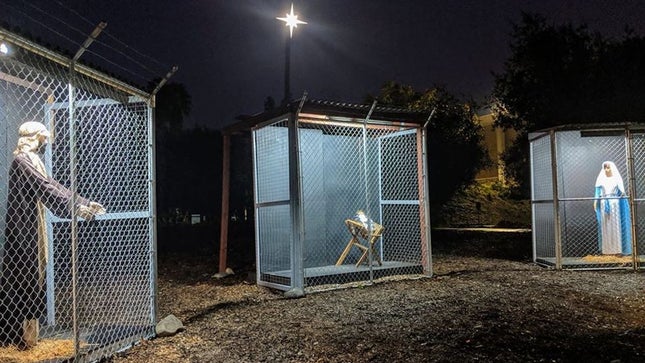
Image source here of emergency shelter for migrants at Blessed Sacrament Church in El Paso, TX.
Posted in Uncategorized
Maybe everybody tips hotel housekeepers, but I didn’t grow up doing that. My parents never taught this to me – maybe because we didn’t stay in hotels much. Now I stay in hotels a lot.
The great Gayraud Wilmore taught my HH to do this and HH taught me, and now I take a few $5 bills to leave for the person who cleans my hotel room with a little note.
It’s important – if you are going to leave a tip – that you do this every morning because – if you wait until the end of your stay – the person who cleaned your room on Day 1 was not necessarily the person who cleaned the room on Day 3.
I share this not because I am a sweet person, but because the world is a hot mess and everybody needs some unexpected joy.
I was in a lovely hotel in Baltimore for four nights last weekend and I did what Dr. Wilmore has taught my family to do. And you would have thought that I’d left each housekeeper keys to a new car.
Little notes were left for me in return with words of deep appreciation. One housekeeper left me bonus bottles of spring water. I was overwhelmed with how little it takes to make someone’s day.
Do most people not tip hotel housekeepers? Really, it’s important. Those people work very hard for little money. Have a happy Thursday.
Posted in Uncategorized
My denomination has no bishops who assign/suggest the new pastor for a congregation. (True confession: sometimes I’d like to be the bishop.)
In Presbyterian Churches, pastors are elected by the elders (for temporary positions) or by the whole congregation (for installed positions) and in between churches hire “interim pastors” – a certain kind of temporary minister who serves between the “permanent ones.”
We have something like a dating app to match churches and congregations. Or sometimes churches and pastors are introduced by mutual friends.
It used to be true that “Interim Pastors” took a week’s worth of training to equip them to help prepare a church for the next pastor.
I believe every church needs a Transitional Pastor – not an Interim Pastor. And the difference is not merely semantic.
All our churches are in transition. In every demographic. In every geographic region. In every denomination and non-denomination. Unless you’ve been living under a rock, you already know that . . .
Fewer people are attending weekly worship. More people are interested in less traditional worship. You know all this.
All our churches are in transition and therefore we need Transitional Pastors and not Interim Pastors.
Here’s the big shift (and once again, thank you Scott Lumsden.)
Healthy “Transitional Pastors” for the 21st Century Church who serve in between “Permanent Pastors” do not prepare the congregation for the new pastor. They prepare the congregation for a new chapter of ministry.
And when “Permanent Pastors” are called, they continue to help the church transition into that new chapter of ministry.
Healthy 21st Century ministry is about the congregation more than the pastor.
Yes – we need faithful, fearless, creative, loving, well-trained pastoral leaders in every congregation. But so much of what determines whether a congregation will thrive or die is based on the congregation not the pastor.
Sometimes church people do not want a new chapter of ministry. And this is sad, because stuck churches die.
And here’s the kicker (again, thank you SL): transitional change is not a tweak. Oh my gosh, I hear church people tell me all the time that things are changing because:
These are tweaks, not cultural changes. Cultural changes are way harder because our culture is so entrenched, we don’t even know what it is. (And that’s the job of the temporary Transitional Pastor: to help us figure out who we are as a congregation right now.)
Transitional ministry is where all of us are right now. To ignore this is a decision to stop following Jesus. (And it’s also really difficult.)
Image of transitioning leaves. They’re pretty, but they actually die before turning green again.
Posted in Uncategorized
I wrote a blog post last week that shared a trend I’ve noticed – for better or worse –
in my denomination. I addressed the post to Pastor Nominating Committees but most comments came from young clergywomen who were stung and I realized that – again, for better or worse – I left out a significant detail.
The post is about age and ageism and it’s also about gender and sexism.
Again – here are the nuggets I’ve noticed regarding trends in calling new pastors:
*I’m 63 and my vision is also urgent, for what it’s worth. If we don’t use these current pivotal days to bring about change right now, we are missing out on current unique opportunities to be The Church.
There is a detail I omitted from my previous post and I share it now to add to the conversation. But first here’s what I’m not saying:
The detail I omitted before is that all the congregations I talked with – who once called a “young pastor” and now want to call a “seasoned pastor” – had called young male pastors. I don’t know exactly why it didn’t work out or was unsatisfactory. Maybe it was because the congregation didn’t expect a male pastor to want to parent his children alongside his spouse to the point of limiting evening and Saturday meetings. Maybe it was because the young male pastor reminded them of a young male pastor they called in 1970 who was indeed available to them 24/7. Maybe it was because they simply called the wrong young male pastors.
So there’s that.
It’s also true that since I wrote that blog post, ten pastors over the age of 64 privately messaged me to say that they had recently been called and installed to new churches. This surprises me. At least one of them had spoken to me about retiring in the next year and yet he was approached by a church that insisted he apply. Almost all of those 64+ year old pastors were not looking for new calls. They were contacted by Pastor Nominating Committees directly.
So what does this all mean?
Speaking as a Mid-Council Leader who is often asked to recommend candidates to Pastor Nominating Committees, I have the privilege and obligation to recommend healthy pastors to congregations in hopes that those congregations will thrive. Sometimes my suggestions go unheeded. Sometimes congregations go with “a safer choice.”
My hope is that The Church will stop choosing what’s “safe” and start choosing what’s faithful. Your next pastor may not look like the majority of members (a shout out to calling Women of Color.) Your next pastor might speak more languages than your members speak – but they speak the language of your church neighbors. Your next pastor might indeed be a 64 year old. Your next pastor might indeed be a 30 year old.
It’s all about God and being faithful. It’s not about us and being fearful. Thoughts?
Posted in Uncategorized
Are you an institutional leader or a movement leader? Where do you fall on the continuum?
William Barber leads a movement. Nancy Pelosi and Mitch McConnell lead an institution. And it’s common wisdom that – today – people are more inspired by joining a movement rather than an institution.
This is some of the good stuff I learned in Baltimore over the weekend with all the Presbytery and Synod Executives and all the Stated Clerks from throughout my denomination – the Presbyterian Church USA. In a nutshell: we need more movement leaders.
Think about your last church committee or board meeting.
Or
This is the difference between institutional and movement leadership.
Institutional Leadership focuses on building up the institution, perfecting bylaws and budgets, and perpetuating the usual way of doing ministry.
Movement Leadership focuses on impact in the community, reaching the most people, and trying new ways of doing ministry.
My hero BW suggested that we try going through a whole meeting in which all questions must be answered starting with this: “Because Jesus . . . ”
People of every age want to make a difference. We want to serve and bless others. We want to be a part of a movement that believes in resurrection and healing and justice.
21st Century Churches are craving movement leaders. (Or if movement leaders scare them, they will stick with institutional leaders and those congregations will slowly die.) Who wants to move towards equality for men and women? Who wants to move towards a world where every child gets a good education? Who wants to move in the direction of peace on the streets, at the borders, in the homes?
I do. And that’s why I love my work. Every day I get to be with people who want to be part of the movement started by Jesus.
The blind receive their sight, the lame walk, the lepers are cleansed, the deaf hear, the dead are raised, and the poor have good news brought to them.
This is how Jesus expects us to lead. I’m in.
Posted in Uncategorized
I’m grateful for the heartfelt comments about yesterday’s post. Some comments were basically about call.
The thought that professional ministry is now a “job” rather than a “call” is painful because it presumes that issues like “climbing the professional ladder” and “seeking a church that can pay more” would be expected. Actually, by God’s Spirit, some pastors are called to small congregations who can barely pay a minimum salary. Some are called to larger churches in poor communities. They will never earn the salary of a rich Big Steeple church pastor. And this is not fair.
It’s also true that when the congregation expects their pastor to sacrifice family time it’s painful. As I wrote in a Facebook comment yesterday:
My biggest regrets in parish ministry have been those times when I chose my congregation over my family.
Our calls are indeed “work.” And it’s good to balance church expectations with family expectations. The more children the pastors have, the more parenting events they will either 1) miss or 2) attend at the risk of hearing punishing comments from parishioners about “taking too much time off.”
It’s not called Tug of War for nothing.
Someone asked yesterday how to change this culture, and it’s basically about love and respect. If I love my people as their pastor, my hope is that they will respect my need to spend time with my family. (Note: for single pastors, you too need to spend time with your family of origin/chosen family.)
So – yes, professional ministers* are called and not merely hired for a job. And also I ask you who are church members:
What family event would you be willing to miss for your job?
And can we be the kind of church family that encourages our pastoral leaders to take at least one day off a week, all their vacation time, and all their study leave time?
Healthy Pastors = Healthy Congregations.
* I use “professional minister” not to emphasize professionalism but to distinguish between Ministers of the Word and Sacrament and ministers who are The Baptized, called to the priesthood of all believers.
Posted in Uncategorized
Age is just a number, and yet many pastors slow down after serving in professional ministry for 30+ years. We are tired . . . unless we find these 21st Century ministry shifts to be exciting and gratifying, and we are committed to un-learning much of what we learned in seminary back in the 1970s -1990s.
Even a 30 year old pastor can offer tired leadership and a 60+ year old pastor can offer energized leadership. It just depends. I’m talking about generalities here.
I wrote this post five years ago and unfortunately it hurt the feelings of some of my 60-something colleagues. Some called it an example of age-ism.
As you read today’s post you might accuse me of being unfair to pastors under 40. But here goes . . .
As I talk with leaders all over the country – mostly in my own denomination – I’m seeing an interesting trend: some congregations who have called “young pastors” have regretted it.
[Please note: This doesn’t mean that all young pastors are ineffective. It doesn’t mean that all churches you’ve called young pastor are dissatisfied. It means that congregations and the youngest generation of pastors often have different expectations for ministerial leadership.]
Over the past 10 years or so, most of the congregations I’ve worked with have sought out pastors in their 30s or early forties to be their solo pastor/senior pastor in hopes that a young leader will attract other young people with young kids. Here is what they have found (and again, these are generalizations):
Although members of Gen X and Gen Y have been patiently waiting for Baby Boomers to retire, I’m seeing Pastor Nominating Committees look for seasoned pastors who know how to shift the culture of traditional churches. Those pastors look like the older generation of members, and yet they have 21st Century Ministry chops.
I believe that the most effective professional ministers of any age have these things:
Especially for those churches whose pastors are now retiring at the age of 70-something after serving for multiple decades, it might seem tempting to call a 32 year old pastor next. Chances are, though, that the resulting jolt might too dramatic for that pastor to be successful – no matter how gifted they are.
I suggest that after a long term pastorate with a retiring pastor, some congregations seek out seasoned pastors with energy who know how to lead the church into 21st Century ministry. Maybe those leaders are 40-something and maybe they are 60-something. It totally depends on who that pastor is.
Interesting enough, I’ve heard of several congregations over the past year who have called and installed 65 year old pastors, ostensibly five years from retirement. Hmm. That could work for several reasons . . . and it could be a longish buffer between the old way of being the church and a new way of being the church which will prime the congregation for calling a 30 or 40-something pastor in five years.
Would love your comments, even if this post makes you angry.
Image source here.
Posted in Uncategorized