
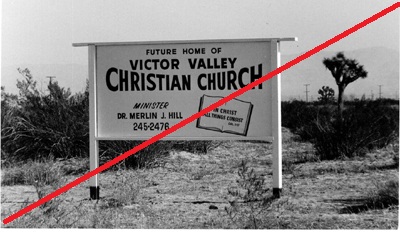
 No, this is not a post about 9-11, although that post might be written later this week. This is about the New Church Plants of the 21st Century and what – imho – will most likely never happen again.
It used to be true that groups of Presbyterians or Episcopalians or Lutherans or whomever found themselves in a growing community without their flavor of church (think post-war Washington, DC in the late 1940s.) Maybe a group of friends threw together a Vacation Bible school one summer because there wasn’t one within walking distance of their apartment or new split level home, and they had so much fun that they decided to form a new church. (Actually, I used to serve that church.)
Or maybe an established church in the neighborhood was so overwhelmed with new members (Baby Boomers everywhere) that they planted a new church themselves just a mile away. You couldn’t have too many churches in the same zip code.
Later it was true that – as new housing developments sprang up in what were once fields out in the country – dioceses and presbyteries and conferences and associations recognized that those new burbs would need churches and so they parachute-dropped a charismatic pastor into that new neighborhood and a new congregation was soon established, and it grew and grew.
As recently as ten, fifteen, twenty years ago, this model still worked. At least in some parts of the country, churches were planted in new neighborhoods and they thrived under strong leadership. Yes, some attempts to starts new congregations faltered. In fact most New Church Starts are not successful. But occasionally, one catches a spark and flourishes.
In many areas – as we all know – megachurches sprang up in the past 20 years, often first meeting in a gifted teacher’s living room and eventually needing a massive warehouse or abandoned shopping mall to accomodate the hundreds and then thousands of people pouring into worship services.
I’m being ridiculously simplistic and over-generalizing here, but my point is this: Those Days Are Over For The Institutional Church. Sure, there could be a new megachurch or two popping up somewhere in 2015. And this is not to say that many established churches, founded in 1950 or 1970 or even 1870 will not continue to thrive and serve in extraordinary ways. But the days of multiple new churches in one neighborhood are over. The days of dropping a fresh faced pastor into a new condo development and establishing a sustainable church replete with a shiny new building in less than 5 years are over.
Again, please hear me out. Congregations that are already established can and will continue to do ministry well in their neighborhoods IF they are missional communities committed to adaptive change. But the majority of new spiritual congregations will look more like Broad Street Ministries in Philadelphia or Wicker Park Grace in Chicago. (Sorry but the WordPress hyperlink is on the fritz.) Those congregations are fluid and open. Membership stats are loose and worship is marked by art (often led by a curator rather than a preacher) and conversation (rather than a sermon.) In Holy Grounds Alexandria (again I can’t hyperlink) we called it grappling.
This may be painful for those of us who love membership rolls to accept but searching millennial generations are not going to join First Church on the Hill and sign up for the mission committee. Sure, there will be young adults who grew up singing from hymnbooks who will seek out a church like the one they knew and loved as children, but even those brothers and sisters in Christ will want something more emergent. Traditional in worship style perhaps but emergent in culture.
How do we make this shift in our thinking and our planning? Baby steps. While continuing to serve traditional congregations, we encourage the creation of missional communities that meet in nontraditional spaces: art galleries, bars, coffee shops, diners, movie theatres, parks. We’ve already seen them out there if we’ve been paying attention.
This is the future of new church developments if you ask me.

 A Church for Starving Artists
I think that’s a realistic assessment, Jan. Two bits of wondering, though:
Is this just true for the oldline denoms, or does it also work for the new corporate-model institutions of nondenominational ministry?
Does this speak to the evolving demographic realities of our culture, particularly in recent immigrant communities?
LikeLike
Non denominational corporate models seem to have plateaued in many cases and they are facing some of the same issues as the large denominational congregations – from what I’ve read. Immigrant communities often struggle when their participants live in a large geographic region (but it’s the only Urdu speaking church, for example, in a large radius.) I believe there will be some serious diversity in what congregations look like. They newest congregations simply won’t all look like traditional churches with buildings, etc.
LikeLike
I’ve always wanted to ask, Jan, about the tension between a community without membership (e.g. Holy Grounds) and the richness of being part of a larger connected community. In the case of a local community connected to a connectional Reformed tradition (PCUSA is what I’m talking about), but having an embedded community without membership, like Holy Grounds, the polity of the larger community says those non-members can’t have a formal leadership role (i.e. Ruling Elders). Where did you go with that tension while you were at your former congregation?
LikeLike
Jo Ann – Some of the Holy Grounders were members but most were not and did not self-identify as Presbyterian. Nevertheless they were leaders. They shared responsibilities. They sometimes led the discussion. They certainly assisted with hospitality, set up, connecting with new people, etc. Membership per se did not make them feel connected. Relationships made them connected. They knew that they had the support of the elders, generally, and so there wasn’t a sense of needing to serve on Session in order to “rule.” (The ruling elders already got it in terms of the DNA of HG.) One thing I will also add is that the HGers were among the most generous givers financially and with their time/talent. The transience of the group often meant that giving was not an annual commitment, but it was regular for as long as they were part of HG.
Now about the tension – and I’m rambling here. The honest truth is that there are those in the “larger connected community” of official members that were not connected at all except on paper. There were official members whose theology was Reformed and also not-so-Reformed. There were official members who were never very committed in terms of giving time and treasure. The millennial generation may not be into joining officially (and that is a generalization) but this doesn’t mean they aren’t committed to each other, to the community, to the neighborhood, to God. They just might not be committed to the church as an institution.
LikeLike
PS to Jo Ann – Thanks for asking that question. It’s a good one.
LikeLike
I do get all that, Jan. But really, what’s the difference between barring gay people from ordained leadership, and barring people who are, from one perspective, pathologically unable to be members? As long as we have the system we have, non-members are not able to take on some roles. Obviously, the solution isn’t to try to change their minds, but to change the system. What might that look like for Presbyterians?
LikeLike
I believe that if they (those who haven’t joined officially) really wanted to join in orde to be eligible to serve, they would. It’s not a pathological thing; it’s just a basic choice. I’m not sure about the comparison to LGBT leaders. But again, thanks for the question.
LikeLike
Here is the link to the Presbytery of Chicago Worshipping Fellowships Policy. Some of you wanted it:
Click to access Worshipping-Fellowships_2011.pdf
LikeLike