
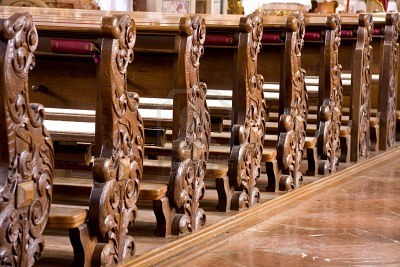
 A colleague was telling me that – since their sanctuary exchanged their wooden pews for moveable chairs – there’s more moving around in worship. It’s almost as if people felt invisibly chained to the straight-backed, sturdy benches of a traditional worship space. Maybe we are thinking that because the pews are immovable, we are too.
A well-know Emerging Church leader tells the story of talking with a church lady about the possibly of moving the pews in her church sanctuary and she said, “Unfortunately, the pews can’t move.” He immediately took a screwdriver out of his pocket, unscrewed the pew from the floor, and said, “Sure they can.”
Some people worship sitting on pews. Others worship sitting in chairs. And still others worship sitting on sofas. (We can also worship walking around, bending over a child or a garden, lying beside a loved one but that’s for a different post.)
I’m convinced that one of the most soul-sucking misconceptions of the formerly mainline church in the U.S. is the notion that there is only one way to worship. For example, I filled in one Christmas Eve for a church whose pastor was away and – as I officiated over communion – the communion servers looked terrified. Their backs were to the congregation during The Words of Institution and so I could see their pained facial expressions. After worship, I asked if they were okay, and they told me that they’d been afraid I would be angry with them for not standing where they usual stood for communion in that sanctuary. They had accomodated me and where I was standing, which was not where their pastor always stood for communion.
I was the one unfamiliar with their customs. I was the one “standing in the wrong place.” I was the one who was a guest for Christmas Eve. But they were afraid I would be angry – as if there was one and only one way to do communion.
How in the world did we get this way? Is it really more worshipful to sit in rows, facing forward staring at the backs of people’s heads, and not moving until the final “Amen”? In other (growing) churches throughout the world, people come and go during worship, folks move around. They might even dance. Our issues involve more than being the infamous “frozen chosen.” We have a way of being the worshipping church that shuts down spontaneity – even if that spontaneity involves getting up to check on a crying child or getting a cup of water.
As a person who grew up sitting in church pews and rather enjoying it, we need to remember that the first gathering places for followers of Jesus had no pews. It will be interesting to see how long it takes for us to evolve away from them for good.

 A Church for Starving Artists
When our renovated sanctuary is open in January there will be only chairs. No pews. One fellow, who was clearly unhappy with this decision, said “It won’t be like church!” I said “Is that a good thing or a bad thing? And have you actually been to congregations that have chairs, for example, the one twenty minutes from us?” To the first question the answer was obvious, to the second he said “no!”
LikeLike
Providence–while not using this exact language, I am questioning why we sit the way the we do in worship in tomorrow’s sermon–an illustration of nurturing community so we can be ones who feed the hungry, give drink to the thirsty, etc.
LikeLike
I think this post really speaks to the concept of people’s love of orthopraxis over belief (sorry for the $.10 word; I’m still in school mode). It’s a lot easier for people to become attached and, more importantly, devoted to doing things a particular way because in familiarity we find comfort. Unfortunately, that can lead to rigidity when change needs to happen. I suspect there are many people out there who truly believe that we cannot worship “properly” without pews, or standing in the correct place during communion, or even playing non-liturgical music during a service (I have personally witnessed an organist almost suffer an aneurism over the suggestion of playing “Here Comes the Bride” as the bridal processional for a wedding).
It is my sincere hope that the my brothers and sisters in Christ who hold this view will at least become more tolerant or accepting of the idea that the sacred can be found in many unconventional places, and people can experience the Divine even while sitting on a comfortable chair, drinking coffee and discussing “Take This Bread”.
Thank you for the post Jan. As always, I enjoy your insight.
LikeLike
You are dogmatic when it comes to removing pews. In addition it seems to be one of your favorite topics. What did a lowly little pew ever do to you?
LikeLike
Hi Scott. Pews are okay. But they aren’t required to worship God.
LikeLike
Required? No, but think how many advantages they provide:
1. You can put kneelers on the back of them so that people can kneel when they pray, which many people like to do. Don’t we want to give people the option to pray on their knees?
2. Chairs will get moved around, so someone will have to move them back (more work for someone).
3. Chairs wear out faster than pews so they have to be inspected and replaced more often (more work, more expense)
4. If a chair becomes wobbly or cracked, as they often do, it could collapse and cause an injury (more liability).
5. Because pews are sturdy parents with kids don’t have to keep one eye on their kids so much to see if they leaning back on their chairs, etc. since climbing all over pews won’t cause them to tip (less distraction from worship for parents, less liability and injury).
6. At least when the church is full, pews force people to sit next to others they might now know; with free standing chairs people will tend to draw their chairs into little clusters with their family or friends (more community)
7. Pews are communal, instead of each person having their own individualistic seat, each person claims some small spot on a larger bench, which they will have to adjust as more people join the pew (less individualistic).
8. You have the slots on the back of the pews of each row to put hymn books and other media so they stay where they are needed (less messy, more convenient).
9. Pews have a nice ordered linearity about them that respects the aesthetics of the church and gives a concomitant sense of order to the experience of worship — we fit ourselves to the pews rather than just having our own chair that we can move about, lean back on, etc. There is a feeling of solidity and permanence to the pews that should tell us something about our faith.
10. Pews can be quite beautiful (like the ones in your photo). When was the last time you saw a comparably beautiful chair fit for use by a congregant in a church?
The advantages of taking pews out? Still haven’t heard a single good argument for it …
“First they came for the pews, and I said nothing because I was looking forward to praying in a barcalounger” … No, I don’t want to say that when I meet my Maker.
LikeLike
Pews are confining, hard, rigid and uncomfortable. People tend to squeeze in pushing people together. They don’t allow for communication, so people whisper if they speak at all.
My first experience sitting in ‘chairs’ was liberating. I felt free to enjoy the worship environment and felt more connection with others whom I could see more clearly, rather than feeling I was in a confessional box. I was surprisingly comfortable not anxious to get away.
Going from pews to chairs is revolutionary. If you mind the change it might just be your need for enduring familiarity.
My church had beautiful pews with doors. The look is engrained in my psychic as what church was growing up, but with age I groan at the thought of them.
LikeLike