
HH and I sat with a beloved parishioner in her apartment many years ago as she was preparing to move into an assisted living facility in another state. She had once lived in a spacious custom built home with a spectacular backyard large enough to host the entire congregation. “This is what my life has become,” she said, surrounded by boxes. “I can pack my whole life into just a few boxes.” Clearly she didn’t have dementia. She knew she was saying goodbye to her former life.
HH and I have now moved four times in our marriage and with each move I have increasingly donated or tossed more possessions. Our current home is a 1031 square foot apartment with dramatically less closet space than we had in Charlotte.
I am the heartless one. “Who needs six pie plates?” But I live with someone who has a memory of every pie plate.
(That’s an exaggeration, but not by much.)
This post is about two things: saying goodbye to our stuff and saying goodbye to institutions we’ve loved.
About the stuff: Dr. Yolanda Pierce says that the difference between treasures and trash is that treasures have a story. Those pieces of broken glass might look like trash, until we realize that they came from the stained glass windows of the 16th Street Baptist Church in Birmingham, Alabama the day white terrorists set off a bomb that killed four little girls. They are forever treasured, now displayed in the Museum of African American History and Culture in Our Nation’s Capital. But the broken Coke bottle from a family reunion in 1982 probably doesn’t need to be saved.
It hurts to give away items with a story. Even though the clock is broken, we remember who gave us the clock. Even though Grandpa has been dead for 40 years, it hurts to throw away his moth eaten brown sweater because we remember when he wore it. If the sweater is in good shape, someone else could wear it (i.e. give it away.) If the clock cannot be repaired, nobody will need it (i.e. throw it away.) Note: if you don’t have the heart to do this kind of gleaning yourself, invite someone like me to come over.
I’ve noticed that we lie to old people moving into smaller spaces. “Sure, we’ll donate this mini-fridge” we tell them, but then it goes into the dumpster. But they can rest easy believing someone will use it in the future.
We all know that saying goodbye to our stuff is about grief for times that have passed. How wonderful that we have those memories though: when we won the trophy, spread the tablecloth, read the book in high school. If we are lucky, the memories remain clear and we can thank God.
About the institutions: I am in a never-ending furor these days about institutions that I and tens of thousands of others have loved and appreciated in Our Nation’s Capital that are being defaced and/or torn down for no good reason. I remember our young children’s faces when Tinklebell flew over the stage at The Kennedy Center. I remember getting everybody up early to see the cherry blossoms before the crowds every spring, and telling our children that they were a gift from Japan. Word has it that on this very day – September 4 in the year of our LORD 2026 – a team of people are examining the roundabout between The Lincoln Memorial and Arlington National Cemetery in preparation for erecting a massive arch that only one person seems to want. It makes me feel sick.
I’ve also known church buildings that were once the site of weddings and baptisms and funerals being torn down after decades of unaddressed maintenance issues. Money pits that haven’t had proper heating for years get bulldozed for affordable housing. Or the little church in the country with less than ten members, now worshipping in a tiny classroom because the sanctuary roof leaks so badly that the walls are covered in mold. And because of the location, nobody buys the property and the building deteriorates until it collapses along with all the memories.
We all know that saying goodbye to institutions is about grief for times that have passed. It makes us angry when it didn’t have to happen. Different decisions in the past could have opened possibilities for a different future. Or – in times of war or political narcissism – we rage against unnecessary violence. Still we thank God for what was.
I have no easy answers about saying goodbye to things. Usually, it’s not about the things; it’s about the people connected with the things. I have a good cry (a really ugly one) and then I toss the box of love letters between my parents. I don’t need 50 of them. I only need one, and that single love letter will one day be tossed or lost. And then I thank God for my parents and friends who have passed and children who have grown up. This is life. Being thankful helps.
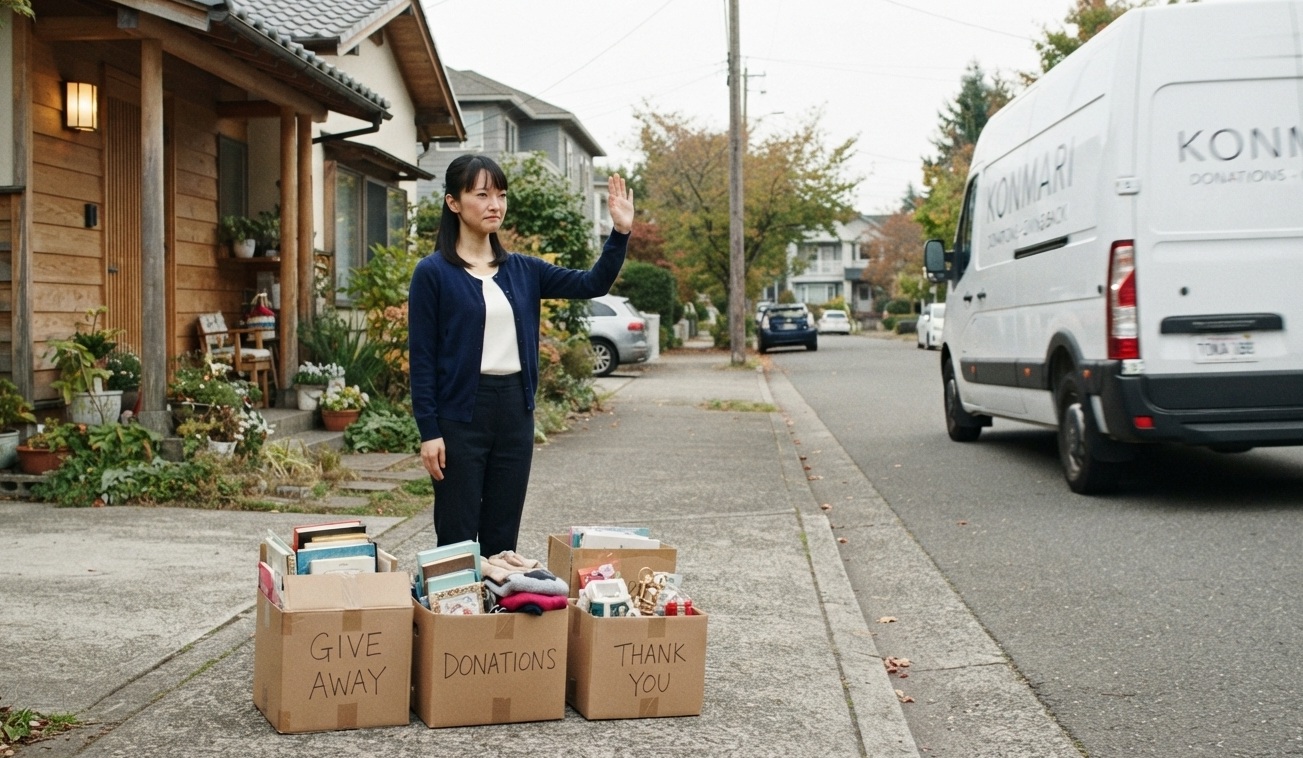
AI image of Marie Kondo being sad to say goodbye to her stuff.


Excellent article! Carol Davis in Houston, Texas
LikeLike
as I spend the next year culling and downsizing, I face the very difficult decisions of what to keep. More than just memories, the hard question of will I ever use this again? Facing reality of aging. And possibly making room for someone else’s life and their memories. Dumpster behind, I’ll face the future with new hope and new memories to cherish.
LikeLiked by 1 person
When dissoluition is imminent, and it is possible, it’s important to talk about a congregation’s “legacy.”
I recently had the honor of moderating the session of a small church that had a proud history, but had dwindled to only about seven (faithful) members. What it did have was a needed and effective food pantry, the only one in that part of the county.
Building maintainence hadn’t happened in years. The manse was sold — finally — which brought in some cash, but even so it wasn’t enough to sustain the congregation for more than about three years. It was at that point that I started periodically asking what the congregation wanted its legacy to be. I tried to get their attention focused on being able to have some money left to keep the food pantry going. I frequently promised to do whatever i could do to ensure that food pantry would continue somehow, somewhere in the neighborhood, even while knowing that I other than being a banging gong, I wouldn’t be in a position to make it happen.
And then God stepped in. Through several circumstances that occurred — including unfortunately the unexpected death of one of the faithful saints — the session made the still difficult decision to request dissolution.
The property was indeed purchased by a company with some specific needs of what the building offered, and it agreed to allow the food pantry to continue to operate at its current location. A separate 501(c)3 organization was created and a board of directors appointed, which was key since it brought it additional, younger people to keep the ministry going. And the 80+-year-old saintly women who had been keeping things going would still be able to keep at it.
The continuing food pantry now carries on the name and the ministry of the church in the same place. Were there still tears? Yes, of course. But they were tempered by the knowledge that the church’s legacy would be maintained for another 20 years or so.
Thanks be to God.
Grace and peace,
John
LikeLike
Oh boy, did this ever open up a can of worms for me. I am right there with you, or at least close behind.
When Mom had to go into assisted living, we were faced with emptying their three houses in three different states. Her dementia wasn’t severe enough yet for this to be easy. She fought us like a wildcat over never used Christmas plates from Pier One to unopened, still in the bag comforters from Carson’s etc. We had no choice: the sale of those homes would fund her care. Thank God there were 3 of them and they sold well. (3 is excessive, but you didn’t know my father. And one of them he inherited from his parents— the house in Tetley DC. I, too, have precious memories of DC, and the malevolent vandalism occurring amounts to desecration. Enraging.)
Anyway, I had already become a repository of sorts for our twin sisters’ things, which is a joy and a burden. But it taught me discipline. While I grieve the removal of reminders of dearly loved people, I understand viscerally that I cannot burden my children with things that do not carry the same associations for them. I work hard to not acquire new/more things, and am slowly winnowing my memory museum artifacts. What stays with me always is a sort of hopeless, bereft melancholy. Such vibrant lives, so much pain and joy and living— now dust, but the dish, the hat, the chair remain. What madness is this? And yet, that is indeed life and living.
Clutching vases and books and candle snuffers won’t bring these people back, but donating them may help others to create their own memories.
Other than that, I got nothing. I regret some of the things I have tossed. I have much more to cull. I am in complete agreement with you and Marie Kondo: honor the service of the object; honor the lives it enriched, but have the legacy of those who have gone before be their lives, not their things.
It’s not easy, but persistence is key. Thank you for such a heartfelt piece. It served as a gentle reminder for me to revisit the basement…
Eleanor
LikeLike
Gah! It’s Tenleytown in DC. Autocorrect strikes again….
LikeLike