
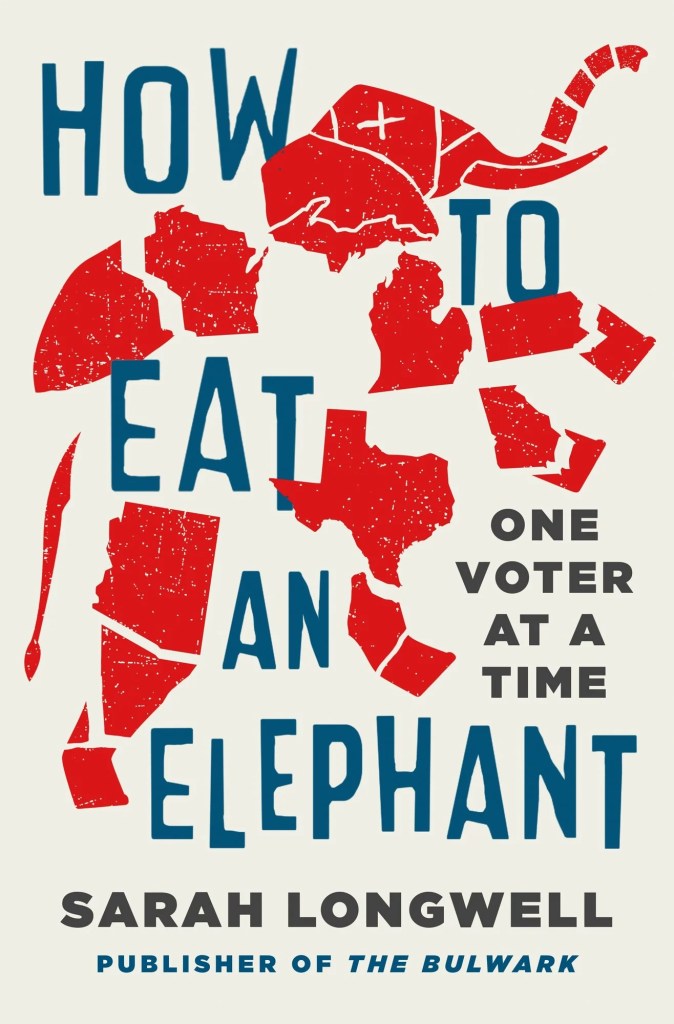
A friend gave me Sarah Longwell’s new book about how we as a divided nation might move forward, especially as elections are closely upon us and then – probably immediately – we’ll be looking at the 2028 elections. I’m already exhausted.
But please read this book.
I encourage you to read it if you feel despair about the politics of these days. And because I might be retired but my brain still filters everything through a Church lens, it’s also informative for the Church.
Sarah Longwell spends most of her time listening to people in political focus groups which must be endlessly fascinating and often frustrating. I’m not sure I could keep my mouth shut when people express views like “the Muslims are trying to bring sharia law to our state.” But she does. She listens to people who love our current President, people who voted for him but do not love him, people who loathe him, and people who don’t really care.
One my favorite comments she makes is this: ‘if it were a drinking game every time focus group participants said they were voting for “the lesser of two evils,” everyone would be dead.’ No matter what your political proclivities might be, our political system is clearly broken. Both political parties are broken.
So . . . how can we who love this country but feel exasperated/infuriated/disgusted/heartbroken over what’s happening in our nation – no matter where we land on the political spectrum – find hope? Sarah has learned things from talking with a wide variety of our neighbors and we – in the Church – could stand to learn these things too and then act upon them.
[Note to Church Book Study Groups: we pride ourselves in staying informed and then we go home feeling smarter but nothing ever changes. Imagine if – with every novel, Bible story, or non-fiction book we read – our behavior changes a tiny bit for the better.]
Lessons from How to Eat an Elephant:
- “The easiest way to build community is to be a community.” We talk about our “Church Family” and yet we are so busy and distracted that we might miss it when people in our chosen family are hurting. We treat prayer lists more like gossipy news sources rather than reaching out with practical support. We ignore certain family members when they annoy us. We give the stink eye to non-conformists. We treat those dealing with certain traumas as if they are contagious. The blessing of being in community is that we are not alone in our traumas, our doubts, our very bad days. (Yes, God is with us but also we are called to be with each other.)
- We need to retire people and programs that are keeping us stuck. I’m not just talking about chronological age here. I know some 40-something pastors who will not let go of the annual church BBQ even though everyone hates doing it. I’m talking about being A Bake Sale Church in an AI Fundraising World. I’m talking about being able to share clearly and succinctly why we do what we do as followers of Jesus. The average age of a pastor in my denomination is 54, and again, chronological age is not the issue. If our leaders are not connected to “modern life, modern challenges, modern communication” God’s people are missing out on opportunities to be the Church.
- “What would you do if your life depended on it?” This is the question one of Sarah Longwell’s mentors asked her when she went to him with a problem. Our calling is urgent but we don’t act like it’s urgent. But people are starving for hope and connection and authenticity. This is the season in Church when we are starting a new program year. For our Jewish neighbors, it’s literally a new year. Do we look upon the upcoming season with dread or disinterest? Or are we excited for the possibilities? What would we be willing to do to protect immigrants, mentor someone seeking guidance, feed people who are having a hard time affording groceries? Political people want to restore democracy. Christian people want to expand the Reign of God. Life is short. We have work to do.
- Are we feeding “The Good Wolf” or “The Bad Wolf:? Sarah shares this Cherokee parable:
One evening, a grandfather sat down with his grandson. “My son,” he said, “Inside us all, there is a battle between two wolves. One is good: It is joy, peace love, hope, serenity, kindness, empathy, generosity, compassion, faith, and truth. The other is evil. It’s is anger, envy, jealousy, sorry, regret, greed, resentment, superiority, arrogance, self-pity, and lies” The grandson thought about it for a minute and then asked. “Which wolf wins?” The grandfather replied, “The one you feed.”
How do we feed The Good Wolf in our spiritual communities? Be The Church. Know why we exist. Be confident in our mission to love God and our neighbor. Worship, pray AND actively serve. Don’t be fake. We are not supposed to be “Christian Influencers” who share our awesome and amazing spiritual lives while – behind the scenes – we yell at the kids and drink too much and depend on a team of therapists and meds to keep it going. Claim who we really are and admit that we need a Savior and each other.
Read Sarah’s book, both for the political tools and for the spiritual connections. And have a great week.


Thank you for the reminder of this book and for the lovely comments. A next-read, for sure
LikeLike
I just put a hold on it at my local library. Since it’s just been published they don’t have copies yet but they are on order.
LikeLike