
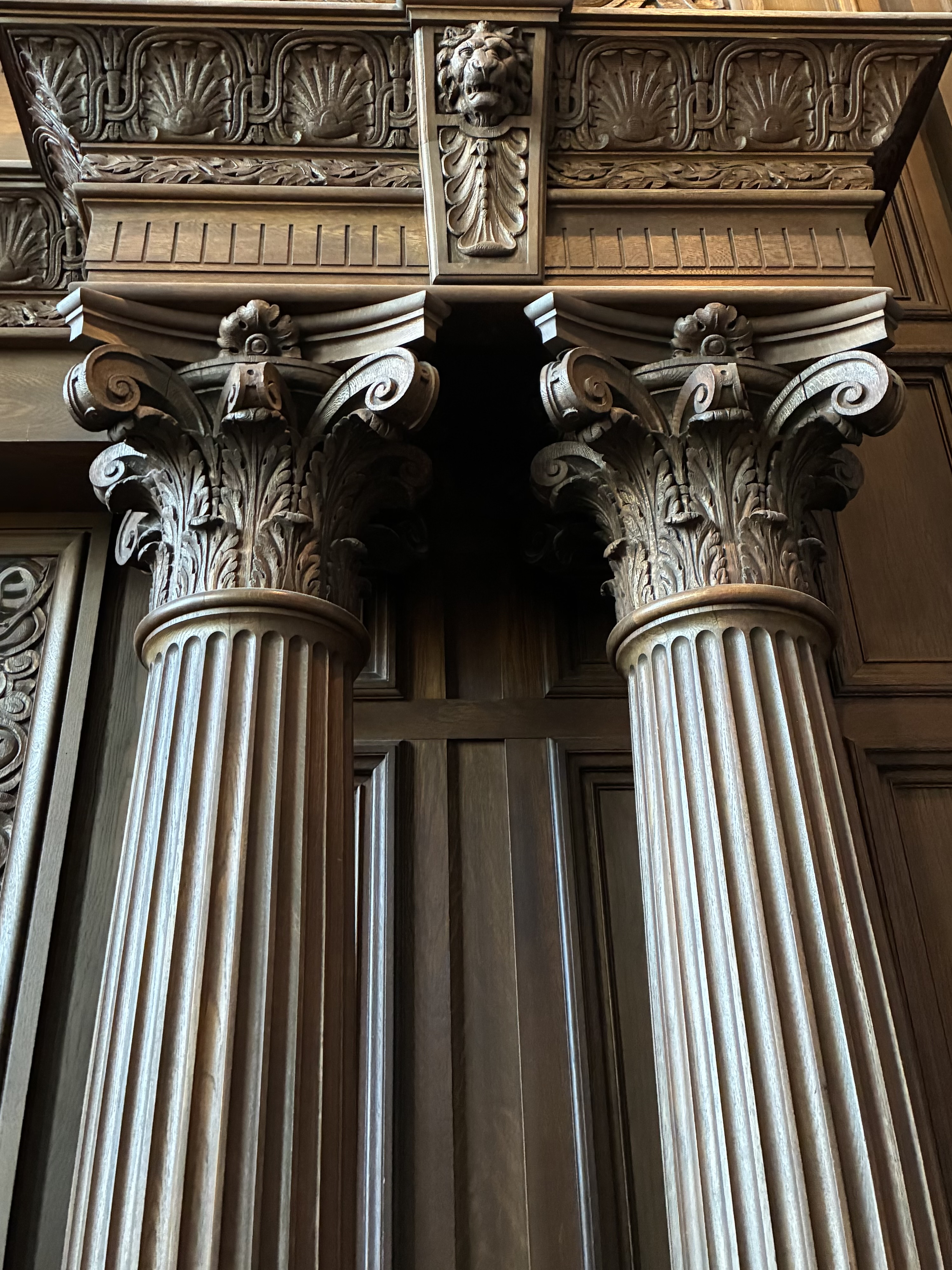
I wonder if the shift from celebrating wedding services in religious sanctuaries to celebrating wedding services in secular spaces was bolstered by the fact that increasingly popular megachurches met in buildings that resembled warehouses. And warehouses do not inspire either spiritual union or romance.
When was the last time your church or synagogue celebrated a wedding in the sanctuary? Couples (including my own double PK children) prefer mountaintops, beaches, public gardens, barns, and “event spaces” to a room also known for having pews, baptismal fonts, pulpits, and beautiful windows. Some of that trend might be practical and/or economical. If you want a band and food at the reception, it’s easier to host a wedding ceremony in the same space as the reception.
Architecture can make a space feel holy. My new favorite coffee shop looks like the dining hall at Hogwarts and it’s tucked away upstairs in the Shakespeare Folger Library. The Quill and Crumb (pictured) also serves beer and wine along with tasty finger foods and everything tastes better with soaring windows and thirty foot high ceilings.
Among my favorite church sanctuaries: The Chapel of the Good Shepherd in the National Cathedral (perfect for a very intimate wedding), Union Church of Pocantico Hills, NY (no sermon necessary; just stare at the Chagall windows for life-changing Bible inspiration) and Second Presbyterian Church in Chicago (where a tour group once came through while I was preaching a sermon. Beware the temptation to worship a building.)
There’s a good article in Christianity Today about the renewed desire for church buildings to look like church buildings – and not just for prettier wedding venues.
“A church of beauty is an invitation, and it belongs to all people.”
Fr. Steven Rice of St. Timothy’s Episcopal in Winston-Salem, North Carolina is quoted here, reminding us of a few things we’ve forgotten:
- Sometimes people wander off the streets in search of a holy place to be and they will notice a building that looks holy and beautiful. I experienced this as a parish pastor several times, especially on Christmas Eve.
- Our holy spaces belong to God, not to the fifth generation members whose ancestors paid for windows or the ladies who control the church kitchen or the pastors who park themselves in that pulpit for decades, refusing to move on.
- A church building communicates what we believe. In my tradition, the pulpit is in the center of the sanctuary to mark the authority of Scripture. Sometimes that pulpit towers above the pews and it’s not because the preacher looks down on the worshippers. It’s (again) to mark that God’s Word is the highest symbol in the room. We place the baptismal font on ground level because it’s available to everyone who claims Christ as Savior. Again – in my tradition, there is no altar; there’s a communion table. The sacrifice has already been made and now we remember it. (Note: even in Reformed Christian buildings, some still call it an altar and the preacher proclaims God’s Word from a pulpit on one side of that “altar.”) But my point is that the sanctuary offers a learning opportunity.
- Holy spaces look, feel, sound, and smell different from other spaces. It’s how we set that space apart. (Another Note: again, my in own tradition, the sanctuary is no holier than my car in that God is everywhere and yet it’s easier to focus on holy things in a sanctuary built for spiritual worship and meditation.)
I read that younger generations in search of meaning increasingly value a break from digital noise. Who doesn’t want authentic relationships (with God and each other) and real life over performance? People in search of life’s purpose – of every generation – want to feel something – and not the cool mist of a fog machine.
When I sat in Mars Hill Church in Grandville, Michigan years ago, Rob Bell’s sermon moved me and made me think. But the worship space had the fluorescent light of a shopping mall (which it once was.) The lights might be softer now, but I would still miss a warmer space.
For congregations out there wondering where all the people are, believe me: there is a hunger for the holy. There is a desire for quiet. The world needs to be soothed, uplifted, held accountable, encouraged. How is our church space helping to fill those needs?
Advent is a time for familiar music and candlelight and greenery – all of which comfort us. It’s one way we can comfort each other in these days. Here is another.


