Author Archives: jledmiston

(Not so) Secret Tunnels

Who doesn’t love them? Secret tunnels – whether we are talking about priest holes or underground passageways – bring out our inner-mystery lover.  The earliest Christians used tunnels to escape from the Romans within cave systems in Antioch.

But tunnels can also conceal nefarious business.

While finishing up a great weekend with God’s people in Colorado, I learned that tunnels run underneath Longmont.  This is so cool, except I was also told that they were used by the KKK to transport people in the 1920s.

I’ve also been reading about the secret tunnels in George Washington’s Philadelphia house which concealed the comings and goings of his slaves.   “Just steps from the Liberty Bell and Independence Hall”  slaves went in and out of his home unseen by Washington’s colleagues.  And in Jefferson news, restoration efforts at Monticello have revealed a once-secret passageway between Mr. Jefferson’s bedroom and the bedroom of Sally Hemings.

Real history includes both the noble and the shameful.  We like to share stories that make us and our people heroic and honorable, but the truth is that each of us also has an inglorious past.

And our churches each have an inglorious past as well.  I don’t know a single congregation of Good Christian People who have made all the right choices when it comes to following Jesus.  We have chosen to serve ourselves instead of serving the poor or weak.  We have excluded people in cruel ways.  And we have secretly (or not so secretly) included KKK members, Nazis, predators, abusers, and bullies in our numbers without holding them accountable.  We have a history of avoiding “unpleasantness” for the sake of keeping peace, even though that “peace” has corroded our souls.

One role of the 21st Century Church is to uncover secrets that continue to enslave us and bring the light that comes with telling the truth about ourselves. Another role is to provide safe haven for those who are terrified for their lives. As our world continues to be confused about serving the most vulnerable around us, the Church will have a bigger role in modeling what compassion looks like.

Secret tunnels are interesting, but what makes them holy versus what makes them horrible is the direction in which they lead.  Do they lead towards freedom and light  (i.e. the underground railroad?) or do they lead towards death (transporting slaves towards further misery?)

Do our own secrets bring life (surprise party!) or death (shame?)

Image of a cave opening in Antakya, Turkey  (ancient Antioch) which allowed early Christians to escape if their worship space was raided in the first century.


This is What Sin Looks Like

God is neither a Republican nor a Democrat.  The Bible is an equal opportunity offender in terms of politics.  But I’m in search of any Christian who can give me a Biblical case for:

  • removing health care for financially insecure human beings
  • deporting people who fear for their lives in their countries of origin
  • opposing abortion while also opposing support for the care of young families
  • failing to welcome the stranger, especially from poor countries.
  • breaking treaties with sovereign nations, including Native American nations
  • assuming that all people of color are dangerous.

Yes, people disagree about politics.  But can someone please explain to me how anyone who claims to follow Jesus can call for and celebrate political actions that target the poor, the sick, the powerless, the minority, the refugee, the terrified, or the desperate?  Anyone?

PS America is not a white nation.

Image source.

If You Ask the Wrong Question You Will Always Get the Wrong Answer

We hear the same burning questions as Church Leaders over and over again: 

These questions make me tired.

What if we asked these instead:

  • How can we bring broken people into the church?
  • How can we shift our culture to care less about what people are wearing and more about how people are connecting with God and each other?
  • What inspires the people in our community and how can we equip them to do what feeds their souls?
  • How can we make it easier for people to contribute their money and time?

Tip of the hat to Laurie Brubaker Davis whose DMin project “Listening to the Moment: Where Young Adults are Finding Church” is where I got the idea for this post.  She is a good person to connect with about young adults and church. She asks good questions.

The best questions these days start with why?

  • Why do we offer Sunday School at 9:30 am?
  • Why do we still do a paper newsletter?
  • Why do we exist as a church?

Honest answers happen only in safe congregations (because it’s important to allow people to respond with “I have no idea.“)

Here are some of my favorite questions to ask church people:

  • Why are you part of this church?
  • What stirs your soul?
  • Who was the first person to tell you about Jesus?
  • If you could write 95 Proposals for today’s Church (we could even call them “theses”) what would they be about?

And here are questions for pastor search committees.  And here are questions for college students.  Don’t make assumptions.  Ask clarifying questions.  And listen well for the answers.


White Savior Barbie


First, a plug:  The White Privilege Conference is an important gathering of educators, religious workers, law enforcement professionals, social workers, and students. Today is the last day of the 18th annual conference and next year’s event will be in Grand Rapids, Michigan April 4-7, 2018.  Mark your calendars.

Secondly, the  workshop on Dismantling White Savior Mentality got me thinking about the times I have seen myself as the perfect person to save the day.  But being White Savior Barbie is a terrible idea.  (Same with White Savior Ken.)

It also got me thinking about the importance of moving from the individualism that’s become our God (“This mission trip will look great on my college application.”) to community engagement as servant leadership. (“How can I connect with people to serve, even if I don’t get any credit for it?“)  In theological terms, community building makes earth as it is in heaven.

This is what we are supposed to be about if we are serious about Jesus.

I believe that my tribe of Christianity has learned a lot through our 200+ years of ministry.  We still have  – as a predominantly White denomination – some White Savior issues.  But we are better at recognizing that the people closest to the problem are closest to the solution.  In other words, we have built relationships with partners all over the world and we trust those partners who tell us what they need.

How can we dismantle a White Savior Mentality?

  • Reconsider who is the expert: The local people on the ground or the not-so-local people who want – probably with the best of intentions – to swoop in and save the day?
  • Trust the locals.  Trust is bolstered when we are not benefitting personally.
  • Build relationships.  Imagine what it’s like for group after group after group to come into a community, take photos of themselves with “the needy” and then leave, never to connect with that community again.  Authentic, ongoing relationships are essential.
  • Ensure that leadership looks like the demographic of people being served.  This also goes for local schools and non-profits.  (Note:  the majority of non-profits serving People of Color in the United States have staffs and boards that are overwhelmingly White.)
  • Share our privilege.
  • Consider a policy of “White Followship.” Listen more.  Talk less.

I remember long ago when a group from a church I served went to Haiti to do good things.  They were working on the second floor of a building in Port Au Prince and – as local children gathered below in the street to wave  – the white church folks decided to throw candy down to those children who clamored for the treats below.  If this image doesn’t make you queasy, consider checking your own White Savior issues.

Christianity is a communal way of life.  Even though we live in a world that promotes individualism, Jesus calls us to something different.  Ministry is not about us.  Mission is not about us.  Service is not about us.  It’s all about making the world a little closer to what God created the world to be.

Image from the White Savior Barbie Instagram account.  Yes, she has an Instragram account.


When I Get to Be the Broken One

Pastors rarely get to be The Broken One. Here are some socially acceptable times when clergy might get to be Broken:

  • Pastor’s parent/spouse/child dies.
  • Pastor acknowledges addiction (but only when he/she is headed into a treatment facility.)
  • Pastor’s house burns down/floods – assuming parishioners’ homes were not also destroyed.  If Pastor’s house was merely one of several homes lost in a disaster, the Pastor still has to be The Strong One.
  • Pastor has cancer or some other life-threatening disease.
  • (Possibly okay) Pastor is going through a separation or divorce.

One of the nourishing things about clergy support groups is that we clergy can be vulnerable without fear of breaking boundaries or confusing roles. My group is called the Preaching Roundtable and we just finished our 18th gathering.

Most of us clergy were trained to be pastoral caregivers and not to be pastoral care receivers.  This means that some of us are in need of pastoral support but we don’t know where to find it and we – for some reason – have not yet found a therapist, coach, mentor, and/or spiritual director, not to mention a team of cohorts.  (Get on that, my friends.)  I need Team Jan.  Your pastor needs a team as well.  And that deep vulnerability support team cannot come from our congregations.

Nevertheless, it’s important for us to show our brokenness.  I am an imperfect mess sometimes and that fact not only makes me feel real;  it is real.

I remember a friend telling me about her church’s interim pastor whom she loved because he spoke about his own disappointments and imperfections in such a way that those in the pews felt like they could do the same.  His sharing made him more approachable.  And – perhaps most importantly – he didn’t make the stories about him nor was he the hero of his stories.  He was sharing the stories in self-deprecating ways to make a theological point related to how God works in human life.

Every caregiver – whether you are clergy or not – needs space to be vulnerable from time to time.  If you have a pastor, you are doing her/him a favor by recognizing this.

I know pastors who suffer great loss (death of a loved one, family catastrophe, health crisis) and the congregation doesn’t want to hear it.  Or at least they don’t want to hear it for long.

Perhaps the congregation will allow the pastor to grieve for a week or so, but then the pastor is supposed to snap out of it.  (Yes, this can be true when people in the general population suffer great loss.  Others hope that the broken will move on  and stop talking about it.  But it’s even more true for spiritual leaders.) The pastor is often our spiritual mother or father. We don’t believe they need much in the self-care department because it’s their job to care for us.

My hope for all clergy is that each of us has a group with whom we can be vulnerable.  Because sometimes we are The Broken Ones.

Image is of a statue in Cormeilles-en-Parisis, Val d’Oise, France.  I thank The Roundtable for being part of Team Jan as I head to my next thing today.  And I thank God for my friend and brother Jeff Krehbiel on whose team many of us have found ourselves, especially over the past five weeks. We remember today that in life and in death, we belong to God.

White Preacher Ideas

I’m pretty good at discerning what God is calling other people to do but I struggle with what God is calling me to do. (I’m only sort of joking.)

As my preaching group meets this week to talk about Preaching While White, I find myself sensing a call to preach a series of sermons about race even though I never get to do this anymore as a person who preaches in a different congregation every weekend. Here’s what I’m thinking and I invite you to take/borrow/steal these ideas.  Or you can invite me to preach several Sundays in a row after June 16, 2018.

[Full disclosure:  I believe that we will continue to have issues about race until we talk about race more/all the time.  White People will continue to have an issue with White Privilege until White People spend each day thinking about what it means to be White.]

Three Sermon Ideas:

  1. Let’s Talk About the Curse of HamGenesis 9:20-27  First of all, how many of us don’t know the story about naked drunk Noah?  And then there’s the evil  notion that Black People are cosmically cursed because of Ham.  Maybe your people never heard this in Sunday School but too many Good Christian People did hear this. And deep in their souls, they still believe it.
  2. When Did You Learn About Japanese Internment?   1 Kings 10:1-13  The Queen of Sheba (a dark-skinned woman) had heard of King Solomon but she didn’t know the whole story. (And we perhaps didn’t know that the QoS was black.) Maybe you’ve heard now about Henrietta Lacks and Katherine Johnson or maybe not. But some of us are angry to learn that these women and their contributions have been hidden.  And in our school books, the ugliest true life stories of our great nation’s history have often been – wait for it – whitewashed.
  3. Aunt Grace is Mistaken Romans 12:3-8  My family members reading this will remember Aunt Grace, a beloved Church Lady and my grandfather’s sister who passed away in 1973.   One Sunday afternoon while I was a child helping Aunt Grace “make a party” (i.e. Sunday afternoon snacks) she leaned down and whispered into my tiny ear, “Don’t ever forget, Jan, that the Edmistons are better than everyone.”  I remember feeling confused and – as soon as I could – I tattled on Aunt Grace to my father.  I told him – my Dad, the Sunday School teacher who had said more than once that ‘God loves everyone no matter what‘ –  what Aunt Grace had whispered into my ear.  And his single-line response was, “Aunt Grace is mistaken.”  The ugly truth is that many of us believe we are better than (or being white is better than, or being male is better than, or being American is better than, or being Christian is better than.)  When Paul wrote that we are connected to each other, he was also saying that we cannot be “greater” than each other in God’s economy. Compared to Jesus, all of us are broken and ridiculous.  Even Aunt Grace.

We who Preach While White have an underused opportunity to speak about race and we have to do this.  We have to do this.

We have to do this.

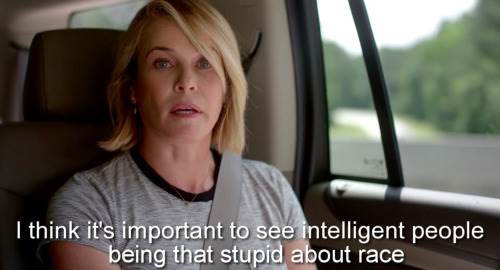
Image of Chelsea Handler whose Netflex series is worth a watch.  Also do yourselves a favor and invite Jessica Vasquez Torres to teach your church group.

Preaching While White

It’s Roundtable Week – the week I meet with my longtime clergywomen’s preaching group to share what’s going on with our lives and our churches. The theme this year involves anti-racism training (and how to preach about it.)  The brilliant Jessica Vasquez Torres will be sharing her wisdom, thanks be to God.  And then I’ll finish the week attending the White Privilege Conference in Kansas City with TBC.  Wish you could be here too.

We who self-identify as Biblical preachers have the power to be prophets, poets, proclaimers, entertainers, teachers, and speechers.  I believe it’s our calling to be equal opportunity offenders in terms of Speaking the Truth in Love to Republicans, Democrats, Libertarians, Independents, and every brand of Jesus Followers including those who don’t really consider themselves to be Jesus Followers.  When I preach, it’s my prayer that:

  1. I don’t waste people’s time.  They made the effort to show up.  The least I can do it proclaim something that points to God.
  2. I stretch people a bit.  If I say nothing that discomfits them a little, I’ve missed an opportunity.
  3. I comfort people a bit.  If I say nothing that brings even a hint of relief, I’ve missed an opportunity.
  4. I say something that pleases God.
  5. I am not boring.

Holy Scripture is pithy and pointed and funny and disturbing.  Preachers get to speak to all of it.

As a person who considers myself white and therefore in the dominant culture, I also have a duty to use the opportunity to point out injustice.  And sometimes that injustice is connected to race.

Maybe those in the pews are white or maybe they include People of Color. But if I fail to note that my pale skin automatically grants me privilege in this world and that I am spending my life trying to follow a brown man whom I believe is the Messiah, I’m failing God’s people.  And if I fail to connect the dots between what Jesus said to 1st Century People with what Jesus is saying to 21st Century People, I am missing the point.

My daily work includes recognizing my personal cluelessness about my own privilege and using my privilege for good as often as possible.  This includes the blessing (and curse?) of Preaching While White.  I have a responsibilitity to understand my power and my limitations.

And how are you dealing with preaching in the skin God gave you?  Do you find you are aware of how your words are impacted by the color of your skin?  I would love your thoughts on this.  Thanks.

Image sources are here and here

Resurrection Idea: Don’t Be Clueless

I am far from being Woke.

The first time I read Waking Up White, I was shocked  to hear – for the first time – that the GI Bill was not made available to the vast majority of men of color. This means that white men got an institutionally-sanctioned leg up:  free college after military service and maybe even free graduate school which meant no student loans to repay which meant you could use your salary to buy a house in a nice neighborhood with good schools and low crime which meant that your own children would reap the benefits of a solid education and a neighbor with safe sidewalks which meant they, too, would get into a good college, which meant . . .

I had no idea.

This is one of the ways that white people have accumulated wealth.  Sure, people worked hard, but being white = enjoying privileges unknown to people who are not considered white. This is how wealth is built and this is how wealth is withheld.  But I was clueless.  And I still am in many ways.

I have grown up assuming my life is the norm, my skin color is the norm, my experience is the norm.  It is not.

One of the things we can do to bring about resurrection in our nation and our world is to become less clueless.  We can notice and appreciate other norms, skin colors, and experiences.  We can become more curious.

In order to kick start curiosity:

  • Read books, blogs, articles and listen to podcasts by People of Color.  These are some of my favorites.  (What are yours?)
  • Pay attention to who is in the room.  And who’s not in the room?
  • Learn about differences:  the difference between Sunni and Shia, the difference between a hijab, a niqab, and a burqa, the difference between a water protector and a pipeline protector, the difference between Sudan and South Sudan, the difference between a sexual orientation and gender identity, the difference between a refugee and an immigrant.

It’s embarrassing how clueless many of us are about people who aren’t like us. And – I hate to admit this, but it’s true – the most clueless among us are the ones who look like me.

Earth will never become “as it is in heaven” until we wake up even though Jesus taught us to pray for this.  And Easter is not just a day; it’s a way of life and we are called to work for resurrection in the image of Christ.

One way to start: be less clueless.

Image from the 1995 movie starring Stacey Dash, Alicia Silverstone,  and Brittany Murphy. 

A Resurrection Message for (Yawn) Tax Day

This is a blog post that most of you will stop reading when you realize it’s about numbers. Terms like “tax code” make many people’s eyes glaze over – especially those of us who prefer the humanities over math.

But we in the Church need to look at numbers.  We follow Jesus who lived for 33 years, rose on the 3rd day, and served under the thumb of an empire that expected Judeans to pay an exorbitant number of taxes which kept them poor.  We are called to live differently if we take Jesus seriously.

Now that we are in Eastertide and resurrection is our message and our mission, please consider listening to this podcast with Jerome McDonald – host of the WBEZ radio program Worldview – and Jeffrey Winters –  Director of the Northwestern University’s Equality, Development and Globalization Studies Program.  It’s both golden and unsettling.

One of the most powerful excerpts:

Jeffrey Winters: “Over the last 30 to 50 years, the story of the United States has basically been one of a massive, almost mind-boggling shift upward in wealth and income. Over the last roughly 30-50 years – the great majority – well, 99%, nearly, of all wealth gains  went to the top 20% and  the biggest part of that went to the top 1%. And then if you narrow it down even more the top 0.1% really gained the most.  And meanwhile, everyone else either shifted downward or was held pretty much stagnant.  A society can sustain that kind of  change in distribution and inequality only so long before it begins to have all kinds of societal effects, some of which are extremely negative.

Jerome McDonnell : The U.S. is the most unequal of all advanced economies.  It does not have a peer.

Jeffrey Winters:  That’s right . . .  Our Wealth Gini Index is 81 which is the highest in the world.

Yikes.  Let me repeat:  The U.S. is the most unequal of all advanced economies.  I’m pretty sure this is a sin.

It feels overwhelming and perhaps even hopeless to consider working towards income equality.  And for many of us with healthy or even generous incomes, we don’t like the idea of sharing.  We worked hard for our big salary . . . 

Right.

Jesus lived and died in the throes of an unequal system that kept the poor powerless and the rich powerful.  He also rose up making the point that love ultimately wins and evil (read: injustice) ultimately loses.

When a billionaire is our President and his cabinet is filled with other millionaires and billionaires, it’s hard to believe that economic resurrection for the poor is possible.  That’s where we come in, moved by a Power that speaks up for the poor and against forces that keep people poor.

Being a follower of Jesus might just involve knowing something about economics and  the tax code – even when it makes our eyes glaze over, for the sake of the Gospel.

Tune in tomorrow for Step One in how to begin to do this.

May You Experience Resurrection

Happy Easter Everyone.