Author Archives: jledmiston

Was Blind But Now I . . .

See  Am still blind.

A colleague and I went to meet with the elders of a church to talk about their future. Ordinarily that was my role in the Presbytery, but this colleague had some exciting insights to share. In a nutshell, it was a disaster.

The elders felt humiliated, dismissed, and blind-sided. They had worked hard to move forward in a new direction with the help of their Committee on Ministry liaison from the Presbytery. It was so bad that the COM liaison quit the next day.

And on that next day when the colleague and I met to debrief, I wondered if we’d attended the same meeting. The colleague thought it went “great!” She had introduced new concepts with role playing and fresh ideas. She offered guidance to help them. At least that’s how she saw it.

What I’d seen was a fiasco that would hurt that congregation’s relationship with the Presbytery for years to come, destroying the goodwill created by their long term COM liaison. My colleague hadn’t read the room. She didn’t realize that those leaders were expecting a different, planned agenda. She didn’t see the “what the hell?” looks on the elders’ faces. She didn’t realize that she hadn’t even introduced herself or explained what she was doing there. She was blind to what was really going on in that meeting and she didn’t even know she was blind.

[Note: I hesitate to share that story because it gives the impression that I always “get it” and I don’t. I’m constantly working on my own vision and I need people to tell me when I’m deceiving myself.]

Adam Grant in Think Again refers to a rare brain disease called Anton’s Syndrome which results in people going blind but they don’t realize they are blind. They literally believe they are seeing what’s being produced inside their brains even though it’s not real. You can read more here.

It’s hard to convince an overly confident leader that what they are seeing is not real.

Adam Grant notes that – while all of us have our blind spots – many of us cannot see our own weaknesses. We all have a little Anton’s Syndrome. “The bad news is that (our blind spots) can leave us blind to our blindness, which gives us false confidence in our judgment and prevents us from rethinking. The good news is that with the right kind of confidence, we can learn to see ourselves more clearly and update our views.” Amen.

  • The longtime pastor who is told by the Personnel Committee that some changes are needed but the pastor is blind to those realities and doesn’t take them seriously.
  • The volunteers who consider themselves church pillars who cannot see that their efforts are actually hurting the congregation.
  • The parishioners who are convinced that “the way we’ve always done it” is the only way but their refusal to embrace rethinking how ministry actually happens in the 21st Century is unwittingly killing their church’s future.

Again: there is good news. If we – as people of faith – are confident that Jesus Christ will always have a Church even if it doesn’t look like previous versions of Church and if we have confidence that the reign of God is upon us, we are free to rethink our understanding of who and what we – the Church – are called to be and do.

Amazing grace how sweet the sound
That saved a wretch like me
I once was lost, but now I’m found
Was blind but now I see.

How to see? Stop being defensive. Pray. Trust colleagues who love us and the Church to tell us the truth.

The Best Leaders I Know

It’s Adam Grant week on this blog.

After reading his latest book Think Again: The Power of Knowing What You Don’t Know, I strongly suggest you devour it if you’re interested in leadership. Whether you serve a congregation, a government agency, an educational institution, or a for-profit organization Grant’s wisdom is extraordinarily helpful.

I’ve been blessed to work with many leaders in my years of professional ministry and even the toxic ones helped me become a better leader myself. God uses everything.

At the risk of offending your pastor/boss/colleague – I hope you will share Grant’s wisdom with leaders in your world. I’ll be paraphrasing his work but these qualities are what to look for if you are calling a new leader, if you are supporting a current leader, or if you aspire to be a good leader yourself:

  • The best leaders do not have to be the smartest people in the room. In fact, they are curious about what they don’t know.
  • The best leaders are not defensive when someone challenges them/suggests they do things differently. In fact, they relish constructive feedback.
  • The best leaders never, ever humiliate their colleagues, nor do they tolerate those who do.
  • The best leaders listen to their peers. If your personnel committee tells you to get a mentor, coach, and/or therapist, do it. If your colleagues tell you to bone up on your preaching, teaching, administrating, or pastoral caregiving, do it – even and especially if you are a seasoned pastor.
  • The best leaders think like scientists. Adam Grant writes that most leaders are either preachers (we have sacred assumptions that cannot be challenged), prosecutors (we attack like lawyers seeking flaws in another’s arguments), or politicians (we want to win over our shareholders/stakeholders in order to win.) Scientists – on the other hand – rethink assumptions, consider the arguments of others, and refuse to lobby for the sake of “winning.” Scientists experiment. They try something and aren’t afraid to fail.
  • The best leaders have interests and skills in other fields beyond their specialty. The best pastors I know are experts in something besides pastoring. Several are BBQ geniuses. Others are tech wizards. And still others roast their own coffee beans, brew their own craft beer, or design their own clothing. Some are excellent dancers and painters.
  • Again, the best leaders are intellectually humble.

Intellectual humility = knowing what we don’t know and Adam Grant shares that he is personally ignorant about “art, financial markets, fashion, chemistry, food, why British accents turn American in songs, and why it’s impossible to tickle yourself.” He also knows quite a lot about lifelong learning and the joy of being wrong. I wouldn’t be surprised if he was also good at rock climbing and Formula One racing trivia.

I am ignorant about Game of Thrones, plumbing, Pokemon, and the Baltic countries. But I’m a very strong navigator on road trips and – as I’ve shared before – I am an award-winning parallel parker. And once I installed a ceiling fan.

Being a leader should feel joyful.

Working with leaders should feel joyful.

If it doesn’t feel that way, please read this book and/or slip a copy on the desk of the not-so-great leader you know.

It’s going to be a generative week.

Forgive Us Our Debts . . .

. . . as we forgive our debtors.

Recent Tweet from the @JesusofNaz3:16 account on Twitter

I was 35 years old when I paid off all my student loans. The year I started college had been a rough one financially for my parents and they regretted that they could not help me with college. I borrowed money for both college and seminary. Tuition and fees were $2,074 annually at the University of North Carolina when I attended, and even with that debt and seminary debt, HH and I had been able to buy a home and have two children with another one on the way by the time we were 35.

Annual tuition and fees at UNC were $31,963 in 2017 according to this source. That’s a bit of a spike from my own college days. They are even higher now and according to this source, college costs double every nine years.

As we all know, education is the way out of poverty. A college education is not the only kind of education, but according to the United States Social Security Administration:

Men with bachelor’s degrees earn approximately $900,000 more in median lifetime earnings than high school graduates. Women with bachelor’s degrees earn $630,000 more.

Men with graduate degrees earn $1.5 million more in median lifetime earnings than high school graduates. Women with graduate degrees earn $1.1 million more.

Inspite of all the statistical facts, helping relieve student debt is a faith issue. Debt forgiveness is a Biblical value in both the Old and New Testaments.

Even so, many people of faith are criticizing Tuesday’s announcement from the White House that students can be forgiven up to $20,000 of their student debt.

  • “I paid off all my debt, so why can’t everyone else?”
  • “My parents worked hard to save up so that I wouldn’t need students loans, so why didn’t all families do that?”
  • “I worked my way through college with multiple jobs, so why didn’t everybody do that?”

Congratulations if you or your family had the generational wealth or circumstances to pull off finishing college and/or graduate without any debt. This doesn’t mean that you are a better/more ambitious/smarter human being. It means that you are lucky/privileged/blessed.

Remember when billionaire Robert Smith announced at the 2019 Morehouse graduation that he was paying all the student debts of that graduating class? A friend of mine’s son – with no college debt – was in that class. I asked her how she felt about working hard to pay her child’s tuition and fees for four years while others were being relieved of their debts and she was thrilled and proud. She responded this way: It’s best for the country as a whole for her son’s classmates to enter the working world with no debt.

Remember when Bank of America subsidiaries (including Countrywide) received a $2,311,102,036 bailout? And CIT Group received $2,330,000,000? And First Bank Financial Corp of Ohio received $72,927,000? And JP Morgan got $3,243,888,392? And Nationstar Mortgage got $1,642,024,635? (I could go on including incentives and bailouts for everybody from Amazon to Walmart.)

Many Americans – especially in the corporate world – believe that these bailouts were good for the country as a whole. Is it not good for the country as a whole for young Americans (and the parents) to get a break so that they can buy homes and support their families and plan for retirement?

What’s best for the country as a whole? This is the big question.

What does it say about our nation if we gladly forgive the debts of financial instiuttions and other corporations, we we don’t forgive the debts of students – many of whom have been paying off that debt for years only to still owe tens of thousands of dollars? #CompoundInterest.

I consider it a sin to offer relief to corporations who earn billions each year while failing to offer relief to individual Americans who are still underwater because of relentless interest payments. Capitalism that only rewards the rich and burdens the poor destroys a healthy and just economy.

If you are a person of faith, I hope you will have mercy upon those who were told

  • A college education is essential,” and
  • We can help you pay for it” – spoken by predatory lenders.

Let each of us celebrate all those who are getting their lives back.

Reframing How We See Ourselves

Therapists often suggest that we reframe the way we’ve always thought about our life situations. Someone might look consider their father to have been neglectful/never home but what if the truth was that Dad worked two jobs to save money for college for his kids so they’d have no college debt? Neglectful Parent is now understood as Committed Parent.

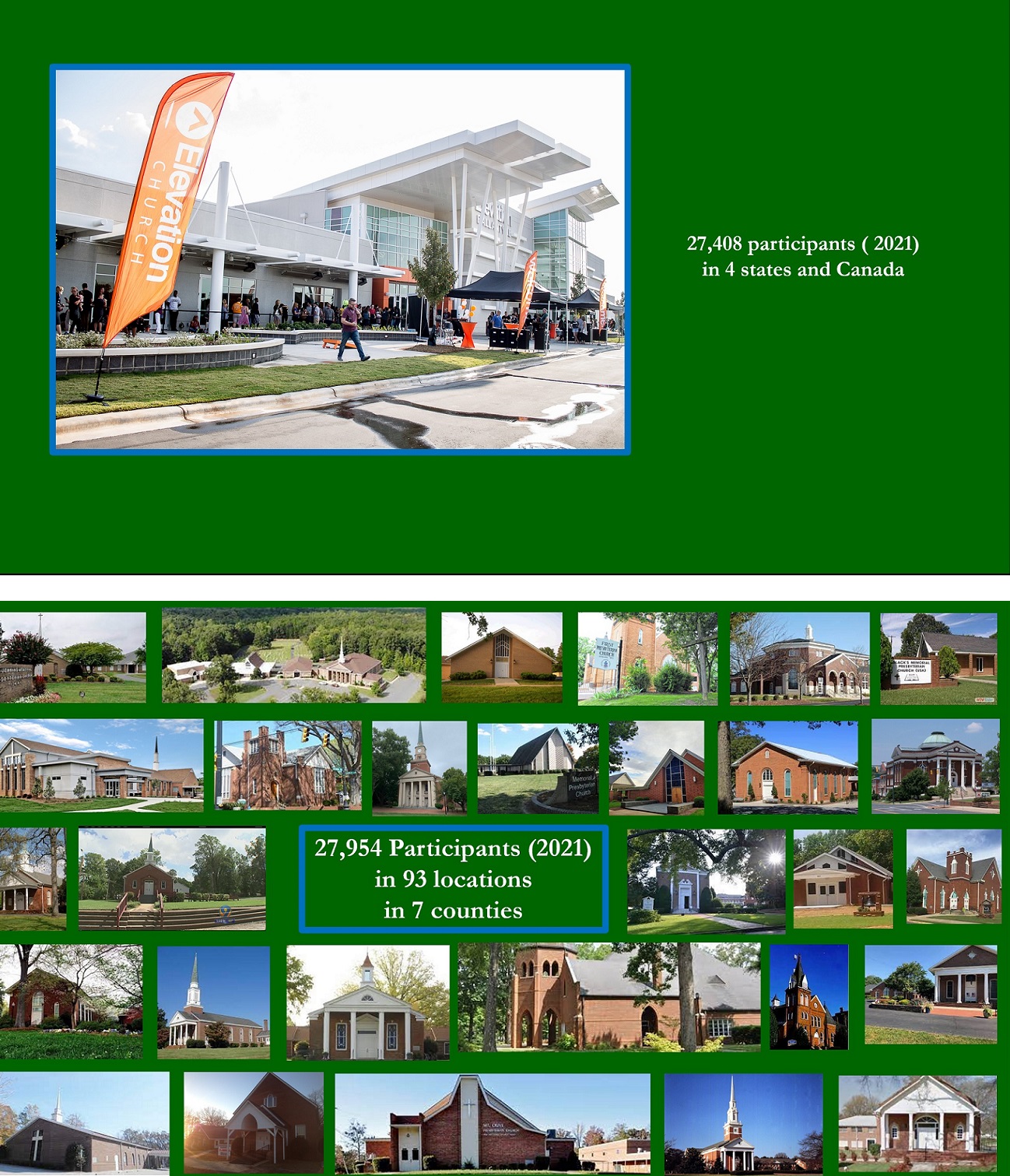
I’ve been thinking about this in terms of the Presbytery I serve. (Sorry for the blurry graphics here.)

A popular megachurch in our area is Elevation (which is affiliated with the Southern Baptist Convention.) In 2021 they reported 27,408 participants in 23 locations in four states and Canada.

In the Presbytery I serve 27,954 participants were reported in 2021 in 93 locations in 7 counties in North Carolina.

Imagine if we reframed ourselves as one megachurch with 93 locations instead of 93 lone ranger congregations with a nominal connection to each other?

That’s it. That’s the post for today: Imagine reframing how we see ourselves.

Another Parent Complaining to the School Board – Please Share This with Yours

The First Day of School in North Texas. Source.

Dear School Board,

I understand that some parents complain to you about the way their children are treated in your school system. They feel unheard. They want more control over their children’s education. They loudly remind you they are taxpayers. Maybe they are entitled and maybe they have legitimate concerns.

I am also a frustrated parent, but my child is not a student. My child is a teacher.

HH and I were not helicopter parents but we were always involved in our children’s public school education. We always volunteered for Teacher Appreciation Week. We attended Parent-Teacher Conferences. We joined the PTA. But when a teacher gave our kids a lower grade than expected, we didn’t threaten anybody. We didn’t call the Principal or the Superintendent. When teachers told us our kids weren’t turning in homework or were spending too much time chatting when they were supposed to be reading, we believed them. Not all of their teachers were stellar. But we trusted them

As the parent of a teacher I’ve heard stories about “those” parents:

  • the ones who demand a passing grade for their child even when that child hasn’t shown up for a single class much less turned in any assignments.
  • the ones who demand an A so their child can be valedictorian when their child’s grades have been solid Bs.

As the parent of a teacher I’ve heard about meaningless “in-service trainings” offered by people who’ve never been educators. I’m aware that the teacher in our family makes suggestions that would save the school system money but instead contractors are hired to do what teachers and students (with teacher supervision) could do for a fraction of the cost. I also know about extra-curricular projects that have been assigned to the teacher in our family without asking for input or paying extra compensation.

You have got to be aware that your school system is hemorrhaging teachers and those leaving are your best educators. They are frustrated, sometimes to the point of leaving professional teaching.

What really bothers me is that – because you are not trusting, appreciating, or valuing your teachers – you are playing into the hands of politicians and white supremacist neighbors trying to dismantle public education in our country. If enough excellent teachers leave, our schools will close and our children will suffer.

I am asking you to fight for your teachers. I’m asking you to consult with them before making decisions that make their lives more difficult. I’m asking you to stop kowtowing to entitled parents. I’m asking you to treasure excellence. (Note: I know about the time when you “treated” your faculty to a single unwrapped tea bag placed in each teacher’s mailbox to “show your appreciation.” Wow.)

The teacher in our family is beloved by students. That teacher keeps up with them when they check in from college. That teacher has initiated fundraisers to help them during their own difficult situations. That teacher has found paid internships for many kids. The teacher in our family says the kids are not the problem

The problem lies with parents who are barely aware of their own children’s lives, administrators whose roles are often unnecessary and/or are filled by people who are not educators, and state leaders who won’t let the teacher in my family talk about systemic racism while sending their own children to private schools that teach the 1619 Project. Come. On.

Happy First Day of School for those starting today. An excellent education is a priceless gift. Please make this happen for our students by listening to their gifted teachers.

Thanks, One Teacher’s Mom

PS In states with no union, there is no protection for teachers who try to do the right thing (like refuse to change a grade for an angry parent.) If they complain, they don’t get fired; they get relegated to teach a subject they aren’t trained to teach until they quit. It’s a shame that we need unions because administrators and elected leaders can’t be relied upon to back them up.

Read This Book

Hope: A User’s Manual by MaryAnn McKibben Dana

“Love is awful. It’s awful. It’s painful. It’s frightening. It makes you doubt yourself, judge yourself, distance yourself from the other people in your life. It makes you selfish. It makes you creepy, makes you obsessed with your hair, makes you cruel, makes you say and do things you never thought you would do. It’s all any of us want, and it’s hell when we get there. So no wonder it’s something we don’t want to do on our own. I was taught if we’re born with love then life is about choosing the right place to put it. People talk about that a lot, feeling right, when it feels right it’s easy. But I’m not sure that’s true. It takes strength to know what’s right. And love isn’t something that weak people do. Being a romantic takes a hell of a lot of hope. I think what they mean is, when you find somebody that you love, it feels like hope.” Wedding homily by The Hot Priest on Fleabag

It might seem strange to recommend a book and begin by quoting another author’s writing. And yet in these days, strange is the not-so-new normal. A Texas dad was forced to wrestle an alligator on his daughter’s first day of school so that she could safely leave the house. Champion Brewery in Virginia has a new beer (new in 2021) that was created to pair with Duke’s Mayonnaise. (Why?) “Wegner’s” and “crudite” are trending on Twitter. Progressive Democrats are pulling for Conservative Republicans.

Along comes MaryAnn’s consistent wisdom in her new book Hope: A User’s Manual. Who among us couldn’t use more hope?

This is not a perky, look-on-the-bright-side book. This is a devotional book for thinking people who want and need to hash things out for the sake of sanity. Imagine starting the fall season with a group of spiritually shaken friends pondering a way forward together in an uncertain world where white nationalism is picking up speed and What We’ve Always Done/Believed is shifting. This is your book.

For those of us who’ve read Moltmann and de la Torres, it’s clarifying. For those of us who feel like “the present is collapsing” around us, it’s encouraging. For those of us who feel stuck, it’s emancipating. For those who feel overwhelmed, it’s permission-giving.

If you’d like to get together for a Zoom group to be blessed by this book together on Wednesday nights in September (5-6 PM Eastern Time) please email me at jan.edmiston@presbyofcharlotte.org. Hope is indeed about love and we need more of it.

3 Questions that Impact Our Whole Lives

What is the point of a life that is nothing more than an endless series of opportunities?

There’s an interesting article here about The Art of Choosing What to Do with Your Life and it remiinds me that the 20s are an especially stressful decade of life. There is – at least among the privileged with many choices – the sense that any wrong choice will result in lifelong regret.

Not true. But it feels true.

We raised our kids to focus on 3 questions that will impact their whole lives:

  • Who (or what) will you worship?
  • Who will you spend your life with?
  • What will you devote your life’s work to?

(Sorry for ending with prepositions.)

Who or what to worship?

I know a lot of self-identifying Christians (and Jews and Muslims) who claim to worship God but their lives seem to say otherwise. They worship money (“financial security is my priority“) or success (“I have to work for that Fortune 50 company/the Big Steeple Church/the impressive non-profit/the top law firm) or parental favor (“my parents expect me to go into business.”) What do we honestly revere? Sometimes we say we revere something holy/eternal but actually we revere our phones/families/way of life. That First Commandment is a bear.

Who to spend my life with?

Choosing the right life partner is an underrated miracle. I know people who married their partners for reasons like these:

  • They were the person I was with when it was time to settle down.
  • They were suitable in my parents’ eyes.
  • They could provide financial security.
  • My kids liked them.
  • I wanted a wedding.
  • They were my best options if I wanted children.

It’s better not to have a spouse/partner than to wish you didn’t have one.

What will be my life’s work?

To follow one’s bliss is not a choice for most of the world. I have a former parishioner who worked in a factory for over 30 years adding the clasps to brassieres. This was not her dream job. She volunteered in her church for at least that long and it gave her joy and meaning. I know others who hate their jobs to the point of bolting just a few years in looking for more respect and autonomy. I have a friend who has earned six figures all her working life, affording her everything from Super Bowl tickets to private education for her children, but she longs to make a broader difference in her life.

Being of service to something or someone beyond ourselves is beyond life-giving. If we’ve made a positive impact doing whatever we do each day whether it’s repairing a refrigerator or shelving books or helping a new driver get their license, we have done well.

I share all this in the context – once again – of Church World. Too many of our congregatios have forgotten who or what we worship, with whom we will partner in ministry and what we are actually doing with ourselves.

Do we worship God or the pastor/building/pet project?

Do we partner with others to support each other or are we in transactional relationships? (You give me A and I’ll give you B.)

Do we primarily serve ourselves or others?

The art of making decisions – if you ask me – involves these three questions, whether we are individuals or congregations. Have a lovely day.

Some White Christians Did the Right Thing. And also . . .

“Growing up in the South was a both/and not an either/or. My story here is told from a young white person’s experience within a mean, segregated culture. My family was very racist. Their job was to brainwash kids into as much hatred and white supremacy as possible.” Filmmaker Carolyn Crowder

[Note: This is a post for my White Siblings in Christ.]

Please watch the trailer here of Carolyn Crowder’s new film about white pastors who did the right thing when they served Southern Presbyterian Churches in the mid-late 20th Century.

Rev. Wallace Alston being interviewed by Carolyn Crowder.

Southern Presbyterians will recognize several of the men interviewed: John Kuykendall, Lee Carroll, Lamar Williamson, Willie Thompson. Their story is so moving and most of us in the Southern Presbyterian Church have not heard it. But I hope you’ll take the opportunity this summer and find a place to watch and discuss it.

If you happen to live in or near Charlotte, NC: The documentary will be shown 8/23 at 6:00 pm at Covenant Presbyterian Church (1000 E. Morehead) in the Fellowship Hall and will include dialogue following with the Director and Co-Director. Other screenings have been scheduled for Auburn, AL, Spartanburg, SC, New Orleans, LA, Dothan, AL, Mobile, AL, Dallas-Fort Worth, TX, McKinney, TX, Chapel Hill, NC, Asheville, NC, Birmingham, AL. Details here.

These are important stories, but I have two important points to reiterate here:

1. Just because a handful of pastors did the right thing in the past, doesn’t excuse us from doing the right thing now or exempt us from doing the right thing in the future. Sometimes when discussing White Supremacy with my White Christian siblings, I’ll hear comments like these:

  • My grandfather served on an all-White jury in 1962 and they found the Black man accused of robbery not guilty.
  • My father built the first community swimming pool for the Blacks.
  • I have Black friends.

Congratulations.

Anecdotes like these gloss over the fact that most all-White juries have found Black defendants guilty, recreational services in minority neighborhoods continue to be substandard, and when was the last time a Person of Color spent the night at your home or ate dinner around your table?

We have a lot of work to do in changing both our awareness of White Supremacy and our civic actions.

2. Doing the right thing can get you killed, kicked out of school, excused from the country club and shunned from the community. (No need to remind you what happened to Jesus.) And yet through the generations there have been people who took their faith seriously enough to defend the vulnerable for the sake of Loving Their Neighbors.

Princess Alice of Battenburg, Leokadia Jaromirska, Raoul Laporterie and Derviš Korkut were all Christians who have been recognized at Yad Vashem for saving Jewish children and adults during the Holocaust. Obviously they risked everything to do the right thing.

Most of us are too afraid of losing friends – much less our lives. Doing the right thing can mean giving up our life for what’s right, but it’s usually more about speaking up when we hear lies and hate. Doing the right thing means ensuring that what we want for our own children is available to all children.

Some say that our nation is on the cusp of another civil war fomented by lies and the demonization of those whose politics differ from our own. A time might come – and surely will – when we will have the opportunity to do the easy thing or the right thing.

If that time comes, I hope we will be as brave as the pastors in this documentary.

A Statement on Christian Nationalism

“You shall have no other gods before me.” Exodus 20:3

People of faith are as susceptible to idolatry as anyone. The bottom line is that God is God and we are not. We are not called to worship the Bible (the Bible is not God), the Church (the Church is not God), the Pastor (the Pastor is not God) or our nation.

We live in a nation of Christians, Jews, Muslims, Sikhs, Buddhists, Bahai, Hindus, and Zororastrians. According to this Pew study, the breakdown of religions in the United States looked something like this in 2017: Christian (70.6%), Jewish (1.9%), Muslim (.9%), Buddhist (.7%), Hindu (.7%) and unaffiliated (22.8%). Again, that was 2017. Pew now reports that only 65% of Americans self-identify as Christian. The numbers of self-professing Christians decreases every year.

Is this why Christian nationalism seems to be on the rise – because there is that whole fear of being replaced by non-Christians, not to mention people of faith – or no faith – who are not white?

You can’t be a serious Christian and a Christian Nationalist. They are incompatible.

By definition “Christian nationalism is the belief that the American nation is defined by Christianity, and that the government should take active steps to keep it that way. Popularly, Christian nationalists assert that America is and must remain a Christian nation—not merely as an observation about American history, but as a prescriptive program for what America must continue to be in the future.” (Christianity Today)

Scholars Andrew Whitehead and Samuel Perry summarize Christian nationalism beliefs with the following statements:

  1. The federal government should declare the United States a Christian nation.
  2. The federal government should advocate Christian values.
  3. The federal government should not enforce the strict separation of church and state.
  4. The federal government should allow religious symbols in public spaces.
  5. The success of the United States is part of God’s plan.
  6. The federal government should allow prayer in public schools.

The belief that the Founding Fathers intended the U.S. to be a Christian nation is a lie.

Christian Nationalists seem to believe that “everyone needs to know their place” and there is – in fact – no place for immigrants, Muslims, LGBTQA+ people, and non-White people. Policies on gun control, police shootings, gender roles, and abortion are based on their own non-negotiable understanding of “Christian values.”

Compare these ideas with what we know about Jesus. Jesus lifted up foreigners as heroes. He healed people of physical and mental brokenness. He engaged in theological conversations with women. And his own band of disciples who were not exactly rabbi material. Jesus said nothing about homosexuality. Jesus challenged those who would conflate Roman rule with the reign of God. Jesus didn’t own a weapon.

There are many reports about the fact that today’s White Christian Nationalists – many of whom are supporters of the former President – have no church affiliation. (Are they Chinos? Christians In Name Only? Actually a lot of us fall into that category.)

We can’t know the teachings of Jesus if we don’t study the teachings of Jesus. There was nothing resembling the message of Jesus among those who broke into the Capitol on January 6, 2021. And I suspect that the killer of four Muslim men in Albuquerque last week had Christian nationalist inclinations just like the killer of nine Black Church people in Charleston and the killer of seven Sikh worshippers in Milwaukee and the killer of 23 Latinos in El Paso and the killer of eleven people in a Pittsburgh synagogue and the killer of ten Black people in Buffalo. White nationalism kills.

We in the Church are called to gird ourselves against those who confuse the message of Jesus and the fear of White Nationalists. We are called to acknowledge and dismantle White Supremacy. We are called to speak the Truth in love.

And if we really want to follow Jesus, we must participate in government (i.e. vote) according to what Jesus actually teaches about money, foreigners, greed, women (Jesus trusted them), lepers, children, healing, and love. The pastoral is political, folks. Jesus was killed for sedition.

And also, there is nothing Christian about Christian Nationalism.

There Is No Teacher Shortage . . .

Actually there are plenty of qualified, experienced teachers. Unfortunately there is a shortage of respect and appropriate compensation, resulting in many teachers leaving the profession. Accoding to this WaPo article:

Experts point to a confluence of factors including pandemic-induced teacher exhaustion, low pay and some educators’ sense that politicians and parents — and sometimes their own school board members — have little respect for their profession amid an escalating educational culture war that has seen many districts and states pass policies and laws restricting what teachers can say about U.S. history, race, racism, gender and sexual orientation, as well as LGBTQ issues.

Teachers don’t enter that profession to get rich. But we are losing committed teachers and it’s our students who will suffer. Our FBC has been teaching high school for 7 years and he loves his students. He gets them paid internships and counsels them about college. What he doesn’t love are parents who threaten him and administrators who don’t listen to him. Maybe he will teach this fall and maybe he won’t.

For what it’s worth, there is also no clergy shortage. Unfortunately there is a shortage of respect and appropriate compensation resulting in many pastors leaving the profession. It’s happening throughout the Church of Jesus Christ.

Pastors don’t enter this profession to get rich. But we are losing committed pastors and it’s our congregations who will suffer. Unfortunately though – unlike in the teaching profession – it’s the congregations who sometimes make it difficult for their pastors to continue. The main issues seem to be:

  • Congregations who can no longer afford a full-time pastor but expect their part-time pastor to work fulltime. It seems like a good deal for the church. It’s unjust for the pastor.
  • Congregations who say “they want to grow” but they truly don’t.
  • Congregations who simply do not treat their pastors (or each other) very well.

Just as gifted professional educators are most concerned with the welfare and development of their students, gifted pastors are most concerned with the spiritual welfare and spiritual development of God’s people.

I’m looking for ways to support our clergy in these unusual times. What can Mid-Councils do to support their pastors? What can congregations do? What can clergy do for themselves?

Would love your comments – if you are a pastor or other church staff member – on what keeps you in active professional ministry? We don’t want to lose you.