Author Archives: jledmiston

Our Bedrock Identity (& What Happens When We’re Confused)

[Note: First and foremost, our hearts are with our friends in Western N.C. and those parts of S.C. TN. and GA. who were similarly hit by Helene. Please consider helping as you are able here.]

How do we identify ourselves first and foremost? Quickly: What’s the first identifier that pops into your head? American? Lutheran? Lawyer? Bob & Betty’s Daughter? Sophie’s Dad? Carpool Mom? Head of Staff? Senior Citizen? Gen X-er?

In working with congregations, especially congregations seeking a new pastor, I regularly talk with church people about how they identify themselves. Some churches self-describe as “small town” or “mission-minded” or “historic.”

Increasingly I am hearing congregations describe themselves in political terms. They are “red” or “blue” or “purple” – although this begs the question: are you reddish purple or bluish purple?

I am very concerned about this. If our fundamental identity as Christians is based on our politics (and not the other way around) then we are confused and confusing followers of Jesus. I received a letter recently criticizing the Presbyterian Church USA for promoting an agenda aligned with the Democratic Party. The evidence noted in the letter was:

  • That we do a land acknowledgement at the beginning of our Presbytery meetings. Our August meeting opened with an acknowledgment that the land on which we meet and worship was originally native land. And – also in August – the Democratic National Convention started with a land acknowledgement. I frankly don’t know why the Democrats did this, but we Presbyterians do it (as recommended by the 223rd General Assembly in 2018) as an act of confession. It is faithful to acknowledge our complicity in hurting the indigenous peoples of our country. One source here.
  • That we remember the history of white supremacy in our Presbytery as we were voting on dispersing funds that come from the sale of church property – especially the property of our historically African American Churches. We did this not because we are politically “woke.” It is faithful to make amends. See Numbers 5:6-7, Leviticus 6:1-7, Ezekiel 33:11, Matthew 5:23-24.
  • That the 2025 Program Calendar published by the PCUSA includes March 31 as Transgender Day of Visibility (which was approved by the 225th General Assembly in June 2024.) Transgender visibility struck the letter writer as being inappropriate for the Church. But – as we acknowledge that the Church includes those who find transgender and nonbinary language troubling – the Church also includes transgender and nonbinary people who are at increased risk of violence. We need to see this and them. In faith, we believe that Jesus died for all the world – including LGBTQA people – that the world might be saved through him.

Jesus also died for MAGA Republicans, Christian Nationalists, the staff of MSNBC and Fox, Benjamin Netanyahu, Ismail Haniyeh, Marjorie Taylor Green, AOC, that guy with the horns on January 6, Ashli Babbit’s Mom, and you and me. It’s incredibly annoying, isn’t it?

Anne Lamott is right:

“You can safely assume you’ve created God in your own image when it turns out that God hates all the same people you do.”

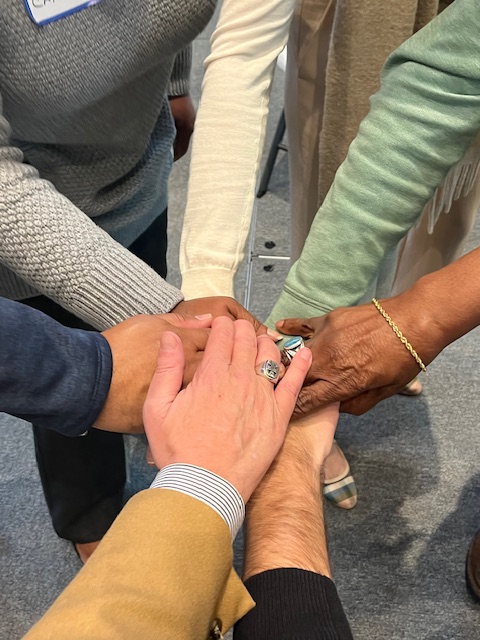
Church: if our bedrock identity is Child of God or Follower of Jesus, we will be more likely to (try to) love as God loves. We might even be able to be a Church in which Democrats and Republicans can sit side by side in sanctuary pews and work together to serve the broken, the invisible, the vulnerable not because we are “tolerant” but because we are trying to figure out the will of God.

Let’s strive to be faithful people who grapple with issues of faith and life. Not a red or a blue or a purple church.

How Do We Help People Let Go of the Straws?

“A drowning man will clutch at straws”

from Thomas More’s Dialogue of Comfort Against Tribulation (1534)

This is a real question: If Church People are clutching at straws – desperately trying to convince themselves and others that their church can survive without energy, money, and spiritual curiosity, how do we – who love these Church People – convince them that it’s okay to let go of the straws?

Some of the straws we clutch:

  • “A new family just moved in down the street. Maybe they will come to our church. And maybe they will join and help us.”
  • “Let’s contact area businesses to see if they will contribute to help repair our roof.”
  • “If we sell some of our property to a developer, maybe those new neighbors will join!”
  • “Let’s print and distribute 500 flyers inviting people to visit our church. I’m sure some will show up!”

We are good at straw clutching. If there is any hope, if there is any possibility that getting that new church sign will help our congregation attract new people, we will try it.

Although grasping at straws won’t help a drowning person, we are in the resurrection business. Do we believe this or not?

As I’ve said to the point of rolling my own eyes, churches addressing what breaks God’s heart in their community in the name of Jesus Christ are healthy, thriving churches. No exceptions. It’s not about church size as much as it’s about a willingness to let go of “what I want, what I believe, what I think” and prayerfully discern what God wants for our ministry.

But when I ask the WBGHINYC Question (what breaks God’s heart in your community?) too many Church People say, “Let me tell you what breaks my heart.” That’s not the question. But that response is why we’ve reached the last straw. When The Church is no longer about what God wants, what God is telling us to be and do – the ministry is already dead.

Resurrection can and will still happen. But it will happen faster if we would simply let go sooner than later.

The Meeting After the Meeting

There’s the prep for the meeting which can involve (and often requires) more effort than the actual meeting. And then there’s the meeting – which goes much better when we’ve prepared.

And then there’s the meeting after the meeting. I find that – almost always – there is a meeting after the meeting. And I’m not talking about the parking lot conversations where people whisper things to each other that they were afraid to say in the meeting.

I’m talking about the follow up plans that were alluded to during the meeting. Or perhaps it could be a meeting about an entirely different thing that everyone in the meeting didn’t need to discuss. Or perhaps it was preparation for the next meeting.

And then there is the very, very essential meeting with whatever calms our nervous system when the meetings are finally over for the day. If we are blessed with privilege, we can take that time for ourselves. And we can offer that time to others.

Friends, be gracious and generous with each other. Meetings are necessary (and please, for the love of God, cancel those which are not necessary.) And cling to those essential meetings with the Holy, with nature, with quiet company that restore our souls.

The Victim Thing

This article about the V-Perspective – as I recently heard it called – is the topic of Lilie Chouliaraki’s new book Wronged: The Weaponization of Victimhood. It resonates with much of what I see in Church World and beyond.

Central to Chouliaraki’s exploration is the distinction she draws between victimhood and vulnerability. She argues that victimhood is not a condition but a claim—that you’re a victim not when something bad happens to you, but when you say, “I am wronged!

In these days of tumultuous ecclesiastical shifts, the work of frustrated pastors and exhausted volunteers sometimes turns into victimhood. Pastors want to spend their time inspiring people, mentoring disciples of Jesus, and reaching out to people who are not currently part of our congregations. But many congregations are more invested in power games and perpetuating an institution that no longer serves God’s purposes. Volunteers are increasingly serving a church that’s closer to closing than anyone wants to admit and they are killing themselves keeping the lights on.

And so we have victims:

  • Pastors who find that the church that called them is not who they said they were feel like victims. And congregants feel like victims when the pastor falls short of their expectations.
  • Volunteers in congregations without pastors can feel like victims when they are picking up all the tasks that (they assume) a pastor would be doing (i.e. unlocking the doors, finding guest preachers, printing worship bulletins, and turning the AC on.) When there are one or two volunteers “doing everything” resentment often builds.

Remember when Christine Blasey Ford testified under oath before the Senate Judiciary Committee concerning an alleged assault involving Brett Kava­naugh? By the end of the hearing, he was the one many considered to be the victim. According to Chouliaraki, those of us with power and privilege can (and have) turned accusations on their heads so that we become the true victim.

Consider church leaders who commit abuses. No matter what actually happened behind closed doors, some will believe that the accuser is the victim and some will believe that the accused is the victim. It’s hard to settle these assumptions.

So . . . the point of this blog post is to invite us to consider our role in disputes in which we have been thinking to ourselves, “I’m the victim here.” Is it possible that – if consider the perspectives of others – we can agree that we are not victims at all?

Favorite example:

The longtime volunteer in a particular congregation who – for decades – has been in charge of:

  • Vacation Bible School
  • The Christmas Pageant
  • The Easter Flowers
  • The Coffee Hour
  • The BBQ Fundraiser

. . . is asked as gently as possible, if they might consider trying some new ideas. Or maybe they would be willing to let a new person step in – maybe by the end of the year? Or maybe they would like to mentor another volunteer to split the responsibility this year?

These words can feel hurtful. “After all these years of helping, I’m being cast aside.” Or would it be possible to think – instead – “If it would help our church re-think the way we’ve always done something, I’m happy to let go.”

Imagine if The Victim Thing was no longer a thing – in churches, in families, in classrooms, in offices. This is a spiritual issue, I believe. Especially for those of us who consider ourselves People Of Faith, it’s not about us, right? We want to transform the world for good in the name of Jesus, right?

Right?

What Pastors Do

In my previous pastoral position, there was a job requirement that all staff members would “be able to lift 20 pounds.” I don’t remember being asked to shlep 20 pounds of anything, but I was ready.

In my role as a pastor, I have done all the usual things (preaching, teaching, administrating, etc.) and I have also:

  • Vacuumed the sanctuary
  • Copied the bulletin
  • Trapped a squirrel in the fellowship hall
  • Driven a goat back to his petting zoo in my minivan (Leviticus 16:21–22)
  • Judged costumes at a Halloween Parade (and was literally bribed to choose a specific witch)
  • Unplugged countless toilets

On this Labor Day weekend, I’ve learned that there is an International Meeting of European Worker Priests comprised of priests whose “tentmaking” involves jobs from aeronautical engineers to ambulance drivers. The pastors I know who support themselves by taking secular work tend to be Uber drivers and barristas, although I do know one pastor/orthodontist.

Most parish pastors who “tent-make” do so being consultants, counselors, chaplains, professors, spiritual directors, or some other parish-adjacent position.

The truth is that seminary rarely trains us for all the jobs that we are asked/expected to do. There are fewer and fewer pastoral positions that involve a specific slice of professional ministry (Associate Pastor for Pastoral Care, Associate Pastor for Children and Families.) Most positions are for solo pastors who often turn on the heat in the winter and unlock the doors on Sunday mornings.

I remember, as an exhausted rural solo pastor in my first call, visiting The Riverside Church in NYC and bursting into tears when I saw that they had ushers whose only job was to welcome people at the doors. They had another set of ushers who collected the morning offering. We opened our own doors in Schaghticoke, New York and we scrambled to find somebody to collect the offering about ten minutes before worship started.

On this weekend when we honor union workers and legislators who gave us weekends and paid vacations, please remember your pastors – especially if they are so “solo” that there is not only not a Christian Educator, but there’s not even a sexton or a financial secretary. These are also the least well-paid pastors, and many only work part-time because that’s all the church can afford to pay.

Note: there is no such thing as a part-time pastor. What are you going to do when someone has a hospital emergency on the same week you’ve already had a funeral and a wedding?

Congregations: think of something creative you might offer to offset the extra hours your part-time pastor is working. Ideas:

  • An elder preaches one Sunday a month. Every month.
  • PT Pastor works the first three weeks of the month, but gets the 4th week off. (This is a great opportunity for church leaders to learn how to visit the sick and pray with people – like the Bible teaches.)
  • Give the pastor free tuition in your church preschool.
  • Loan out your family vacation home (with no expectations that this means you will always get your way in church business decisions.)
  • Never ever interrupt the pastor’s Sabbath, Vacation, or Sabbatical. (Uncle Joe’s funeral can wait until the pastor’s back or you can happily accept the neighboring pastor’s willingness to step in.)

Most pastors I know have fixed copy machines and coffee makers. Many have a disturbing wealth of knowledge about boilers and sump pumps. Most of us love Jesus, and we would rather prepare a sermon than clean out the church fridge. The very least church members can do is ask if you can help clean the fridge. (Thank you.)

Image source.

On This Day – August 28th

My mother was born on this day 91 years ago in a one-story farm house with no running water in Rowan County, North Carolina. There was still an outhouse when I was a child and my great grandmother still lived there. A cousin lives there now and the outhouse is long gone.

This is a holy day and not just for me.

On this day when Mom celebrated her 22nd birthday, Emmett Till was tortured and murdered in a barn in Sunflower County, Mississippi.

On this day when Mom celebrated her 30th birthday, Dr. King preached his I Have a Dream speech at the Lincoln Memorial.

Long after Mom died, Chadwick Boseman died on this day in 2018.

On this day, a dear friend and colleague lost both of his parents decades apart – his mom when he was a child and his dad not so long ago. It comforted me to talk with him this morning.

On the elevator today, I saw a woman wearing a Peace sweatshirt. “Does your shirt stand for world peace or for Peace College?” I asked her. “I don’t know Peace College,” she said, “But you’re right, it does look like a college sweatshirt font.” “My Mom went to Peace College,” I said. “Today she would have been 91 years old.” (Note: I’m that person who brings up morbid factoids.)

Cool,” the woman said. “Let’s call it a Peace College sweatshirt then.” Sometimes people are so kind.

Today is a holy day for me and for many of us. Tomorrow will be someone else’s special day. My sibs and I were trying to imagine what Mom would be like today if she were still alive. She would have 13 grandchildren and 8 great-grandchildren with two more expected soon. Maybe she could still play “Love is a Many Splendored Thing” on the piano by heart. Maybe she would have sewn simple dresses for her granddaughters. Maybe we would all be together today eating SNE’s poundcake.

I have no idea what the afterlife is about, but I love to imagine my mom with all the moms, and Chadwick Boseman with Emmett Till who’s been rejoined with Mamie since 2003, and Dr. King still praying regal words in his deep tenor voice. I love to imagine.

Image of the barn where Emmett Till was tortured and murdered (public domain). This story by Wright Thompson is worth a read.

False Expectations Kill Churches

Or at least they cause deep pain.

[Note: You can always tell when my life is more hectic than usual in that I don’t have time to write a blog post. My last one was written August 8. All is well because Jesus reigns and yet the damage caused by false expectations takes a little time. I write to refuel. Lately I’ve just taken naps.]

I was asked last Sunday, after worshipping with a congregation, if I would choose to return to worship again with that congregation if I had been “a regular visitor” and not someone from the Presbytery staff. It was clear that she wanted me to say “no.” This is a church with a tiny choir and a Commissioned Pastor as their leader (i.e. an elder who has taken seminary coursework but doesn’t have a Master of Divinity.) She wanted me to say “no” – I believe – because she wanted my judgement on their church to be all about the worship hour.

I said I would indeed visit again for these reasons: 1) according to the announcements and bulletin, they are making a difference in their community feeding the hungry, gathering for spiritual nurture, partnering with other congregations. 2) The people were very friendly and welcoming. 3) Although it is a small church, there is diversity in ages and I was especially impressed that the liturgist was a 20-something leader.

If I expect church to be all about perfectly choreographed worship and television-worthy preaching and you expect church to be about making disciples through education and service, and serving the community, we are going to be at odds with each other. This is especially difficult for smaller congregations with less capacity to fulfill almost everybody’s expectations.

My #1 favorite topic concerning Church World is about shifting the culture from a 20th Century Culture to a 21st Century Culture in the name of Jesus Christ. Congregations that continue to expect a 20th Century Church in 2024 are in trouble. We are in a different place now as God’s people and this is a good thing.

At the risk of repeating myself over and over again:

  • Congregations more intent on serving themselves within the walls of their church building than serving their neighbors are dying. Matthew 22:39
  • Congregations focussed on the ABCs as their building blocks of “success” (Attendance, Building, Cash) instead of building blocks based on the NOPs (Neighbors, Organization, Partners) are dying. Acts 2:43-47
  • Congregations that expect their Seminary Trained Pastor to be the sole provider of pastoral care, education, worship leadership, administration, and vision are dying. Ephesians 4: 11, 12
  • Congregations unwilling to welcome all people – especially “the least of these” – authentically into their fold are dying. Matthew 25: 40,45
  • Congregations that believe that their church will grow if only they had the right logo, street sign or young pastor are dying.

When a church reaches the point of bitter division, the shame and blame are relentless. It’s always somebody’s fault.

Actually this is what success looks like:

the blind receive their sight, the lame walk, the lepers are cleansed, the deaf hear, the dead are raised, and the poor have good news brought to them

“Success” is about spiritual maturity and authentic relationships and genuine hospitality, especially to the poor. This – I believe – is what God expects of the church. To expect less leads to death. (Sorry, not sorry if this sounds harsh. It’s been a long two weeks.)

We’ve Got You

During coffee with a colleague yesterday, it occurred to me that the words, “We’ve got you” are among the three most important words in human relationships.

  • We’ve got you if you’re afraid to come out.
  • We’ve got you if you lose your job.
  • We’ve got you if the pain is incapacitating.
  • We’ve got you if you’ve been betrayed.
  • We’ve got you if you’re hungry.
  • We’ve got you if you need help with your kids.

Please be a “we’ve got you” person or school or church.

What Happens When the Leader Does Everything?

In a nutshell, the organization suffers. Sometimes the organization closes.

As I’ve shared before, I remember a church staffer who admitted that she would be crushed if the church didn’t suffer a little bit (or a lot) when she left. My response.

Especially in a small congregation, it’s tempting for pastors to do it themselves. The volunteer pool is limited in size. “Nobody else will do it if I don’t do it.”

If the leader stops doing it – whether we are talking about the pastor or (when there’s no pastor) the committed volunteers who do everything from unlocking the building to paying for the new boiler – one of two things will happen:

  1. Someone else will step up if it’s really important.
  2. Nobody will step up and it doesn’t happen.

We pastors usually want our congregations to thrive as best they can. As a solo pastor, I often overdid it. If congregations I served didn’t have the capacity to offer multiple adult classes, for example, I offered them all myself – something for young parents, something for people who don’t drive at night, something for professionals who don’t get off work until after 7 pm. It’s unsustainable.

I know a pastor who – during COVID – offered every worship option: online worship, outdoor worship. regular worship in the sanctuary with or without masks. This was a congregation of less than 15 participants. Believe me, people will never appreciate this kind of commitment until after that leader leaves. And even then they still might not appreciate it.

Paul wrote to the people of Ephesus:

The gifts (Jesus) gave were that some would be apostles, some prophets, some evangelists, some pastors and teachers, to equip the saints for the work of ministry,

Leaders: our role is not to do all the ministry. Our role is to equip others to do the ministry. If nobody wants to be equipped, if they don’t have the time, if they are just too tired – it’s time to close that church. And the church will close not because the Presbytery/the bishop has closed their church.

The church closes because – through the years – they have chosen to close their church. They chose to close their church when they:

  • Used funds to prop up an institution rather than serve people. (They’ve used money primarily for their building upkeep, their cemetery, themselves.)
  • Assumed that mission and programming is about “getting new members” rather than serving their neighbors without expecting something in return.
  • Privileged rules over relationships, by legislating what people should be doing in the first place based on their relationship with Christ and each other.
  • Going cheap in terms of personnel and other resources.
  • Expected the church to cater to their own needs and preferences.

Jesus didn’t die for cemetery maintenance, new member campaigns, dress codes, single ply toilet paper (it’s so much cheaper!), favorite hymns, pew cushions, or the copy machine. Jesus died for you and me and exhausted leaders and cranky members and my-way-or-the-highway pastors and that homeless guy who smells terrible and the Christian nationalist who is so confused and that stupid Putin. This I know.

Image of Cinderella unravelling (played by Lily James in the 2015 film)

Do We Close Churches Who Can’t Afford a Pastor?

Here is my conundrum and I hope you concur with my basic assumptions:

  • Professional Ministers, most of whom have graduate school degrees and many of whom have educational debt, deserve a liveable wage.
  • All people deserve to have spiritual community and support.
  • Christian Congregations committed to “making disciples of all nations” and serving “the least of these” require at least one paid leader because a thriving congregation requires someone devoted to administration, worship and educational leadership, pastoral care, and community engagement. Volunteers cannot sustain such responsibilities without financial support when they also have their own employment and families – unless they have trust funds.

Where I live and serve . . .

an individual must make an annual salary of at least $101,338 — or an hourly wage of $48.72 — to achieve a comfortable lifestyle as defined in this study. That breaks down to nearly $50,700 going toward needs, about $30,400 toward wants and close to $20,300 toward debt/savings” according to the March 2024 Charlotte Business Journal.

These are the figures for the Metro Charlotte area and – frankly – they seem high. I also serve Presbyterian Churches in rural counties. It would cost much less to live in Richmond County, Stanly County, Anson County or Montgomery County – the rural counties on the East side of our Presbytery.

You would not be surprised to learn that our required minimum salary to pay pastors is much less than $101,338 annually. The minimum in the Charlotte Metro area is $60,711 and $56,604 in the rural counties. And if a church cannot afford a full time pastor, they can contract a pastor for $20/hour for pastors serving in rural congregations and $23/hour for those serving in the urban or suburban congregations.

No. One. Can. Afford. To. Live. On. These. Wages. Without. Serious. Financial. Insecurity. And our Presbytery minimums do not take into account whether or not their Pastor has dependents. Unfortunately, in my denomination (the PCUSA) it will soon cost more in terms of required benefits for those installed pastors with dependents.

So what happens if a congregation cannot afford an “installed” full-time pastor? Well, they could call a contracted part-time pastor. But what happens if a church cannot afford a contracted part-time pastor (at $20/hour or $23/hour)? Here’s what happens:

  • Retired pastors (or others who can afford to work with very little compensation) serve those small congregations – and this is a decision to close the church most likely. A part-time contracted pastor cannot possibly lead a congregation to a point where they can shift to become a thriving church again. And devoted volunteers cannot sustain their ministry for long. They get tired.
  • Multiple small churches can choose to share one pastor and pay what they can in hopes of building a package their pastor can live on.
  • The church can close and make way for a new ministry to be born using funds from the sale or repurposing of their property.
  • Churches can go week-by-week with a different Pastor every week.

These are fighting words, especially for a church in denial about their reality. Overhead countless times: “I just want my church to stay open until my funeral.

With all due respect, closing a church could be the most meaningful, most faithful, most life-giving choice a congregation can make if it means that their legacy can be something new, serving people whose needs have not been addressed. Imagine the joy in knowing that – although we don’t know where our funeral might happen – we die knowing that people have affordable housing, affordable childcare, affordable medical clinics, affordable arts education . . . and a different kind of church for future generations

Thoughts?