Category Archives: Uncategorized

If I Were Doing Your Premarital Counseling

My calendar includes lots of Post-COVID weddings and I’m officiating at least two of them. In some cases, the couples were “paper married” during the pandemic and now it’s time for the “big wedding” (also known as “the God wedding” in our family although the LORD blesses courthouses weddings too.)

I’ve officiated in hundreds of weddings and I’ve always found premarital counseling to be less than satisfying, often because it’s an afterthought once the reception venue has been reserved and the flowers have been ordered. I like PREPARE-ENRICH for premarital counseling, but what I’d really like would be for couples – in the weeks and months before their ceremony – to select one of the following questions to discuss in depth over the course of a whole week or a whole month.

Consider it a date. While sipping coffee together on a Saturday morning, choose one of these questions and discuss thoroughly. The point of premarital counseling – at least for this pastor – is to ensure you have discussed what’s important in depth.

I don’t care if you want four children or no children – but I care that you two make that decision together. Please don’t save the “Do you want children?” conversation for after the wedding. Yes, circumstances shift and decisions we make in our 20s or 30s do not make sense perhaps in our 40s or 50s. But please- if you are planning a life with someone- make time to have a Question of the Week (or Month) prior to the wedding. Here are some suggestions:

  • For Christians and anyone who celebrates Christmas, do you set up a real tree or an artificial tree? White lights or colored lights? If Christmas always means the smell of fresh spruce and it’s can’t be Christmas without those fat colored bulbs, speak up now. Battles have been fought over lesser issues.
  • What holidays will be important for you to continue to celebrate together when you are married? And why? What do they mean to you? If you were raised Christian but your grownup self doesn’t care about Easter Sunday, make that clear. If you were raised Hindu, is Diwali essential for you? Do you fast for Ramadan if you were raised Muslim? Keep in mind that – if children are in the picture – you might not care about the faith of your childhood until you have children of your own. What will it be important for you to teach your children about faith traditions?
  • How do you like to spend your birthday? And please don’t say that birthdays don’t mean that much to you, when deep down in your heart, you are crushed when there’s no cake.
  • What kind of surprises do you like and what kind do you hate? Most of us agree that a bad surprise is a surprise credit card bill for $500 worth of cute shoes. Many of us disagree about surprise parties. Discuss.
  • What do you intend to be your first earthly allegiance? Say it out loud. Will your first earthly allegiance be your spouse? Your parents? Your job? Your BFF from college? I have firm opinions on this one: if you are committing yourself to be someone’s partner for life, that person is your first earthly allegiance. It’s important for you to be each other’s #1 person.
  • What are you willing to do to save your marriage during times of stress? Seek counseling? Move in with your in-laws? Defy your parents in favor of your spouse? Yes, these are hard conversations perhaps, but it’s good to talk about. You don’t have to commit to anything right now, but – if things got really hard – what would you be willing to do? Talk worst case scenarios for a minute. Then treat yourselves to some ice cream to recover.
  • What would make you leave the marriage? (Remember that “for better, for worse, for richer, for poorer, in sickness and in health” part of the traditional vows?) This is another one of those tough questions, but it’s important to hear each other say it. I’m tempted to share sad stories here, but I’ll spare you.
  • What do you imagine your golden years will be like? Do you hope to retire to the beach? Do you plan to keep working until you die? Do you dream of settling down in a retirement community with golf carts? (Again, this conversation may change dramatically through the years, but please circle back to this from time to time. Two of my parishioners got divorced after their 50th wedding anniversary trip to Hawaii because one had always assumed they’d retire to Florida and the other one had no intentions of moving to Florida. It was not good.)

So, here are eight questions for the next eight weeks or months. If you are planning to be married, feel free to engage in DIY Premarital Counseling. Don’t be afraid of conflict. You love each other, right? It will be okay.

Read This Book

I was at a N.C. beach on our family vacation just after Lee Dingle died in an internationally reported accident just a couple beaches away in 2019. I had long followed his spouse Shannon on social media and couldn’t believe it. When people say, “I can’t imagine” I always think, “Actually, I can imagine this.” I’m surprised when it doesn’t happen to me. And yet it still felt unreal.

With that little clue about my own pathology, I can’t stress enough how essential this book by Shannon Dingle is for anyone who has experienced trauma, loss, mental illness, addiction, and/or all forms of disability. Her writing is engaging. Her theology is spot on. Her story is horribly tragic and yet we can all relate because she authentically walks us through the parts of life’s that crush us – or threaten to crush us.

I jotted down several needlepoint pillow-worthy sayings:

  • Bravery is never meant to be an excuse to be a dick. That’s not really brave, y’all. That’s a jackass in a unicorn costume.
  • When we’re brave, we’ll make some people unhappy.
  • I had just pretended for so long that I thought I was telling the truth.
  • The beauty of fundamentalism is how clear the rules are.

While reading Living Brave: Lessons from Hurt, Lighting the Way to Hope, I felt like I’d experienced several appointments with my own therapist. And the insights are important.

There are lots of Christian women who have become our mentors through their writing: Glennon Doyle, Brene Brown, Rachel Held Evans, Kate Bowler. Shannon Dingle is like them and not like them. Yes, read all those excellent authors. And spend a chunk of time reading Living Brave this summer because we all need it, especially in these days.

Interfaith Family

I’m part of a Christian family which now includes people raised Hindu and Sikh. We were already a family with daughters raised Muslim. It’s quite beautiful.

There are two things I’ve noticed about this particular way of being a family:

  • Other Christians make comments which assume HH and I didn’t do something right for our kids to choose partners of other faiths. “Are they seeking Jesus? Why not?
  • Being raised a certain faith doesn’t equal being committed to that faith – except perhaps culturally. Think of all the people you know who celebrate Christmas without it ever being about Jesus.

It occurs to me that there are millions of people who identify as a Christian, Muslim, Hindu, Buddhist, Sikh, or Zororastrian who do not practice that faith except during the holidays and even then it might not be about the spiritual reasons for those holidays. I was in Jordan for Ramadan a few years ago and while there were lights hanging on the lamp posts, there were also lots of local people eating in cafes during the day. Being devout is a way of life. Being a participant in the culture can be merely a holiday thing.

We all need to work on our interfaith awareness. In Istabul, I was once with a group touring the Hagia Sophia Holy Grand Mosque. Our group was 100% Christian. The former Church of Hagia Sophia became a mosque in 1453 and then a museum in 1935. There were quite a few folks in our group who refused to enter in 2009 because they considered it a Muslim house of worship and being inside would make Jesus unhappy. Note: entering a house of worship of another faith or having loved ones who practice a faith other than Christianity isn’t an act of faithlessness. Keep in mind that Jesus had several encounters with people of faith. The Syro-Phonician woman. The Samaritan woman. He treated them with love and respect, even when their own culture didn’t.

So here’s my question:

Would a person of no faith or a faith other than Christianity want to follow Jesus based on how you treat them?

Following Jesus means loving everyone – even aliens, even enemies, even people of other faiths or no faith – as Jesus loves. So far, I am not great at doing this but I’m working on it. Within my own family, I am called to respect and treasure those who don’t know Jesus and I deeply hope that they see Jesus in me.

I pray that my faith will not be a hammer that beats them into saying they believe what I believe just to quiet me. I pray that my faith will not be used in a way that makes people feel less than. Eboo Patel says he is a better Muslim because of his connections to people of other faiths. Yes, we Christians might even learn something about Jesus by loving people of other faiths.

Last weekend we became family with people from two different polytheistic faiths – and it was glorious. I just hope I can be the person Jesus calls me to be in this adventure. Salvation is and always has been about love.

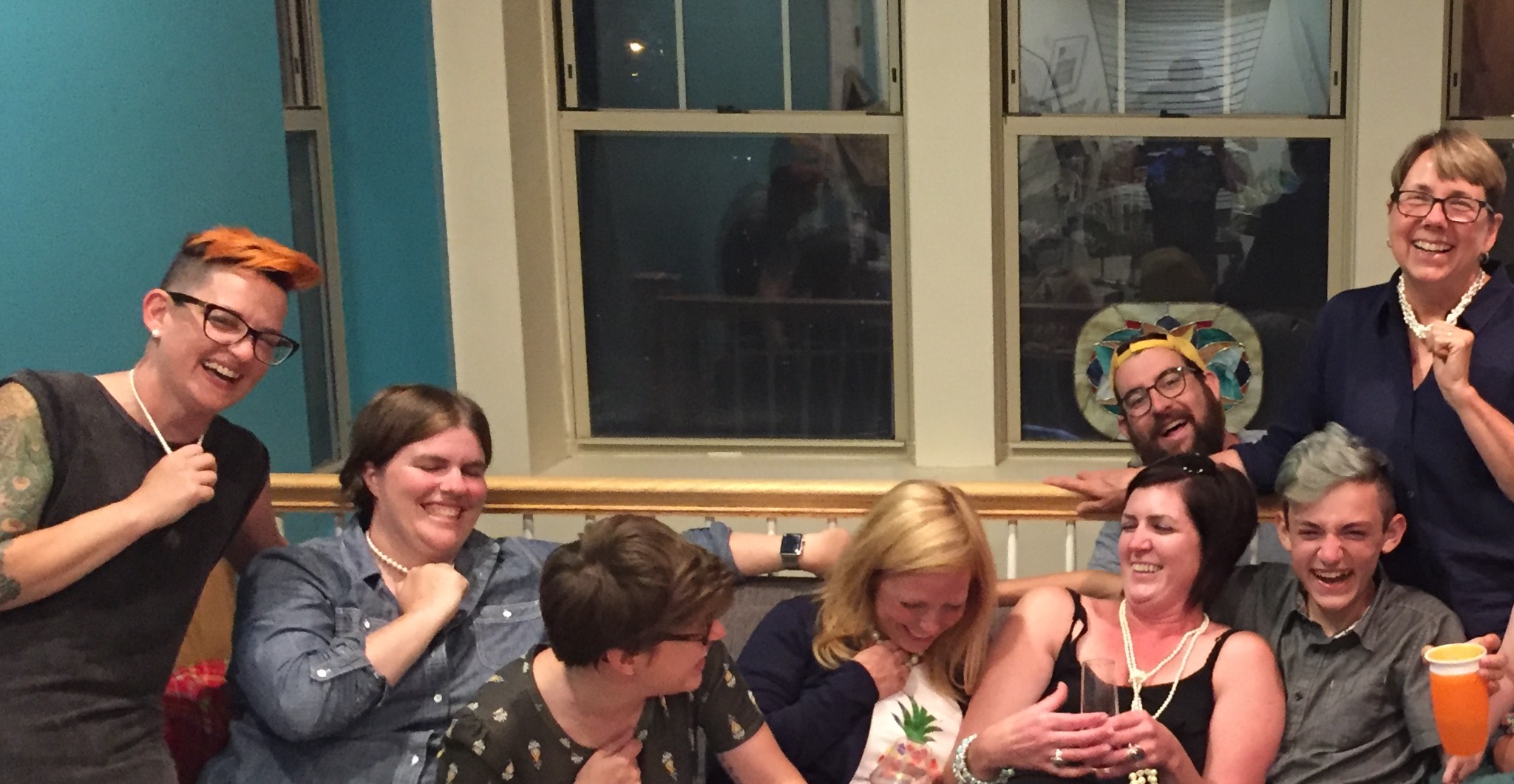
Image of SBC and AJC at last weekend’s Roka.

One More Time: Trust

Note: I am re-publishing a February 2020 post because in a Post-Pandemic Church, trust is more essential than ever.  Do we trust our leaders to lead us or not? 

Yes, things are different now after 12-18 months of isolation and we are called to be the Church in a different way.  But please – Church People – trust that after keeping things going during a global pandemic, your Pastor and Elders are moving forward with a great deal of  insights that they didn’t have before COVID.  Trust your leaders especially when they’ve shown you that they could handle a pandemic.

Either we trust each other or we don’t. Please read this one again.

Image source showing what not to do to each other.

Soak Up the Love

I have a hard time relaxing and perhaps I’m not the only one.

Friends and strangers alike post that they can’t relax, they don’t take vacations, they can’t stop their minds from racing, they can’t sleep, they sleep too much, they have COVID fatigue. When we are advised simply to STOP, we chuckle. Yeah, right. Stop.

A handful of congregations are On Fire to be The Post-Pandemic Church. Yay.

And most of the rest of us are ready to take it easy this summer.

You don’t need my permission but if you’d like someone like me to suggest some new Summer Goals, here you go:

  • Don’t even try to recruit fall volunteers until later this summer. We are just now reminding our vaccinated selves that we can meet people in person again. I shook someone’s hand last week without panicking.
  • If you can skip the usual summer activities, do that. If they feed your soul, then by all means keep doing them. But if the thought of making Vacation Bible School happen this summer makes your head hurt, it’s okay to say “not this year.”

A wise pastor told me the other day that this fall is about Soaking Up God’s Love. Their church is not going to kick off forty new things in September. They are not initiating plans to create new relationships with neighbors in Malawi or Turkey. They are not going to rush that staff search.

Instead they’re going to meet over comfort food and share stories: Did God feel close by or faraway during COVID? And by the way, you are awesome.

God loves us beyond all telling. Jesus is different from all the cable hosts and politicians and mean people out there. Who is God and just how much does God treasure us? Let’s soak that up.

My Dad always responded to our hanging-wringing about difficult people with these words: Just love them. Don’t demonize them. Don’t complain about them. Don’t stress about them. Just love them – preferably seeing them as Jesus sees them.

Take a deep breath. Feed somebody your best mac and cheese recipe. Tell them that you love the way they _____. Say how much your appreciate them. Bolster your Please and Thank You skills. Smile at the cashier. Go to the party. Make the phone call to Aunt Betty.

Don’t be judge-y. Give people a break. Take a leisurely walk in a lovely place.

Soak up God’s love and – as simply as possible – be the Church.

Leadership Languages

Here’s a quick post for today.

Perhaps you are familiar with Gary Chapman’s Love Languages? (My love language is Acts of Service because my heart goes all aflutter when someone vacuums for me.)

Shane Hipps has created a tool for assessing our Leadership Language. (You might know Shane as a former pastor at Mars Hill Church in Michigan or as an author of leadership books.) You can take his quiz here.

As a leader, do you need:

  • Recognition?
  • Mentoring?
  • Purpose?
  • Proximity?
  • Connection?

This could be a helpful tool for staffs to do together. I know that the way to squelch my own leadership is for me to misunderstand your leadership style – or my own.

Happy Thursday.

One (Quick) Way to Assess the Spiritual Health of a Congregation

Tell me about your church’s elders.

In my tradition (Presbyterian/Reformed Christian) the congregation is “ruled” by elders who shepherd the congregation’s ministry in worship, mission, education, and vision. The pastor is the one who equips the elders to lead in this way, but it’s the elders who govern as the official board. You can tell a lot about the health of a congregation by looking at who serves on the governing board.

Are your elders . . .

  • The Big Financial Givers?
  • The oldest, most longterm members?
  • The church bullies?
  • The same people for decades – with the required break of one year between terms?
  • The community leaders like the fire chief, the mayor, the bank executive, the school principal?
  • People with a pulse because it was hard to fill those open slots?
  • The Pastor’s biggest fans?
  • Descendants of historic members who will preserve the church’s traditions?
  • People with spiritual depth who can pray without notes, be trusted with finances and personal confidences, and regularly participate and lead in worship and teaching?

Chances are that all those people on your board, but what kind of leaders dominate?

I occasionally hear what I never want to hear from a pastor or a church member: “I’m not even sure our elders believe in God.” Those words assure me that a congregation will be closing sooner than later.

Healthy congregations are led by spiritually mature elders (who might in fact be among the youngest members of the church rather than “elderly”) who stand up to bullies and speak up when they witness disturbing activity in terms of how the members treat each other.

Healthy pastors are possible because of healthy elders. From the beginning, the right elders ensure that the Pastor Nominating Committee is comprised of people who will be in prayerful discernment rather than push their own agendas. They will give the pastor back up and hold the pastor accountable. They will understand that their pastor’s calling is to cast a vision with them and that vision is about God rather than personal desires.

So, who are your church elders and are they helping your congregation thrive in the name of Jesus Christ? And if they aren’t what are you willing to do to help change that? Things can be different if we want them to be different.

Image of the modern-day shepherds

Who Are Those Guys?

Sometimes I sit on the balcony of our apartment which backs up to some woods between our building and Independence Boulevard in Charlotte. And every once in a while, men appear coming out of the trees just like that scene in Field of Dreams. Apparently they live in the woods.

I remember talking with a young man in Zada Jane’s Restaurant in the neighborhood a couple years ago who told me he lived in the woods by the highway and I thought he meant that he lived in a house there. I realize now that he meant he lived in the woods as in under the trees with the rabbits.

Who are those guys? They are literally my neighbors.

We all live near people who are invisible to us: the retired couple who rarely leave the house, the single woman of a certain age who walks her dog, the men who emerge from the woods every morning while I’m having coffee on my balcony.

We often fail to see the homeless neighbors or the lonely neighbors or the grieving neighbors or the addicted neighbors but they are all around us. Some of them are in plain sight and we still don’t see them.

One of our callings as The Church is to notice what’s going on around us. Where is there brokenness? Where is there injustice? Who is hurting? Who needs a hand?

We see our friends and others who look like they could be our friends. But we fail to see those who are different from us. Who are those guys?

It’s risky for me to try to befriend the men in the woods. One local businessman told me that they’re drug addicts so I should stay away. My family reminds me that not everybody is safe. Local police officers have advised those of us who live in homes with doors that we should not approach the people who live without doors.

And yet they are God’s people as clearly as I am.

For the longest time we in The Church believed that if we built it, people would come, but that’s a thing of the past. Today, God is calling us to go into the world and notice who’s out there.

In my neighborhood, there are men living in the forest without tents.

Image from the movie Field of Dreams.

One Way

Father’s Day Memory: My Dad got pulled over once for going the wrong way down a one way street. “What’s the problem, Officer?” and the Officer informed him that he had been going down a one way street. “But I was only going one way,” Dad said.

Jesus answered, “I am the way and the truth and the life. No one comes to the Father except through me. John 14:6

Five years ago last weekend, I was among four people standing on a stage in front of hundreds of people with countless more watching online on the first night of the 222nd General Assembly of the Presbyterian Church USA. We were two teams of two and the commissioners could ask us anything they wanted as we were standing to be their Co-Moderators. This is terrifying, for the record. “What’s the capital of South Dakota?” What’s your plan for world peace?” They could ask anything.

Denise Anderson and I were one team and someone asked this:

Do you believe that Jesus is the one way to salvation?

Our answer was a quick yes which led to a smattering of applause. (Apparently we were being rewarded for not giving them a circuitous answer.)

I continue to believe that the answer to this question is “yes” and there are indeed nuances including the fact that God is God and we are not, so God gets to save whomever God chooses. Earlier in the Gospel of John, Jesus notes that God sent his son to save the whole world. So there’s that.

HH and I raised three PKs (preachers’ kids) and they have varying connections to organized religion these days, but they all hold onto their Christian roots. This summer we are adding to the family a Hindu bride and her Sikh father to join two daughters-in-love who were raised Muslim. I am now the owner of a beautiful shalwar kameez which I’m wearing to SBC and AJC’s Rokka ceremony preceded by a prayer ceremony led by a Sikh priest.

So who gets to be saved? Most people of faith agree that Jesus was a “great man” and perhaps even a prophet. I believe that Jesus saved my life – quite literally – on this earth. I hope to enjoy the life that comes after this in God’s eternal light. AND since God seems to surprise us on a regular basis (look out Pharisees) I am not worried about whether or not those raised Muslim, Hindu, or Sikh in my family recite the precise words of The Jesus Prayer in any of it’s forms.

What if you follow Jesus in behavior but never say the words? What if you say the words but live a selfish life? What if you lead a “good life” while clueless about the injustices that the people Jesus died for deal with every day?

I went to a funeral recently during which the preacher reminded us that not one of us is good – including the person in the casket whom I knew as a profoundly loving and kind human being. Okay – yes. We all fall short of God’s glory. And also God moves us to live lives of love to all people including those who are hard to love, including the least of these, including people who were born in parts of the world that worship God in other ways.

Some of us are clearly going “one way” in the way we live that we believe to be the correct way while it might in fact be the wrong way in the eyes of God. I’m grateful that I don’t have to be the one to judge who’s in and who’s out. Again, I’m trusting that – like always – God will surprise us.

Have a wonderful week.

The Next 18 Months

The next 18 months of being The Church could be the most fun we have ever had in ministry. Or not.

I remember talking years ago with a colleague in the first year of a new call and when asked how things were going, he exuberantly said, “I’m having so much fun!”

There are parts of professional ministry that aren’t fun. Filling out forms. Meeting with bullies. Sitting through poorly prepared meetings. Serving people who have zero interest in discipleship. Realizing your congregation is more of a social club than a faith community.

These are the fun parts: Watching the Holy Spirit move a congregation from stuck to unstuck. Meeting the person God has sent you to help with ___. Teaching Bible studies among people hungry for God’s Word. Preaching a sermon God has inspired you to preach. Sitting with siblings in Christ during their holiest moments.

If you are not having fun in ministry, ask yourself “Why?” And what needs to change?

Note: Jesus didn’t die “for fun.” Don’t get me wrong.

Our role as The Church is to be with people in their pain and confusion. And yet nothing is more exhilarating than watching God work.

This is a bone dry time for many people. Exhausted. Frustrated. Anxious about the future viability of our congregations. But the next 18 months will tell us all we need to move forward in this ministry.

  • People will trickle back, and many who are “coming back” will not return immediately. They’ve loved Sunday mornings in their pjs and it might take a while to realize how satisfying it feels to be with everyone in the same space.
  • God will use what we learned during the worst of the pandemic. At the extremes we learned – on the one hand – that we have no energy to be a 21st Century Church or – on the other hand – that we are surprisingly good at pivoting.
  • Churches without the capacity to serve people their community well will close. The tiny churches will close faster.
  • Lots of 60-something pastors will retire. They had planned to retire at 70 or 72 but COVID wrecked them. Or “it’s just not fun anymore.” Retirement is a good thing.
  • Lots of pastors will be re-energized (including some in their 60s) because God has shown us what’s important in 21st Century Church. Clue: it’s not the pew cushions.
  • The spiritual lives of many deepened during COVID. One pastor shared with me that their deacons met every Friday via Zoom during COVID to pray. And now those deacons have little tongues of fire floating above their heads.
  • Summer is a good time to let go of some things. Yes, there might be Vacation Bible School or Youth Trips. But you can cancel all those July meetings. Yes. Meetings can be cancelled.

This is a good time to assess personally what’s giving us life and what’s sucking the life out of us. And then do that with your Church Leaders. What is energizing our congregation right now? And what do we have zero energy for?

Where do you want to be in 18 months? If God keeps telling you that you want to be living near the grandchildren, listen to that. If God is saying “There are people in this community who need you” listen to that. If God is saying “My people are really tired and we can get rid of those soul-sucking activities and still do ____ and ____,” listen closely.

Deep breath.

Image from the 24/7 Prayer Room in Charlotte, opening at Amity Presbyterian Church in July 2021