Category Archives: Uncategorized

The Parable of the Farmers’ Market

Parables are the shocking stories Jesus told to teach us about God.  And this is the Parable of the Farmers’ Market.

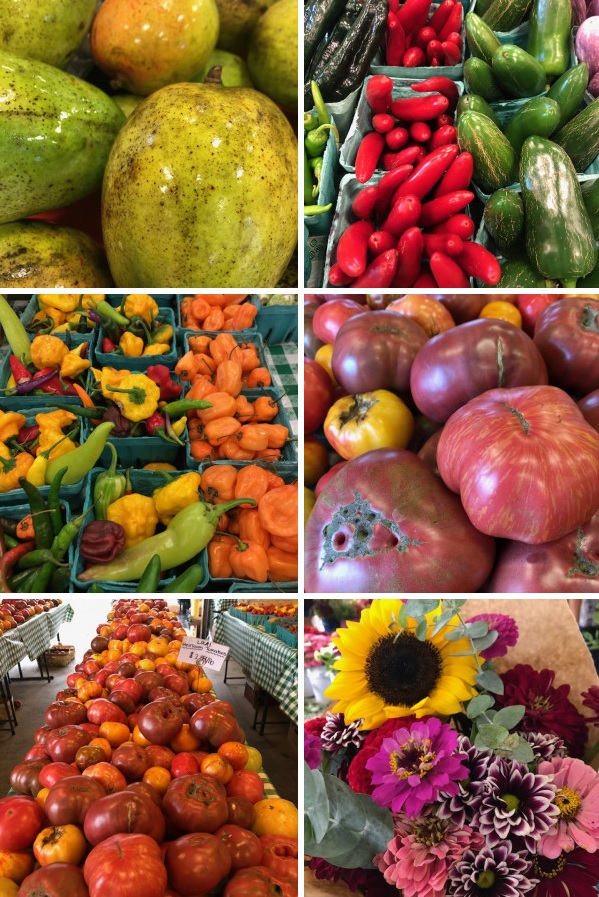
There was a Farmers’ Market in Charlotte, NC and the vegetables and flowers were almost too beautiful to bear. The smells were intoxicating.  And the world seemed as it should be. God did this.

Baby bok choy in deep greens.  Eggplants in royal purples. Sweet peppers in colors never before seen in the average garden. Jalapenos to delight the soul. Flowers too gorgeous to choose just one bouquet.

Catfish and fresh rainbow trout. Breads for the gluttons and gluten free. Olive oils and honey as far as you can see. Coffee beans and fruit juices. Peaches and blackberries large enough to make a person weep.

And the people. On one particular Saturday the people were from Korea and India and Syria and Ghana and Honduras.  There were women donning bindis and chadors. There were men in Lily Pulitzer shorts and in blue jeans. Their skins were golden and brown and black and white.

It was a happy place, a God-given place.

And then three middle-aged white men were overheard talking about how “those four police officers taught that crook a lesson.” “They shot the hell out of him” the one in the turquoise shirt said, laughing.

And there was a guy wearing this T-shirt.

And the LORD said,  “I have given you blessings of every color and shape,  from every nation and creed.  And you curse my blessings.  And while you are rich in worldly power and contempt, you who do not treasure the colors and textures I have created in this life will be condemned in the next. To those who love, love will drench them even in times of brokenness.  And to those who hate, there will be deep sorrow.”

Have a hope-filled Monday.

Images from the Charlotte Farmers’ Market on Saturday, August 29.

Conversations with an Unexpected Twist

I try to take somebody’s mother out to dinner on August 28th every year because it’s my mother’s birthday and I can’t take her out to dinner.  Last year I took her sister out for dinner and I called at the last minute to get a reservation:

Me:  Hi.  I’d like a reservation for two outside.  Someplace with a nice view.

Hostess:  Is this a special occasion?

Me:  Yes, it’s my mother’s birthday and her sister and I are meeting for dinner.

Hostess: Will you mother be coming with her sister?

Me: Unfortunately no.  My mother is dead.  But please wish a Happy Birthday to her sister if she gets there before I do.

I love eating out. When we arrived, the hostess mentioned how nice it was that V & I were getting together for Mom’s birthday. And then the hostess told me about her own mother who had died recently of breast cancer.  Yep.

Yesterday, I had a doctor’s appointment and as I was leaving, the conversation went like this:

Me: (to my doctor who has a LeBron poster on his wall) Did you see LeBron talking about the NBA boycott last night?

*Doc: Why do people have to be so emotional?

Me: ?

Doc: I mean, I don’t see race.  But clearly this black man was a bad guy.  He had a knife.

Me: I think the knife was in his car.  He didn’t have a weapon on him at the time he was shot.

Doc: But the police know what they are doing.  They were just defending themselves.

Me: Do they? He was shot in the back seven times.  I don’t think he would have been shot if he was a white guy.

Doc: People are so emotional. 

*Maybe I don’t need to say this, but this doc is a young straight white guy.

I like doctors – especially those who like basketball.  We were talking about my shoulder and then the conversation made a twist and I found myself talking about racism with with this guy who is a specialist I don’t need to see after next week.

We never know when simple conversations turn into more complicated conversations.  But it’s important that we see people and talk with them – even if the simple becomes more complicated.  There could be a pastoral twist.  Or a political one.

But we need to keep talking to each other.

Happy birthday Mom.

Image of the dessert I always ate for Mom’s birthday when we lived in Northern Virginia: The Flourless Chocolate Waffle at The Carlyle.

Protesting As a Faith Practice

Cutting straight to the chase here:  Peaceful protest is protected by the U.S. Constitution.  PROTESTING IS NOT THE SAME AS RIOTING. Protesting is also a spiritual practice.

I was asked in a church interview in 1988, “Can you think of any reason why you might protest something in a public gathering?”  It was an interesting question to ask a pastoral candidate.  I thought for a moment and responded, “Any reason?  There are many reasons why I might protest something for the sake of the Gospel.  Wouldn’t you?

I sounded so confidently evangelical and social justice-y, didn’t I?  At that point in my life, I don’t know that I had ever protested anything in public.  I voted.  I wrote letters to my representatives.  But I was a rule follower who was taught to be ladylike and marching with signs seemed a little radical.  It never occurred to me that protesting is a spiritual practice.

Consider what Jesus did for the sake of the Gospel.  (And he was actually a little destructive in this story.)

Today, protesters are confused with looters and definitions have become political.  One side is all about Black Lives Matter and the peaceful protests asking for justice for George Floyd, Brionna Taylor, and now Jacob Blake. The other side equates protesting with breaking windows and setting buildings on fire.

Senator Mitt Romney joined evangelical Christians to peacefully protest the death of George Floyd on June 7th. People of many different faiths have joined protests here in Charlotte, NC where I live.  Why do we do this?

  • Because we want to express our support for mistreated people.
  • Because we want to draw attention to injustice. (Still – nobody has been arrested for the March 13th murder of Breonna Taylor in her own bed in a case of mistaken identity. Wouldn’t you be enraged if that were your daughter or sister?  Wouldn’t you ask for justice for her?)
  • Because we want to gather in unity to support each other.
  • Because peaceful actions often change policy. (In Charlotte, the police will no longer be buying chemical weapons after protests in June.)

Can you think of any reason why you might protest something in a public gathering?  I hope we all would, for the sake of the Gospel.

We pray.  We read Holy Scripture. We gather for worship. We serve our neighbors.  And we stand up for what’s right because that’s what God commands.  These are just some of the ways we practice our faith.

He has told you, O mortal, what is good;
   and what does the Lord require of you
but to do justice, and to love kindness,
   and to walk humbly with your God? Micah 6:8

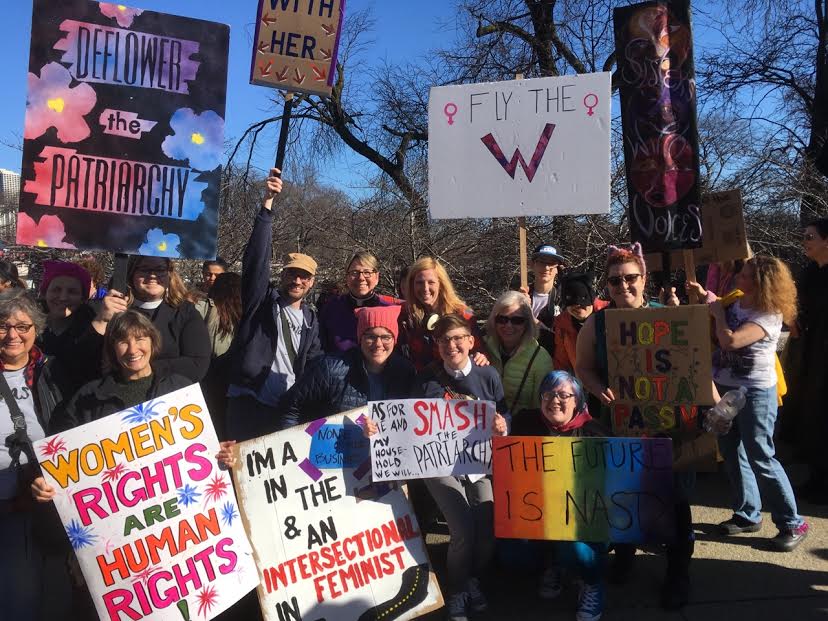
Top image from Senator Romney’s Twitter feed.  Bottom image from the 2017 Women’s March in Chicago.

Blurry Lines

My brain is blurrier these days for several reasons ranging from pandemic fog to Zoom overload. Yesterday I couldn’t remember the word “liturgy.”

Professional and personal boundaries are also blurred during this pandemic time in small and not-so-small ways:

  1. We get to see inside people’s private homes and offices on Zoom calls. This Global Health expert has an electric guitar on her wall. Anthony Fauci collects baseballs. (Not surprisingly) Martha Stewart has a really nice espresso machine and (surprisingly) a dog that sheds like crazy. Would someone please interview Phoebe Waller Bridge from her London flat? Or Cynthia Erivo? Fun game you can play at home: who has a Bible on their bookshelf?  In a world in which it is not okay to peep through somebody’s windows, it is okay to check out their private space online.
  2. Work/Home lines are definitely blurred during this time of home quarantine, if we are fortunate enough to have jobs and be able to work from home.  I can turn off my Zoom video and eat a sandwich while the rest of the committee talks.  I can bake a quiche during a staff meeting.  And I can answer emails after 10 pm if I want. (Actually that was always true.) My therapist recommends that I shut down work at 5 and not look at it again until the next morning, and I wasn’t even good at that pre-COVID.  In a world where it’s not okay to wear pjs to the office, now it’s perfectly fine to wear them all day with an appropriate shirt.
  3. After beloved pastors leave our church to go to another church, we can still see them in worship every Sunday via YouTube and Facebook Live.  It’s like they never left!  In a world in which former pastors sign separation agreements to refrain from offering pastoral care after they leave us, it’s now okay to watch them preach every Sunday.

Clear boundaries are essential in any organization and yet those boundaries might be forever altered post-pandemic.  Many people plan to continue meeting via Zoom.  Many congregations plan to offer online worship long after a vaccine is available.  And it’s increasingly difficult to fully separate from the relationships we enjoyed in previous workplaces.

We face the adventure of figuring all this out in the coming years.  I see the creation of new boundaries that maintain appropriate roles and norms AND allow for more permission-giving and fluidity.

This is a good thing if we take on the attitude that this is a time of creativity and courage.  As a person who wears eyeglasses, it’s a little scary when the world looks blurry.  But if we help each other and ask for holy guidance, we’ll continue to move in the right direction.

Image source.

A Vote That Hurts My Family

As a pastor who serves people of differing political opinions, I often say that the Bible is an equal opportunity offender.  There are verses that offend most Democrats and there are verses that offend most Republicans.  God is neither a Democrat nor a Republican.

Although they might make me sad, frustrated and even angry, political differences about issues like bank deregulation or clean water or the defense budget or the next Supreme Court justice are not enough to make me want to break up with you as a friend or colleague or family member.

But – and I write this with trepidation – there is a vote coming up ten weeks from today and the results could physically threaten my family.

[NOTE: It always frustrates me when politicians speak up because it personally impacts their own families.  Example: The senator who is quiet about protecting LGBTQ citizens until his son comes out as gay. And yet, here I am.]

I am white. And there are three brown people in my immediate family: two by marriage and one by unofficial adoption.  And I fear for their safety in these politically divided days.  It’s one thing when you vote for someone whose policies are against what I believe as an American Christian.  It’s another thing when you vote for someone whose incendiary words could get my kids killed.

The heartbreaking part is that people who know and love my kids are the very people who are considering a vote for the one who’s put their lives at risk in a way they’ve never been at risk before in this country.

Isabel Wilkerson spells out what I’m talking about in her excellent book Caste: The Origins of Our Discontents:

  • (Before the 2016 election) – A police commander in southern New Jersey talked about mowing down African-Americans and complained that the woman candidate, the Democrat, would ‘give in to all the minorities.’ That September, he beat a handcuffed black teenager who had been arrested for swimming in a pool without authorization.  The commmander grabbed the teenager’s head and, witnesses said, rammed it ‘like a basketball’ into a metal doorjamb.  As the election drew near, the commander told his officers that the reality television star ‘is the last hope for white people.’
  • (After the 2016 election) – A man on a golf course in Georgia could feel freer to express himself.  He was a son of the Confederacy, which had gone to war against the United States for the right to enslave other humans. The election was a victory for him and for the social order he had been born to. He said to those around him, ‘I remember a time when everybody knew their place. Time we got back to that.’
  • (After Inauguration Day) – A white man in Kansas shot and killed an Indian engineer, telling the immigrant and his Indian co-worker to ‘get out of my country’ as he fired upon them.
  • (In February 2017) – A clean-cut white army veteran caught a bus from Baltimore to New York on a mission to kill black people. He stalked a sixty-six year old black man in Times Square and stabbed him to death with a sword.
  • (In May 2017) – On a packed commuter train in Portland, Oregon, a white man hurling racial and anti-Muslim epithets, attacked two teenaged girls, one of whom was wearing a hijab. ‘Get the ___ out,’ he ranted. ‘We need Americans here.’
  • (In August 2017) – A white supremacist drove into a crowd of anti-hate protesters in Charlottesville, Virginia, killing a young white woman, Heather Heyer, in a standoff over monuments to the Confederacy . . . 

I could go on and on with more examples from Caste and from myriad news reports. And my brown kids could also share what has been said to them, yelled at them, and done to them over the past four years, but those stories are theirs to tell. It’s never been easy to live in their skin.  But the past four years have been increasingly dangerous.

Maybe you don’t take me seriously. But I share this with humility and not a little fear:

A vote for one candidate on the ballot again this year is a vote against the safety of my own family.

Yes, I care about your families too.  Yes, I care about my neighbors.  But when it’s possible that my own kids are at risk of physical harm, my heart pounds like the mothers of brown and black children throughout our nation’s history. My fears are minimal compared to theirs.  My worries shrink in comparison.

You might say that this candidate for President did not hold the sword or the knife or the gun that committed those crimes. You might say that his hands were not on the wheel of that car in Charlottesville. But the truth is that extremists have been given permission to dehumanize people because this candidate publically dehumanizes people. It’s on tape. He says dehumanizing things about God’s children out loud with a microphone on a regular basis.

You might say that all the haters I’ve mentioned are the exceptions, the bad apples, all mentally ill individuals.  But they’ve been emboldened.

I would hope that we vote based on what’s healthy for our nation as a sovereign country and as a global leader.  I would hope that any candidate who professes belief in Jesus Christ would look to Jesus to inform decision-making and personal behavior.

But if those hopes fall flat, maybe you will vote for the protection of my family and all families whose children are not white and for our daughters who are objectified. We can work out political differences together.  But we can’t stop the hate until we vote against hate.

Thanks for listening.  I’m kind of desperate.

Image of the White Supremacist who killed two men on a commuter train who were defending two young women.  In one of the videos, he yells “f*** all you n*****s”

Side Hustles

I once knew a pastor who had a side job as a public school bus driver – unbeknownst to the congregation he served.  One of the elders from his church was sitting at an intersection waiting for the red light to change, when she glanced at the bus to her left and saw that the driver was her pastor.  That’s why he was never available for early morning or afternoon meetings.  That’s why he complained about having to work Holy Week or around Christmastime.  We also learned later that he’d been renting out his own study at the church building to another pastor and keeping the rent money.

This is not what I’m talking about when I refer to pastors with side hustles.

A financial mentor HH and I are reading believes that every person needs three streams of income.  Whether you are a teacher or a barber or a pastor, she suggests three streams of income for all.

For pastors, this is called Tentmaking and it usually refers to pastors whose churches do not or cannot pay the pastor a living wage.  The Apostle Paul was literally a tentmaker on the side, and I’ve known part-time preachers who also work as web designers, therapists, jewelry makers, and bakers.  Usually these additional jobs are known to the congregations served by those pastors (unlike the bus driver-pastor.)

I once made a comment about getting a second job when I was serving as a pastor, paid the minimum salary and having a hard time covering our family expenses.  The parishioner was clearly horrified:

Why would you do that?  It would bring embarrassment to our church because people would think we don’t pay you enough.  And besides you already work for us 24-7.

Seriously, that’s what she said.

So, what about “appropriate” side hustles?  Having three streams of income could mean that two adults both have salaries and you also have investments.  Or you could have a single income but on the side you sell stuff on eBay and do calligraphy for weddings.  Or maybe you get paid well but you rent out your guest room via AirBNB and you make face masks at home to sell on Etsy for “vacation money.”

Pastors do a lot of things for free:

  • Weddings and funerals for friends and even strangers (even though people should offer an honorarium.)
  • Preach for churches that can’t afford a pastor (although – again – they should be paid for their services plus mileage.)
  • Write articles for journals.
  • Speak at conferences.
  • Lead workshops.

My new financial mentor friend says that we should never offer our expertise for free, even for church leaders.  Pastors tend to be generous with our time and we often perceive that faith organizations cannot afford to pay us.  We didn’t choose professional ministry for the money.

And yet . . .

Everyone reading this post has something valuable to offer.  Intellectual property. Time. Creative ideas. Tangible artistry.

We’ve been saying this for a long time in Church World, but side hustles are going to become more and more essential as fewer and fewer congregations can afford full time pastoral leadership.  I like thinking of side hustles as a creative outlet rather than a burdensome requirement for supporting ourselves and our families.

So, I ask you faithful readers:

  • If you have a full-time pastor, how would you feel about your pastor earning extra income on the side?
  • If you are a professional pastor, have you ever picked up extra work either because you wanted to or you had to?

Please share.

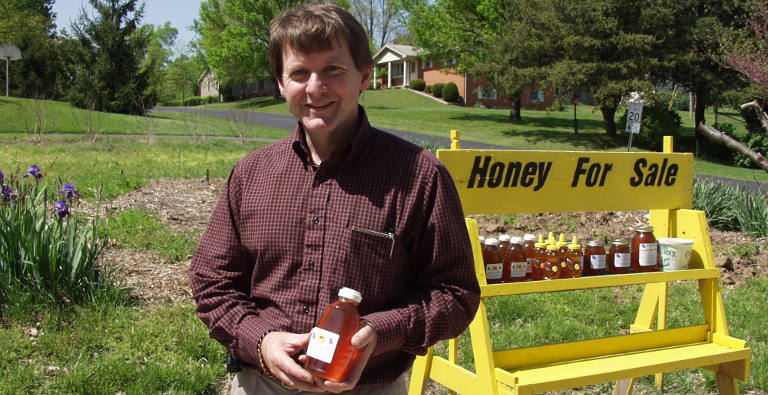
Image of retired Presbyterian pastor Grant Gillard who – even while serving congregations – raised bees.  He continues to sell honey in his retirement.

Partnering With the Police

Law enforcement personnel have stressful jobs.  For the sake of this post, I’ll include sheriffs, highway patrol officers, and police officers as “local law enforcement.”

In light of the tumultuous issues surrounding law enforcement these days, Anti-Racism Training opportunities are everywhere.  (Please tell me you are taking advantage of them: the podcasts, books, panel discussions, training, etc.) Yesterday, one of those opportunities was a webinar sponsored by Massanetta Springs Conference Center called Racism, Law Enforcement, and the Church featuring Alonzo Johnson, Byron Wade, and Denise Anderson.  Part Two happens today.  And thanks to Mary Newbern-Williams for moderating the program.

One of the questions asked was: What is the Mission of Police?

  • To protect and serve?
  • To control crowds?
  • To rescue people?
  • To arrest people?
  • To teach community safety?
  • To resolve domestic conflicts?
  • To break up fights?
  • To check out neighborhood “annoyances”?
  • To guard schools?
  • To find bad guys?
  • To inspect people in their cars or on the streets?
  • To address mental health issues?

And a second question is: What role does the Church have in partnering with law enforcement?

There are congregations who’ve invited police officers to come help them ramp up their security measures in light of church shootings and this is not what I’m talking about.

I’m talking about partnering with law enforcement in regards to mission and ministry.  For many years, I’ve advised church leaders to contact their local law enforcement leaders and meet for coffee, and then ask the officers: “What do you do all day?”

Churches: we might be surprised to find out how law enforcement officers spend their days.  Are most of their calls regarding domestic violence? Drug addiction? Runaway kids?  These specifics are important for local churches to know because they can work with the police to provide support for neighbors in need like:

  • Provide shelter for victims of trafficking and domestic abuse.
  • Provide needle collection sites for the disposal of needles.
  • Provide space for teaching harm reduction.
  • Provide support for the families of both crime victims and perpetrators.

Imagine the community that could be built if relationships between law enforcement and houses of faith were stronger.  In rural communities and suburbs and inner cities, personal relationships and partnerships could also improve violence rates where we live.

Law enforcement has some tragic history in the United States when we consider the early slave patrols.  But it doesn’t have to be this way.  The 21st Century Church must be familiar with their neighbors in law enforcement for the sake of expanding the reign of God.

So, Let’s Talk More About Generations

I wrote yesterday about pastors in different generations:  The Greatest, The Silent Generation, The Boomers, Gen X, The Millennials, and the Zs.  There was controversy, especially because I, myself, confused the generations in my post.  I first wrote “Millennials” when I meant to write “Gen X.”

Frustration ensued and rightly so.

I, too, have found that Generation X is often passed over when Pastor Nominating Committees are seeking new leadership.  A Boomer Pastor retires at 70 and the congregation subsequently calls a 35 year old to be the new Head of Staff.  I received quite a few private messages about my contributions to the dismissing of Generation X and they were right.

My #1 concern as a church person is that congregations find pastors who will lead them in such a way that they will thrive in the 21st Century.  Such pastors can be found in every generation.  They are:

  • Entrepreneurial
  • Authentic
  • Deeply faithful
  • Emotionally intelligent
  • Unafraid of failure
  • Missional

For what it’s worth, here are some facts about my own denomination – the Presbyterian Church USA:

  1. Of the nine largest congregations in my denomination, 8 of them are led by Gen X Pastors and only one is led by a Boomer.  At least in 8 of those largest of the large congregations, their senior leaders are between the ages of 41 and 56.
  2. Of those nine largest congregations, only one of those Heads of Staff is a woman.  Not one is a Person of Color or a person who identifies as LGBTQA+ or a person who is differently abled – as far as I know.
  3. Median congregational membership in the PCUSA is 70 people as of 12-31-19 according to PCUSA Research Services.  Many congregations cannot call full time pastors of any age.

Here’s what I wonder:  Are people called or not called to serve churches for reasons beyond generational?  Black, Indigenous, and other People of Color have a very hard time in the call process.  This is also true for LGBTQA+ pastors. (God bless the Black Queer Clergy.)  As a mid-council leader, I have literally heard Pastor Nominating Committees say that their churches “are not ready” for a gay pastor or a brown pastor.  It’s not always about age.

I would like to hear your personal stories, particularly about your own age or your own generation. I suspect there is anxiety and frustration all around among Boomer, Gen X, and Millennial Pastors.

A few stories that inform the generational issues for me:

  • A seasoned pastor asked me a couple years ago how he could engage the neighborhood around his church building and I suggested books, films, podcasts, mentors, blogs, and retreat leaders.  And he responded by saying that he was only looking for “a brochure or something at his age.” (He is a youngish Boomer.) He said he didn’t have the energy “at this point” to delve into it.  And he probably will not retire anytime soon.  (This kind of thing makes me want to yell, “Get behind me, Satan.”)
  • Another seasoned pastor told me that he feels written off for being “another old white guy.”  He is in his mid-60s and still feels the energy and imagination to serve for a while longer.  The fruits of his ministry continue to tell me that he’s right.
  • A pastor in her late fifties told me that she got a phone call from a church looking for a speaker for their officer’s retreat.  She thought they were about to ask her to be the speaker when the caller said, “We were wondering if you could suggest a younger clergywoman to keynote our retreat.” Ouch.
  • I have a collegue who’s a 30-something rock star and she was called to be the pastor of a medium-sized congregation because they’d hoped she could “bring in the young families.”  And she’s wonderful. But she is not taken seriously by the older generation in the church and it sabotages her ability to do what they’ve called her to do.
  • I have a Gen X friend who was called to serve a large congregation when she was in her early 40s.  Her predecessor stayed for 30 years and it’s expected that she will stay that long as well.  I asked her once if she thought she would actually do that, and she said, “I think I’ll have to whether I want to or not.  Who would call me as a 50-something or 60-something pastor.”

All in all, I’m finding that there are excellent and not-so-excellent pastors in every generation.  But – again – I would appreciate hearing your stories if you want to share.

And thanks for forgiving me my brain blip yesterday.

The Last Boomer

Who will be the last Baby Boomer Pastor?

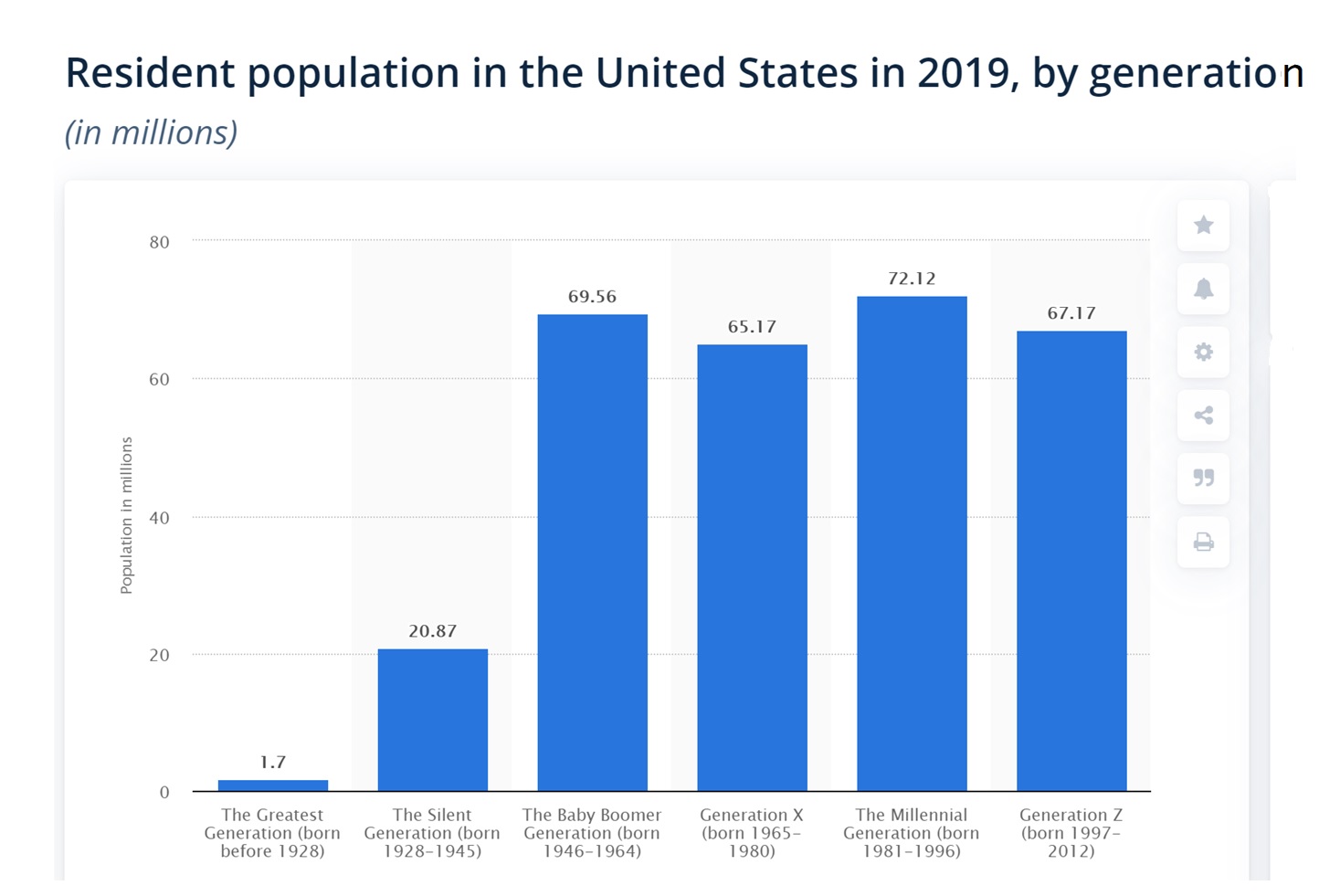
Currently, there are six human generations alive:

  • “The Greatest Generation” – Born in 1924 or earlier.
  • “The Silent Generation” – Born between 1925 and 1945
  • “The Boomers” – Born between 1946 and 1964
  • “Generation X” – Born between 1965 and 1979
  • “Millennials” – Born between 1980 and 1996
  • “Generation Z” – Born between 1997 and today*

*These dates vary a little depending on sources.

As you can see from the graph above, there are quite a few Baby Boomers alive today and – within my denomination and many denominations – there is a wave of Boomer Pastors who will be retiring in the next decade.  The youngest Boomers will turn 70 in 2034 and – God willing they will be retiring at that time if not earlier.

In 2064, the youngest Boomers will turn 100.  It’s not that far away.

On the earth on this day, there is someone alive who will be the last living Baby Boomer Pastor.  This is amazing and wonderful to consider. (Also, I hope it’s not me.)

I am a Baby Boomer and – at the same time – I am often frustrated by my own generation.  While there are creative, energetic, hopeful, entrepreneurial leaders in their late fifties and sixties, there are also leaders in this age group who are tired and ready to retire.  And yet those weary pastors do not plan to retire until they are 70 for many reasons.

I believe that every Boomer Pastor should have a trusted colleague or friend who can tell us when it’s time to step aside and make way for a Generation X Pastor**- or someone even younger.

My dream is that The Last Boomer Pastor to retire will be a kick-@$*, door-opening, permission-giving, Jesus-loving, expectation shattering human being who will joyfully look at the generations coming after and be overwhelmed with gratitude and hope.  We who are blessed to be part of this generation need to begin preparing our congregations now for the changes ahead.

Image source.

** My deepest apologies to Generation X Pastors. I meant to write your generation here (before I corrected it from saying Millennial.) It obviously shows my own unconscious bias. Please forgive me for this brain blip.

Could We All Just Take a Breath?

I’m choosing not to watch either the Democratic or the Republican Conventions.  I love political conversations and political ideas.  I loved living in Our Nation’s Capital for a couple decades and being close to the action.

But I just can’t do it.  I wish everyone could just take a breath.

This coming election is so important. And yet –

I’m tired of political ads that are half true – or totally untrue.  I’m tired of people repeating lies in hopes that if they repeat the lies long enough, they will become the narrative.  I’m tired of smugness and snarkitude.  I’m tired of the focus being on winning and losing elections, while ignoring who is winning and losing in life because of unfair government policies.

I’m tired of good people voting against their own interests (i.e. people voting for candidates who don’t promote clean air and water while their own air and water is making them sick.)

I’m tired of watching good people voting against their own religious beliefs (i.e. people voting for candidates who mistreat immigrants while reading a Bible that says so many things about how we are supposed to treat “aliens.”)

So, here’s what I’m wondering: could we all take a deep breath?  Could we also:

Is this who we’ve become?  Someone says that “it’s possible” or “they’ve heard” that Candidate A is engaged in child sacrifice or Candidate B is running a drug ring in Mexico – and we go with it because we didn’t like that candidate anyway?

Is it ever okay to place a target on any candidate’s face?

Is it ever okay even to joke about seeking help from foreign governments to win an election?  (Actually, I think this is illegal – for any political party.)

Can we try to be smart, thoughtful voters?  It’s not only good for our emotional well-being, but it’s also good for our country, our democracy, and our humanity.

Special note to Christian readers: Clearly all candidates fall short of the glory of God.  But we can do better in both nominating and electing individuals whose character and principles inspire rather than divide.

Election Day is 11 weeks from today.  Can we re-boot our attitudes and try to be the people the Constitution says we are?  I suggest we breathe deeply and pray for every kind of peace. And vote.

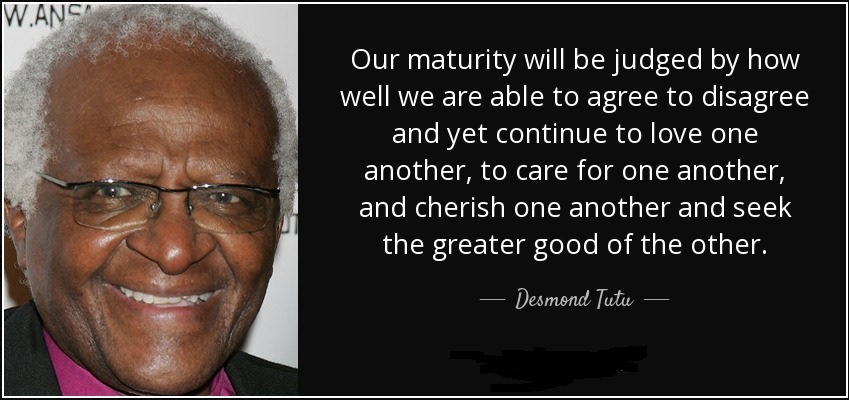
Image of retired Bishop Desmond Tutu of Cape Town, South Africa.