Category Archives: Uncategorized

Art Helps

Say Their Names by Kadir Nelson

Today is the fifth anniversary of the murder of nine Children of God who died at the hands of a young white supremacist during a Bible study.

There are problems with that sentence – the biggest one being that it fulfills our image of white supremacy: a broken white man who embraced the Confederate flag attacks people because of hate and racism.  We all know the story about officers treating the white man with Burger King in jail.  (Most white supremacists don’t look like that man.  They look more like me.)

I received my copy of this week’s New Yorker magazine yesterday and the cover by Kadir Nelson is profoundly moving.  Look at it.  Lament over it.  Let it inform our prayers of personal and corporate confession.

In these days of brokenness and sorrow, art helps.

 Kadir Nelson is a supremely gifted American artist.

When Somebody Says “This Is Not the Time”

I would buy the scotch and Marj would tell stories.
The quote above was shared yesterday by a former Moderator of the General Assembly of the Presbyterian Church USA who will remain nameless for their own privacy, upon hearing that Marj Carpenter had died.  Marj hailed from Big Spring, Texas which sounds like the kind of place a great storyteller would come from.

She wrote down her stories and she orally shared them through the years and I especially remember both reading and hearing this one:

In 1864, the states were at war with each other.  It was an ugly time and even the Presbyterian Church was divided in two:

  • The Presbyterian Church in the Confederate States of America
  • The Presbyterian Church in the United States of America.

In spite of the war, each branch of the Church met for their annual General Assembly – the CSA Presbyterians in Charlotte, North Carolina and the USA Presbyterians in Newark, New Jersey.

While ministers and elders were deliberating on church policy, homes were being burned and church buildings were being sacked.  Presbyterians from both the north and the south were killing each other and enslaved Presbyterians were considered less than human by the very church people who had taught them to read the Bible.

Lord have mercy.

If there were ever excuses NOT to care for “other people” it was 1864.  The blood and treasure of a broken nation was being devoted to a brutal war that would take the lives of 618,222 human souls – 360,222 from the North and 258,000 from the South.

Important point to remember: This death toll doesn’t count the tens of thousands of men, women and children who died as a result of being treated as human chattel in this country from the time enslaved Africans arrived in Virginia in 1619 to that point.

So here’s the interesting thing:

During that General Assembly in Charlotte, the commissioners voted to send an additional missionary to Brazil.  In spite of the war, in spite of financial hardship, they realized that God was calling them to reach out to the people of Brazil.  Nobody said, “This is not the time.”

During the General Assembly in Newark, the commissioners voted to send three missionaries to Cameroon.  In spite of the war, in spite of financial hardship, they realized that God was calling them to reach out to the people of Cameroon.  Nobody said, “This is not the time.”

Important point to remember: There were enslaved people in the South whose ancestors had hailed from Cameroon and other parts of West Africa.  I don’t know if the Northern Presbyterians were trying to offer some kind of twisted reparations to the West African cousins in the South by serving their kinfolk back home, but – again – Lord, have mercy.

So, here’s my point:

We are living in divided times at this very moment.  There is enormous work to do in the now “united” Presbyterian denomination and beyond.  There are reparations to be made.  There is lamentation to be expressed. I would suggest that my White siblings and I schedule a rending of garments.

We are living in pandemic times with over 118,000 dead in this country and another countless number of People of Color killed since the end of the Civil War by lynchings – both ancient and as recently as last week.  Our world is on fire both literally and figuratively.

And lots of people in the Church are saying that this is not the time.

  • This is not the time to build affordable housing.
  • This is not the time to provide internet access to poor communities.
  • This is not the time to grapple with the needs of refugees and immigrants.
  • This is not the time to feed hungry people.
  • This is not the time to provide job training.
  • This is not the time to reach out to our transgender neighbors.
  • This is not the time to address domestic violence.
  • This is not the time to talk about racial justice.

For the love of all that’s holy, this is the perfect time to do what God is calling and has always called us to do. If there was ever a time, this is it.

This. Is. The. Time. To. Be. The. Church.

Marj Carpenter visited both Brazil and Cameroon and met the leaders who were bringing Good News to the Poor and Relief to the Captives because of the Church’s efforts in 1864.  She cried when I heard her tell those stories.

The Church has made massive mistakes out in the mission field from offering toxic charity to perpetuating colonialism.  And we are still making up for that – and for so many sins of our past.

But this is the time to do better.  This is the time to take risks for the sake of the Gospel of Jesus.  At the risk of sounding self-serving, the next time someone in your congregation says, “This is not the time” feel free to hand them a copy of this post.

It is always the time to do justice, love mercy and walk humbly with our God.  This is that time.

Image of Marj Carpenter  who died at the age of 93 on Saturday, June 13, 2020. We give God thanks for a well-lived life. She was the Moderator of the 207th General Assembly of the Presbyterian Church (USA).  The 244th General Assembly begins this Friday “in Baltimore” (i.e. virtually in our homes.)

Anniversaries That Matter

Every day is the anniversary of something.  On every single day of the year, somebody died and somebody was born. Something was invented and something was destroyed.

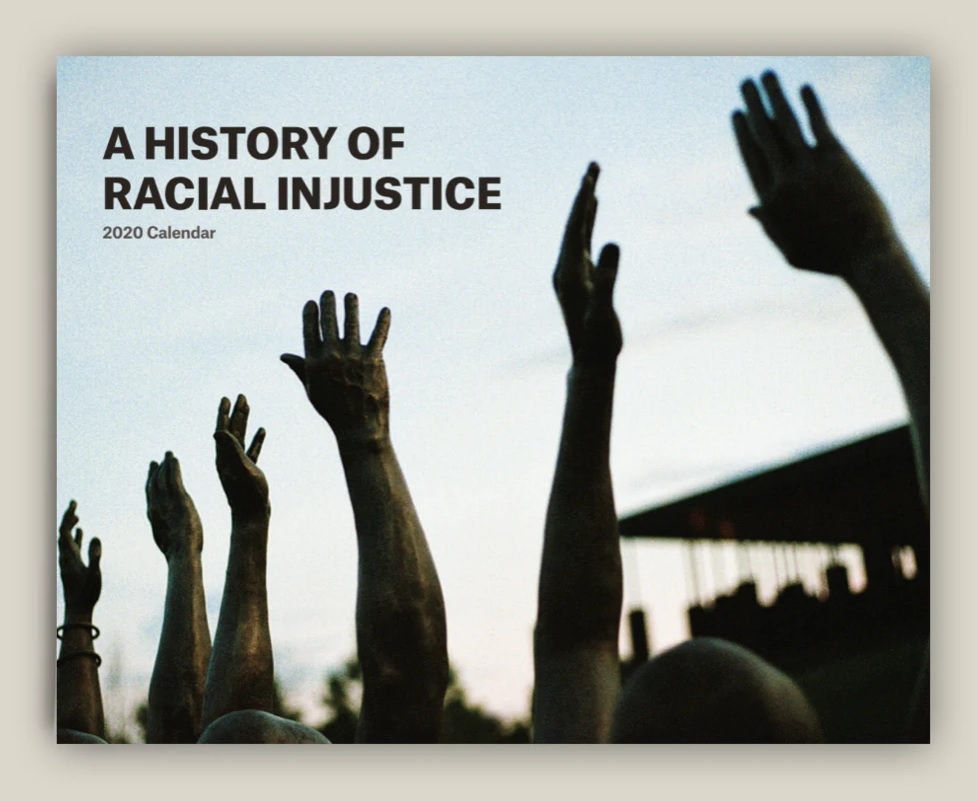
The Equal Justice Initiative publishes a calendar you can order here (a deal at $2.00) that includes – on every single day of the year – the anniversary of a racial injustice that happened that day in history.  It is an excellent devotional resource for lamentation.

There are certain personal anniversaries that will forever mark the particular Befores and Afters of our lives.  September 16 will always be that day for me because it marks the day my life was divided between “having my Mom” and “not having my Mom.”  Pete Davidson’s demarkation date is September 11, the day his father died in the attacks on NYC.  He was 7 years old.  Many people I respect on social media often refer to their own personal Before and After days.  For Shannon Dingle it’s July 19th.  For the family of Rachel Held Evans, it’s May 4th.

Our culture in the United States is marked by anniversaries that some of us recognize annually and some of us do not.  Among those include several in the month of June:

  • The beginning of the Tulsa Massacre of Black Wall Street – June 1
  • The assassination of Medgar Evers in Jackson, MS – June 12
  • The murders of LGBTQ siblings in the Pulse Nightclub in Orlando, FL – June 12
  • The murders of nine church people attending a Bible study in Charleston, SC – June 17
  • The final declaration of The Emancipation Proclamation to enslaved people who had not yet heard in Galveston, TX – June 19 (i.e. Juneteenth)

This particular week is also a special anniversary for me as I mark June 17 as the date when Denise Anderson and I became the first Co-Moderators of the General Assembly of the Presbyterian Church USA.  It marks a Before and After time of my life.  One June 17, 2016 Denise and I stood before the commissioners of the 222 General Assembly of our denomination and spoke these words:

Good evening. We greet you in the name and with the love of our Savior,  Brother, Friend, and Lord Jesus Christ. Our names are Denise Anderson and Jan Edmiston and we humbly ask you to consider electing us to be Co­-Moderators of this 222nd General Assembly. 

Less than a week after the worst shooting in American history in a  gay bar during Pride month, the day after the first anniversary of the murder of our brothers and  sisters in Mother Emanuel Church in Charleston, on the eve of Juneteenth when slavery was finally abolished in Texas and throughout the Confederate South, and the year of the 60th anniversary of the ordination of women . . . we hope to be Co­Moderators who talk about these things.

We are still talking about those things – and rightly so.  Since that night, new anniversary dates have marked our history forevermore:

  • The shooting of Alton Sterling in Baton Rouge, LA – July 5, 2016
  • The shooting of Philando Castile in Saint Paul, MN – July 6, 2016
  • The shooting of Stephon Clark in Sacramento, CA – March 18, 2018
  • The shooting of Breonna Taylor in Louisville, KY – March 13
  • The choking of George Floyd outside a grocery store in Minneapolis, MN – May 25

Each one of these deaths was caused by professional police officers resulting in the deaths of unarmed people of color.  And these are the ones with video or sound recordings.

I look forward to joyous anniversaries in our futures:

  • The day when a vaccine is proven effective against COVID-19 and we can all get back to a sort-of normal time.
  • The day when we elect political leaders who care for “the least of these.
  • The day when our nation becomes what we say we want to be.

This Friday marks the first day of the 224th General Assembly of the Presbyterian Church in the United States of America. 

The 224th.

For the first time it will be virtual.  It will be shortened because nobody can Zoom 10 hours a day for 10 days.

And it will be both inspirational and aspirational – I pray.  I also pray it will mark a holy “Before” and “After” moment for all the commissioners who make decisions for the Church in the name of Jesus Christ.

Image of the 2020 EJI calendar.  They make inspirational and aspirational gifts.

Because We Don’t Really Want to . . .

The National Treasure known as Dr. Yolanda Pierce tweeted this the other day:

It occurred to me – as someone who works with churches in transition (which is all of them) – that this is exactly why churches flounder and die.  We speak the words of spiritual growth and church growth but we really don’t want to do what we say we want to do.

  • “We want to become more diverse.”  This line can be found in countless files of congregations seeking a new pastor.  The white churches have noticed that demographics are changing in the U.S. and they’ve heard that “the young people” like diversity.  What this really means, though,  is that the church wants to think of themselves as open and inclusive to all God’s children.  It’s not true.  These congregations want to welcome new people who will pledge money and keep their diversity to themselves.
  • “We want to reach out into the neighborhood.”  Sometimes this means that we want to reach down to the neighbors.  We want to help the poor but not to the point that they are sitting beside us in the pews.  We will go out to the homeless shelter or the soup kitchen, but we don’t want to house the homeless or invite them into our own kitchens.
  • “We want to deepen our spiritual maturity.”  Interpretation: we want our kids to have good morals and we want to learn enough about Jesus to hold our own in the Bible Belt, but please don’t make us sacrifice anything. We have a hard enough time giving up coffee for Lent.
  • (Especially in these days post-George Floyd’s murder) “We want to understand what white privilege is and of course, we want to dismantle it.”  So, is there a book I could read?  Is there a short video I could watch?  Actually a commitment to dismantle white privilege – not to mention white supremacy – is a life long responsibility that will involve being very uncomfortable.  It will mean acknowledging that we white people have prospered in this system.  It will mean that we must pay close attention to what’s happening around us where we haven’t had to pay attention before.  Is there a person of color being dissed in line at the grocery store? Is there a young black man being roughed up beside his car after being pulled over?  Is there a brown family interested in buying the house next door?  Will I choose a person of color when I next look for a new doctor or dentist?  Will I be curious about the life experiences of my Native American neighbor, myTransgender cousin, my Asian colleague?

We don’t lack the resources or the imagination to dismantle oppressive systems – from everyday white supremacy out in the world to entrenched patriarchy in our congregations.

We just don’t want to do it.

Nevertheless . . . there are people out in the world who are willing to make the changes the world is clamoring for – in the name of love.  There are congregations that clearly see what is breaking God’s heart in their communities and they can no longer stand by and watch God’s children suffer.

These are the people, these are the congregations that will thrive after the marches have ended and the vaccine is discovered and the election is over.

We pray for melted hearts and open minds all around, for the love of God.  And we thank God for the brave people out there who are making sacrifices for the weak and vulnerable.

Image of Yolanda Pierce’s on-the-mark tweet from June 9, 2020

Beyond Diversity Training

Almost every for profit and non-profit institution requires some sort of Diversity Training these days.  (Just the words “Diversity Training” make many of us roll our eyes.)  I wish I had a dollar for every White Church Person who told me that they wanted their church to be more “diverse.” [Note: Churches with mostly People of Color never tell me they want to be more diverse.  Discuss.]

Edgar Villanueva has written:

“Diversity” is how white people talk about race when they don’t want to talk about race, but it also can mean the representation of any marginalized group including Indigenous people, women, queer folk, people with disabilities, immitrants, and people of particular regious or ethnic background.  It can mean people with different mindsets and values, or people of different ages and people from different parts of the country.

Healthy organizations look for the second part.  The “but it also can mean” part.

Some congregations tell me that they have no diversity in their churches because there’s no diversity in their town/neighborhood.  We forget that “diversity” includes skin colors – yes – but even the most homogeneous community has diversity in terms of physical abilities, ages, income, and life experiences.

But the bottom line here is that we White Church People lie about diversity:

  • We actually don’t want to be more inclusive unless that means that the “others” become like us and don’t ask us to change.
  • We are actually more interested in how we look than who we are.  “We have a Black administrative assistant” is often about optics. (My North Carolina siblings: remember that our state motto is To Be Rather Than to Seem.)
  • Even when we welcome a Person of Color on staff, we expect that person to be our consultant on All Things Racial rather than allow them to bring the full wealth of their gifts to the table with the power to influence our congregation’s culture.

Also from Edgar Villanueva:

Having a seat at the table is not the same as feeling free to speak in your own voice, to offer your own divergent ideas, to bring your full self to bear on the work.

There is a lot – a whole lot – of competative wokeness going on right now.  Yay for all of us who have marched, tweeted, and shared #BLM photos.  The most woke among us still have work to do in eradicating racism.

Let’s not fail in this amazing opportunity in the (almost) summer of 2020 to wrestle with the truth of who we are – White Churches – and who God has called us to be.  It’s not about optics.  It’s about inclusion and equity.

Read This Book

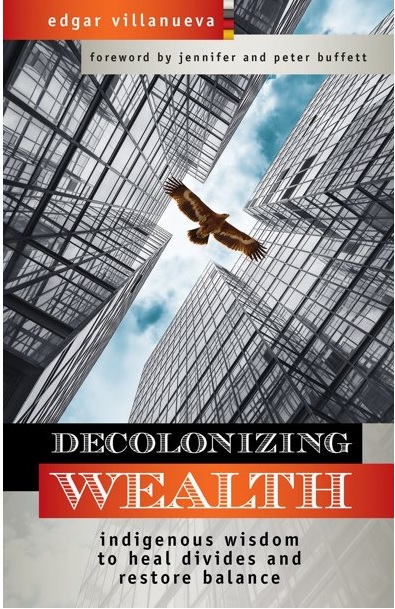
After my colleague WK recommended it, I picked up Edgar Villanueva’s book Decolonizing Wealth and it is everything.

Villanueva speaks to everything from the history of colonization as a political and philosophical practice to basic leadership skills to the sins of fake diversity training (“global bleaching”) to Native American history.

White People: this is required reading for us.  This is a book to grapple with personally and in groups.  This is a book that will make it impossible to continue life as usual.

If we are serious about doing more than marching or posting how woke we are, please read this book and then work to decolonize our culture – including the Church.

P.S. Also please read The Bible. Compare and contrast with Villanueva’s book for a very interesting conversation.

Guest Blogger Kate Maynard

[Note: Kate Maynard and I went to high school together in Chapel Hill and I’ve invited her to share the poem she wrote this week.]

Double Sawbuck

They claim it started with a twenty-dollar bill

like the one in my hand. 

My note has ML 84304239 H,  

Legal Tender, Series 2013 stamped right on it. 

I assume it’s real. It says it is.


Andrew Jackson gazes out at me, 

lips pursed, unruffled despite the swirl in his hair, 

probably because he is backed by the White House

broadly etched on the other side, 

words about trusting God arching overhead.


This paper weighs nothing in my hand,

not worth much, just enough for few sandwiches, 

some small kitchen gadgets, a child’s toy,

or perhaps a pack of cigarettes, 

with change to spare. 


Counterfeit bills circulate, I know, 

but to my unpracticed eye 

mine seems real enough, but who the hell 

studies their money anyway, I just grab 

my change, rush off to my next errand.


But after this week’s events I think, 

I must be wrong, it must be worth so much more 

for someone to think a man’s cries I can’t breathe 

worth absolutely nothing in contrast, 

nothing Legal or Tender about it. 


Katherine H Maynard  6-1-2020

White People: Walking on Eggshells

“I’m afraid I’ll say the wrong thing.” 

This is what White People tell me sometimes in terms of “How to Talk with People of Color.”  (Reminder: I am a White Person myself.)

  • What if I say the wrong thing?
  • What if I unintentionally say something racist?
  • What if I make it worse?

We will.  We will use the wrong prepositions:

I am angry for you” instead of “I am angry with you.”

We will erroneously expect Black and Brown People to be our teachers.

“Would you please show me how to be anti-racist?” 

We will say profoundly stupid things.

“Can I touch your hair?”

We will expect People of Color to be sensitive to our shame and regret.

(Ugly Crying) “I’m so sorry my ancestors had slaves.”

So . . . here’s the thing:  it’s not the responsibility of our Brown and Black and Golden siblings to dry our tears, hear our sad stories, be our new best friends, instruct us on U.S. history and policy, or carry our burdens.

It’s our responsibility to educate ourselves, grapple with our own racial biases, listen more than talk, and use our privilege for good.

It might feel like walking on eggshells.  But at least we are moving when we walk.  At least we are not waiting for cultural transformation to magically happen without putting any skin in the game.

A friend shared with me last week that most White People will not care until White bodies are on the line.  I believe this is true.

Becoming anti-racist is something I’m trying to work on.  It’s exhausting work, but it’s not nearly as exhausting as it is to live in Black or Brown or Golden skin.  I am trying to pay attention.  I am remembering and asking others to remember personal stories of systemic racism and white supremacy.  I am trying to school myself.  I am trying to value friends with whom I disagree.

I will make mistakes.  So will you.  And we have no choice but to continue to walk forward.  As we walk, there will be fewer and fewer eggshells.


White People: As We Talk About Race Together

If you happen to be in a culture or congregation or family that is not talking about race in America right now, this post is not for you – except that I ask, “Why?”  If we are not talking about race now, when will we ever talk about race?

If your life context and culture and community is indeed talking about race right now, things are complex and fraught with factors that will undermine the conversations.  Can we avoid . . .

  • Making these conversations about ourselves?  This is not the time to seek personal glory for being woke.
  • Making these conversations about competition?  I cannot compare what I’m feeling as a White person to what Black and Brown people are feeling.  I have no idea what it feels like to be a Person of Color.  How dare we – White People – say, “I know how you feel” to a Brown or Black person.
  • Making excuses?  This is an excellent time to refrain from “whataboutisms.”
  • White-splaining?  Enough said.

White People: This is a good time to consider race.  Talk about it amongst yourselves with an emphasis on listening to people with whom we disagree.  That’s the beginning.

And here (again) is a resource to take the 21 Day Challenge.  Please.

Image from the June 2, 2020 protest in the Myers Park neighborhood of Charlotte, NC. 

Everyday White Supremacy

Most White Supremacists don’t wear white hoods.  Most look more like me.

As a faith leader with a platform and privilege, I’ve been trying to convince the White Church that “White Supremacy” is important for us to acknowledge.  Some of my colleagues – Black, Brown, and White – prefer “Racial Injustice” or “Systemic Racism” or “White Privilege.”  I’m more interested – at this time of my life – to name what’s really going on now and for the past 400 years: White Supremacy.

Yes, there is Racial Injustice. (I believe most people who look like me would acknowledge this.)

Yes, there is Systemic Racism. (I believe that fewer White people might agree with this, but students of U.S. history and politics would have a hard time denying it.)

Yes, there is White Privilege. (I often hear White friends say, “I worked hard for all I have.” And the truth is that even the poorest, least advantaged person with White skin enjoys privileges in this country that people with Brown or Black skin do not.)

And yet – White Supremacy is the culture, the legacy, and the norm of our nation.  It shows up every day, every time someone makes assumptions based on a person’s skin color.  Here’s what every day White Supremacy looks like when practiced by “good White people.”

  • A distinguished Black man is in the elevator of a prestigious building and we assume he is the elevator man, when actually he is a Supreme Court Justice.
  • A Black man dressed in casual clothing because he’s working in the yard is approached by a White woman driving by who asks how much he charges by the hour to do lawn work.  “I don’t charge anything,” he says to the woman.  “But the lady of the house lets me sleep with her.”  (He’s not the yard man.  He’s the owner of the house and was once my neighbor in IL.)
  • A White Mom calls her second grader’s school over the summer to ask that her son be in Mrs. Z’s class this fall.  She fully expects the principal to grant her wish because . . . well, just because she’s always been granted these requests.  And so have her friends. (This mom is a friend of mine.)
  • There are four Black boys in Mrs. T’s first grade and she places all four of them in the Turtle Group (which is – not so subtly – for “slower” students.)  As it turns out, three of the four boys test at advanced reading and math levels, but she had assumed that they’d grown up without enrichment opportunities. (One of their moms is a friend of mine.)
  • A college student is riding her bike on the “wrong side of the road” near the campus of Oregon State University and she is arrested by two police officers who handcuffed her and pinned her to the ground because she wouldn’t show her ID to them.  Picture this happening to a white coed.  (It wouldn’t.)
  • A 12 year old Black boy was playing with a toy gun at a playground with his sister and others.  Someone called 911 to report that there was someone pointing a gun in the park.  Twice the caller said it was probably a toy gun and the caller even mentioned that the person with a gun “was probably a juvenile.”  But that information was not shared with the two policemen who drove up to the park and shot the boy within seconds of parking their car. Imagine that happening to a 12 year old White boy.
  • Two Black seminarians are in a public high school parking lot near their campus.  One is teaching the other to drive a stick shift.  A police officer approaches them, asks for their IDs and arrests both of them for trespassing.  (They were seminary classmates of mine.)

Every. Single. Day. It’s assumed in countless places that Black and Brown people do not belong in the places where they actually live, work, shop, and play.  It’s assumed that Black and Brown people are not worth as much as White people and that they are more dangerous, less intelligent, less law-abiding, less disciplined than White people.

This is the sin that continues to tear our nation apart.  White People: we need to acknowledge that White Supremacy is our problem.  Once acknowledging it, we need to learn about it, talk about it, dismantle it.

Here’s one place to start.

May the Spirit move us – for the love of God – to do more than talk.