I don’t want to make a recycling bin out of melted aluminum cans. I don’t want to make an automatic plant watering system from plastic bottles. I don’t want to make a Christmas wreath out of feathers.
I marvel at the Renaissance People in my life. You know who you are. (Her crafts make excellent gifts.)
I remember hearing a sermon preached by a seminary professor called “Craft Me a People” based on Ephesians 4:11-13 – the passage on equipping people for ministry and “building the body of Christ.” Obviously this is not a Do-It-Yourself endeavor. Equipping God’s people to serve is a team effort guided by the Spirit. DIY Pastors are tired/ridiculous leaders. Not one of us can do it all by ourselves.
(Note to pastors who solely preach, teach, visit, vacuum, unlock, set the heat/AC, and answer the phone: you are killing your church. And congregations allowing you to do this are choosing to die.)
So . . . how do we craft God’s people for these days? It has nothing to do with yarn or clay. It’s about equipping faith leaders instead of managers, pray-ers instead of complainers, and people who see possibilities instead of dead ends. We need more visionaries and adventurers in the name of Jesus.
It’s almost officer training time for new leaders. Imagine teaching them how to pray out loud (I know! Shocking) or how to share their faith story to the congregation or how to visit someone’s bedside not merely as a friend but as a sibling in Christ. If this sounds too churchy for you, let’s remember that we are spiritual communities, not secular clubs.
If crafting is your gift, go for it. On this week when I remember my sister Cindy Bolbach who passed away 12 years ago Thursday, I cling to our hilarious conversations about being allergic to glitter and glue guns. We didn’t do crafts. But she taught me a lot about crafting God’s people.
After the most recent election, some say that they are leaving the country for their own safety. (This is no joke for people whose very existence is at risk.) I understand this completely.
Others want to organize politically. I get this too.
But I suggest that we resist in Jesus’ name. Our King (today is Christ the King Sunday) and the Incarnate Word (next week we begin Advent) is Jesus. And Jesus has many things to say about loving our neighbors, sharing our wealth, tending to “the least of these” and standing up to tyrants.
(Note to all who don’t want politics in the pulpit: Jesus was crucified for his loving response to the politics of his time. The pastoral is 100% political.)
Yesterday, the Presbytery of Charlotte held an Affordable Housing Symposium to introduce/share/teach about the need for more affordable housing in this area. The stats are overwhelming all across the country: there are not enough homes for low and middle income people: service workers, teachers, police officers, childcare providers. All I can say about this event is that my cup overflows. God is doing some very cool things via church people/disciples of Jesus who are open to being moved by the Spirit.
A couple folks recommended this book by the great Joan Gray. (We exhaust ourselves rowing the boat for years and years without getting very far. Let’s try a sail boat and let the Spirit move us.) Read it. Invite your friends to read it.
At least in my denomination, we are builders. We have not only built church facilities over the past 300 years in this country. We have built colleges and universities (4 in my Presbytery alone) and hospitals and camps and schools.
What will God move us to built next? That depends on where we live. What breaks God’s heart where you live? Build something to address that in the name of Jesus.
This is what Resistance in the Name of Jesus looks like:
The blind receive sight, the lame walk, those who have leprosy are cleansed, the deaf hear, the dead are raised, and the good news is proclaimed to the poor. The Gospel of Matthew 11:5
I was hungry and you gave me food, I was thirsty and you gave me something to drink, I was a stranger and you welcomed me, I was naked and you gave me clothing, I was sick and you took care of me, I was in prison and you visited me. (What serving “the least of these” looks like) The Gospel of Matthew 25:35-36.
In everything do to others as you would have them do to you. The Gospel of Matthew 7:12
I could go on but you get the gist. Yes, this is a time to resist those who do not hold abusers accountable. This is the time to resist cruelty. This is the time to resist greed. This is the time to resist those who make life unbearable for the poor. This is the time to resist those who say “Lord, Lord” but they only serve themselves. We resist in the name of Jesus. God is doing amazing things. And resisting will be hard.
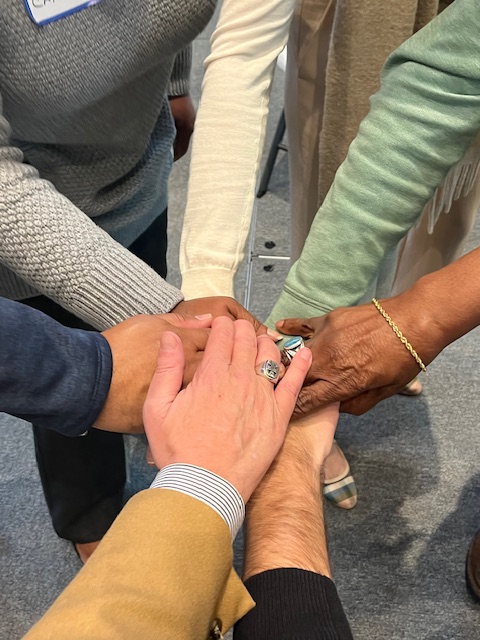
Image of the Housing Huddle Team at the end of yesterday’s symposium. Thanks be to God.
Optimistic means “things will get better.” Hopeful means “things could get better.” Liz Clasen-Kelly, Executive Director of Roof Above in Charlotte
I heard Liz say those words at a fundraiser last week and they inspire me post-election. I am inherently an optimist with every privilege making that possible:
“Things” have always gotten better for me after bad news, trauma, disappointments.
I have multiple safety nets.
My Scarlett O’Hara vibe is strong: Tara! Home. I’ll go home. And I’ll think of some way to get him back. After all… tomorrow is another day.
Again, privilege.
Today I believe that things could get better on this amazing, glorious, hot mess of a planet. Things could get better, but only if . . .
We notice our neighbors in distress
We serve in ways that address that distress
We shift from focussing on me to focussing on we
We understand that “we” includes all of God’s children.
I’ve tried to avoid analysis of the recent election for the sake of my wellbeing. But I heard one interview about voting in general that explained some of my questions last week.
People On The Street were asked why they vote and all of them – except one – said something like this:
“I vote for the candidates who will help improve my life.”
The one different answer was from a young man who said:
“I vote for the candidates who will offer the greater good to everyone.”
Two very different perspectives. And yes, it’s easy for that young man and any of us who agree with him to feel self-righteous. But also – this is who we are as Americans today. We are individualistic to the point of not caring nearly enough – if at all – for our neighbors especially the neighbors who don’t look or live like us.
We have an excellent opportunity as followers of Jesus to shift this perspective based on the Gospel. Imagine if – in each of our congregations – we worked towards shifting our church culture from serving ourselves first to serving our neighbors first. This would change the world.
Why do I ask that question in light of the fact that we Christians are supposed to be doing that already? Because we aren’t doing that already. We don’t love our neighbors as ourselves. We consider our own wellbeing before considering what’s good for the whole.
But I am hopeful.
Do yourselves a favor and listen to this sermon preached by the Rev. Jerrod Lowry on Sunday, November 17th starting at 48.7 on Ecclesiastes 3:1-8 called “So What Time Is It?” Newsflash: it’s time to be the Church so that all God’s children are treasured and safe especially in light of the recent election results. Trans people, pregnant people, newborn people, immigrating people, poor people, sick people, unhoused people, broken people. All of us are God’s children.
I am hopeful. Because of the Church of Jesus Christ, things could get better for all God’s Children. We just have to be that Church.
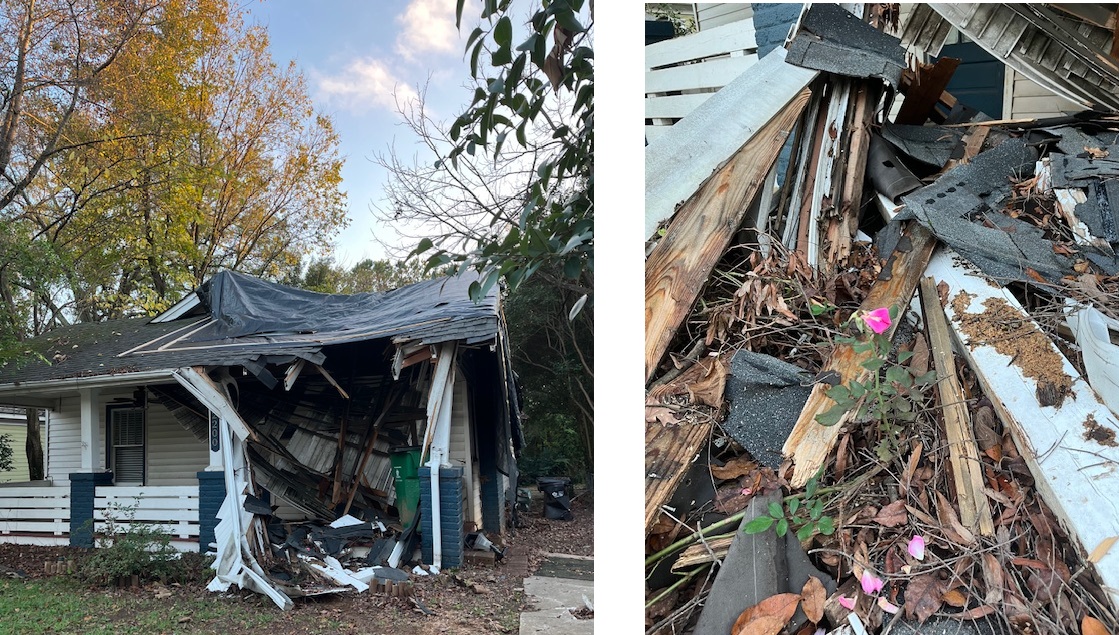
An old house in our neighborhood was crushed recently by an even older tree. Thankfully nobody was living there but nobody will be living there for a while. Actually it will most likely be razed.
I was walking the dog past this house the other day and noticed a pop of color among the ruins. It was a pink rose. A sign of hope in the midst of chaos. It helped me last week.
I have written about hope before – how some of us (privileged, blessed with a safety net) still have it after trauma and how some of us (generational refugees, victims of incessant wars) have never had it.
I’m weary of all the post-election analysis. Can we agree – no more analysis necessary – that this recent election reflects exactly who we are.
Christian People who have ostensibly been taught the basic teachings of Jesus and – nevertheless – choose a twice impeached felon, found guilty of sexual assault and accused by dozens of others, who has actually campaigned that disabled people, POWs, refugees, immigrants, women, the poor, the war-wounded, the war-dead, gang members, trans people, children falsely accused of crime, Muslims, and Palestinians are not created in God’s image.
Where is the hope if not only Christians but especially Christians – would choose this person to lead a nation that purports to
Where is the hope when bullies not only win but they reward other bullies? Where is the hope when the vulnerable are made more vulnerable by those in power? Where is the hope when people charged with establishing justice are guilty of injustice?
As a follower of Jesus, I continue to believe that Jesus is our hope. There is a more eternal resurrection coming than the one recently experienced by the 45th and soon the 47th President.
Where is the hope? It’s in Jesus. And it’s in those of us who authentically want to follow Jesus. What if each of us committed each day to offer hope to the world in some small way:
Volunteer to help refugees, victims of natural disasters, hungry people. (Don’t just send $. Make a new friend who can teach us something about life.)
Notice. Notice the elderly man in the coffee shop who sits alone and say “hi.” Notice the mom who is struggling with tired children and tell her she’s doing a good job. Notice hardworking people and thank them.
Ask God to help us be energized to do the right thing and be the people we were created to be.
There is so much trauma. We have a cosmic purpose to support those who have no hope.
(Note: The owner of the property pictured above is actively buying many contiguous homes in our neighborhood in hopes of developing additional mid-rise or high-rise apartments. His company bought this property in the last six months from an elderly couple for cash. What was once an affordable home will eventually become part of a not-so-affordable apartment complex along with several other properties on our street. This exacerbates the housing crisis in Charlotte, NC but that’s for another post.)
When Denise Anderson and I stood for Co-Moderators of our denomination’s General Assembly in 2016, we were taught to talk in terms of “prevailing” or “not prevailing.” We prevailed. We did not “win.”
Standing for Co-Moderator was about a calling from God. We felt called to “stand.” (Note: you don’t “run” for this office; you “stand.”)
When asked “When did you first feel called to serve as Co-Moderators?” we agree that we realized we were called to serve the moment we got elected. We honestly didn’t know until that moment.
On Tuesday, November 5, in the year of our LORD 2024, eligible voters in the United States of America – including all territories (e.g. Puerto Rico) – will vote for a number of national, state, and local leaders. The eyes of the entire world are watching the election of our new President. I have been trying to prepare myself as well as our Presbytery for the results, no matter who prevails.
The problem is going to be that this election will be seen as resulting in “winners” and “losers.” There will be accusations and aspersions. There will be trash-talking and name-calling.
I find myself begging God for results that will result – instead – in peaceful transitions and authentic patriotism. I pray that we will come together and work for a nation that values all people by virtue of their humanity. As a follower of Jesus, I pray that our leaders – from the President to the Commissioner of Roads will recognize that each person on this planet in every condition is created in God’s image.
Remember that in the reign of God, not only will the first be last and the last will be first. But the world’s losers will be God’s winners and “life’s winners” will actually be the losers. In the words of Rob Bell: Weak is the new strong in God’s world.
Justice will come to bullies. The Truth will set us free. There will be resurrection even after humiliating death. This I believe. This is what I deeply want to believe.
Whatever happens on November 5 and the weeks after, maybe it would help to lift up those whose candidates do not prevail. Jesus taught us to pray for our enemies and to care for the least of these. This week is an exceptional opportunity to try to respond as Christ would respond.
If you haven’t done so already, please cast your vote on November 5. God help us.
“I looked at myself and I realized I am no longer the best coach to lead this program in this current environment.” Tony Bennett, University of Virginia Head Basketball Coach.
I have long been a fan of UNC basketball and their coaches, but there is another basketball coach I’ve long counted among my favorites: Tony Bennett of the University of Virginia.
In an athletic conference of full of GOATs, Tony Bennett still stands out. His career as a high school, college, and professional basketball player is impressive, but as a coach, he is even more extraordinary.
It’s not only because his team won the NCAA title in 2019 and not only because he has been voted national coach of the year multiple times, but because he is also a most excellent human being. He has modeled good sportsmanship and humility in a field where NCAA violations and arrogance are not uncommon.
And then the NIL rules kicked in. Starting in 2021, college players could be paid for the use of their Name, Image, and Likeness – which is fair. Even Coach Bennett says so.
Also in 2021, collegiate basketball players were allowed to enter the NCAA Transfer Portal which means a player can transfer to another college without having to sit out a year before playing for their new team.
“This game, I think it’s right for players, student-athletes to receive revenue. Please don’t mistake me, I do. I think it is. But the game and college athletics is not in a healthy spot. It’s not, and there needs to be change. It’s not going to go back — I think I was equipped to do the job here the old way. That’s who I am, and that’s how it was.”Coach Tony Bennett
I can imagine that it’s hard to coalesce a team of college students while some players are making serious money with shoe deals and others might be leaving just as the team starts to gel.
Believe me, I know the feeling. I once served a congregation just outside D.C. which we often called “a way station.” We were the church they joined fresh out of college or grad school when they moved to Our Nation’s Capital to change the world. But just as we’d equip a team of leaders to lead, they would move “back home” to Nebraska or Kentucky or Ohio. Or they would decide to settle in the suburbs where they could afford a home with a yard. I kind of had abandonment issues.
2021 was a year of dramatic shifts not only for college basketball. Every profession and every community changed forever because of COVID. Those post-COVID shifts deeply impacted The Church and professional ministry.
It’s been true for a long time that clergy need different skills in 21st Century ministry than were needed in the 20th Century. In addition to preaching, teaching, administration and pastoral care chops, 21st Century ministers need somanythingsI’vebeenwritingaboutforawhilenow.
But there is an important skill all pastors need in these particular days of political division, unprecedented misinformation/disinformation and general meanness:
We need pastors who know how to be conciliators. In other words, we need pastors who can not only read the room; they also know how to calm anxious people and mediate pot-stirrers. We need pastors who are equal opportunity offenders in terms of secular politics – because the Bible is an equal opportunity offender. (Jim Wallis: God is not a Republican or a Democrat.) But they can be pastors to almost every kind of personality and political persuasion.
We need pastors with the energyto coalesce a congregation of independent-minded, individualistic, Biblically semi-literate, serenity-challenged individuals who live in a world where people are generally out for themselves. The largest generations living today are basically distrustful.
Today an unprecedented number people are incapacitated by fear, anxiety, abandonment, discomfort, and insecurity.
Again – we need spiritual leaders who can lead the Church in the old ways but also help congregations become spiritually healthy today. This is not for the fainthearted. To paraphrase Coach Tony Bennett:
“The Church is not in a healthy spot. It’s not, and there needs to be change. It’s not going to go back — we must be equipped to do the job here in new ways.”
It’s a rare gift to work with leaders like Coach Bennett who knows when it’s time to step away because things have changed and he’s not up for it.
It’s a rare gift to work with leaders in the Church who know when it’s time to step away because things have changed and they are not up for it.
It’s a rare gift to work with leaders in the Church who are very good at the classic duties of a Pastor AND they know how to coalesce a community of diverse people into a congregation of effective followers of Jesus.
Such gifted Church leaders are out there. We need more of them.
As I chat with people who serve the Church like I do – namely Mid-Council Leaders/Bishops/Conference Leaders – I am finding that we are in the thick of what Phyllis Tickle called The Emergent Church. It’s hard to be the Church these days, and it’s often ugly. I hate watching Church People try to destroy each other. But I see it every day.
Things have changed. It’s not only okay; it is the moving of the Spirit.
In review
The Emergent Church/21st Century Church is not going to thrive because of pew comfort, pipe organ power, or Tiffany window flourishes.
We are never going back – to churches that resemble country clubs, heritage sites or social organizations. The Church of Jesus Christ is called – especially now – to be communities of spiritual support, welcome, and healing in the name of Jesus.
Congregations/denominations that will thrive in the future will be the spiritual communities that welcome and love the broken, the vulnerable, the least of these.
This is a holy, essential time for Jesus’ Church. I regularly hear lifelong Christians tell me that they don’t pray out loud, they don’t talk about Jesus in public, they don’t know how to articulate why they believe that Jesus is Lord. Especially for mainline Christians, we need to be confident in talking about our faith.
I, for one, believe that God calls all kinds of people to serve. They might be transgender. They might be addicts. They might be shy. They might be children. But God calls all kinds of people to serve. This I believe.
I believe that denominations and other non-denominational churches that welcome all God’s children to be disciples/leaders/ministers – even women, even LGBTQA humans, even marginalized people – are the future of the Church. We need each other. We are all created in God’s image.
In my own ministry, I am seeing people reject each other for many reasons – mostly reasons of individual perspective and experience. My own brother doesn’t believe that women are called into church leadership and yet he says, “I’m just not there yet” as if one day, he might be.
I’m not there yet is a wonderful way to describe where we are, especially if we have hard time believing that God might thoroughly love and call into ministry people who make us uncomfortable.
I feel like I’m living in Crazy Town sometimes. The Church I love can be cruel and ever so judgmental. And yet I know that God is unspeakably good. God even loves me. God even loves you.
Please refrain from demonizing each other. Please trust that the Spirit of God is working. Expect to be surprised. God loves even the people we hate. Really.
Zillow just announced that – in its home listings – it would now include a Climate Risk Score with each home for sale. The hope is that potential homebuyers will be able to avoid homes in a flood plain, on a fault line, in a tornado zone, or in a hurricane-prone region. In other words: Buyers Beware.
I would love to have this kind of honest assessment for our churches and pastors.
When I served a church in Virginia, we opened Session meetings by sharing our “internal weather.” It helped to identify where everybody was – spiritually and emotionally – after a long day. Elders might share that their internal weather was stormy (maybe some chaos at work?), sunny (all is well), or overcast (a friend is sick?) This was helpful as important business was being discussed because we would have insights about where our colleagues were coming from. And it gave us an idea how we might support each other.
Imagine congregations and pastoral leaders being thoroughly honest about where they are and who they are in terms of Climate Change.
What if pastoral candidates (and any other leader seeking a church position) were told that the church they are considering . . .
Was experiencing unprecedented dryness? The dryness has impacted spiritual health and fires easily break out where there were never fires before. Members have been forced to move to more fertile communities. (Obviously this church needs a pastor who exemplifies and points us to Living Water.)
Feels like it’s on the cusp of springtime? New initiatives are about to bloom. Long planted seeds are rooting and poking up out of rich soil. God’s creation is vivid and inspiring everywhere we look.(Obviously this church needs someone who will know how to fertilize and tend the soil and keep the growth coming.)
Is on fire? (And not in a Pentecost way.) Our church is a hot mess. What we’ve loved is gone. We don’t know where to begin to recover. (Obviously this church does not need an incendiary leader. They need leaders who not only put the fires out, but they know how to repair the soil.)
Is under a dark cloud? Is the dark cloud actually air pollution – which is hard to get rid of? Or is it a small passing storm that will turn into a sunny day tomorrow? (Obviously this church needs someone who is right beside them in the darkness with the belief that the Light is possible.)
Is in the eye of a very destructive storm? While this sounds scary, it’s actually quite calm. Yes, a lot of turmoil is going on “out there” but we are okay for now. (Obviously this church needs to stay strong in the midst of a volatile world with a non-anxious presence in leadership.)
And what if interviewing committees were told that the candidates they are considering . . .
Have been like a hail storm in previous positions? It seems fun (golf balls!) but it can be very destructive.
Are susceptible to starting wildfires? The sermons are incendiary and there are private comments to certain members that only stoke the flames.
Have served in the midst of more destruction than a whole season of hurricanes? This pastor has never had a successful pastorate although they seem so amazing.
The reality is that pastors need work and congregations need pastors. Sometimes we accept what we know to be an imperfect situation – and it is an underrated privilege when we have options. But one of the joys of my ministry involves observing individuals and congregations find each other and become The Church as God intended.
Climate Change – in terms of Church World – is not necessarily a bad thing. Sometimes we need the climate to change to the glory of God.
There are lots of fish in the sea. (Me: But are there any potential human partners?)
It’s better not to have a spouse than to wish you didn’t have one. (Me: Also true for congregations.)
There is no such thing as “the one.” (Me: A reminder for Pastor Nominating Committees too.)
Opposites attract. (Me: Nope.)
Don’t try to be more attractive than you are (i.e. don’t use a headshot from 2001 when you looked younger). Me: Don’t agree with everything a PNC – or a candidate – says in hopes of appearing more attractive than you are to them.)
I expect my partner to be my Everything – best friend, confidant, tennis partner, etc. (Me: Not only can your pastor NOT be your everything – i.e. shepherd, savior, bff – but pastors must have relationships with people who are not in their congregation. The church can’t be the pastor’s Everything either.)
Nice guys finish last. (Me: Just as we should run from romantic partners who are Not Nice Guys/Gals, PNCs need to avoid the pastors with perfect hair who look good on paper but in real life are not so great. PNCs need to take a hard look at the ones who might not look like your dream pastor but God is calling them to lead you because they are awesome – real, inventive, joyful, followers of Jesus rather than believing they are Jesus.)
I am reminded daily of Phyllis Tickle’s “Every 500 Years” teaching in that the tumultuous shifts happening in The Emerging Church – today’s Church – have moved from slight tremors to Richter Scale worthy quakes. Honestly, Church World is particularly tumultuous these days.
And it’s showing up mostly when churches are calling new pastors. Too many of our Pastor Nominating Committees are realizing that they are seeking new leadership based on myths, dated assumptions, and impossible expectations.
Just because you call a young pastor with little children, your congregation will not grow/attract young families. This is a myth.
Just because you are a ‘great church’ doesn’t mean you will be inundated with amazing pastoral candidates. Fewer people are going to seminary, looking to move, etc. Once upon a time you might have had 300 candidates. Now you might have 20 – if lucky.
Just because you call a pastor who reminds you of a much-loved former pastor doesn’t mean that this is who you need now. And believe me, that former pastor lookalike is not your former pastor.
Just because you say you want to “get back to where we were 20 years ago” doesn’t mean that will ever, ever, ever happen under any pastor. Truth: it will never again be like it was 20 years ago. Or five years ago.
Please do not call a pastor who isn’t a good match for 2024 and beyond. Consider where you are as a church today. Look for someone who will love you no matter what and who wants you to thrive according to how the Spirit is leading you.
The same could be said for a romantic/life partner.
[Note: First and foremost, our hearts are with our friends in Western N.C. and those parts of S.C. TN. and GA. who were similarly hit by Helene. Please consider helping as you are able here.]
How do we identify ourselves first and foremost? Quickly: What’s the first identifier that pops into your head? American? Lutheran? Lawyer? Bob & Betty’s Daughter? Sophie’s Dad? Carpool Mom? Head of Staff? Senior Citizen? Gen X-er?
In working with congregations, especially congregations seeking a new pastor, I regularly talk with church people about how they identify themselves. Some churches self-describe as “small town” or “mission-minded” or “historic.”
Increasingly I am hearing congregations describe themselves in political terms. They are “red” or “blue” or “purple” – although this begs the question: are you reddish purple or bluish purple?
I am very concerned about this. If our fundamental identity as Christians is based on our politics (and not the other way around) then we are confused and confusing followers of Jesus. I received a letter recently criticizing the Presbyterian Church USA for promoting an agenda aligned with the Democratic Party. The evidence noted in the letter was:
That we do a land acknowledgement at the beginning of our Presbytery meetings. Our August meeting opened with an acknowledgment that the land on which we meet and worship was originally native land. And – also in August – the Democratic National Convention started with a land acknowledgement. I frankly don’t know why the Democrats did this, but we Presbyterians do it (as recommended by the 223rd General Assembly in 2018) as an act of confession. It is faithful to acknowledge our complicity in hurting the indigenous peoples of our country. One source here.
That we remember the history of white supremacy in our Presbytery as we were voting on dispersing funds that come from the sale of church property – especially the property of our historically African American Churches. We did this not because we are politically “woke.” It is faithful to make amends. See Numbers 5:6-7, Leviticus 6:1-7, Ezekiel 33:11, Matthew 5:23-24.
That the 2025 Program Calendar published by the PCUSA includes March 31 as Transgender Day of Visibility (which was approved by the 225th General Assembly in June 2024.) Transgender visibility struck the letter writer as being inappropriate for the Church. But – as we acknowledge that the Church includes those who find transgender and nonbinary language troubling – the Church also includes transgender and nonbinary people who are at increased risk of violence. We need to see this and them. In faith, we believe that Jesus died for all the world – including LGBTQA people – that the world might be saved through him.
Jesus also died for MAGA Republicans, Christian Nationalists, the staff of MSNBC and Fox, Benjamin Netanyahu, Ismail Haniyeh, Marjorie Taylor Green, AOC, that guy with the horns on January 6, Ashli Babbit’s Mom, and you and me. It’s incredibly annoying, isn’t it?
Anne Lamott is right:
“You can safely assume you’ve created God in your own image when it turns out that God hates all the same people you do.”
Church: if our bedrock identity is Child of God or Follower of Jesus, we will be more likely to (try to) love as God loves. We might even be able to be a Church in which Democrats and Republicans can sit side by side in sanctuary pews and work together to serve the broken, the invisible, the vulnerable not because we are “tolerant” but because we are trying to figure out the will of God.
Let’s strive to be faithful people who grapple with issues of faith and life. Not a red or a blue or a purple church.









 A Church for Starving Artists