We Have a Hate Crisis

Why do so many of us seem to hate each other?  While it appears that we have an enormous immigration problem in our country, the bigger issue is that we have a hate problem.

This opinion piece by Paul Krugman last week spelled out a couple of explanations for why our personal hate quotients seem to have ratcheted up, especially in light of the turmoil on the US-Mexican border.

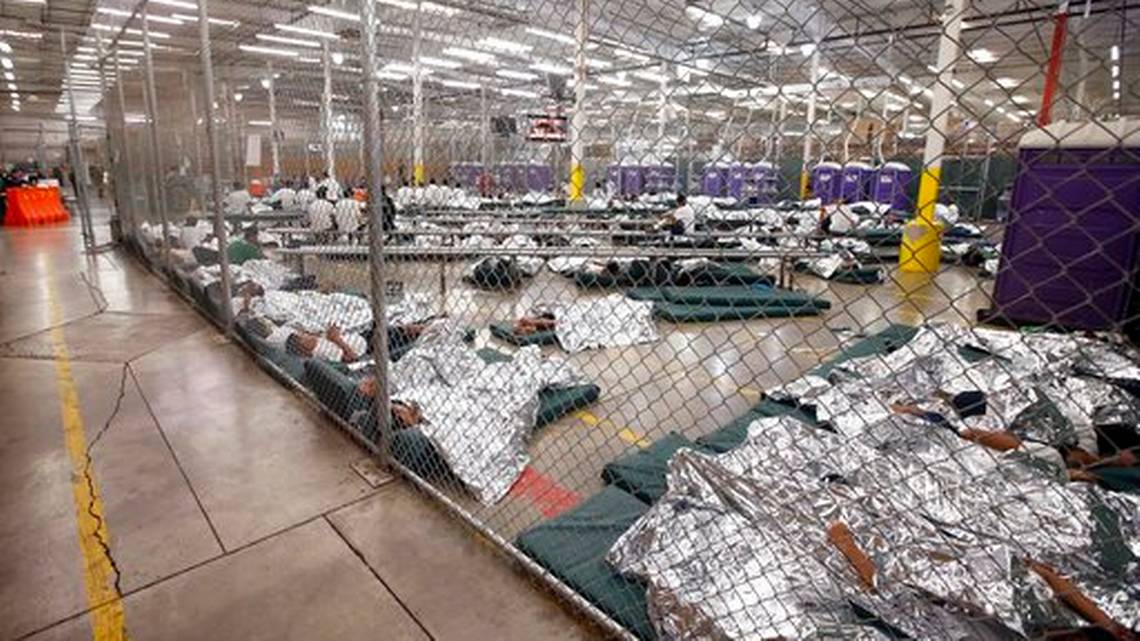
  1. Misinformation about immigrants at the border is rampant.  Immigrants rarely take our jobs or murder our children.  In fact, there is a negative correlation between violent crime and undocumented immigrants.  Most Americans do not want jobs that involve picking tomatoes eight hours a day or cleaning hotel bathrooms.  And whether people are being held in cages, tents, or barracks, the language around housing for immigrants is emotional and terrifying and can be incendiary.
  2. People tend to hate/distrust what is unfamiliar.  According to the Krugman article “The most anti-immigrant states seem to be places, like West Virginia, where hardly any immigrants live.”  Even if we do not have immigrants (or other groups that are often hated because “they aren’t like us“) in our communities, we need to try to learn.
  3. Too many people are okay with our President name-calling and sharing false information – as long as the economy is strong.  Using words about people like infest are dehumanizing.  Dehumanizing language literally kills people.

Just to be clear, righteous indignation and anger are not the problem.  Even God gets angry.

Jesus was angry when he witnessed injustice.  That Cleansing the Temple story is important enough in Scripture to be mentioned four times:  overturning tables and chairs according to the Gospels of Matthew and Mark, simply driving out the temple salesmen in Luke and pulling out a whip in John.

This is not the same as stirring up a crowd with epithets and lies.

There are times when righteous indignation is our responsibility:  when innocent people are being targeted, when there is no one speaking for the poor and powerless, when bullies are terrorizing people, when lies are proclaimed as truth.  If we are not speaking up in righteous indignation in those situations, we are as guilty of denying Christ as Peter.  Remember that story?

So what do we do when we interact with someone whose behavior has been hateful?  Do we heckle them in restaurants?  Do we refuse to serve them? Do we shame them in return for shaming others?  Jesus has told us what to do about these situations, but it’s very hard.  It takes a level of spiritual maturity that I do not yet have.

When our leaders seem to delight in shaming people, it’s important to speak up against that evil, but it’s not okay to return the evil for evil.

So . . . how to we tone down our culture’s Crisis of Hate?  I have a couple ideas.

  • When we hear something outrageous, we need to do our research.  Was Sarah Huckabee Sanders “kicked out” of the Red Hen Restaurant over the weekend?  Actually, it sounds like what happened was less dramatic and more thoughtful.  Check it out.
  • When we are confronted by someone who profoundly disagrees with us, we need to listen to them.  (And listening is not waiting for our turn to talk.)
  • We need to learn from each other. Why is my neighbor terrified of transgender people?  Why have parents risked their lives and the lives of their children to come to Texas from Honduras and El Salvador and Guatemala?  What can I learn from the undocumented person in my Church or my school?  What can I learn from the former coal miner or the addict or the barrista or the English as a Second Language teacher or the Black Lives Matter protester in my town?

We have got to take a breath and try hard to see each other through God’s eyes.  We have got to fight the hate that is bubbling around us – and in our own hearts.  It’s going to kill our souls.  And it’s going to kill more bodies.
Image source.


Too. Many. Words.

I love words. Beautiful words artfully placed together by the likes of Toni Morrison and Mary Oliver and Lin Manuel Miranda can change lives.

But sometimes there are too many words and this post is written after a week of reading overtures, manuals, articles, liturgies, indices, and quite a few tweets.  These are my end-of-the-week thoughts about words in Church World.

  1. No wonder the average person thinks Church is irrelevant when we spend more time in committees discussing the use of upper case vs lower case letters than having conversations with the people around us.
  2. Boxed factoids are a quick read and they spark interest:
    1. Did you know that Presbyterians in St. Louis during the General Assembly last week bailed out over 3 dozen poor, non-violent offenders who could not pay their cash bail for minor offenses?
    2. Did you know that there’s an Arabic speaking Presbyterian Church in Des Moines, Iowa led by a clergywoman from South Sudan?
    3. Did you know that members of the PCUSA have donated over 1.5 million dollars in grants to Puerto Rico since Hurricane Maria hit the island in 2016?
    4. Did you know that the Presbyterian Church has 220 congregations and 22 schools serving 6000 students in Pakistan?
  3.  Long form articles go unread much/most of the time.  (Are we still printing church newsletters with “musings from the pastor“?)
  4. We clergy like to hear our own voices.  Invite Ruling Elders to talk more.

It’s been a long week of words but – the great news – is that many of those words moved people:  the words of a young man who felt safe enough to come out in a room full of siblings in Christ, the words of the second Arabic-speaking woman ordained in the National Evangelical Synod of Syria and Lebanon, the words of children asking questions at the communion table, the words of installation to new Co-Moderators of the General Assembly.

But let’s use our words wisely and sparingly.  We have a lot of listening to do.

I Don’t Want to Love Ivanka

Worship yesterday morning at the PCUSA’s 223rd General Assembly was going to be especially wonderful because Najla Kassab would be our preacher. I met Najla in Lebanon last year and ever since I’ve become a shameless Fan Girl.  She is extraordinary.

And then God promptly cracked me over the head via Najla’s sermon.  Najla preached on this text and suddenly, surprisingly Ivanka’s face popped into my brain when these words were spoken:

First from the Apostle Paul:

“regard no one from a human point of view; even though we once knew Christ from a human point of view, we know him no longer in that way. So if anyone is in Christ, there is a new creation”

Then from Najla:

“Imagine if we saw everyone from a heavenly point of view.” 

And then from God to Jan:

“You can be a new creation only if you see the tender age shelter worker, the immigration officer, and Ivanka through the eyes of Christ.”

I confess before you and God that I have an especially hard time loving Ivanka. She seems to be tone deaf in her social media presence posting professionally posed photos with her own son while other mothers’ sons are being taken out of their arms on the Mexican border.  She seems to care about appearances more than true service, posting a tweet last week (which has since been removed) about the fact that the images of crying children at the border are a PR problem (but not a justice problem?) She seems to be using her proximity to power for enriching herself (coincidentally?) receiving coveted new trademarks in China just prior to her father promising to help President Xi Jinping save the Chinese telecommunications company, ZTE.

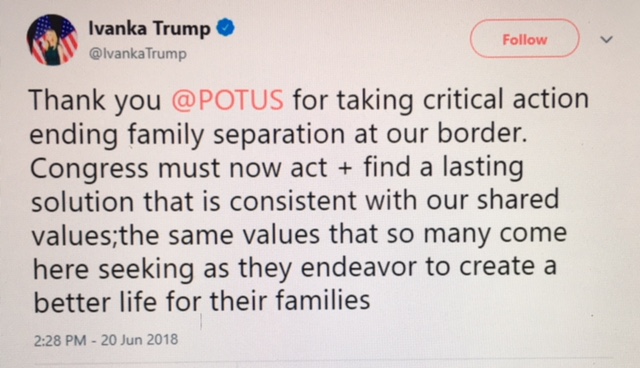
And just yesterday, she thanked her father for “taking critical action” on a crisis he himself initiated. 

I do not want to love her.  She strikes me as being the opposite of Jesus.

But I do want to be spiritually mature and whole and able to forgive as I’ve been forgiven.  I cannot change her – or anyone else – but I myself can change with some potent doses of divine help.  But I need to want to accept that help.

Who do you have a hard/impossible time loving?  Consider those people who have hurt the people you love or those who have hurt you:  the bullies, the abusers, the cheaters, the thieves.  And consider those who hurt the innocent in Flint and Syria and Tornillo and Yemen and Nigeria.

Najla preached on the importance of seeking “moments beyond the flesh.”  If we can see people – even those we deem as evil – then we can challenge them without hating them.  Again – this is a profoundly difficult spiritual practice.  Most days, I don’t want to love people like Ivanka.  I really don’t.

But I know that I need deep peace in order to do the work I’m called to do.  As a Church, we are called to have the energy to do what we Presbyterians did on Tuesday.  But we cannot do it well if we are incapacitated by anger towards other human beings.  Anger towards evil actions or lack of action – definitely.  But I for one am trying not to hate people.

It’s not easy.

Image source here.


This is What Theology Looks Like

I could not be prouder of my Church today.  About 400 of us marched from the St. Louis Convention Center to the courthouse to share $47,000 to bail out non-violent offenders who could not afford to pay their cash bail.

It has been our hope that the Presbyterian Church USA General Assembly would not merely come into town for a convention but that we would make a practical difference in the lives of regular people in the name of Jesus Christ who spent a lot of time talking about care for the poor.

We continue to meet to discuss issues and changes to our constitution.  But if we achieve nothing else, we have made a difference in the lives of at least three dozen people.

Here’s the local news report.

This is what theology looks like.

A Plea to Churches: Give Our Young Leaders Power

Live from the Presbyterian Church USA 223rd General Assembly in St. Louis:

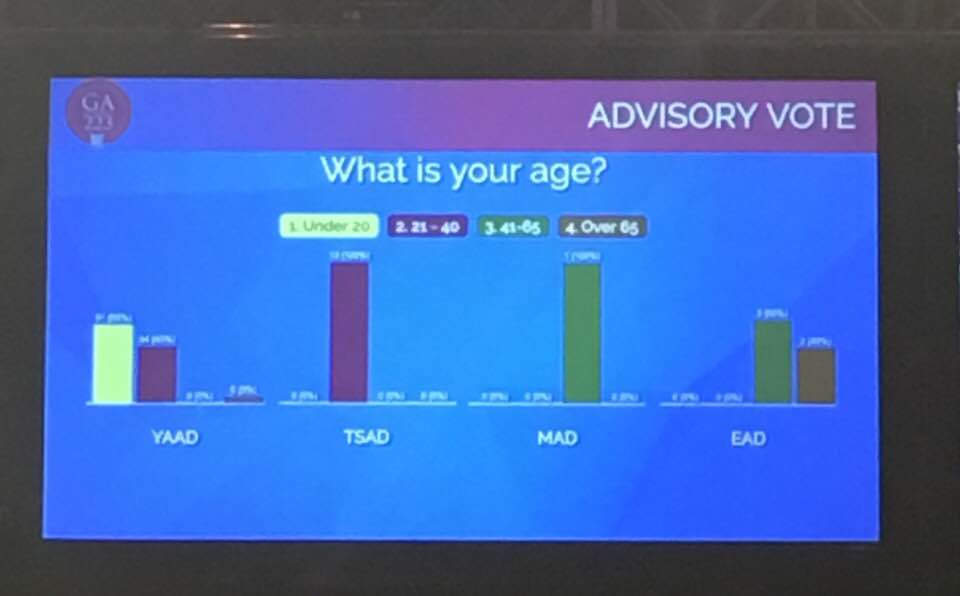
We elected amazing new Co-Moderators on Saturday night and – as with all votes – “Advisory Delegates” cast their votes first.  And then the actual Commissioners vote after being advised.

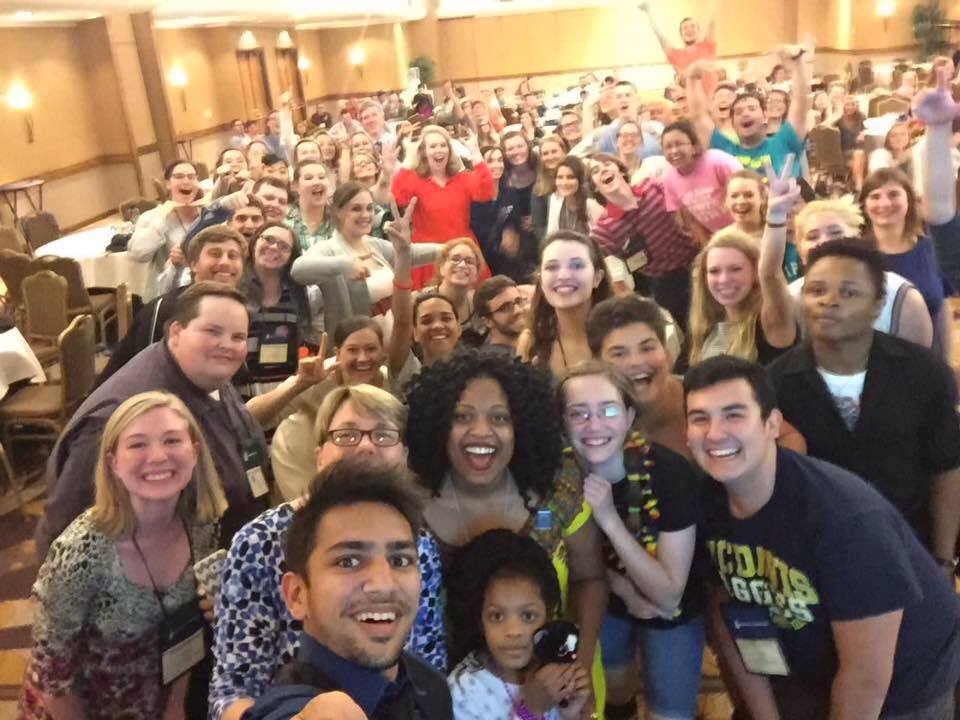
Our General Assembly Advisory Delegates include Young Adults (YAADs), Theological Students (TSADs), Ecumenical representatives (EADs), and Missionaries (MADs) and you can read more about them here.  The largest group are the YAADs who range from ages 17-23 and they are among the most important voices at the Assembly . . . except that their voices do not count in the official votes.  They are not voting commissioners.

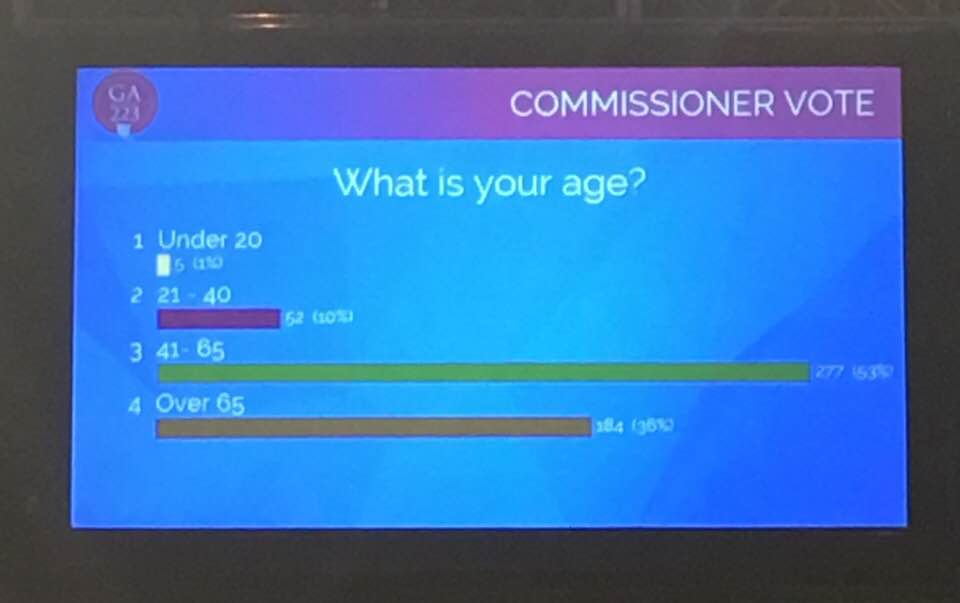
Please note in my photos from Saturday night that the age breakdown in terms of voting commissioners looks like this:

  • Under Age 20 – 5 (1%)
  • Ages 21-40 – 62 (10%)
  • Ages 41-65 – 277 (53%)
  • Over 65 – 144 (36%)

This looks pretty much the demographics for other denominations, but we have the power to make real changes in our denomination because we do not have bishops.  We can make our “corporate bishop” – the body of the General Assembly – younger by virtue of electing younger commissioners.

All commissioners to GA must be either Ruling Elders or Ministers of the Word and Sacraments and I’ve noticed that Ruling Elders and Ministers of the Word and Sacrament are elected to become official GA Commissioners after:

  • They have suggested their own names or their names have been suggested and then they are elected by their Presbyteries.
  • They have been nominated by a committee and are then elected by their Presbyteries.
  • Someone begs them to go (because nobody seems to want to go) and then they are elected by their Presbyteries.

Ministers of the Word and Sacrament – unless they graduated very early from high school and/or college are at least 24 years old after graduating also from seminary.  Ruling elders can be any age after confirmation – usually at least 13 years old.

As a former Co-Moderator of the 222nd General Assembly and as a former pastor and as a current Mid-Council leader, I am asking/begging/imploring/faithfully encouraging/praying that:

  1. Our congregations will strive to elect faithful teenagers to serve on our Sessions/Boards of Elders
  2. Our Presbyteries will strive to elect at least one commissioner to the 224th General Assembly in Baltimore who is under age 35.

Maybe your congregation does not have “young people.” But if you have a high school within 10 miles of your church building, you have young people in your community. 

  • Why are they not part of your congregation?  (Be careful for what you pray for.  The teenagers in your community might want to change some things.)
  • What is breaking their hearts and are you interested in addressing that issue in the name of Jesus?  If you don’t know or you don’t care, then your church is on the cusp of closing no matter what else you are doing.

There are young clergy people in most of our Presbyteries.  Please – for the love of God – do not use the responsibility of General Assembly Commissioners to reward older pastors for years of devotion to the institution.  Please do not elect commissioners who have no idea how to serve the 21st Century Church.  There are young in heart but older clergy who would also make excellent GA Commissioners in 2020.  Please, please, please start seeking them out now and keep your eye on the young and newly ordained as well.

This is how a denomination thrives:  when we have diversity – including age diversity.

(Also look for diversity in terms of life experience, skin color, gender and sexuality, and theology.  We best reflect God when we reflect the diversity around us that God made.)

I look forward to different age demographics among our voting commissioners in 2020.  Who’s with me?

Images are –  from top down – of the 222nd General Assembly YAADs in 2016, the 223rd General Assembly Advisory Delegate age demographics, and the 223rd General Assembly Commissioners age demographics.


Let Me Tell You About the Father of My Children

For the past two years, he has not only supported my ministry serving the General Assembly of our denomination, but he’s been my biggest fan and then some. He has taken me to and picked me up from the airport more times than we can count since June 2016.

His best days are when our kids and I are having great days.

He can be ridiculous in Dad-like ways (note the pants) and he has modeled both integrity and deep faith to our children throughout their lives and especially now that they are young adults.  He is brilliant and kind.  He loves our dog.  He makes healthy smoothies and rubs my feet when I’m exhausted.  A masterful insight or excellent pun from one of the kids makes his day.  He stands up to bullies and he has a soft spot for others who stand up to bullies.  I can’t thank him enough for being who he is and so I thank God.  It was a life-changing day when I met him.  (Thank you Susan Wonderland.)

Happy Father’s Day to the BDE.  LYB.

#GA223 #PCUSA

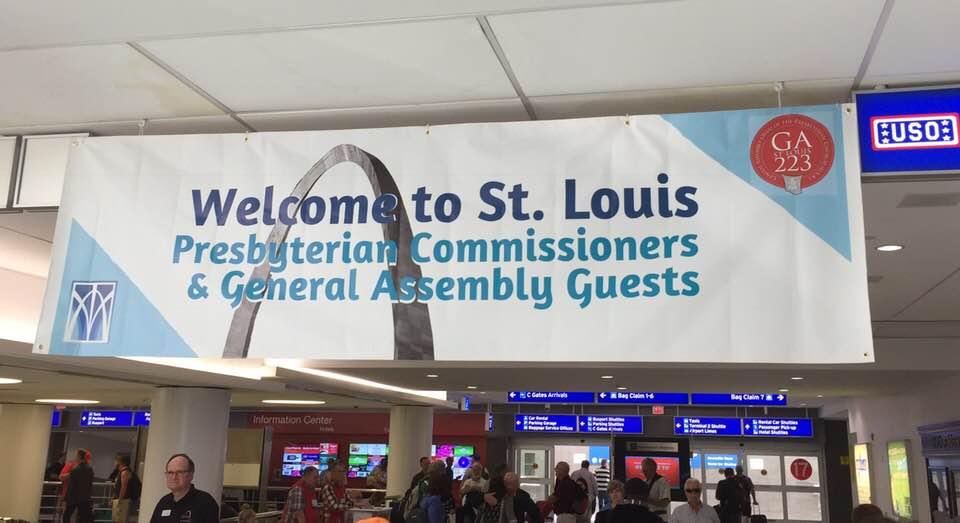
It’s General Assembly Week in the Presbyterian Church USA June 16-24 in St. Louis.  I might be writing here and I might not this week.  We’ll see.

It’s been a wonderful two years as Co-Moderator.  Thanks be to God.

The Mother of All Paradigm Shifts (*It’s Not About Getting People to Join Our Congregation)

Our faith communities are embracing huge paradigm shifts today — or they are dying.  One of the most basic shifts is being the church versus going to church.  And there is one singular alteration that surpasses all others.

Never again do I want to hear that “our church is opening a preschool/offering a computer class/calling a young pastor in hopes of attracting new people who will join our church.”  That’s not ministry.  That’s a transaction.  (The church gives A and in return the church receives B.)

My denominational leaders are meeting in St. Louis today for a week of business and reunions at the 223rd General Assembly.  We Presbyterians have been doing this for over 200 years:  meeting, worshiping, arguing, praying, making decisions.  We’ve split and reunited and split again.  We grapple with what God is calling us to be and do right now for such a time as this.  And sometimes we make mistakes.  And when we do the right thing, it’s by God’s grace.

But here’s the thing:  true ministry is not transactional.  We don’t follow Jesus to get into heaven.  (What kind of devotion to God is that if we are only doing it to get something out of it ourselves?)  We are not called to minister only to “our own.”  Jesus was not crucified for being cuddly.  [Note:  when our current day political leaders declare that obeying government laws is Biblical, they are overlooking that Jesus was executed for sedition. He broke Roman law – the law of the land.  Following the law is complicated in Holy Scripture.  Note Shiprah and Puah.]

We are called to reach out to the hungry, the homeless, the hopeless, and the broken even when – especially when – we will never personally benefit from that ministry.  We serve because we love in the name of Jesus, not because there is a heavenly or ecclesiastical benefit to us.

And so I leave today for St. Louis and look forward to the wrestling, the debating, the preaching, the singing, and the connecting with old and new friends.  I also look forward to noticing what the Spirit of God will do.  One of my hopes is that all of us who gather will embrace the changes around us that point us to being a more faithful Church.

Image of The Blessed Virgin Mary but I’m fairly certain that she didn’t look anything like this.

If This Is Not What You Believe, Please Speak Up.

Sometimes I sound political  because I am.  And I pray that my politics reflect what I say I believe about who God is and who we are as children of God.

A friend who has worked in border ministry along the Mexican border in Texas reminded me yesterday that little girls are often put on birth control for the trek across the border because it’s assumed that they will be sexually assaulted along the way.  Clearly people do not cross the border into Texas because they simply want a better job.  They are risking everything to find safety and freedom.

This story reminds me that the United States of America has become cruel.  We have always been cruel in many ways just as we have been noble in many ways.  Because I love our country, I want us to be better.

It’s true that our nation cannot accommodate every person who wishes to come to America.  But we have a duty to welcome those in danger because they are human beings.  This is the bottom line that trumps (sorry) all other things:  the men, women, and children we see at the border are human beings who have a God-given dignity we are called to respect.  This is a complicated issue, but it can be addressed in ways that do not strip us of our own humanity as Americans.

The President’s administration is doing this in our names.  Especially if you voted for him, this is the time to speak up.  I trust that those who did not vote for him are already speaking up.

Image is a file photo from June 18, 2014 when President Obama was in office.  It was wrong then and it’s wrong now as “The Trump administration is looking to build tent cities at military posts around Texas” according to McClatchy.

Intentional, Interstitial, and Invisible Spiritual Lives

I love this article by Daniel Pink.  It has everything to do with Church today – or more authentically – with 21st Century spiritual lives.

Dan Pink notes that – in his family – there are certain television programs that warrant carving out space to watch in real time:  the finale of The Americans, for example, and Better Call Saul.  There are other shows he likes but he watches them on his phone.  Or waiting for the dishwasher cycle to end.

The last television show that our family Stopped Everything For was Lost.  We ate island food every Wednesday night and even after FBC went to college, we had a family conference call to discuss the deeper meaning of Desmond’s visions or Charlie’s good-bye.  (Not Penny’s Boat!)  The finale fell on OBC’s birthday and we had an island cake with a crashed jet that caught on fire with the candles.  It was epic even if the finale was a disappointment.

So – connecting all this to our spiritual lives:

  • There are many people for whom Church is an interstitial activity.  It fills that space between one’s everyday, workaday world filled with chores and deadlines with a holier world of sermons and hymns and pews.  It’s what we do on Sundays.  And we will do it until we die – but maybe – if we are honest, we don’t want to think making disciples of all nations.  We just really hope we are going to heaven after all this.
  • There are many more people for whom Church is invisible. If I ask a random person on Main Street where the Methodist Church is or where I can find a Lutheran Church, most people in Hometown, America will not have any idea.  My local NPR station aired this program yesterday about the changing landscape of religion in North Carolina (my new home and a longtime notch on the Bible Belt.)  More than half of all Baby Boomers are unaffiliated in the U.S. now.  And this is even more true for Gen X-ers.  And even more true for Millennials.  And even more true of Generation Z.  And yet, the majority of these generations believe in God/a Higher Power.  Traditional church doesn’t do it for more than half of America these days.  [Note to my people:  so what are we going to do about it?]
  • There are many of us who are very intentional about our spiritual lives.  It’s appointment-worthy.  It’s holy.  It’s meaningful.  It connects them to each other and to something bigger.  They don’t want to miss it – with “it” being anything from a weekly worship time to a Bible study to Monday night community dinners to – even – a church meeting to talk about how we might help our neighbors.  We feel empty without it.

Dan Pink writes:

What’s more valuable is getting me to intend—to plan, to identify a block of time, and to summon a spouse or a friend. And that, in turn, changes the way creators ought to think about their creations. 

I hope we who lead spiritual communities/churches/temples are noting this.

Image source unknown.