1000 Under 25

college-conference

You’ve seen the lists:

  • Forbes’ 30 Under 30 list was published yesterday highlighting “today’s leading young change-makers and innovators in the U.S.” Many of them have experienced enormous financial success before their fourth decade on this earth.  Good for them.
  • South Carolina honors 20 leaders under 40 each year through The State magazine.  They include young mayors and business leaders.
  • Billboard published their 40 under 40 list last fall declaring that “today’s superstars wouldn’t be topping charts, filling arenas, and disrupting the music business without the vision and hustle of these pioneering young executives.

As writer Julie Rodgers tweeted yesterday “The 30 under 30 lists are cute and all, but I’m looking for 70 over 70 in 2017.  Where’s the love for our elders?”

Amen.

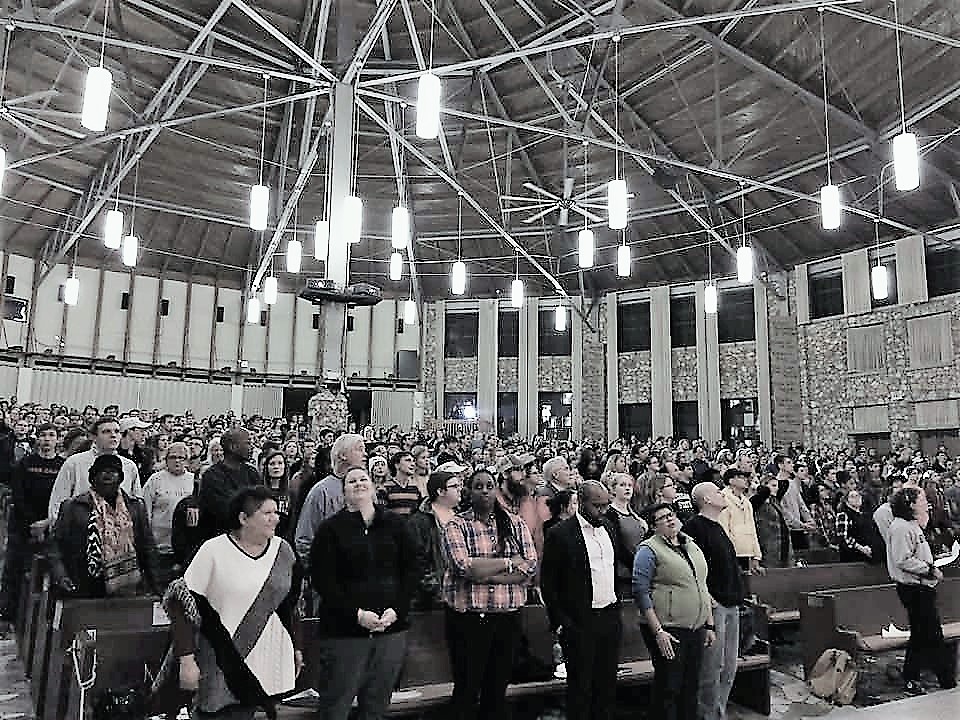
Nevertheless, I want The Church to know that there are 1000 under 25 who are spending the last days of their college winter vacation at the Montreat College Conference learning about being the hands and feet of Jesus, discovering their life’s purpose, serving faithfully in the business world, waking up to systemic racism, considering work as Young Adult Volunteers, and strategizing for social justice.  Actually most of them are younger than 25.  But their leaders are here too and most of them are under 35.

The Church is not dying; it’s reforming because we are here.”  J. Herbert Nelson, Stated Clerk of the Presbyterian Church USA reminded us of this truth yesterday.

Like an anthropologist studying exceedingly rare creatures, I’ve been asking around about these unicorns who have shown up at Montreat this week:

  • Do they all have a romantic idealism about saving the world?
  • Do they all hope to go to seminary one day?
  • Are they really here because they just wanted to get out of their parents’ houses for a couple of days before returning to college?

Actually many of them said that – get this – they want to be active in local congregations when they get out of school and start their first jobs.

Dear Church People:  Please do not waste this opportunity to welcome the participation and leadership of the young adults who cross the thresholds of your church building doors.  For the love of God (literally) please do not shatter their optimism with un-Jesus-like behavior. Please do not assume that you know what’s best for them.  (Maybe they don’t want to work in the nursery.)  Please listen to them when they tell you what they know.  They know a lot.   Sincerely, Jan

Also:

  1. Consider ordaining high school students and college students to the office of Ruling Elder.  Yes, they will be leaving town soon, but they have spiritual insights that we need to hear. And (with my co-moderator hat on)  Denise Anderson and I are often asked to select ruling elders to serve on committees and task forces. We would love to have a larger pool of leaders under 40 to consider. National church service is excellent experience both for the wider Church and for these young leaders as they discern their life’s calling.
  2. Allow young adults to mentor you.  I occasionally talk about co-mentoring – like here.  Yes, there’s wisdom that experienced/older leaders can share with not-so-experienced leaders but we have so much to learn about how to be a 21st Century Church from people who are turned off by a 20th Century Church mentality.
  3. Make intergenerational participation more than cosmetic. This, frankly, also goes for other kinds of inclusion (race, gender, sexual orientation, nationality, etc.)  It’s not enough to have a variety of participants.  We are best served by a variety of leaders.

The Church is not dying; it’s reforming.  There are over 1000 college students proving that before my eyes this week.  Thanks be to God.

Image from Anderson Auditorium at Montreat Conference Center on 1-2-17.
A Deeper Bench

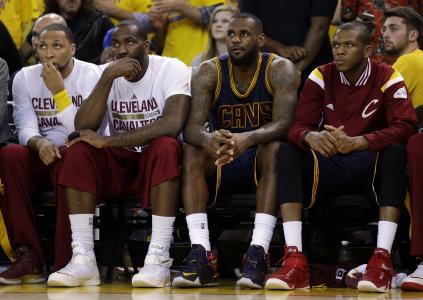
Imagine how good your basketball team is if your sixth man is LeBron James. lebron-on-the-benchLast year during the NBA playoffs, Lebron James offered to sacrifice his place in the starting lineup to be the Sixth Man if it would benefit his team –  the Cleveland Cavaliers.  He was willing to take a seat if it would get his team closer to winning the Eastern Conference.

This is not a post about basketball, though.

Many of our congregations are small and we believe our “bench” of volunteers is not strong.  We don’t know what we’d do without Mr. B teaching his Wednesday night Bible study because “there is no one else who could do it.”  Ms. C. has been in charge of coffee hour and flower arrangements and Vacation Bible School forever because she is good at those things and why change?

But I wonder if our bench is deeper than we’ve noticed.

This week, I’m at my denomination’s College Conference and more than 1000 college students and their pastors have come to talk about diversity and how God is nudging us in our relationships with God and each other.  They’ve come with ideas and callings and dreams.  Yes, they are busy college students.  But they won’t be in college forever.

And while there are probably some future seminarians in the room, most of the students I’ve talked with have plans to go into secular work after college.  These are our future church elders and deacons and teachers and worship leaders. Maybe.

It’s possible that their church participation won’t continue after college, but the fact that they are spending their winter vacation coming to a church conference makes me assume they take their faith somewhat seriously.

I wonder how we might continue mentor these students for leadership and be mentored by them in terms of doing effective ministry that will impact future generations.

But we don’t have any young people!” you might say.

And there could be many good reasons for this.  But my hope is that one of the reasons we don’t have young people is not because no one would ever take a seat to let them be in the starting lineup.

Don’t Read to Me. Talk to Me.

I am a big fan of reading books to children.

I am not a big fan of preachers reading sermons to me.  I also find it less and less inspirational to read unison prayers or responsive liturgies from church bulletins.  And this article helped me figure out why.  From Doug Chaplin:

carrie-fisher-as-leiaLiturgy should give us “words for speaking, not for reading” – which brings me to Carrie Fisher.

In her 1990 interview with Terry Gross, Carrie Fisher – who was in her own right an extraordinary writer – was asked, “Have there been lines you’ve had to read during your career that you didn’t think quite work that you really wanted to rewrite?”

Her response:

“General Kenobi, years ago you served my father in the Clone Wars. I have begged you to help… I have placed information vital to the survival of the rebellion into the memory systems of this R2 unit. My father will know how to retrieve it.”

Her point was there are some words that sound great on paper but they don’t convey the way people actually talk to each other – even in outer space.  Some lines make us all sound more like an R2 unit than a real person.

Liturgy can be like that too.  Doug Chaplin suggests that these words might sound too pious/formal/stilted/unnatural for our liturgy – especially if we are supposed to be talking to God.

churchtimes

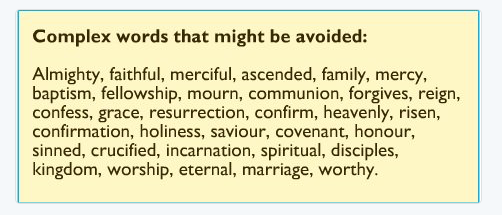
Frankly, I use some of these words in my day to day conversations but I’m a card-carrying professional minister.  I probably would not use words like “incarnation” or “fellowship” with my local barrista.  And it’s not that these words are actually “complex.”  It’s just that they do not connect most people with God.

God is real.  God’s heart breaks.  God’s Spirit calms me.  God’s presence helps me.

I am increasingly more connected to God when worship offers more time for silence than for repeating words – however beautiful – if those words sound like a recitation of somebody else’s sentences.  I am definitely not moved when a sermon is read to me rather than preached. I need stories. And I need an invitation to make God’s story my own.  I need a glimpse of authenticity regarding the preacher’s story too.

Don’t read to me.  Talk to me.  Make the story real.

Image of the future General Leia Organa with gratitude for the life of Carrie Fisher.

2017: The Year of Dignity

God gave each of us inherent worth and value; accept it in yourself, discover dignity-mosaicand encourage it in others, and peace may just be possible.  Archbishop Emeritus Desmond Tutu

Depending on who you talk to, 2017 is slated to be The Year of The Rooster or The Year of the Deal or The International Year of Sustainable Tourism for Development.

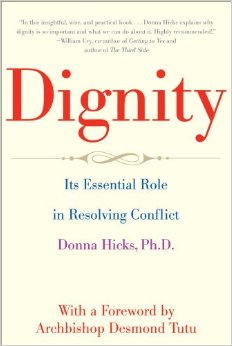
I’m hoping for something different.  A mentor recently recommended Dignity: The Essential Role It Plays in Dissolving Conflicts and it was the last book I read in 2016.

We live in undignified times.  

We are about to inaugurate a President who was recorded saying words that would have gotten him expelled from most elementary schools. At least one Pulitzer Prize-winning fact check organization has had a field day with his statements.  And to make matters worse, at least half the nation seems to hate this man.

There are some who will hate him and relish in schadenfreude no matter what he does in 2017.  And there are some who will love him and excuse his missteps no matter what he does in 2017.  So what’s a person to do?  Especially a person who is trying to follow Jesus.  Especially a person who loves this country.  Especially if we want to embrace our own human dignity and act accordingly.

dignity-by-donna-hicksDonna Hicks (the author of Dignity) writes that “dignity” is not the same thing as “respect.”  All human beings are born with an inherent dignity and worth.  We don’t have to respect everybody though.  Respect is earned.

My hope is that the 45th President will earn our respect and one of the ways he can do that (for me) will be to treat  women, refugees, Muslims, People of Color, and undocumented workers with dignity.  He will earn my respect when he pays attention to the needs of the poor.  He will earn my respect when he listens to people without waiting for his turn to talk.  He will earn my respect when he does not use the Presidency for personal gain or for the personal gain of his children.  This is my prayer.

In the meantime, we must treat him with dignity as a child of the living God. This is not always as simple or as easy as it sounds.  I will need divine help.  The President-Elect’s words have already hurt people I love.  His threats have already made a tangible negative impact on their lives.

But today brings a new year. And as a new spiritual discipline, I’m going to try to make 2017 The Year of Dignity  – at least in my own head.  My hope is that it will change my heart.  And as a bonus, maybe it will also help me with bad drivers, rude people, cranky people, bullies and Duke fans.

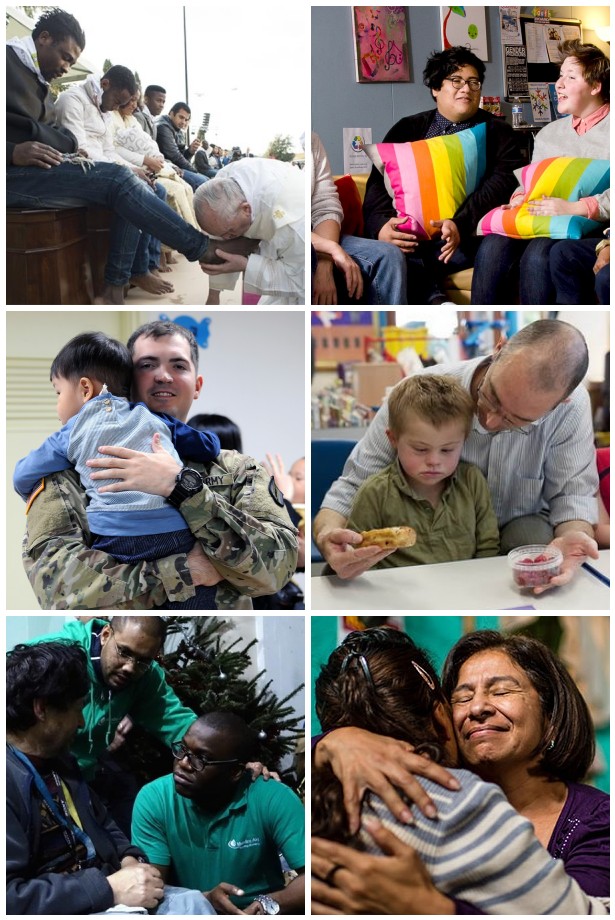
The mosaic shows 2016 highlights of human dignity acknowledged by ordinary people – and the Pope.  Clockwise from top left  1)  Pope Francis washing the feet of Muslim, Orthodox, Hindu, and Copt refugees in Castelnuovo di Porto, Italy, 2) LGBTQ support group meeting in Charlotte, NC  3) a man helping a child with special needs in Glasgow  4)  an aftercare worker comforting a trafficking victim in Guatemala City, 5) Muslim and Christian volunteers feeding the homeless in London, 6) a U.S. soldier visiting orphans in South Korea.  Not only do we belong to God; we are all created in God’s image. Amazing.

Good-bye 2016

As I  go semi-radio silent for the rest of 2016, here are some of my favoriteobama-waves-good-bye finds from the past year.

[Note:  I am a late-ish bloomer so what I discovered recently you might have discovered years ago.  Feel free to share your own discoveries in the comments if you wish.]

These are not in any particular order.  But all of these things have changed my life for good in the past year:

  • Standing for Co-Moderator of the PCUSA General Assembly is the way to go.  The 222nd General Assembly was the first time that Co-Moderators (rather an a Moderator and Vice-Moderator) could be elected . . . and we were elected.  The pluses include having an officially equal partner in this ministry and being able to model a healthy way to divide the travel responsibilities. Denise and I are committed to being away from our respective homes and jobs no more than 10 days a month (each.)  Usually it’s been more like 5-7 days away per month (each.)  This is doable  We hope to model that you don’t have to be retired or away from your regular job terribly much to serve as Co-Moderator.
  • Colson Whitehead is an extraordinary writer.  The Underground Railroad was my favorite novel  in 2016.
  • Chance the Rapper is the real thing.  Blessings keep falling in my lap.
  • Sally Kohn speaks the truth.  I’m not really a fan of the term “correctness” whether we are talking Political Correctness or Emotional Correctness, but we have got to learn what she calls Emotional Correctness if we are going to be a civilized nation.
  • Hydration Serum with Peptides by Lucrece makes me feel better.  I turned 60 in 2016.  Although I’m a big fan of wrinkles because it means your face is doing what it’s supposed to do (smile, frown, think hard) I also want to look kind of fresh faced . . . for a 60 year old.
  • Being 60 years old is underrated.    This is worth a whole blog post but you’ll just have to trust me on this one.
  • These are great days to be the Church.  Maybe the best of days because God does God’s best work when the world is a hot mess.  And the world is a hot mess.  As church participation continues to dwindle in most parts of the United States, congregations who have lost their reason to exist (clue:  Jesus didn’t die for church buildings) will continue to close and congregations that make an impact to care for the poor, the hungry, and the broken will continue to grow.  [Note: “best of days” means it’s good for God but probably stressful for God’s people.  500 years ago was no picnic for Christian Reformation leaders either. Luther was excommunicated less than 4 years after hammering those 95 theses into the church door.]
  • Hamilton was ubiquitous in 2016 among the privileged, but it continues to be the finest piece of art created in a long time. Look around, look around at how lucky we are to be alive right now.

We have holy work to do in 2017.  The nation is divided. The incoming administration does not seem to plan to prioritize the poor.  Fake news and vulgar behavior have become the norm.

This time next year, I hope we can look back and say that there was justice for those who have experienced injustice.  I hope we can look back and recall scientific breakthroughs, great art, feats of heroism, and another World Series win for the Cubs.  Okay – I’d be happy without another World Series for the Cubs, but it would be nice.

Happy New Year everyone.  May God bless each of us with strength.

So . . . Now That The Baby’s Born

christmas-ladderI believe the birth of Jesus changes things here and now.  

If it doesn’t, then Christmas is merely about presents and food and parties and a sentimental old story.

So*. . . what’s next?  If we believe the light of Christ has come into the darkness, we will want to let that light shine, right?  But sometimes shedding light on darkness is uncomfortable.  Cockroaches run when the lights are turned on.  Lies are revealed when light shines on them. Sometimes those lies are whoppers.

Among my personal favorites from a lifetime of professional ministry:

  • You are an only child.
  • Your uncle died in the war.
  • Your mother left the family for several months for cancer treatment.

Sometimes we lie to protect others.  Sometimes we lie to protect ourselves. Sometimes we lie to promote our agenda.

This article–  from what I believe is one of most reliable newspapers on earth – talks about today’s ubiquitous topic:  fake news.  Its twist is that political conservatives are accusing mainstream news outlets of being purveyors of fake news too.  It’s not just about outrageous stories coming out of new services called 100percentfedup.com or Huzlers.  Some fake new sites have real-sounding names like Bipartisan Report and ABCnews.Com.co.  A good list to check out is here.

But this morning’s article is about conservatives accusing journalists from top notch journalism schools with deception.

We live in a time when someone can repeat a lie over and over and over again to the point that people start to believe it.  But we need the truth – both politically and spiritually.

The truth will set us free, but first it might make us miserable.  The truth is that there is deception on all sides and it’s often hard to figure out what’s factual. Example:

  1. The Atlantic magazine reported on November 2nd – as did many outlets – that an African American Church was burned in Greenville, MS in November with “Vote Trump” painted on the wall.  This story was used as an example of more brazen racism as a result of Trump’s candidacy.
  2. The NY Times reported on December 21 – as did many outlets – that an African American member of the church was charged with the arson (so ostensibly it wasn’t a politically motivated event after all.)
  3. News outlets on both sides took these stories and used them for their own political purposes saying either that a) “Trump’s candidacy/election is incendiary“or b) “These accusations against Trump’s candidacy/election are false.”

Pontius Pilate once asked, “What is truth?” and it continues to be an excellent question.

From the NY Times story today: “We now live in this fragmented media world where you can block people you disagree with. You can only be exposed to stories that make you feel good about what you want to believe. Unfortunately, the truth is unpopular a lot. And a good fairy tale beats a harsh truth every time.”

So how do we connect our faith in the One called the Light of the World with what’s going on in our divided nation today?

Jesus said:  ‘See, I am sending you out like sheep into the midst of wolves; so be wise as serpents and innocent as doves.”

  • Read a variety of sources from media outlets.
  • Be critical thinkers.
  • If something you read makes you really, really angry, do your research.  It might not even be real.
  •  Here are more ideas for discerning real from fake news.

We who follow Jesus are called to be different.  I believe this and hope you do too.

Image of Christmas Ladder by Christian Ryan.

*h/t to my HH.

Merry Christmas 

Peace to all.

Great “First Calls”

There are jobs and there are callings. My first jobs included babysitting and waiting tables.  My first “call” to professional ministry was with a tiny church in a tiny town nowhere near family or friends.  I stayed for five years and the experience changed my life for good.

Now I work with clergy seeking their first calls and – on the cusp of this new year – I have great hopes for all who have finished the seminary race, have been deemed “ready” and now await the nudging of the Spirit.  What we have here is an Advent/New Year’s Resolution mashup.

It’s not as fun as waiting for Santa.

I’ve observed too many new pastors experience soul-sucking first calls.  The common denominators to these debacles include:

  • Congregations who were not transparent about their issues during the interview process. The issues might range from  no money to actually pay the new pastor to a failure to inform the new pastor that the Town Matriarch is actually the de facto pastor and you’ll be working for her to an expectation that the pastor is the hired help and it’s expected that he’ll do everything while we watch from the pews/parking lot.
  • Pastors who were not honest during the interview process. You said you loved youth work when you were just kidding/desperate to get ordained.
  • Colleagues who pitch themselves as collaborators but are not. You find yourself sabotaged by other staff members/volunteers for all kinds of reasons including feeling threatened, jealous, or basically cranky.

A good first call is a joyous thing and I’d love to hear your tips to finding a good first call if you have positive wisdom to share.  What I’ve noticed is this:

  • A good first call is all about God.  It’s not about “getting ordained” or “paying the rent” or “being in the same town with ___” or “impressing the parents” or anything other than being where God calls you to be.  You do not want to be where God isn’t calling you to be.  #disaster
  • A good first call will bolster your pastoral identity.  Whether your first call is in a parish, a hospital, a school, a homeless shelter, an interfaith organization, or a soup kitchen – if you are called to professional ministry by God in that particular setting, your understanding of yourself as a pastor will blossom.
  • A good first call is among people who allow you to have a life apart from work.  Your people will want their spiritual leader to have a social life, an intellectual life, and – yes – a spiritual life that will be fed beyond the congregation/ministry site. They will expect you to take your day(s) off.  They will be happy when you take vacation and study leave because they care about you.
  • A good first call allows for mistakes and missteps.  New pastors fail in small and huge ways.  Forgiveness goes both ways.

Actually these are helpful tips for all calls, but if they don’t happen in the first call, a pastor could find herself wounded and cynical to the point of never wanting a second call.

And here’s the last thing (which should be the first thing in your process towards ordination):  everyone is called to a life of ministry but not everyone is called to professional ministry.  This is one of the few professions that cannot be achieved like a certification program.  We can leap through every hoop and still not be called to that first call and, yes, that feels brutal.  But the good news is that we are still called to ministry.  It’s possible that it’s just not what we expected.

So to any of you who might hope that 2017 brings ordination:  I hope that for you too if that’s where God is leading you.  It’s all about the One whose birth we celebrate later this week and – just like the coming of the Messiah –  it’s always different from what we expect.

All I Want for Christmas is . . .

Let’s start with this.

A smart person I know mentioned recently that it’s easier to call people names (racist, stupid, privileged, misogynist, self-righteous, dismissive) than to attempt to connect.  [Note:  most of us are racist, stupid, privileged, misogynist, self-righteous, dismissive in our own way.]

In other words, we will never connect with anyone by calling them names (either out loud or in our heads.)  And do we really want to understand each other?  Or are we happy living in enmity?

Only  the sickest among us wants verbal/proverbial/actual war if you ask me.

Please watch the Sally Kohn TED Talk on the difference between political correctness and emotional correctness.  It might change your life and it’s less than six minutes long.

Basic takeaway: “We can be politically right and emotionally wrong.”

In the meantime . . .  this article was published recently about the long-standing racial divide in Arlington, Virginia which was my home for 22 years.  I love Arlington.  I love its politics.  I love its walkability.  I love its diversity.  I love how LGBTQ friendly it is. I love that it used to be part of the District but now it’s not but if you live there you still feel like you can say you live in DC.  I love how our neighbors were so interesting (our neighbors included lots of former Peace Corps workers, a professional magician who starred in TV specials, assorted White House staffers, teachers, an opera singer, several immigrant families.)

Also, Arlington County has some of the best schools in the country. Nevertheless, the high school in our neighborhood was Wakefield – also known as “the ghetto school” or “the bad high school.”

One of the problems with this article is that the white people on the north side of the country are called “pasty” which is not a helpful/emotionally correct thing to say.  And it’s not even factually true.  There is racial-ethnic diversity in North Arlington.  There is also economic diversity.

But most of all that diversity is in South Arlington, along with all the eyesore kinds of properties (i.e. school bus garages, warehouses, etc.)  It’s more expensive to live in North Arlington.

esse-quam-videriIt’s also not true to describe something/someone by what we have heard and not by what we’ve experienced.  Many have heard that Black men – for example – are dangerous.  My experience however is that Black men are smart, kind, polite, ambitious, etc.  Just like men of other skin colors.  There are not-so-nice men and women of all skin tones and nationalities.  It’s just that – in my opinion – men of color have been systematically profiled as dangerous.  It’s not true and it’s not right.

FBC shared yesterday that when people found out he went to Wakefield High School the reaction was that he must be crazy because “people get stabbed at Wakefield” or “there are gangs at Wakefield.”  This is what they had heard. The truth is that Wakefield – like every other high school in Arlington – offers an excellent education but with more cultural richness than most.

We live in a world that embraces lies as truth:  Obama is Muslim. Trump won the popular vote. Republicans are – by definition – racist. Democrats are – by definition – arrogant.  Christians hate gay people.  Muslims are terrorists.

None of these things are factually true.  When we are talking about groups of people (whole political parties, whole religions, etc.) it’s true that individuals within these groups can be embarrassments and worse.

But we have got to make judgments – if we make them at all – according to our experiences and not what we’ve heard/read on fake news/imagined.

The world is screaming.  I can barely listen anymore even though I want to holler myself.  All I want for Christmas – though – is a movement to become a more emotionally correct planet.

Image Esse Quam Videri is shared in honor of those in my home state of North Carolina who indeed believe it is better to be rather than to seem.  

Overcoming Death at Christmastime

bettys-apple-cake-recipeMy grandmother Ethel died on Christmas Day 1968 and it wasn’t as sad as it could have been.  We cried.  But I remember – even at 12 – that it was fortunate that she got to see her whole family who were in town for the holidays. She had lived a very full and beautiful life, and at last she was no longer in pain.

Pastors can attest to the fact that many church people die at Christmastime. Sometimes it’s horribly tragic and sometimes it feels a bit less traumatic.

And all of us can pinpoint deaths this time of year that are senseless and beyond brutal.  The Christmas eve car accident.  The (God help us) mass shooting.

HH attended a funeral yesterday that he didn’t officiate, which is rare.  The lovely woman who passed away had lived a remarkable life, blessed with more than the threescore and ten that the Psalmist suggests.  She almost made 90.

Here’s the best part:  her family printed her Secret Polish Apple Cake Recipe on the back of the funeral bulletin.

It got me thinking:  what recipe would I want on the back of my funeral bulletin? What last “secret thing” would we like our family and friends to know that only we can share?

Maybe it wouldn’t be a recipe.  Maybe it would be the secret to getting the baby to sleep, or the secret way to get the lawn mower started, or the secret way to live a life that others want to emulate.  That last one is a little presumptuous, so it probably wouldn’t happen.

What gift do we want to give for people to carry with them beyond our deaths?  It’s a good thing to be thinking about now,  Because we who follow Jesus can bet that God had already considered this long before Jesus was born.

So now I’m headed to the kitchen to bake Betty’s Polish Apple Cake.  I didn’t know her but I love her.