Who Will Carry On the Family Name?

“Within the domain of White Christian America, white Protestants have been locked in an internal dispute over who will carry on the family name.”  The End of White Christian America by Robert P. Jones

robertpjones-theendofwhitechristianamericaI didn’t change my name when I married HH but our children have his name (as well as mine in the middle.)  There are lots of Edmistons in my family and not many with HH’s last name.  If our kids wanted to hyphenate that’s their choice. But – from what I’ve noticed – they identify with both/all family names.

Carrying on the family name means different things to different people and I like the way that The End of White Christian America talks about the struggle to claim who is a “real Christian.”  In my denomination, there is also an historic battle over who the “real Presbyterians” are.

Maybe we should all get together and remember that we are cousins (with the same name.)  Cousins don’t always agree but ultimately we have the same roots.

Whomever carries the name ostensibly carries the power.  And whomever does the naming wields great power as well.  Remember Adam?

Robert P. Jones offers a clear history of the shifts from the days when White Protestants ran the country in every way to the days when that is no longer the case.  The powerful demographic changes in the United States are shifting everything.  (And they also explain why Donald Trump is a candidate for President.)

I am a White Protestant Christian writing this post from the Mother Ship of my denomination in Louisville, KY.  One of our ongoing conversations concerns how we as an overwhelmingly white denomination will move forward to be a  church that is relevant – and pleasing to God – in a changing world.

My first thought involves repentance.

Some of my people share the same name with people who have a darker skin color and that’s because of slavery.  People with my last name once believed that they could own people.  And then name them.

We who have benefited from injustice must acknowledge that we have indeed benefited from institutional racism all our lives regardless of our financial standing.  (Note:  we can be financially poor white people and still be privileged because it’s easier to be a poor person with white skin than a poor person with brown or black skin.)

We (in the dominant culture) need to educate ourselves about what it’s been like in this country to grow up without the obvious and not-so-obvious power of whiteness.

This is important because I believe that God claims us and renames us – whether we realize it or not.  We share one family name.  And remembering that truth is a spiritual discipline that changes everything.

Where Is God When Old Certainties Vanish?

‘ “Somebody is taking everything you are used to and you had” — your steady middle-class existence, your values, your security. It’s not that the economy is bad in all of Kentucky; the arrival of the auto industry has been a boon, and the unemployment rate is just 4.9 percent. It’s that all the old certainties have vanished.’ From this article by Roger Cohen 9-9-16

coal-country-kentuckyThis – of course – is the story of the 21st Century Church (especially if we miss the 20th Century Church.)  This is also why Donald Trump will win the votes of many who feel unheard and dismissed in Coal Country and beyond.  This is also why people are so angry at Colin Kaepernick.  This is why the world is feeling a little nutty.

Everything we used to consider certain is changing:

  • If you work hard, your job will be secure and you can stay until you retire.
  • If your church offers good preaching and strong Sunday School, people will come.
  • If you are a good American, you will be proud of our country no matter what.

It doesn’t seem fair or right.  And maybe it isn’t.  But God is in this.  We just need to figure out how and then move in God’s direction.

Because Jesus didn’t die for church institutions or corporations or flags.  Jesus died for human beings so that we might be the people we were created to be.  This is an everlasting certainty.

Image from Wikipedia.

Everybody Gets to Preach This Sunday (So What Will You Preach?)

This Sunday marks the 15th anniversary of four terrorist attacks in New York City, Arlington, VA, and Shanksville, PA.  It also marks the Muslim holiday Eid al-Adha.

Some people are concerned.

whirling-dervishWhen I was a pastor in Northern Virginia, several Sufi Muslims bravely joined us for worship on Sunday, September 11, 2005.  Their point was that they were grieving alongside us  – as Americans.  They prayed with us in the pews.  They brought Turkish sweets to share during coffee hour.  They invited us to get together for future social events.  I was grateful that our congregation was kind and welcoming.  Even the most outspoken patriots greeted them very warmly.

I have no idea what I preached that day but the Christians and Muslims who gathered preached quite memorable sermons using very few words.

Those of us professional pastors who are preaching this Sunday have many homiletical options.  There are the common lectionary texts.  There are narrative lectionary texts.  Some will preach a Back-to-School message or some other secular seasonal theme.  And some will mention the fifteenth anniversary of September 11, 2001.

But all us – every single one of us of every faith – have the unique opportunity to preach a healing and holy sermon this Sunday.  Few words will be needed.

Although we can expect angry voices to spew words of division and violence, we have the choice to express a different message.  It’s important to start thinking about the personal sermons we will preach this Sunday wherever we are.

What will we personally preach  in the way we carry ourselves, in the way we express our politics, in the way we will imitate Jesus (or not)?

Image of a Whirling Dervish also known as one of The Mawlaw’īyya, an order of Sufi Islam.  The whirling is a spiritual practice called the dhikr.  

Now She Knows

SchlaflySocial media can be so mean-spirited, and last night’s news of the death of Phyllis Schlafly offered a fresh opportunity for many people to match vitriol with vitriol. Twitter was especially vicious.

Today is a good day to exemplify what it looks like to try to embody the message of Jesus, even when dealing with people who wound us and express views that we might consider heinous.

Michael Kirby- my colleague and brother in Christ – puts it this way:

Perhaps precisely because she would never fail to say something derogatory about people like me and many people I love, the most appropriate response I can make to the passing of beloved child of God, yet increasingly marginalized political religious figure, Phyllis Schlafly, is to note that it is my fondest wish and prayer that now she knows. In eternity’s embrace, may all of her disdain and, yes, hatred, fall away in a refining conflagration of grace. May that be the peace in which she rests…one in which she joins for all time those whose deaths from HIV/AIDS she proclaimed as divine judgment but who now welcome the eternal part of her with a love and grace born of the very God she purported to understand.

In this life, Phyllis Schlafly was  a practicing Roman Catholic Christian, and a beloved wife, mother, grandmother, and great-grandmother.  One of her sons is a gay man.

By faith, I believe that Now She Knows:

  • That  her son John is beloved by God just the way he is
  • That it’s not a woman’s fault if she is sexually harassed at work
  • That transgender people are not “nuts”
  • That husbands can indeed sexually assault their own wives
  • That human beings might do illegal things but we cannot be “illegal” because we were created in God’s image
  • That evolution doesn’t preclude the existence of a powerful Creator
  • That grace abounds for each of us.

May God bring comfort to her family and friends.


Another Reason to Believe in God: Back to School Edition

Welcome to 4th gradeFourth Grade was rough for our SBC.   His teacher announced in early October that she would be out for several weeks with health concerns but  – not to worry – she’d be back in December.

She didn’t return in December.  Or in January.  Or March.  Or May. Even though there were regular announcements about her return dates, she never returned again.

For a kid who found transition difficult, this brought some anxiety.  There were different substitute teachers each week.   And with each substitute teacher came  a different set of expectations.

SBC strategically got into trouble a lot because at least he knew what would happen. Acting out = Time Out On The Red Bench and the consistency of that consequence brought comfort.

The summer after Fourth Grade, SBC and I ran into his teacher out running errands and she shared updates about her health and all was well.  After a brief chat, I asked SBC if there was anything he wished to say to her before we moved on, thinking he would say, “Have a good summer!” or “It was good to see you.”  (HH and I had tried to teach our kids basic niceties.)

SBC put his 9 year old hand on the shoulder of the person who’d been his  Fourth Grade Teacher for about five weeks and said this:

May the LORD bless you and keep you.  May the LORD make his face to shine upon you and be gracious unto you.  May the LORD lift the light of his countenance upon you and grant you peace.

(We had also taught our children The Aaronic Blessing.)

My point is that SBC is amazing.

And here’s the kicker:  next week he begins a new job working with Fourth Graders in Brooklyn.  It occurs to me that God is redeeming Fourth Grade for our SBC.  He has the chance to give other children the Fourth Grade he never had.

Another reason I believe in God.

Joyfully Closing a Church

Not Sorry We're ClosedNo congregation aspires to close.  When a church’s founding members first gather as a new church, they dream of great things.  Maybe it was just 30 years ago or maybe it was 130 years ago, but those first members surely imagined classrooms filled with children and sanctuaries filled with people praising God with glorious worship.  They imagined making a difference.

But churches eventually close.  Every single church eventually closes.*

The oldest church still active in the United States is 388 years old.  But consider all the congregations who have closed in the past 300 years.

As for our First Century sisters and brothers, note that The Church in Ephesus has closed.  The Church in Philippi has closed.  The Church is Rome is obviously open, but it no longer exists in its earliest forms.

Last Sunday I was honored to be with a congregation as it closed. They worshiped together for the last time.

Although tears were shed, the overwhelming feelings expressed were joy, hope, and gratitude.  It was one of the best Easter celebrations I’ve ever experienced.

As  congregations continue to close in the coming years, how do we encourage them to close well? Here are a few pro tips I’ve observed from churches who have closed faithfully:

  • Don’t wait too long.  Most dying churches wait until the point when a) only a handful of people remain, b) there’s no money left to pay utility bills, c) there hasn’t been a new visitor cross the threshold for many years, d) there hasn’t been a baptism for a long time, and/or e) most of the budget comes from rental income.
  • Create a legacy that honors the historic ministry of the congregation.  Before the coffers run out, make a prayerful act to fund those ministries that have special significance to the church.  If some of the last members are now residents of a retirement community, for example, consider making a contribution to that retirement community.
  • Honor the last members in meaningful ways.  At last Sunday’s closing worship service, the American flag from the sanctuary was given to the oldest veteran in the congregation.  A basketball from the weekend basketball team was given to a faithful team member.
  • Thank the pastor well.  She/he has labored extra hours during an especially emotional time.

Congregations who make the spiritually mature decision to close – because it’s time – are to be appreciated and honored.  It’s not a sign of failure.  It’s a sign of faithfulness.  And it’s an excellent opportunity to allow resurrection to happen.

*Note: While individual congregations come and go, The Church of Jesus Christ will always be with us.

The Daughter of a Real Estate Guy

My dad was in real estate and there are certain bits of property advice I brick and mortarremember intermingled with the usual fatherly advice you might get about driving or being safe on a Friday night.

  • Avoid flat roofs.  They are more likely to leak.
  • Make sure the soil perks.  Flooding is a mess.
  • Buy the smallest house in the best neighborhood.  Property appreciates.

These are not necessarily true today because there are new ways to drain water. And real estate is not necessarily the best investment.  And so it goes – too – with church property, and business properties in general.  Conventional wisdom changes with the times.

Check out this article about the shifts in brick-and-mortar retail properties.  Like everything else, retail businesses are shifting but one size doesn’t fit all.  The same is true for churches.

For one thing, we don’t necessarily need to own a church building.

It depends on your communities context and mission.  But basically, note whether or not your church building fits your current mission.

  • Do you still have an “education wing” which was a popular addition after World War II that might be dated now?  (Lots of classrooms.  No children.)
  • Do you have a kitchen that can accommodate huge church suppers even though you don’t host huge church suppers anymore?  (Or is your kitchen tiny and you are serving large community groups?)
  • Do your hallways, stair steps, and bathrooms still reflect the abilities of your founding members when they were 30 or 40-somethings?  (But today, you need an elevator and wider doors/bathroom stalls.)

Building decisions must be based on mission.  (How can we use our building to serve the neighborhood and what do the neighbors need?)  But sometimes we base our decisions on money (We don’t have any) or stuck thinking (Nobody in our church needs an elevator so we don’t need to install one.)  Or maybe we want service to be all about us while there are community partners who could work with us – financially and otherwise – to serve collaboratively.

Although people seeking spiritual community and purpose  are more than “consumers” or “targets” Entrepreneur article notes something interesting here:

“According to the U.S. Census, 92 percent of purchases continue to be made off-line. And, contrary to popular belief, as many as 82 percent of millennials say on surveys that they prefer to shop in a brick-and-mortar store.”

People want a connection.  Maybe we don’t need a connection when we buy a sweatshirt.  Or maybe we do.

But we definitely need to connect when we want to help refugees or make sense out of a national tragedy or find comfort after a  personal loss.  We definitely want to connect on the big things – at least eventually.

And so we need to innovate the way people find us and the way we serve them. Sometimes we need buildings and sometimes we need something else.

Buildings That Declare Resurrection

new sandy hook 2Today is the first day of school in Newtown, Connecticut and  – perhaps as you are reading this post – the students of Sandy Hook Elementary School will  be gathering in their beautiful new building for the first time. The former building was razed in 2013 and  I assume you remember why.

The new school has two inside “tree houses” overlooking the forest outside. The roof undulates over glass and wood. The lobby is decorated with aluminum tree sculptures.  Native plants will be watered outside by a landscape bioswale.  The new school points to life and living.be kind sandy hook

There is art work in the hallway that says: “Be kind.”

What the people of Newtown, CT  – and all of us – are witnessing today is resurrection. Our church buildings could learn from this.

As I’ve shared before, the Arlington Presbyterian Church building in Arlington, VA is being razed so that affordable housing  can be erected, with space for the church to meet as well.  The new complex will be called Gilliam Place in memory of a church member whose name has adorned the church’s clothing bank for over 30 years. This is not bad news.  This is life-giving news.

In the United States of America alone, religious denominations and independent congregations own millions and millions of dollars worth of real estate.  Some of those church buildings are in disrepair to the point of being uninhabitable.  Many church buildings are on the market.  Many more should be.

The only reason for any church to have a building is to use it as a tool for ministry. Our church buildings exist to declare resurrection.

They are not club houses or museums.  They exist to serve the neighborhood and beyond.  They endure to harbor those who need spiritual nourishment, food, shelter, counseling, support, education, friendship, and a place to connect with God and other human beings.

Yesterday I was honored to be with a congregation who made the faithful and selfless decision to sell their building to the school next door (who needed more space) and then to close.  The members made a spiritually mature move to offer resurrection to other ministries in their community by sharing some of their assets with neighboring churches and other  organizations.  It felt like a death because it was a death.  But after death, many of us believe in resurrection.

Or do we?

Do we believe that there can be resurrection even after a horrific crime?  After a congregation no longer has the energy to start something completely new?  After a neighborhood changes or an act of nature destroys property?

This is the hope of our faith:  that there is always resurrection even in the darkest times.  Our job as followers of Jesus is to work for resurrection for as long as we can.  It’s so easy to forget this.

Image sources.

The Privilege of Walking Away

Many years ago I was visiting a parishioner in a nursing home facility who couldWalking-away not communicate except through grunts. It must have been enormously frustrating. Her mind was clear.  She had a graduate school education.  But she could not speak or move her limbs.  This was a permanent condition she would endure for the rest of her earthly life.

After trying to talk with her and clearly upsetting her because I couldn’t understand anything she was trying to say, I prayed with her and then I left. I went home to my safe and easy life.

I distinctly remember feeling relief.  I could simply walk away.  I also remember feeling pangs of guilt because she could not walk away.  It was her reality and she could not escape it.

So, just last week, I talked with a stranger – a straight white man about my age  – who told me that:

  • He was tired of being called racist.
  • He was tired of being called sexist.
  • He was tired of being called homophobic.
  • He was not going to talk about those things anymore with anybody.

On the spot, I was speechless.  Later, I wished I’d said, “congratulations” to this man.  He can just walk away.  What an enormous privilege.

His daily life does not involve enduring flagrant racism.  It’s assumed he is always supposed to be wherever he is.

His daily life never includes cat calls or inappropriate stares.    His daily life probably doesn’t include name-calling if he happens to be holding his partner’s hand in public.  He doesn’t have to talk about daily injustices and he doesn’t even have to think about them because they don’t belong to him.  He can just walk away and not think about such unpleasantness any more.

The thing is, however, that – as followers of Jesus – we cannot walk away.  We have been commissioned – not only to think about injustice but to oppose it actively in Jesus’ name.

I get that things are changing for straight white men.  It’s not assumed that you are the smartest, most skilled, most important people in the room anymore. What you might be experiencing now is what people of color and women and LGBTQ people have known as their daily reality.

I don’t say this because I hate straight white men.  Five of my favorite people on the planet are straight white men.  I’m crazy about them.  (But they also get that they’ve had clear advantages throughout their lives.)

We who say we believe that “the Word became flesh and blood and moved into the neighborhood” in the words of Eugene Peterson know that we can’t just walk away when we see people suffering.  We can’t save them (and they already have a Savior anyway, whether they realize it or not.)  But we can stand with all who experience injustice, especially when we don’t have to.

Strengthening Weak Ankles

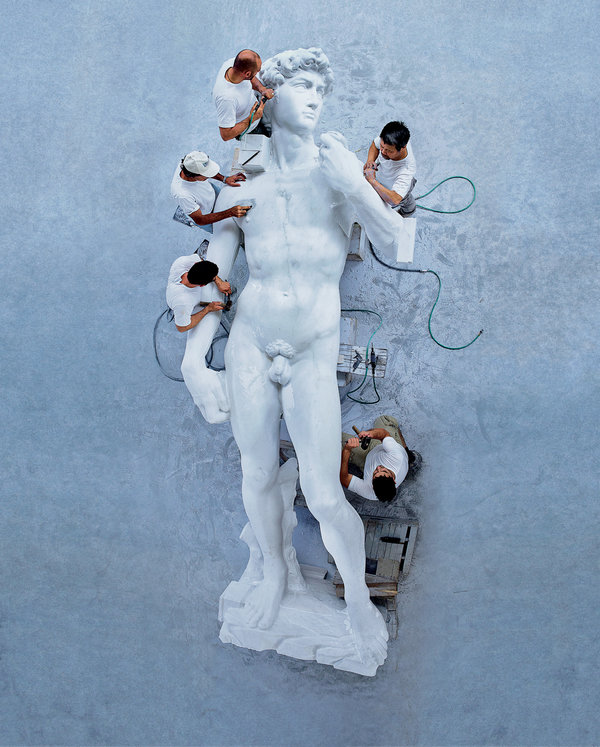
“If the David were to be tilted 15 degrees, his ankles would fail.”

David by MichelangeloI haven’t been to Italy for many years, but this news came to me as a terrible shock:  Michelangelo’s perfect sculpture of David is cracking.  Or at least the ankles are cracked – those smooth and sinewy ankles of  brilliantly chiseled Carraran marble.

Apparently, because of natural tremors or traffic jolts, David has shifted his weight throughout the years which has brought uneven balance to his ankles.  You can read more in this article by Sam Anderson in the NY Times.

Human ankles serve two purposes:

  • Dorsiflexion  – the ability to flex the toes backward towards the leg.
  • Plantarflexion – the ability to flex the toes downward the sole of the foot.

Ankles help us walk and keep our balance.  Without strong ankles, we fall.

If the Church is Christ’s body in the world, we need to consider the ankles.  I, for one, usually think about body parts like the hands and feet, the eyes and ears, the mouth and voice when I ponder the body of Christ.  I don’t wonder much about the ankles.

If we are off balance as a congregation, if we are a bit shaky moving forward, I wonder if it’s because we need to work on our flexibility.  I wonder if we need to strengthen our ankles.  What might that look like for the Church?

Image source here.