Look Out for Sick People

prodigal son bishops garden national cathedral

Maybe this is a mission statement we can all embrace:  Look Out for Sick People.

I just spent 2 hours in traffic due to the Hurrah For The Blackhawks Parade and between the horn blowing and helicopters hovering overhead, I’ve been trying to get my head around the shooting in Charleston.  This post is not about sharing my take on the situation.  [Note:  We should all be reading Rocky Supinger.]

This post is about figuring out how to do something positive about a catastrophic situation in our country involving bigotry, guns, and mental illness.

Sure, we can pray.  The only relief I can muster is the fact that the victims were literally in prayer or just finished being in prayer when they died.  We can only hope that we all die in a state of spiritual connection.  I have no doubt about the eternal peace of those victims.

The sick feeling in my gut is about the young man who apparently sat for about an hour in that prayer service himself only to shoot his brothers and sisters before he left.  Only God knows what this deeply sick person was thinking while sitting in a room called a sanctuary with a gun in his hands.

Had his hands been folded in prayer prior to the shooting?  Lord have mercy.

HH and I are slowly watching the 3rd season of OITNB and the first two episodes are particularly disturbing in terms of the children in the plot lines. The first episode of Season 3 shows children visiting their mothers at the prison for Mothers’ Day and it’s clear that many human beings (people with children and people without children alike) have no idea how to treat people, much less how to treat little people.  For a myriad of reasons, we do not understand what breaks a person.  Some children grow up traumatized from the get-go.

The second episode features a “father” who is violent, reckless, selfish, evil, and deeply disturbed.  The assorted kids under his care are doomed until someone intervenes. One of the reasons that I watch this show is because it shows some of the real life that I’ve seen as a pastor.  Most of my privileged world never sees this side of life although it is real and closer to us than we would like to believe.

The past few hours have made me . . .

  1. Profoundly grateful for public school teachers and staff who model healthy behaviors, especially in light of children who do not have such models at home.
  2. Sure that we are called to be kind to all people, even (especially) the troubled ones.  (Note:  people will persecute us for being kind to the likes of Dylann Roof or Eric Casebolt.  And being kind doesn’t erase accountability.)
  3. Longing to learn how to respond to sick people.  What do we do when someone is acting out at a public pool?  In a church?  How do we intervene when someone is clearly dealing with mental illness?

There are many times during each day when I question the efficacy of the institutional church in terms of transforming the world for good.  But today I believe, more than ever, that we in the church have been called to create communities that look out for sick people, tend to hurt people, and model what it looks like to love like Jesus.

Image is The Prodigal Son from The Bishop’s Garden at the National Cathedral in DC.

Dinosaurs

Apparently Rachel Dolezal’s parents are Young Earth Creationists who believe Land of the Lost
that human beings walked the earth with dinosaurs. And Jurassic World is a box office sensation. And thriving businesses are slowly ridding their boardrooms of dinosaurs for the sake of the company.

But who are the dinosaurs in church leadership?

  • Dinosaurs are not necessarily older. I recently heard a 30-something leader refer to other leaders in her congregation as her elders, her organist, and her treasurer. (Please don’t do that.)
  • Dinosaurs are not necessarily dimwitted. The sauropod might have had a tiny brain, but many of our most old-fashioned leaders are very bright.

Dinosaurs – whether we are talking about pastors, elders, or whole congregations – are not extinct (yet.) What can we do now to prevent extinction in the future?

This is what so many of us in the 21st Century Church are trying to figure out. What can we do now to ensure that the future is not fraught with dead bones?

Another White Guy

White GuySome of my favorite people are White Guys. There are three in my immediate family and over thirty in my extended family of brothers, cousins, uncles, in-laws, etc.  Most of my clergy colleagues are White Guys.  Most people running the country are White Guys and many of them are smart and interesting.

31% of the population in the United States are White Guys.  But projections show that by 2043, White People will no longer be the majority.  Some people love this trend and some feel anxious.

A twenty-something male friend recently shared how tough it is to be a White Male these days and I tried to listen without strangling him.  He is getting a tiny taste of what it’s been like for minorities and even White Women for a while now.  I further delved into this phenomenon of  White Guy Anxiety by interviewing The White Guy I Live With:

Me:  Do you feel any anxiety about being a White Guy?

TWGILW:  I don’t. I’m a White Guy.  I can’t do anything about that.  And I don’t feel threatened by the trends you’re citing.  I try, however, to make sure that my words and actions are sensitive to people who don’t happen to be White Guys.

[Note: This is one reason why I married TWGILW.]

This post is not intended to slam White Guys in any way. My bigger concern is that we who are not White Guys find positive ways to help shift the culture.  If most of the people in power right now happen to be White Guys, here are some thoughts about what is not helpful:

  • Mocking them (although it’s tempting.)
  • Treating them the same disrespectful ways we who are not White Guys have been treated.
  • Sabotaging them – again the way that some of us who are not White Guys have been sabotaged.

Jesus said it best.

And here are additional thoughts about what might be helpful as our culture shifts:

  • Remind search committees  – and others in charge of seeking new leaders  – that diversity of all kinds makes a community more creative and vital.
  • Connect with White Guys who get that.

A fairly constant comment I hear (and say myself) these days is:  Another White Guy got the job.  Let’s hope that – when it still happens – they are the ones who are unafraid to open doors for those of us who are not.

Image source.

Closing Our Own Churches

Yesterday someone said to me: We don’t church_closed_trust you because we think you want to close our church. It wasn’t the first time I’ve heard that and it won’t be the last.

The truth is, though, that those churches are usually closing themselves.

That sounds really harsh and I don’t mean to be disrespectful.  But congregations on the cusp of closure are often there because they’ve made choices that have risked the future of the church they love. Among those poor choices:

  • They chose to make their pastor the professional Christian, believing that it’s the pastor’s job (and only the pastor’s job) to do ministry.
  • They chose to morph into a club, more worshipful of their building than God.
  • They chose to perpetuate an institution rather than make disciples or love their neighbors.
  • They chose mission that either separated them from the community they were trying to serve (“We’ll send money but we don’t really want to know those people“) or elevated themselves over the community they were trying to serve (“We go down and help those people because they are too uneducated/irresponsible to help themselves.“)
  • They chose to become landlords (renting their property to “tenants”) over engaging in relational ministry (using their buildings as tools for ministry with partners whose names and needs they actually know.)
  • They chose the wrong pastor or they chose not to listen to the right pastor.
  • They chose to do ministry on the cheap even when they could afford more.
  • They chose to forego basic building maintenance to the point that maintenance became impossibly expensive.
  • They chose to allow ineffective volunteers and paid staff to keep their jobs too long.
  • They chose to leave the praying, the Bible study, the continuing education to the person who went to seminary.
  • They chose to hold their pastor to impossible standards.
  • They chose to devote their congregational efforts to something less than God.

Yep, that sounds severe, but it’s sadly true.  Before denominational leaders have the conversation about a church’s plans for the future (which might mean closing so that a new congregation might be resurrected in their place) it’s almost always the case that church members have unwittingly made choices that are killing their ministry.

Sometimes reboots are not possible because the culture is beyond shifting.  But sometimes reboots are indeed possible.  Again:  another choice.

I want your church to thrive and make an impact in the name of Jesus Christ. I don’t want your church to close if you are truly and authentically ready to choose a completely different way of being the church.

Image source.

OK, We Need Both Leaders & Managers (But We Mostly Need Leaders)

pushpull

Years ago, I read several books telling me that Pastors Should Not Be Managers. Managers make the trains (or liturgies) run on time.  Managers solve problems.  Managers direct.  Managers address needs.  Managers are reactive. Managers placate.  Managers in churches are – if a congregation can afford it – are also called Church Administrators.

The 21st Century Church is craving leaders.

In small congregations, when the Pastor is Administrator, Secretary, Custodian, Christian Educator, Youth Director, Web Master, Music Leader, Volunteer Coordinator, Therapist, and . . . Pastor, being a Leader either 1) doesn’t happen or 2) happens at the expense of the website being updated or the confirmation class getting permission slips, or the piano being tuned.

A classic HBR article explains it all here.

It’s a serious question:  What do we do when a congregation of 20-50 people seeks to be the church in these days?

If they are both well-heeled and committed, a congregation of 20-50 members can – perhaps – afford a full-time pastor.  But chances are they cannot also afford a FT or PT anything else. And nobody doing Everything has the time to also be the Vision Caster or the Global Ponderer or the Equipper of Managers.  And  so we have many smaller congregations (in the PCUSA in 2010, 3,001 churches had less than 50 members) that are floundering because the pastor either:

  1. Is okay with being a manager, but nobody’s looking into the future and the church will probably close when the pastor retires.
  2. Is wanting to Look To The Future but the church has a culture of the pastor managing everything and so she/he is The Frustrated Leader.
  3. Is wanting to Look to The Future but the church has a culture of the pastor managing everything and so she/he is Casting a Vision and nobody can find the pencils.

I was blessed to meet some excellent Small Church Leaders recently and here’s how ministry happens well:  The Leader has the skills to teach members to manage the ministry.  And those members truly want to do ministry.  They do not wear figurative bibs expecting the pastor to feed them bite by bite.  They want to make guests feel welcomed.  They want strangers to find schedules and directions.  They want the sick to be fed and the lonely to be visited.  They want walls painted and floors vacuumed so that the atmosphere is fresh and clean.

We have too many congregations led by Pastor Managers rather than Pastor Leaders.  Smaller congregations can thrive in the 21st Century only if members want to thrive.  Only if Pastors are allowed to ask questions and point to the future.  So, here’s my question:

What’s the best way to teach this to our churches?  (It’s a real question.)

Image Source.

P is for Paradigm Shift (or How to Take Somebody a Casserole in the 21st C. Church)

CasserolesAfter making my “P is for Paradigm Shift” pitch at a retreat last weekend, one thoughtful church leader asked, “I understand that we have to do it.  But can you give an example of how we do it?

Pastorally.

Take casseroles, for example. Congregations have organized the sharing of consecrated casseroles for decades.  If you have a new baby, if you are recovering from surgery, if you are new neighbor – and you are part of a church community – chances are that somebody will bring you a casserole.

To be perfectly honest, it may not be a casserole these days.  It could be a pizza from a local restaurant or it could even be a gift card to Panera.  But the casserole is classic.

I know a church that found itself in a paradigm shift over casseroles and it went like this:

  • The older ladies wanted to take casseroles to moms with new babies in their congregation.
  • The new moms were grateful for the gesture.
  • The older ladies baked those casseroles (and side dishes) using their best heirloom china because that’s how their generation expressed lavish hospitality. You serve your best recipes in your best dishes.
  • The new moms were extremely anxious that 1) they’d break the heirloom china and 2) they’d have to wash the serving pieces and then pack up the baby with the heirloom china and then return the heirlooms to the donor.  Imagine the added anxiety if mom had given birth to twins and there were two babies to get into car seats.  With heirloom china.
  • The older ladies believed that the new moms felt isolated and so they often stayed for an hour or so, during which they offered tips to the new moms on how to clean their houses and take care of themselves and the baby.
  • The new moms felt too tired for a long visit.  And housekeeping/self-care/baby-care tips made them feel judged.

An intervention was required.

After some friction between the heirloom china ladies and the new moms, someone approached a church leader to ask if the new moms might come up with a list of helpful suggestions for anyone volunteering to provide a meal for future new moms or families in need.  “Great idea!” said the church leader.  And so they did:

  • Please call before dropping by.
  • Please ask about allergies or food restrictions.
  • Please bring meals in disposable containers.

Some of the older ladies felt hurt and angry.

  • They dropped off meals when they were out running errands and they didn’t know exactly when they’d be stopping by.
  • They don’t understand what’s up with all these peanut allergies and “nursing mothers should be eating meat.”
  • They thought disposable containers were tacky.

This is perhaps an extreme example of generational changes in assumptions that require honest conversation and grace.  When the culture shifts, it doesn’t mean that the old ways were bad; it’s just that things have changed in terms of convenience and norms.

And the point of sharing meals with those in need is that it’s about those in need, right?  It might make us feel good to offer this service, but it’s not about us. Another paradigm shift:

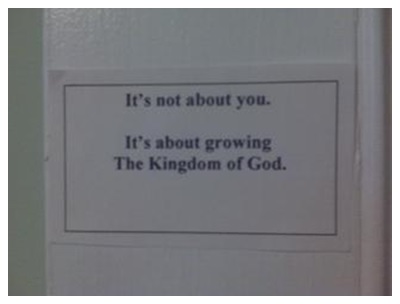
It's not about you

And another one:

Be the Church

We make cultural changes not for the sake of making changes.  We make cultural changes and paradigm shifts for the sake of others:  the ones not yet with us, the ones with the most pressing needs, the ones who are new/hurt/on the fringe.

21st Century Church leaders do not focus on the ABCs (attendance, building, and cash.)  We focus on the NOPs (the neighbors, organizational structure, and paradigm shifts.)  Yes, this is old news in this year of our LORD 2015.  But we still need little reminders.

Get out there and be the church!  And consider taking somebody a meal in disposable dishes.

O is for Organization

See yesterday’s post for the intro to this little series.Carsten Holler (2003)

Just as the 21st Century Church requires a fresh emphasis on our neighborhoods, 21st Century Church also requires a different way of being organized from the congregations we once knew.  Sadly, most of our churches are organized exactly the same way our grandparents’ churches were organized:

  • There’s the preacher who is often the de facto Professional Christian.
  • There are elders and/or deacons who may or may not be spiritual leaders, but they are always power players (or so they believe.)
  • There’s a dependence on members who don’t have paid employment which means that any stay-at-home-mom and all the retirees are expected to fulfill all the volunteer jobs.
  • There’s an organist and/or a choir director.
  • There’s a church secretary who actually runs everything.

In “contemporary churches” a Worship Leader may have been added in the 1980s.

The problem with this kind of church organization is that it fulfills neither the needs of a postmodern spiritual community nor the Biblical guidance on how spiritual communities are called to exist:

  • The pastor is far more than a preacher who delivers “good sermons.” The most effective pastors today are entrepreneurial vision casters who equip and coach the rest of the staff so that they connect people to a higher purpose and inspire the people to make an impact throughout the neighborhood.
  • The elders/deacons are servant leaders.  They are spiritually grounded and willing to create a community that welcomes all people.  They track spiritual transformation.  They work well together – not always agreeing but leaving each decision-making meeting as one unit for the sake of the Reign of God.
  • The anxiety over not having enough volunteers (unlike the 1950s when churches enjoyed the time and talent of many stay-at-home moms) is negligible because even busy people are committed to offering what they can with their eyes on being the church (not going to church.)
  • Music is varied and moving – regardless of what kind of instruments are used.  Maybe there are no instruments except for human voices. But there’s a clear understanding that music is about praising God rather than personal performance.  Music leaders express joy because that’s their authentic feeling.
  • The administrative support could be a business director, a volunteer coordinator, a building supervisor, and/or a communications leader.

Most of all the organization of a thriving church today . . .

  1. Is relentlessly innovative
  2. Always asks “why?” (and not just “what” and “how” – as in “Why are we doing this?”)
  3. Is passionate for growth even if it means dismantling tired ways of doing ministry.
  4. Puts itself in the shoes of those who are not yet among them. Recognizes that everything (from the signage to the prayer list) needs to be guest-friendly.
  5. Evaluates everything lovingly and fearlessly from the performance of paid staff and volunteers alike to every meeting, class, program, and event – so that it can be better next time.  God deserves our best.

The 21st Century Church is organized for a relational community rather than an attractional community.  It takes a bit of adapting, but we can do this.

Image is relational art (with lots of light bulbs) by Carsten Holler

N is for Neighbors

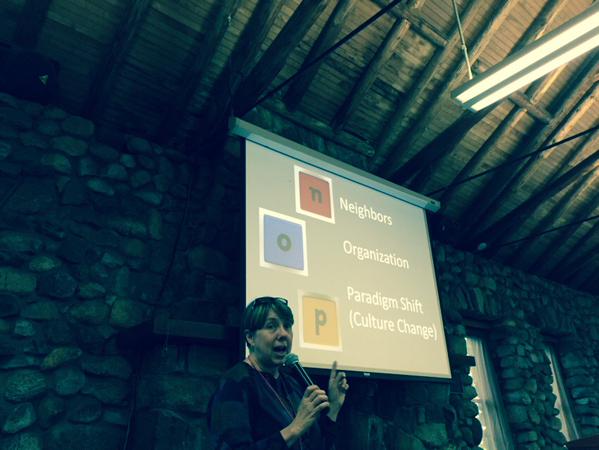
I’m freshly home after spending a couple days in the Adirondacks with Albany Presbytery, which was a joy. And I share this photograph taken by my friend, Shannan Vance-Ocampo with some anxiety . . .

NOP

. . . because 1) my talking face is ridiculous and 2) anyone who has heard me do my 21st Century Church presentation is rolling his/her eyes. After doing varieties of this presentation for almost ten years, I am surprised that we haven’t all moved on. But people continue to want/need the reminder that what made a 1950s church thrive is not what makes a 21st Century Church thrive. And with Harvard’s recent report by Chetty and Hendren on the importance of neighborhoods, it’s clear that we in the Church really need to make these changes from a focus on Administration, Building, and Cash to Neighbors, Organizational Structure, and Paradigm Shifting. Today I want to ponder ministry in our neighborhoods.

[If you’ve heard me talk about this to the point that you could give this talk yourself, I’m not offended if you stop reading here.]

If you are interested in how our congregations can grow by engaging with our neighbors, read this. Some of the congregations I serve happen to be in one of the best counties in the United States in which to raise kids. I also serve congregations in some of the most violent neighborhoods in the state if not the nation. Imagine if all church leaders – especially upon our ordination – realized that our calling is to serve the poor in our neighborhoods and in adjacent neighborhoods. Some of us are “rich in things, but poor in soul.” Some of us are financially impoverished. But everybody – including the financial disadvantaged – deserve a safe and nurturing place to live.

Imagine being the church that knows what breaks God’s heart in the neighborhood and then We Engage In Ministry That Addresses The Brokenness. Imagine being a church with the #1 goal of making a positive impact in the neighborhood. It would alter everything.

Some of our churches try to copy the successful programs of other congregations. If the parish down the street offers a popular preschool, we want to do the same thing so that we, too, can attract new families. Maybe there’s a person in the congregation who really wants to offer tutoring for children as a church program . . . but there’s not really a need for tutoring. There is a need – let’s say – for adult job training. So maybe that’s what the church should be doing.

How can we find out what’s truly needed in our neighborhood? Talk to those who would know: police officers, school guidance counselors, county social workers, free clinic nurses. Ask what they do all day. Ask what they wish was different. Ask what they need. Consider them experts because they are.

One of the phenomena in many of our congregations is the fact that many church members do not live in the neighborhood where their church building is. They might travel five miles or twenty-five miles for church gatherings. It doesn’t matter. If we are serious about living out our faith, we live it out both where we sleep at night and where we gather as the church.

It’s not possible to thrive as a church in the 21st Century if we do not address the needs of our neighbors. It’s. Not. Possible.

We can’t address the needs if we don’t know what they are. So let’s get out there! It’s almost summer. The weather is beautiful. Oh- and God requires it. We have no excuses.

Five Generation Church Staffs = Amazing Possibilities

generations of handsFor the first time in U.S. history, it will soon be possible to have five generations working together in the same office.  Generations are – generally speaking – different in terms of their institutional loyalty, expectations, dress codes, organizational structures, and more.

So imagine what it would be like to have – on the same church staff – the Gen X Head of Staff, the Baby Boomer Music Director, the Millennial Office Manager, the Silent Generation Parish Nurse, and the Generation Z communications intern working on her high school service hours.  It could be a disaster or it could be amazing.

What would make it amazing?

  • An attitude that we can all learn from each other.  The seasoned staff person  might have lots of experience working with personnel committees while the youngest staff member might have tech skills that everybody else needs to know.
  • Respect for and enthusiasm about differences.  Instead of feeling disdain over the fact that one staff member wears a suit and heels while another wears jeans and an untucked shirt, appreciate the differences for the way a variety of parishioners can connect. Acknowledge that dress styles mean different things to different people.
  • Patience.  No eye rolling allowed.  No jokes that diminish colleagues and make them feel foolish.
  • No sweeping generalizations:  “You people need to learn how to use google maps.”  “Why is your generation so lazy?”  Not helpful.
  • No cute name-calling:  The youngest members of the staff might indeed be the age of your grandchildren but don’t call them “kids.” The oldest members of the staff might be somebody’s Grandpa, but he’s not yours.  He’s your colleague.
  • No throwing colleagues under the bus.  Honestly this is essential for all church staffs of every age.  Heads of Staff:  support your young colleagues, especially when parishioners criticize them behind their backs.  Young pastors, back your older colleagues. Healthy personnel evaluations don’t happen in church parking lots.

The best staff relationships I’ve enjoyed included a 20-something colleague, three thirty-something colleagues, and a 50-something me.  We learned so much and it made for better ministry for our congregation.

As Generation Z enters the work force in the not-so-distant future and retired people need to keep working because they are pension-less, and all the generations in between have so much to offer, this is a great opportunity to enliven our ministry.  I would love to hear from those of you whose church staffs enjoy broad age diversity.  Anyone?

Imagine Church as a Safe Haven Against Sexual Abuse

Note: This post is a bit disturbing and I honestly ask you to consider stoppingYou are now safe here if you are sensitive.  I include an unidentifiable but difficult detail.  But my hope is that you will note that I share it as an example of what a healthy church looks like.

I, too, have been pondering the whole Duggar family debacle.  One of the best responses is this, written by trendyand2kids.  Amen sister.

In Christianity After Religion, Diana Butler Bass refers to 2000-2010 as “The Horrible Decade” for several reasons – one of which is the fact that in 2002 we all learned that five Roman Catholic priests had been accused of sexually abusing young parishioners.  We learned that the abuse of children had been systematically concealed for decades by the Church.  And it’s ludicrous if we don’t agree that this crime has driven thousands of Roman Catholics – and others – away from the Church.  It’s also ludicrous if we fail to see that Protestants are equally guilty of such crimes.

Sexual abuse of children is among the most heinous crimes imaginable.  I agree with trendyand2kids regarding what Josh Duggar’s criminal activity has wreaked:  Their self image and view of human sexuality for the rest of their lives is now and forever 100% rooted in their first sexual experience, which you forced upon them. They can never get that back, no matter how many times you said you were sorry, or how long you talked to your parents or your church leaders about it. You cannot tearfully “pray away” damage of this magnitude.

But imagine – if we can – the Church being a safe haven against sexual abuse.  I strongly believe that this is both possible and part of our calling and mission.

I looked over the calendar and – over the past three years – I have participated in worship in over 50 different congregations.  I am often asked to lead in The Children’s Message during Sunday worship.  In one particular congregation, while I was sitting with the children, I asked them a question about Jesus or the Bible or something. A couple of the kids offered responses.  And then one very young child quietly said this:  “Sometimes my brother puts his penis in my mouth.” She said it so quietly that I wasn’t sure I heard her correctly.  And I’m sure that the rest of the adults didn’t hear what she said.  She repeated it and I asked her if we could talk more about that afterwards, and she said yes.  So we did with one of the educators and her relative who disclosed that the family was aware of this and she had been advised by her counselor to talk about it with people she trusted.

Friends, meet a healthy church:  A child with a damaging secret feels safe enough to share her secret with trusted leaders in her church.  No one has given her the impression that she will be shamed or shut down.  She is under the impression that she can share most anything that’s on her mind – even something scary.

Imagine a church where even the adults feel safe to share their darkest thoughts and experiences.  Imagine a church in which people can share that life is not perfect or even okay.  Imagine a safe haven, a true sanctuary.

We cannot be that community unless we each have a deep acknowledgement that we are all broken, all in need of shelter, all born to care for each other to the point of self-sacrifice.  We hold each other accountable.  We do not hide our misconduct. We show each other what the love of Jesus looks like.

While feeling angry and perhaps even self-righteous about the Duggar family, what can we do to be a safe church?  It’s a real question.  In a world that is increasingly broken and scary and judge-y, imagine being a community that’s totally safe.