How to Get Run Out of Town in 6 Easy Steps

10763_simpsons_angry_mobI’m a big fan of Bill Tenny-Brittian and the good people at Effective Church.  But I wonder how realistic this article is – as we are newly called in the 21st Century Church to spend most/much of our time reaching out beyond the hallowed walls of Church World.

On the one hand:  what would happen if you/your pastor . . .

  • Attended only one meeting per month?
  • Spent almost no time preparing the Sunday bulletin?
  • Kept no office hours except by appointment?
  • Delegated all pastoral calls to church members?
  • Trained and deployed church members to do hospital visits?
  • Spent less than two hours on sermon preparation/week (for churches with less than 150 members) and no more than five hours/week for larger congregations?

Yep, you/your pastor might be run out of town.

But on the other hand:  Ephesians 4 (the only Biblical job description for “pastor” meaning the person who shepherds a church) makes it clear that we are supposed to equip God’s saints for ministry and not do it all ourselves.  If we are not preparing others to make lead, care, visit, and even preach then we are not doing our jobs.

And yet, these are fighting words.  20th Century Pastors were all about meetings, bulletin prep, office hours, pastoral calling, hospital visitation, and – God-knows – sermon preparation.  This is What We Do.  People pay us to be the professional Christians, right?

Not in a 21st Century Church.  Not in a thriving congregation.  Not in a spiritual community with a deep sense of satisfaction and energy.

If we pastors devote less time to a 20th Century job description, we will be freed up to connect with people who are not already in our church community.  We will be freed up to be connectional, missional, and focused on our community in hopes of figuring out its greatest needs.

Many/most pastors today are:

  • still fulfilling those dated job descriptions
  • seminary-trained only to do 20th Century ministry
  • unprepared to be community leaders
  • untrained in change management

Believe me, people will want to run you out of town.  If  you propose Terry Brittian’s ideas for clergy time management and suggest the kind of changes he’s talking about, they will not be thrilled.

They have (often woefully) believed that change is about tweeting and singing U2 in worship. But the change that will create growth is actually about following Jesus in a new way, taking seriously our own baptism vows, and discerning our own calling.  Much more difficult.

I remember Easum and/or Bandy saying years ago that a pastor should never ever do hospital visits.   She/he should train parishioners to do them.  Honestly, I get this to a point. But I also know that Clinical Pastoral Education is the real thing and there’s a reason why we require it of seminarians.  I, myself have experienced spiritual mayhem when an unskilled person visited me in the hospital and made things worse.

So, I’m saying that Tenny-Brittian has some good points, but pastors have got to spend A Lot Of Time equipping their people to excel in ministry.  It doesn’t necessarily take a seminary degree to be a trained minister.  But it takes massive dedication, along with the spiritual gifts required to make the ministry about God.

And if we try to make changes without success, they will run us out of town.

Your thoughts?  Anybody ready to choose only one meeting/month?

Image from The Simpsons.

Negotiating Church Salaries & Benefits (when budgets are tight)

Every church I know (EVERY church I know) has a budget crunch as we move into the new year.

Belt tightening

Why? There are many reasons – some deeply analyzed by church historians and sociologists, and some pondered unscientifically by pastors and bloggers like me.

Among those reasons: Consistently-generous givers (who tend to be in older generations) died or moved away in 2014 . People who no longer worship regularly (i.e. every Sunday unless they are out of town or sick) have stopped giving as regularly too. Younger generations (who – by the way, in my experience – are very generous financial givers) are trying to pay off student loans. Unemployment is still a huge issue in many communities.

We in the non-profit world did not accept this calling expecting financial riches. And yet, we work hard and we deserve to be compensated accordingly. So, how do we ask for what we need (and maybe a tiny bit of what we want) in a culture of Financially Struggling Church? Here’s what not to do: Allow pastors, educators, and musicians who pay for their own supplies. They do it because they need certain things to do their jobs and they want their congregations to thrive in spite of what feels like a time of scarcity. The problems with this practice are:

  1. We sabotage the next pastors, educators, and musicians who cannot do this. (“Our last educator bought all the bulletin board supplies out of her own pocket! This is why we miss her so much/can’t function without her/wish you were her.”)
  2. We will not have correct financial information for budgeting purposes if financial gifts are donated off the books. If Vacation Bible School actually costs $2500 but the pastor has donated $2000 for it, it looks like VBS costs $500. Then somebody gets blamed for “overspending” down the road.

So, how do we Church Professionals negotiate our salary and benefits in times like these? Do we take one for team? (Leigh Thompson of Kellogg School of Management at Northwestern University says no. Also, Kellogg has an excellent Non-Profit Leadership program you need to check out here.)

Full disclosure: I just asked my own Personnel Committee to consider increasing my benefits in 2015.

The bottom line is that gas costs more (if our jobs require driving for on-site visits) and continuing education classes cost more (along with transportation and hotels if required.) The minimum for Continuing Education in our Presbytery – we hope – will be increased in 2016 because 1) most pastors get the minimum and 2) you can’t attend a conference out of town within the $700 minimum we require.

Yes, our congregations are strapped. But if we want vibrant ministry, if we want well-prepared clergy, educators, and musicians, if we want sharp support staff we need to help them succeed. Removing financial stress is a good start.

Final note: if your congregation has more than one pastor and the Associate Pastor(s) make(s) less than half what your Head of Staff earns, please prayerfully consider the fact that this might be unjust. At least consider it.

Minimizing the Mean in 2015

Few of us believe we are mean.  fruit

Especially we Church People tend to consider ourselves to be friendly (especially to visitors and guests), tolerant, and generous.  I visit a lot of congregations comprised of the gracious and well-mannered as bulletins are distributed and friends are welcomed.  But increasingly, I notice that – when fewer people are looking – they are mean.  They don’t even realize it.

I don’t realize it either. I find myself saying something unnecessary or untrue. And I barely realize I’m doing it.

A wise person said to me yesterday, “Some of our congregations need exorcisms.”  Ouch – and yet she’s right.  The foundational DNA of too many of our congregations is snarkiness and suspicion.  Maybe we can resolve to be less snarky and suspicious of each other in the new year.  Or maybe we need an exorcism.

It’s kind of painful and shocking to realize how much we need to check ourselves. Overheard in the last month or so in church meetings/events*:

  • Expect a couple of people to bitch that we aren’t singing all five verses of that hymn.”  (During a bulletin review before worship)
  • We had hoped to go to Florida this week but our nephew decided he needed to ruin that and get married in Minnesota this weekend.” (Said without a sarcastic twinkle)
  • Maybe it was wrong to pass that rumor about the pastor, but some of us think it’s true.” (By a church elder)
  • Why does she have to bring her baby everywhere?” (About a church leader who is also a single mom)
  • What does our pastor really do all day?  (To a room full of people drinking coffee. Note: Why don’t you ask?)

*Details have been changed.

So, remember that Bible verse about being known by our fruits?  We can do better.

What Will We Not Do/Have/Want in 2015?

Just Say NoIf over the past two weeks, we were blessed with 1) jobs and 2) time off from those jobs, today is probably The First Day Back.  “See ya next year!” we chirped to our colleagues in late December and now we return to our usual schedule.

Resolutions have already been made and broken, but unspoken goals are still swimming around in our heads.  Can we Have It All in 2015?  No.

Read this for background.

As I recently shared on FB, my 2015 hopes include inserting hearing aids into my ears, finishing a book I’m writing, and preparing – as stress free as humanly possibly –  for FBC’s wedding.  Oh, the list goes on and on in my head:  I also want to spend MLK weekend in DC and my birthday weekend in NYC.  I need new shoes.  And maybe boots.  (I still haven’t purchased Chicago-worthy winter boots even after 3 1/2 years in The Prairie State.)  People already tell me that I need to take a week’s vacation after the wedding.  I have two classes, one training, two retreats, and a week with my preaching group planned.  And my job is transitioning in a semi-huge way.

But what will I NOT be doing/having/wanting in 2015?  This is as important a question as it’s polar opposite.   Stating up front in January that I cannot do/have/want “it all” takes some pressure off, don’t you think?  What can I release?  What can I toss?

These questions are deeply spiritual. It takes some staring into space to figure it out.  It also takes humility and some serious vulnerability.  But here goes.

  • I will not lose weight for FBC’s wedding.  I know many brides, bridesmaids, mothers of the bride, etc. who cut their calories for the sake of the form-fitting gown.  And it would be nice to be my own marriage weight for the August 2015 nuptials of my FBC.  But it isn’t going to happen. I’m not even going to try.
  • I will not join a gym or do Pilates on a regular basis.  It would sound awesome to say “I spend four nights a week at the gym” or “I take Pilates some mornings before work.”  But I can’t do these things and do my job well, considering the commute and the hours.  It’s fine.
  • I will not clean out every closet in my house this year. Okay, the foyer closet really needs it, but Too Bad For You, bedroom closets.  That over-sized Thomas the Tank Engine gift bag in The Washington Room closet will just have to stay there.  The zebra bag with baby gifts to dole out two years ago?  Probably won’t be sorted in 2015.
  • I will not read HBR in 2015.  Yes, it makes me sound really smart and less churchy, but it also drives me crazy and I turn into a non-profit maniac with ADD.
  • I will also stop reading articles like this.  This kind of cultural phenomenon makes me so crazy that I start to think that secretly I want to be one of these ladies in my deepest, darkest parts.  Some of them are wearing tiaras.
  • I will just say “no” – without feeling guilty about it.  (2014 was a good year for saying “no” but I was still consumed with guilt. Upward and onward!)

So, I’m not expecting comments about what you will or will not do/have/want in the new year, but I hope you’ll ponder.

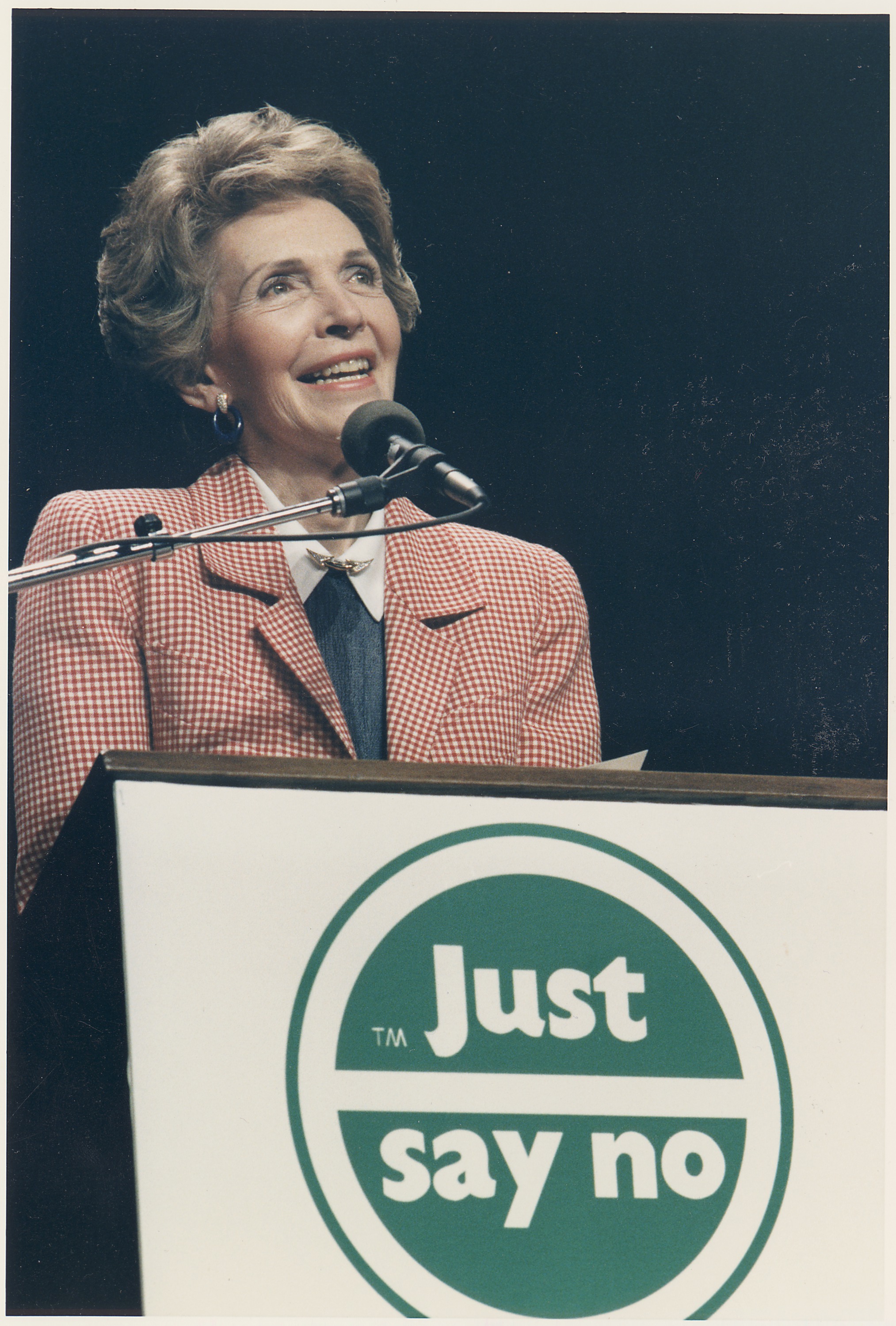
Image of First Lady Nancy Reagan discouraging children from using illegal substances.  (1987)

What Will Be Our Default Response in 2015?

grace-circus-letters-web-940x400My seminary friend J includes this in her resolutions faith practices for 2015: Make grace the default response.

This comes the week that a member of the British royal family has been accused of participating in an international sex slave operation.  (I was about to call The Duke of York “the cute one” but then I re-read yesterday’s post.  My hope is that the 2015 currency in the Duke’s pocket is actually less about his appearance and more about his charitable work. And God help this guy if he’s guilty.)

Although we Americans ostensibly ascribe to the gracious notion of “innocent until proven guilty” let’s face it:  we rarely do this.

In my line of work, I receive reports about clergy misconduct which can run the gamut from child abuse to adultery to financial malfeasance. The process involves accusations, investigations, proceedings under oath, reports, and  – if necessary – consequences.  Let’s be honest: there are pastors whom “everybody” knows are being irresponsible, to say the least.   There are pastors that parishioners feel queasy about in some way, but they do not want to rock the proverbial boat.  And there are people out to get pastors for whatever reason.  Jealously?  Power struggles?  Evil?

It’s one thing to make our default response grace when someone cuts us off on the highway or breaks in line at the movie theater or refuses to quiet their children in the library.  But what if someone is accused – like the Duke of York – of something particularly heinous and life-ruining?  It’s tricky and fraught with crazy-making emotions.  But:

  1. We have to trust.  Listen to the stories with open minds.  Prayerfully discern.  Mostly trust God who ultimately makes things right.
  2. We have to support the victims – who are not always the obvious ones.
  3. We have to hold each other accountable.  For the love of God, you all have permission to take me aside and hold me accountable if you observe me doing something that hurts the people I serve or God or myself or my dog.  Honestly, please tell me. I (and maybe you) have taken vows that deserve to remain sacred.

Even when it’s determined that someone is unquestionably guilty, we who seek to follow Jesus are called to act accordingly.  We all need forgiveness.  We all have fallen short.  We all carry something shameful in our lives.  I’m not saying we should not hold each other accountable (I’m talking to you, abusive seminary boyfriend.)  But what if grace was our (attempted) default response in 2015?

Image source.

What’s Your Currency in 2015?

2014-lunar-year-of-the-goat-gold-proof-coinI want to be Amy Poehler’s friend.   She says many pithy things in Yes, Please which I enjoyed more than this person. One of her bits of advice for life and love is:

Decide what your currency is early. (page 21 in the hardcover)

Maybe your currency is physical beauty or wit or brains.  But Amy counsels, “Let go of what you will never have. People who do this are happier and sexier.” True, but not completely true.

I will never sing like Aretha, write like Flannery, or cook like Julia, and I’ve accepted those realities.  I will never again look like my twenty-something self.  All okay.  Nevertheless, I believe our currency changes through the years.

Sometimes we exchange yen for drachma.  Or in other words, we once carried X in our pockets and now we are flush with Y.  Again – all good.  Or it can be.

What if this could be the year that we:

1- Figure out our prevailing currency situation.

2- Exchange some of our old (no longer needed) currency for what we need/have today.

3 – Circulate our currency well in 2015.

For example, I was once known for my baked goods.  They were excellent. Although it probably gave all my children eating disorders, we had a baked dessert for dinner almost every night during their childhood and our home was a gathering place that smelled of double chocolate muffins.   But now I am not known for prowess in the kitchen at all.  Empty nesting and late nights at work have contributed to this shift in identity from Betty Crocker to the lady who buys pre-chopped kale salad at Costco.  I am trying to accept and embrace this.

My currency used to be Active Mom.  I ran Teacher Appreciation week for over ten years in our elementary school and even my church personnel committee once included the line “Jan is a good mother” in my annual review.  Now I live in a community who has never known me as the mother of young children and it’s as if I’ve never had them.

We are coming off of a holiday week during which many returned  to their parents’ houses where they backslid into the currency of their teenage years.  Once again, we became “the smart one” or “the moody one” or “the funny one.” Actually we traded in those roles long ago.  We’re in different places now.

Imagine figuring out what’s especially precious and valuable about ourselves at this time and place, and then spreading it around.  It’s possible that our currency has changed.

Image of a 2015 Australian Gold Proof Year of the Goat coin.  It was all I could do not to include the question “What’s in your wallet?” in this post.


Signs of Hope for 2015

Happy New Year ChicagoWe have never been a big New Year’s Eve family.  I went to Times Square for NYE once in college, but it was raining and we stayed inside and played Monopoly.

But this is a holy night as we look forward to an uncertain but hopeful future. What gives me hope – in spite of the fact that I serve the institutional church in a post-denominational context, that I try to live as a Jesus-follower in a post-Christian culture, that I grieve being American in one of the most fractured periods of our nation’s history?  Several things.

Points of Hope on this last day in The Year of our LORD 2014:

  • FBC is marrying our beloved SK in August which will unite families from Pakistan, Puerto Rico, Canada, Texas, New York, Virginia, North Carolina, Massachusetts, Pennsylvania, and Maryland.  The gathered mass will include Christians, Jews, Muslims, at least one Buddhist, Agnostics, and Atheists.  There was a time when somebody would have been burned at the stake or stoned to death for this.  But we will be celebrating with people who are Different – as family.
  • Churches in our presbytery and denomination will close.  This will be good because it means that those congregations are making faithful choices in light of changing demographics and culture.  And the funds that have perpetuated those congregations can be directed towards something new that makes God happy.
  • People will fall in love with other people they have not yet met. This is always fun to consider.
  • People will retire who need to retire.  Far from meaning that they are washed-up, unnecessary, or irrelevant, they will begin new chapters of their lives, and the organizations from which they retire can make healthy changes.
  • Scientific, medical, technological, and spiritual breakthroughs will happen.  Makes me giddy.
  • God will continue to speak and act.  This is the best news ever.

We have many choices tonight that will impact our tomorrow.  We can start the new year with a hangover/cranky attitude/wringing hands.  Or we can prepare to listen to the positive voices around and within us reminding us that we were created for something bigger than ourselves.

Happy New Year everybody.

Image of the Chicago skyline.

Let’s Be Gentle with Each Other: The Busiest Pastoral Care Week of the Year

marlborough-bronze_w210_h209_cw210_ch209_thumbThere are both sacred and profane names for this week between Christmas Day and New Year’s Day.  (See Urban Dictionary for the profane ones.)

Most of us however – whether in secular or non-secular professions – call this Vacation Week.  A Thursday to Thursday holiday means that we get a whole eleven days off – unless we work for scoundrels.  And yet . . .

This is The Most Pastorally Heavy Week of the Year.  Consider this:

  • While suicide peaks in the springtime according to this article, it’s nevertheless a blue season for many people.
  • There are lovers who thought they might receive wedding proposals at Christmas, but they were disappointed.
  • There are adult children who were treated like their adolescent – or even preschool  – selves while visiting relatives and it didn’t go well.
  • There are unemployed people who have little hope for a quick and easy hire in the first weeks of the New Year.
  • There are addicts who will have spent multiple hours in 12-Step meetings.
  • There are individuals with no families, no friends, toxic families, fake friends.
  • There are people who could not “afford” Christmas this year.

You get the picture.

So what happens when professional clergy take the week off – which of course they deserve after a relentless Advent and Christmas Eve extravaganza? My hope is that we all notice that this is one of the toughest weeks of the calendar year in terms of emotional and spiritual needs.

And I hope that we reach out in compassion.  Has anyone taught us how to do this?  (Heads up:  this is an excellent goal for churches in 2015 – that this time next year there are dozens of people equipped in our spiritual communities to offer pastoral care during the week between Christmas and New Year’s Day 2015.)

Let’s take notice out there.  And be gentle with each other.

Image is the sculpture of The Prodigal Son by Charlie Mackesy (2009) 

Favorite Discoveries of 2014

maryam-mirzakhani-iranian-woman-win-math-top-prize-copyI’m a late bloomer so some of these finds might be old news to you.  But they
made 2014 richer and better in my little world.  Enjoy!

  1. Ta-Nehisi Coates wrote this article which may go down as one of the essential pieces of our time on race in the United States.  Required reading if we hope to understand the people who came to our nation as slaves.
  2. Emiliano Sciarra invented the card game Bang! in 2002 but my family just discovered it in 2014.  Love. It.  Our favorite part: the cards are in both Italian and English, so we are learning essential terms like “Uccidere lo sceriffo!”  I have not yet won a round of Bang! but instead of being frustrated, I am in awe of Signore Sciarra.
  3. Molly Zuckerman-Hartung is a Chicago-based painter whose art makes me think.  It also makes me happy.  Check here out here.
  4. Maryam Mirzakhani is smarter than we are.  I would be content to hear her tell stories about her childhood in Iran or to watch her eat a sandwich.  She won the Fields Medal in 2014.
  5. Brussel Sprouts became my go-to vegetable in 2014, redeemed after memories of nasty, overcooked versions consumed exactly one time in childhood in a meal that still leaves me gagging.  And now they are delicious.

Here’s to creativity and discover in 2015.  Happy New Year everyone!

Image of Maryam Mirzakhani and the beauty of math.

These Are a Few of My Favorite Things

When the dog bites, when the bee stings
When I’m feeling sad
I simply remember my favorite things
And then I don’t feel so bad.
Oscar Hammerstein II – 1959

My Favorite Things

1.  Congregations with the energy and fearlessness to make positive changes that alter the lives of their neighbors.

2.  Pastors who spend part of their study leave time learning something that has nothing to do with church (even though it still does.) Note: If you live in NYC, Chicago, or LA, check out Course Horse and take a class in Indian cooking or Dramatic Accents (!) or Black and White Photography.  It will feed your soul.

3. That moment when someone is telling her story and she realizes her true calling.

4. That time when someone is telling his story and he decides he can finally let go.

5.  Sermons that you think are dross but then someone shares that it was golden for them.

6. Those frugal church people who appear to have minimal income but leave a fortune in their wills to organizations trying to change the world for good.

7. Church leaders who relinquish their long-time responsibilities to let new people try their hands at it. (Yes, I’m talking to you, Superintendent of the Sunday School Emeritus.)

8. Pastors who retire before the congregation thinks they should retire.

9. Congregations who present gift cards to their church staffs at Christmas (or just say “Thank you.”)

10.  Pastors who share their imperfections – especially during this season.

These things make me smile every time.  Happy Christmas Week, everybody!

Image from The Sound of Music.  (And when did this become a Christmas song?)