Those Annual Charities Guides

And so it begins  . . .

Magazines, websites, newspapers, and maybe even church newsletters are already publishing their Recommended Charities Guide for the holidays. One of my favorite magazines recommends Ten Charities Worth Your Charity – with a list of nonprofits ranging from organizations fighting hunger and poverty to scholarships.  The point is to match your personal interests (saving rain forests, saving stray animals, etc.) with solidly managed organizations:  combining “Scrooge’s fiscal discipline with Saint Nick’s generosity.”  Right.

I get that many of us want to offer our support to far away needs – especially when we see footage of post-Sandy destruction in NY or Haiti, and we don’t happen to live in NY or Haiti.  But one of the problems with sending money only to those faraway, well-publicized places of need is that we can merely write a check or text a quick $10, feel good about ourselves, and then put the need out of our minds.  This is not what Jesus was talking about when he charged his followers to care of the naked and hungry.

Yes, give to those faraway places of need, but give even more to the local needs in your particular neighborhood and community.  And how do you find out what those needs might be?

HERE’S MY PITCH FOR THE INSTITUTIONAL CHURCH:

The Issue –   All of our communities have social needs.  There are refugees in some of our towns who need sheets and towels.  There are students in our local schools who need winter coats.  There are men in area homeless shelters who need socks and underwear.  There are women in safe houses who need toiletries and work clothes.

The Bigger Issue – If we cannot personally name those needs in our communities then we are blind at best and merciless at worst.  Or maybe we are just in our own personal bubble.

The Biggest Issue – If we are a faith community in a neighborhood/town/suburb/city and we do not personally know the needs of those in our local area, then we are missing the point, unless the point of our existence is to love ourselves first and foremost.

If you want to help your neighborhood, connect with a church.

Attention churches:  if someone comes through your doors this week and says, “I would like to do something to help our neighborhood,” what will you have to offer that person?  Note: Please don’t invite them to come to a New Members Class.

In two weeks, Thanksgiving will be over and Christmas Eve is a mere six weeks away.  What if we committed to serving the specific needs of our neighbors before writing checks or texting donations or jumping into a service project we think would be fun – whether it’s needed or not.  (**It’s important to  ask what is needed before taking action.  Many homeless shelters are inundated with cute child-sized winter gloves this season, when what they really need are wool socks for men or shampoo for the group bathrooms.)

Check out I Live Here, I Give Here based in Austin for ways one city decided to serve locally.  We in the church could learn from this organization.

The Lesbian Prayer Group

A friend invited me to go to her Prayer Group back in the 90’s and I soon realized that everybody was a lesbian but me.  It was fine.  Actually, it became fine, but I have to admit feeling strange at first because I’d never been the only non-lesbian in a group before.   I learned that we had more things in common than not.

Recently I was talking with a friend who told me about her daughter’s school in Chicago.  My friend is a single mom who lives in an apartment in a part of town that’s often in the news because of shootings.  Her daughter’s Spanish teacher doesn’t speak Spanish so she is trying to save some extra money to have her daughter take a real Spanish class in a community college.  I consider this friend “like me” because she’s a mom and we often talk about our kids together.  But her life is very different from my own.

I’m already pondering New Year’s Resolutions for 2013 and – especially in light of the recent election – I would like to suggest a global resolution.  (I’m kind of bossy that way.)

What if we commit to getting together socially with someone who is not like us at least one time – not to “convert” the person or to judge the person or to congratulate ourselves about doing one small act of reaching out, but to simply reach out.  To engage someone who is not like us.  Not only is our church, our nation, our world doomed if we don’t get to know people Not Like Us, but we cannot follow Jesus if we don’t do this.

We will find that:

  • Not all lesbians love KD Lang (although, honestly, they should)
  • Not all Republicans are insensitive to the poor
  • Not all Democrats are financially irresponsible
  • Not all immigrants cause crime to rise
  • Not all African Americans live in the inner city
  • Not all Mormons are white
  • Not all sexually active young women are promiscuous
  • Not all men love sports and cars
  • Not all poor people are lazy
  • Not all rich people are hardhearted.
  • Not all Muslims are terrorists.
  • Not all Christians believe homosexuality is a sin.

What if we started 2013 with an eye on hanging out with someone so different from ourselves that a just-like-us friend might wonder, “What is she doing talking to that person?”  What if we enjoyed it so much that we made it a regular part of our social lives?  What do you think?  Possible?

Image is a 16th C. orthodox icon of Jesus talking to the Samaritan woman.

It’s a Sin to Be Boring

The Lord said: Because these people draw near with their mouths and honor me with their lips, while their hearts are far from me,and their worship of me is a human commandment learned by rote;  so I will again do amazing things with this people, shocking and amazing.  Isaiah 29:13-14a

I was talking with the amazing L. yesterday about why a person who is not now part of a church would join one.  So many of our worship experiences are boring.  (Rote prayers.  Joyless singing.)   So many of our people do not share what’s most interesting about them. (Their questions.  Their doubts.  What God is doing with them.)  So many of our congregations are stuck. (No vision of the future.  No energy to shift what isn’t working towards spiritual growth.)

This could kill the institutional church.  And maybe it should.

God is not boring.  The God who creates the human eye and snowstorms and coral reefs, the God who moves people to create glorious art in the form of films and music and baked goods and poetry and architecture – this God deserves the most splendid response possible from us.  But we are boring.

As we are sitting in worship this weekend, or meeting with church about an upcoming event, or gathering for a book group or Bible study we need to ask ourselves:

  • What is interesting about this?
  • Why would this particular event be engaging to a new person?
  • How would our favorite unbeliever find this?

It’s so wrong to be boring as followers of Jesus.  Think about it.  If we discover a new restaurant or a new book, we can’t wait to tell people about it.  A fabulous new recipe on Pinterest sparks more interest than the average church mission fair.  Why is that?

If we are excited and moved by the message of Jesus, we can’t help but talk about it, live it, crave it, want it.  It’s a sin to be boring if we are serious about following Jesus.

Peace

Praying for peace for our divided nation today.  That is all.


Image is Fingerpaint USA by Jasper Johns

The Elect & The Elected

The political world is abuzz with who will be elected today. In the spiritual world, we speak of ourselves as The Elect.  The Christian Doctrine of Election is about God electing us. 

Being among those elected by God for special ministry (and I believe we are universally elected, by the way) is not cause for feeling like we are All That.  I heard Richard Mouw explain it this way:

Once someone has been “elected” (either politically or spiritually) the work has just begun.  Nobody wants to elect a president or other government official and then have her/him do nothing.  The election is not the end; it’s the beginning.

  • It takes work to be elected if you are a political figure. 
  • It takes grace to be elected for regular human beings. 

But both of us have work to do to make the world look more like heaven, especially for the least of these.  Prayers today that our politics won’t get in the way of our faithfulness.

Read This Book: The Cross in the Closet

Being gay for a year saved my faith.

The Cross in the Closet feels especially timely in these days of vicious election conversations – if we have conversations with “the other side” at all.  Tim Kurek is not gay.  But he decided to plunge into the life of The Other for one year, living as a gay man as a  sort of personal spiritual discipline.

Tim grew up in a conservative Christian home within a conservative Christian culture in which gay people were demonized and feared.   When he told his own mother that he was gay, she said she would have preferred he had terminal cancer.

I loved this book for the story of Tim’s commitment to meet and care for people whom he had always been taught were beneath him spiritually.  I loved watching his own journey to discover what it means to be gay.  (It’s not about clothes or gait, by the way.)

What felt discomfiting, though, was that – in order to live as a gay man for a year – Tim had to deceive people, because he was not in fact gay.  He even had a pretend boyfriend so that he would not be put in a position of having a real physical encounter with another man.  Unlike the spiritual discipline of living for a year as a Biblical Woman (Rachel Held Evans) or taking her family through a year of intentional Sabbath (MaryAnn McKibben Dana), Tim had to pretend to be something he’s not.

I remember a friend finally telling me he was gay after watching the funeral scene in Three Weddings and a Funeral.  He didn’t want me and others to find out at his or his partner’s funeral that they were a couple.   But it hurt a bit that he’d pretended to be straight – replete with a “girlfriend” at one point.

Trying to imagine how Tim’s new GBLTQ friends felt about the eventual revelation that he was not actually gay made me uncomfortable.  That, and the fact that gay Christians – and non-believers alike – have been trying to tell this story for years but have not received the attention Tim has received for pretending.

Nevertheless, this is a great read which – in my mind – is more about connecting with The Other than gay-straight relationships.  We who follow Jesus believe that God became the ultimate “other” to connect with us.  God gave up supreme privilege to become one of us.  Tim Kurek’s personal journey to become one with the GBLTQ community offers some important insights, especially for Christians who have vilified people for being different.  Read it.

Generation Wars in Church

I am 56 years old.  My retirement date is closer than my ordination date.  I could no more serve as a youth group leader than I could wear a leather mini-skirt in public.  Even if I could pull off the mini skirt, it would look ridiculous and be wholly inappropriate, just as it would be for me to start a church in a trendy bar.

And yet, I still remember being the 30-something pregnant pastor.  I remember always being the youngest pastor – and often the only woman –  in interfaith leader gatherings.  I remember what it was like to work part-time in a church while raising three kids under the age of four.  I have tried to stay fresh, read current books, keep informed through conferences and conversations, learn from seminarians.

But I see a trend  that older pastors (meaning every pastor older than 50 and especially those over 70) and younger pastors (the 20-40 somethings) are clearly engaged in a huge mutual disconnect.  I see this especially here:

  • In yesterday’s news my denomination’s Board of Pensions proposed
    a new health care dues structure that makes health care much more expensive for pastors with children starting in 2014 while continuing to give incentives for postponing retirement.
  • In Boundary Training events when older pastors and younger pastors clearly hold different understandings of who is vulnerable in clergy-parishioner relationships and why.  Say “boundary issues” in a room full of pastors and individuals have a much different idea of what this means, depending on generation.  (Example:  For the older generations of pastors, it was perfectly normal to marry a parishioner.  For younger generations, this would be considered misconduct.)
  • In preaching that finds many older pastors still proclaiming the Word with three points and a poem while younger pastors experiment with new forms of proclaiming the Good News, often involving dialogue, art, and group spiritual direction.
  • In what it means to be a pastor in general.  Older pastors are more likely to spend their time at their desks preparing sermons and classes, doing pastoral care, and moderating meetings while younger pastors are more likely to focus on missional outreach and equipping others to do ministry.

There are older pastors – mostly men – who have given their lives and energies to serve the institutional church during the glory days of the mainline denominations.  They were respected in the community and they have been doing ministry for a long time.

There are younger pastors who are serving – or trying to serve –  a church that, for many in our postmodern culture, is obsolete,  flailing, and shifting.  Many young pastors have school loans, and there are few possibilities in terms of available calls, especially calls that are open to creative ministry for a new season of Church.

I remember in serving my last church that it was very much like serving two different congregations.  There was the church that expected ministry from me like the ministry they had experienced for the majority of their lives.  And there was the church for people who had been hurt by the church, had never been part of the church, and who would never walk through the door of a traditional church.  Today serving in a Middle Judicatory (in my case a Presbytery), I serve two sets of pastors and two sets of churches.  There are the churches who want a pastor who preaches, teaches, baptizes, buries, and visits the sick.  And there are pastors who know how to do this, both with and without enthusiasm.

And then there are the (rare) churches who want a pastor to lead them into the 21st Century, to equip them to be ministers, to teach them not so that they are smarter but so their faith is deeper, who train others to do pastoral care, and who spend more time out in the community than in their church buildings.  There are especially younger pastors who long to do this usually with great passion.

So here we are.

I believe that both kinds of pastors are faithful and good.  But our church has got to focus on the future.  What do we imagine for our churches over the next ten to twenty years?  And how might the older generations make way for the younger generations to lead?

Mosaic includes images of some of the generational rock stars of the Christian Church.  (And there are countless others.)

Saints Wear Aprons (not bibs)

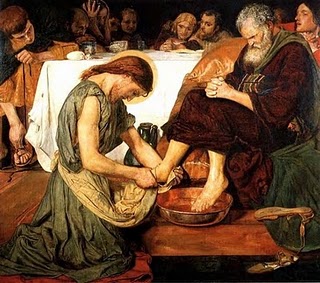
My genius friend AD was telling me that she hopes to one day have church business cards that say something about the responsibility of church members to wear aprons, not bibs – but she had a much more poetic way of putting this.

She heard about the idea in a class, and then we found this post which spells out the details.  Amen Mountain Wings.

“Bibs are for people who only want to be fed.  Bibs are for those who are not yet ready or willing to feed themselves.  Bibs are for those who are more interested in being served than in serving. Bibs are for those who insist that the church exists for them and their needs. Bibs are for babes in the faith, those who haven’t  caught God’s vision for the church, or those who are not yet of the faith.”

“Aprons are for those who have a heart to serve others in Jesus’ name.  Aprons are for those who know they are the church.  Aprons are for those who don’t mind getting their hands dirty.  Aprons are for those who take the time daily to feed their spiritual hunger.  Aprons are for those who are growing in faith, and hunger to help others grow.”

It occurs to me that an apron would be the perfect “Welcome to This Church” gift for new members.  If new members receive “welcome gifts” at all, it’s often a coffee mug or a key chain or a Church Cook Book.  But what if we required a commitment to service – in the image of Christ – before asking people to join.    “Membership” would become less about receiving ecclesiastical benefits and more about committing to serve others in Jesus’ name.

Even Jesus wore an apron when he served others according to scripture.  If true saints are those in the church who follow in the likeness of Jesus, shouldn’t we all be wearing one?  Something to think about on All Saints’ Day.

Image by Ford Madox Brown is Jesus Washing the Feet of Peter (1852-56)

The Four Scariest Words in Church

Thy will be done” are the four scariest words in the Bible.  

I am fairly enamored with my own way of doing things, and yet, faith involves trust.  Even when things look hopeless, I believe love will always win because of this and other things.  But trusting in God’s will and not my own is essential – at least for a person of faith.

But what about the scariest words we might hear or repeat in church?

My nominations:

  • Actually, that’s my pew.
  • Our table is closed.
  • We can’t afford it.
  • You are not invited.
  • God really hates you.
  • But our policy says . . .
  • God doesn’t call women.

And your nominations?

Happy Halloween to all!

If I Could Be Queen of the World

My favorite #sandy tweet from yesterday was this one from Cory Booker:

Just spoke with Gov Christie. His team has been a tremendous support in this emergency & I appreciate his personally reaching out (again).

Cory Booker is the (Democratic) Mayor of Newark, NJ.  Chris Christie is the (Republican) Governor of New Jersey.  Doesn’t it feel good when bi-partisanship happens?

Previously in the day, Gov. Christie mentioned how helpful President Obama had been in terms of offering federal support.  All this goodwill made me feel safe and proud of my country.

I sometimes ask people looking for a new calling or a general life change:  If you were King/Queen of the World, what would you do?  

Today, it’s my turn.

If I were the Queen of the World, I would decree the following five things.  They would be non-negotiable, because I would be a bossy monarch.

1.  All Americans have to listen to this conversation between Alice Rivlin (the Democratic economist) and Pete Domenici (the former Republican senator) regarding the United States economy and the importance of bipartisanship in a democracy.

2.  The Electoral College would be abolished.  It’s obsolete and makes a vote in Ohio worth more than a vote in Montana.

3.  Citizens’ United would be overturned.  Our leaders should be chosen by independent citizens, not by corporations or unions.

4- Whoever loses the elections next Tuesday must announce that he/she will wholeheartedly support the winner for the sake of our nation’s future and well-being.

5- Once elected, all members of Congress are required to partner with a member of her/his opposing party for regular meals, outings, and – if they are praying people – prayer.  The only agenda for these meetings would be to get to know and care for that colleague and her/his family.  It’s harder to demonize someone on the other side when your kids have played soccer together and your spouses have exchanged recipes.

After a terrible storm, people come together in selfless care.  Coming together after an election is the least we can do for our country.


Image of the crown made for Caroline of Baden, Queen of Bavaria in 1806.  She liked pearls.